
Introduction
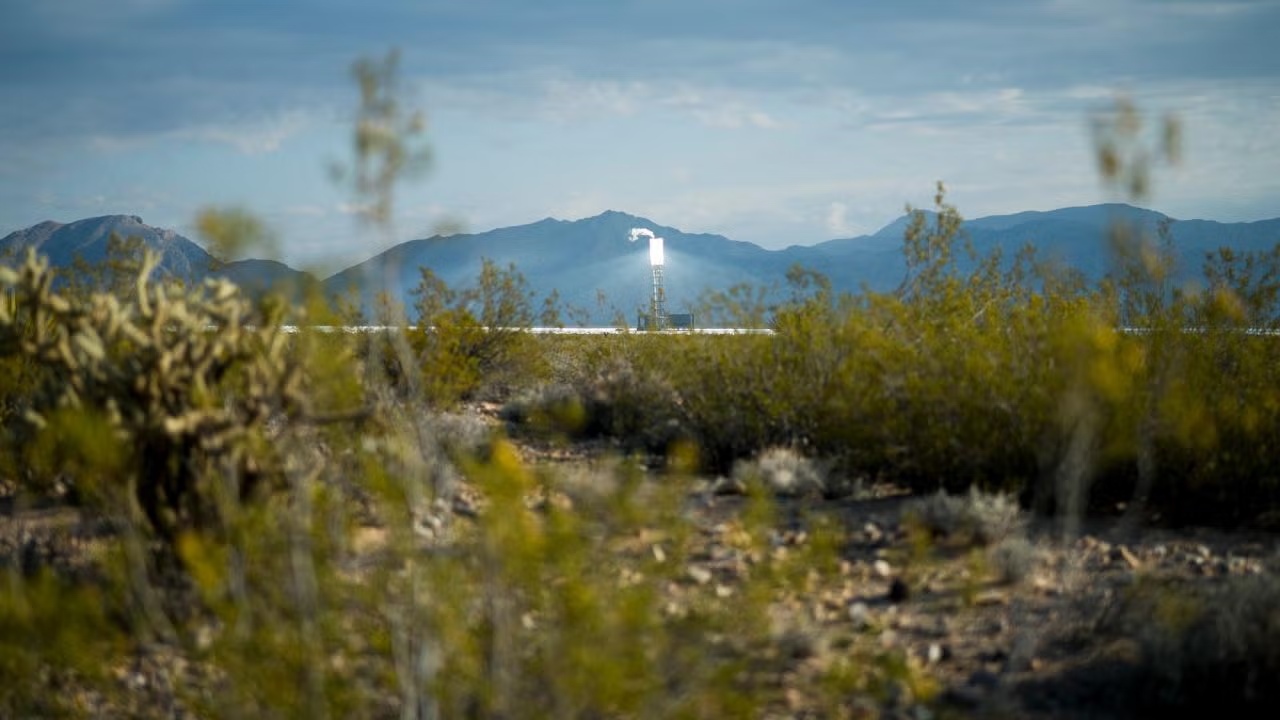
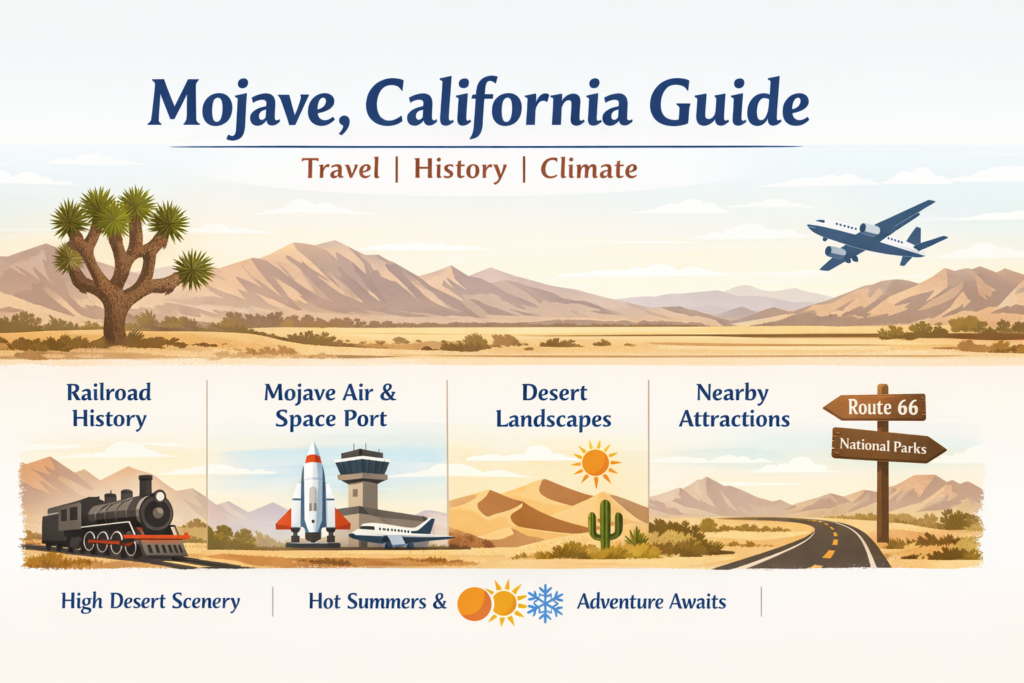
Mojave, California, is a small desert town in Kern County known for its rich history and unique setting in the High Desert. From railroad roots to aerospace innovation at the Mojave Air and Space Port, it offers a mix of history, open landscapes, and access to iconic desert destinations.
- Quick Facts About Mojave, California
- Why Mojave, California, Is Worth Knowing
- Location and Geography
- Where is Mojave, California?
- How big is Mojave?
- Why does geography matter for travelers?
- Mojave and the High Desert Landscape
- Table: What Makes Mojave’s Geography Special?
- Climate and Weather Patterns
- What is the climate like in Mojave?
- What should travelers expect?
- Best time to visit Mojave
- Travel weather tips
- History of Mojave, California
- Early Native history
- The railroad era
- Borax and freight history
- Aqueduct-era importance
- Aviation history begins
- The Mojave Air and Space Port
- Why is the airport so important?
- What makes it different from a normal airport?
- Public visitor experience
- Why aviation fans love Mojave
- Nature, Landscape, and Desert Scenery
- What does Mojave look like?
- Why the scenery matters
- Flora: Desert Plants Around Mojave
- What kind of plants grow here?
- Why desert plants matter
- Example of what travelers may notice
- Fauna: Wildlife in and Around Mojave
- What animals live in the Mojave region?
- Desert tortoise protection
- Best time to notice wildlife
- Human Culture and Desert Identity
- How Mojave feels as a place
- Why that matters for content and travel
- Nearby Attractions and Day Trip Ideas
- 1. Mojave National Preserve
- 2. Mojave Trails National Monument
- 3. Route 66 landscapes
- 4. Hiking and trail access
- 5. Aviation stops
- Things to Do in Mojave, California
- Aviation sightseeing
- Desert photography
- Road trips
- Hiking and outdoor exploration
- Desert history learning
- Travel Tips for Visiting Mojave
- Plan for fuel and supplies
- Check road conditions
- Use desert-safe habits
- Respect the weather
- Stay aware of the distance.
- Safety and Survival Tips
- Desert safety is essential.
- Important safety reminders
- Example of smart desert planning
- Conservation and Environmental Responsibility
- Why conservation matters in Mojave
- How travelers can help
- The bigger desert story
- Local Services and Community Basics
- What kind of town is Mojave?
- Why this matters for visitors
- Interesting Facts About Mojave, California
- 1. Mojave started as a railroad camp
- 2. It played a major borax role
- 3. It was tied to aqueduct construction
- 4. It is an aerospace destination
- 5. It is linked to major desert trails
- 6. It connects old and new California
- Who Should Visit Mojave?
- Pros and Cons
- Pros
- Cons
- Best Time to Visit Mojave
- Best season by travel goal
- FAQs
- Conclusion
Quick Facts About Mojave, California
| Fact | Details |
| Status | Unincorporated community |
| County | Kern County, California |
| Region | Western Mojave Desert / High Desert |
| Elevation | About 2,762 feet |
| Population | 4,700 at the 2020 census |
| ZIP codes | 93501, 93502, 93519 |
| Area code | 661 |
| Known for | Railroad history, borax routes, aviation, desert travel |
Why Mojave, California, Is Worth Knowing
Mojave stands apart because it has a clear sense of place. It does not compete with big destinations by offering shopping districts, nightlife, or dense urban activity. Instead, it offers something more unusual: a concentrated mix of landscape, engineering history, transportation heritage, and frontier atmosphere.
The town carries the memory of several different eras. It began as a railroad camp, grew into a shipping point for borax, played a role in aqueduct-era development, and later became closely tied to flight testing and experimental aviation. That kind of transition is rare. Many desert communities have one historical identity. Mojave has several.
For visitors, that means there is more to see and understand than a casual glance might suggest. The town is useful as a base for desert travel, but it also works as a story in itself. It is a place where the land, the past, and modern innovation all remain visible.
Location and Geography
Where is Mojave, California?
Mojave is located in eastern Kern County in Southern California. It sits below and east of the Tehachapi Mountains and Oak Creek Pass, on the western edge of the Mojave Desert. It is roughly 50 miles east of Bakersfield and about 100 miles north of Los Angeles.
That position gives Mojave a special role. It acts as a threshold between Southern California’s urban belt and the broad desert lands farther east and north. One direction leads toward highways, cities, and dense development. The other opens into long desert distances, remote terrain, and protected natural space.
How big is Mojave?
Mojave covers a large land area of about 58.45 square miles. Most of that is land rather than water. The size helps explain why the town feels open, spread out, and airy instead of compact and crowded. It has the character of a desert hub rather than a tightly built city center.
Why does geography matter for travelers?
Mojave’s geography is one of its main strengths. It gives visitors access to a wide range of experiences, including:
- scenic desert drives
- railroad and industrial history
- hiking and trail routes
- aviation landmarks
- nearby protected lands
- classic High Desert scenery
This is not the kind of place where the main pleasure comes from rushing between attractions. In Mojave, the journey itself is part of the experience.
Mojave and the High Desert Landscape
Mojave belongs to California’s High Desert, which means it sits at a higher elevation than many lower desert areas. That elevation affects both the climate and the scenery. The land feels dry and sunlit, yet it also has cooler nights, strong winds at times, and dramatic changes in color depending on the season and time of day.
The surrounding landscape includes:
- broad desert flats
- dry basins
- mountain edges
- rugged travel corridors
- open sky views
- rocky and volcanic terrain in the broader region
One reason people enjoy this region is its scale. Roads stretch far into the distance. Mountains rise against the horizon. The sky feels Enormous. This sense of openness is one of the most memorable parts of any Mojave visit.
Table: What Makes Mojave’s Geography Special?
| Feature | Why It Matters |
| High Desert setting | Produces cooler nights and a distinct desert climate |
| Large land area | Creates an open, expansive feel |
| Mountain backdrop | Adds scenery and visual contrast |
| Route connections | Supports road trips and desert travel |
| Protected lands nearby | Expands the visitor experience beyond town limits |
Climate and Weather Patterns
What is the climate like in Mojave?
Mojave has a desert climate with hot summers, cool winters, low rainfall, and frequent clear skies. The air is dry. The sunlight is strong. Rainfall is limited, and when storms do appear, they often arrive in short, sudden bursts rather than long periods of steady rain.
Because the town sits in the High Desert, the weather has contrast. Summer heat can be intense during the day, while winter nights can be surprisingly cold. Wind also plays a role and can make temperatures feel harsher than the numbers suggest.
What should travelers expect?
In practical terms, visitors should prepare for:
- hot daytime temperatures in summer
- cold mornings and nights in winter
- low humidity
- intense sun exposure
- occasional strong winds
- limited rainfall
Many people think of deserts as simply hot places. Mojave shows why that is incomplete. Desert weather can shift quickly. A warm afternoon may turn into a chilly evening. Wind can make an otherwise mild day feel less comfortable. The environment rewards planning and flexibility.
Best time to visit Mojave
The most comfortable time to visit is usually during the cooler months, especially fall, winter, and early spring. These seasons are better for walking, sightseeing, road trips, and outdoor exploration.
Spring can also be beautiful when rainfall has been enough to bring out seasonal desert growth. After rain, the landscape may appear greener, softer, and more colorful than many visitors expect.
Travel weather tips
- Carry more water than you think you need.
- Wear sunscreen, sunglasses, and a hat.
- Check road conditions before entering remote areas.
- Dress in layers so you can adjust to temperature changes.
- Do not assume winter is always mild.
- Do not assume summer is safe for long outdoor exposure.
Mojave is a rewarding place to visit, but weather awareness is part of smart travel.
History of Mojave, California
Early Native history
Long before railroads, highways, or airports, the Mojave region was home to Native desert peoples, including the Kawaiisu and Kitanemuk. Their history in the region goes back far beyond modern settlement.
This is important because Mojave is not only a town with railroad and aviation history. It is also part of an older cultural landscape shaped by Indigenous knowledge, seasonal movement, survival skills, and long-standing ties to the desert environment.
The railroad era
Modern Mojave began in 1876 as a Southern Pacific Railroad construction camp. Like many towns in the American West, it developed because rail lines needed workers, supply points, and strategic stops along their routes.
The railroad changed everything. It transformed a desert crossing into a functioning community and connected the area to broader commercial networks across California and beyond. That moment laid the foundation for Mojave’s later growth.
Borax and freight history
From 1884 to 1889, Mojave served as the western terminus for borax freight transported by twenty-mule teams from Harmony Borax Works in Death Valley. This is one of the most famous episodes in the town’s history.
That era helped define Mojave’s identity. Borax freight was not just a business operation. It became part of California desert legend. The image of heavy wagons moving through dry country remains one of the strongest symbols of the region’s past.
Aqueduct-era importance
Mojave also became a headquarters area during the construction of the Los Angeles Aqueduct, one of the most significant infrastructure projects in California history.
This chapter added another layer to the town’s story. Mojave was no longer just a freight point or railroad camp. It became part of a major water and engineering project that helped shape Southern California’s growth.
Aviation history begins
The next major shift came with aviation. The Mojave Airport opened in 1935 as a small rural airfield serving local gold and silver mining operations.
Over time, the site changed its purpose and grew in national importance. It later became a military location and eventually developed into the well-known Mojave Air and Space Port. That evolution is one of the most important reasons the town is known today.
Mojave’s story is unusual because it moved from rail to freight to aqueduct support to aerospace. Few places in the country can point to such a varied and consequential path.
The Mojave Air and Space Port
Why is the airport so important?
The Mojave Air and Space Port is one of the town’s most recognizable landmarks. It is widely associated with experimental aircraft, aerospace testing, and commercial space activity.
This gives Mojave a special position in American aviation culture. Many towns have a transportation history. Far fewer have an active aerospace identity that continues to shape the present.
What makes it different from a normal airport?
This is not just a standard airport for routine flights. It is also a test center for aircraft design, aerospace research, and specialized flight work. That makes it a rare and fascinating place.
The airport is also connected to public-interest displays, aviation events, and a broader flight culture that appeals to engineers, pilots, and curious visitors alike.
Public visitor experience
The airport does not function like a daily tourist attraction with constant open access. However, it does welcome visitors during Plane Crazy Saturdays and offers public display spaces such as Legacy Park.
Because of that, planning matters. The best experience often comes from checking official schedules and timing a visit to match public access days or special events.
Why aviation fans love Mojave
Mojave attracts aviation enthusiasts because it combines:
- experimental aircraft
- flight testing
- commercial space history
- aerospace engineering
- aircraft displays
- desert runway culture
That mix is unusual and highly memorable. It also gives Mojave strong content value for travel writers and SEO publishers because aviation interest tends to be focused, loyal, and deeply engaged.
Nature, Landscape, and Desert Scenery
What does Mojave look like?
Mojave is surrounded by the kind of scenery people often associate with the desert, but the experience is richer and more layered than a simple stereotype. It has open ground, long road lines, big skies, and a feeling of wide physical space.
The area is not flat in a dull way. It includes shifts in elevation, distant mountain views, and a larger desert backdrop that changes with light and season. That variety makes driving, photography, and sightseeing more rewarding than many first-time visitors expect.
Why the scenery matters
The scenery in Mojave is not lush, dense, or green in the way many travelers imagine a destination. Instead, it is stark, dry, spacious, and quiet. For many visitors, that is exactly the appeal. The beauty is restrained but powerful.
The desert gives you:
- broad horizon views
- striking sunrise and sunset colors
- dramatic shadows
- clear night skies
- peaceful open spaces
This is a place that encourages slowness. It invites visitors to observe textures, colors, distances, and silence.
Flora: Desert Plants Around Mojave
What kind of plants grow here?
The plant life around the Mojave is adapted to dryness, heat, wind, and limited water. You will not find thick forests or deep green cover. Instead, you will see desert shrubs, hardy ground plants, and species that are built to survive with very little moisture.
Depending on the season and rainfall, the region can also show seasonal blooms and surprising bursts of color. A desert may appear sparse from far away, but it often contains many layers of plant life once you pay attention.
Why desert plants matter
Desert plants are essential to the health of the ecosystem. They keep soil in place, provide shelter and food for wildlife, and help the land remain stable in difficult conditions.
Without them, the desert would feel bare and exposed. With them, it becomes a living system with quiet resilience.
Example of what travelers may notice
Travelers may spot:
- low shrubs
- sparse brush
- dry grasses after rainfall
- hardy plants near rocky areas
- seasonal wildflowers in favorable years
These plants may not look dramatic in the same way as forest trees or mountain meadows, but they are perfectly adapted to the desert environment.
Fauna: Wildlife in and Around Mojave
What animals live in the Mojave region?
The wider Mojave region supports a surprising range of wildlife. Desert animals are often quiet, cautious, and hidden, but they are there. The area supports species that can survive heat, dryness, and long open terrain.
Examples of wildlife in the broader region include:
- desert tortoise
- coyotes
- bats
- mountain lions
- bighorn sheep
- birds of prey
- smaller desert mammals and reptiles
Desert tortoise protection
The desert tortoise is one of the most important and best-known species in the region. It is also a protected and threatened desert animal. Visitors should be careful in areas where tortoises may live.
This is one reason conservation matters in Mojave. Even simple actions like driving carefully, staying on approved routes, and respecting habitat can help protect fragile desert life.
Best time to notice wildlife
Wildlife is usually easier to observe during cooler parts of the day, especially early morning and evening. During those hours, many desert species are more active, and the harsh midday heat is reduced.
The desert may appear still when temperatures are high, but much of the animal world becomes active when the air cools down.
Human Culture and Desert Identity
How Mojave feels as a place
Mojave has the feeling of a frontier town, but in a modern desert form. It is small, practical, and shaped by movement. Some people pass through on road trips. Others stay for work, aviation, rail history, or nearby exploration.
That creates a unique character. The town is not polished or overdeveloped. Instead, it feels rooted, functional, and directly connected to the land around it.
Why that matters for content and travel
A place with a strong identity is easier to remember, easier to write about, and easier to rank for in search. Mojave has that advantage. It is not a generic destination, and that is part of its strength.
The town appeals to many different audiences:
- history lovers
- aviation fans
- desert hikers
- road trippers
- photographers
- Route 66 travelers
- conservation-minded visitors
That broad appeal makes the place useful for both travel planning and long-form SEO content.
Nearby Attractions and Day Trip Ideas
1. Mojave National Preserve
One of the biggest nearby highlights is Mojave National Preserve. It is a large protected desert area with remote roads, camping, trails, and broad scenery.
The preserve matters because it extends the visitor experience far beyond the town itself. It adds solitude, adventure, and a sense of scale that many travelers look for in the desert.
Think of Mojave as a base and the preserve as the wider outdoor world surrounding it.
2. Mojave Trails National Monument
Another major nearby destination is Mojave Trails National Monument. This protected landscape includes Route 66 segments, mountain ranges, dunes, lava fields, historical points, and wildlife habitat.
It is especially appealing to road-trippers and landscape travelers. It shows that the Mojave region is not just a town; it is part of a huge and connected desert system.
3. Route 66 landscapes
The surrounding area also links into the culture of historic Route 66. That makes Mojave appealing to travelers who enjoy old highways, roadside Americana, vintage motels, and classic road-trip imagery.
4. Hiking and trail access
Mojave is close to trail corridors used by long-distance hikers, including the Pacific Crest Trail route area. That makes the town relevant to backpackers and hikers who are passing through or staging a trip.
5. Aviation stops
For visitors who care about aircraft and aerospace, the Mojave Air and Space Port is the main attraction. Even a short, well-timed stop can be memorable because the place has such a strong and unusual identity.
Things to Do in Mojave, California
Aviation sightseeing
The most distinctive activity in Mojave is aviation sightseeing. If you enjoy planes, spacecraft, aerospace engineering, and flight history, this town offers a rare setting.
Public access days, display areas, and airport-related stops can make a short visit feel meaningful and memorable.
Desert photography
Mojave is a strong location for photography because the light is intense, the land is open, and the sky dominates the scene. Sunrise and sunset are especially good times to take photos.
Good photo subjects include:
- desert roads
- open sky views
- distant mountains
- aviation landmarks
- trail signs
- dry textures and landscape details
Road trips
Mojave works very well as a road-trip stop. It is useful for travelers moving between Southern California, the desert, and inland destinations.
The town is not only a destination. It is also a practical pause point for fuel, rest, food, and route planning.
Hiking and outdoor exploration
Nearby protected lands offer hiking and exploration for travelers who want a deeper desert experience. The main rule is to prepare carefully, carry enough water, and respect weather conditions.
Desert history learning
Mojave is also excellent for people who enjoy learning history through place. Its railroad, borax, aqueduct, and aviation stories all show how the desert helped shape California.
Travel Tips for Visiting Mojave
Plan for fuel and supplies
One of the most important travel habits is planning for fuel, food, and water. Desert travel is not the place to improvise carelessly.
Do not assume services will be close together. Bring what you need before heading into remote roads or preserve areas.
Check road conditions
Road conditions can change in desert environments. Some routes may be sandy, rough, or less maintained than expected. Always check current information before leaving paved roads.
Use desert-safe habits
Basic desert travel habits include:
- carrying extra water
- protecting skin from sun exposure
- Checking your vehicle before long drives
- keeping reliable maps or navigation tools
- knowing where the nearest services are
Respect the weather
A hot day in the desert can become uncomfortable quickly. A cold night can also feel more severe than expected. Dress in layers and do not ignore wind, sun, or storm conditions.
Stay aware of the distance.
The desert often looks closer than it really is. Wide spaces can create false impressions of distance. Allow more time than you would in a city.
Safety and Survival Tips
Desert safety is essential.
Mojave rewards prepared visitors. It can be unforgiving to people who arrive without a plan. The biggest risks are usually not dramatic but practical: heat, dehydration, bad route choices, wrong turns, and underestimating distance.
Important safety reminders
- Never travel with too little water.
- Do not walk far in extreme heat without planning.
- Keep your fuel tank as full as possible.
- Stay on approved roads and trails.
- Watch for wildlife.
- Do not leave trash behind.
- Do not depend on outdated directions in remote areas.
Example of smart desert planning
If you plan to visit Mojave National Preserve, think about:
- Where will you get gas? How much water do you need
- where you will stop for rest
- What time will you return
- whether road conditions could change your route
That kind of planning makes the trip safer and more enjoyable.
Conservation and Environmental Responsibility
Why conservation matters in Mojave
The desert around Mojave is not empty land. It is a living environment with wildlife, plants, cultural history, and delicate ground systems that can be damaged by careless travel.
Conservation is not just a job for scientists or park managers. It is also part of responsible visiting.
How travelers can help
You can help protect the desert by:
- staying on legal roads and trails
- respecting wildlife
- not disturbing tortoises or nests
- packing out trash
- not damaging plants or rocks
- following preserve rules
The bigger desert story
Mojave is part of a larger conservation picture that includes protected lands, habitat connections, and long-term preservation efforts. Every visit is part of that larger system.
Travelers who understand this often enjoy the region more because they see it as something valuable rather than just scenic.
Local Services and Community Basics
What kind of town is Mojave?
Mojave is a small community, but it still includes practical local services. That makes it useful for travelers who need support while moving through the region.
You can expect the town to include institutions such as:
- post office
- fire services
- sheriff-related services
- school district functions
- library services
- utility support
- court access in the broader local system
Why this matters for visitors
This shows that Mojave is not remote in a meaningless way. It is still a real community with real functions, even if it is much smaller than nearby cities.
That balance is part of the town’s appeal. It feels distant, but it is still workable and grounded.
Interesting Facts About Mojave, California
1. Mojave started as a railroad camp
The town began in 1876 as a Southern Pacific Railroad construction camp. That beginning still shapes how people understand it today.
2. It played a major borax role
Mojave became an important terminus for borax freight hauled from Death Valley.
3. It was tied to aqueduct construction
The town played a role in the development of the Los Angeles Aqueduct, one of California’s major engineering achievements.
4. It is an aerospace destination
The Mojave Air and Space Port gives the town one of the strongest aviation identities in the country.
5. It is linked to major desert trails
Mojave sits on the wider travel map for the Pacific Crest Trail and other desert routes.
6. It connects old and new California
Mojave links railroad history, frontier desert travel, and modern aerospace innovation in one place.
Who Should Visit Mojave?
Mojave is best for people who enjoy:
- desert landscapes
- aviation and space history
- railroad and California history
- road trips
- hiking and trail travel
- open skies and photography
- quiet, less crowded destinations
It may not suit someone looking for a resort atmosphere or nonstop entertainment. But for the right traveler, it is an excellent place to spend time.
Pros and Cons
Pros
- Unique aviation identity
- Strong desert history
- Good access to protected landscapes
- Great for road trips and photography
- Interesting mix of old and modern California stories
Cons
- Harsh weather can be difficult
- Services are limited compared with larger towns
- Some attractions require planning
- Public airport access is not available daily
- Remote travel requires caution
Best Time to Visit Mojave
The most comfortable season for visiting is usually the cooler part of the year. Fall, winter, and early spring are often the best choices for outdoor exploration.
Summer is still possible, but visitors should plan carefully and avoid long outdoor exposure during extreme heat.
Best season by travel goal
| Travel Goal | Best Time |
| Aviation sightseeing | Fall to spring |
| Desert photography | Early morning year-round |
| Hiking | Cooler months |
| Road trips | Fall, winter, spring |
| Preserve visits | Cooler season with good road conditions |
FAQs
Mojave is known for railroad history, borax freight routes, aqueduct-era importance, and especially the Mojave Air and Space Port.
Yes. Mojave is located in the western region of the Mojave Desert and is part of California’s High Desert landscape.
The airport does not offer standard public tours, but it does welcome visitors during Plane Crazy Saturdays and offers public display areas such as Legacy Park.
The cooler months are usually the easiest and most comfortable for travel. Winters can be freezing and windy, while summers can bring very high heat and thunderstorms.
Yes, especially for travelers interested in desert landscapes, aviation, railroad history, and practical road-trip stops. It is a small community, but it has a very strong sense of place
Conclusion
Mojave is a quiet but meaningful destination, blending desert scenery, History, and aviation. Whether you are passing through or exploring nearby desert landmarks, it offers a distinctive and memorable experience.