
Introduction
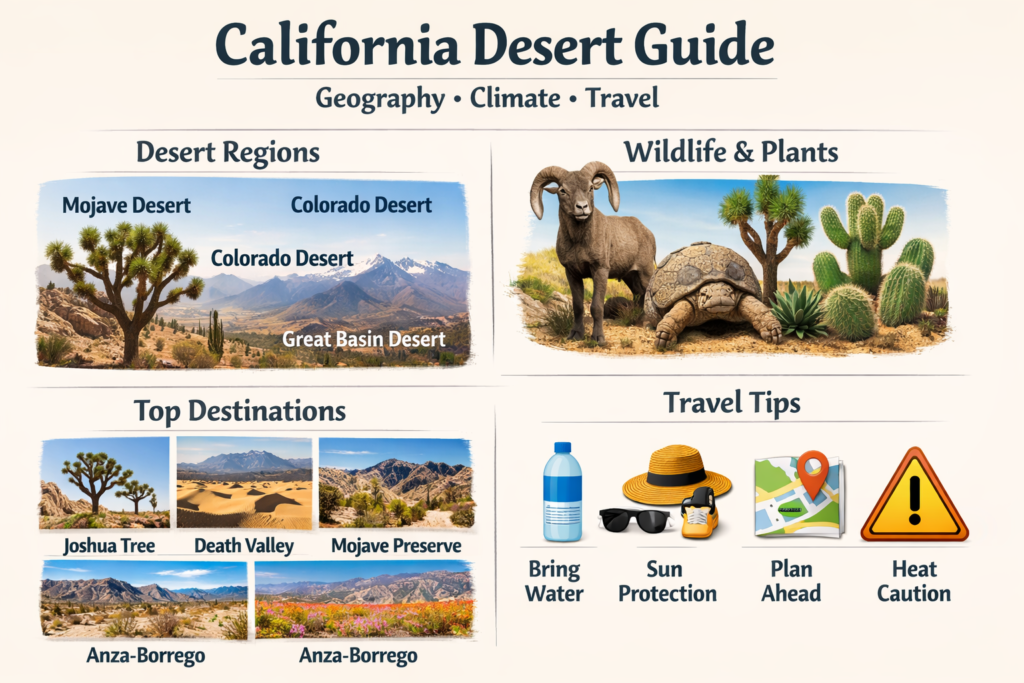
The California Desert is a vast and diverse region where multiple desert ecosystems meet, including the Mojave, Colorado, and Great Basin deserts. Far from empty, it features rugged mountains, dry basins, unique plant life, and remarkable wildlife adapted to extreme conditions. Iconic destinations like Joshua Tree National Park and Death Valley National Park highlight its natural beauty and ecological importance. This guide provides a clear overview of the region’s geography, climate, landscapes, and travel essentials in one place.
- What Is the California Desert?
- Where Is the California Desert?
- Why the California Desert Exists
- Climate and Weather in the California Desert
- Best time to visit
- Landscape and Geology
- Plants of the California Desert
- Wildlife of the California Desert
- Human History and Indigenous Heritage
- The Main Places to Visit in the California Desert
- Joshua Tree National Park
- Death Valley National Park
- Mojave National Preserve
- Anza-Borrego Desert State Park
- Travel Tips for the California Desert
- Simple desert safety checklist
- Conservation and Environmental Issues
- Interesting Facts About the California Desert
- Pros and Cons
- Pros
- Cons
- FAQs
- Conclusion
What Is the California Desert?
The California Desert is a broad inland and southeastern region of California where several desert systems intersect. It is not a single park, a single town, or one flat zone of sand. Instead, it is a large, diverse desert landscape with shifting elevations, varying temperatures, and distinct ecological communities. Joshua Tree National Park illustrates this beautifully because it is one of the places where two major desert ecosystems meet: the Mojave Desert and the Colorado Desert.
That distinction matters because desert environments are often misunderstood. Many people imagine a barren place with little life, but the California Desert is far from empty. It contains mountains, granite domes, canyons, playas, alluvial fans, and wide open basins. It also supports tribal homelands, habitat corridors, tourism, recreation, transportation routes, scientific study, energy planning, and extensive public land management. The official materials from Joshua Tree describe the region as a landscape shaped by wind, occasional heavy rain, night skies, cultural history, and unusual geological features.
A major part of the modern story is conservation. The Bureau of Land Management explains that the California Desert District exists to protect the region’s natural, historical, recreational, and economic assets, and the National Conservation Lands in the California desert include millions of acres that are closed to energy development. That is one reason the region has such a strong presence in U.S. land policy. It is not simply scenic terrain; it is a protected and carefully administered landscape with national significance.
Where Is the California Desert?
The California Desert stretches across inland and southeastern California. It reaches toward the Nevada border, extends through the Colorado River side of the state, and includes a broad network of desert roads, protected lands, preserves, parks, and communities. The most useful way to think about it is as a region where several desert provinces overlap rather than as a single compact shape on a map.
A simple breakdown helps show how the major desert systems fit together:
| Region | Main location in California | Main traits |
| Mojave Desert | Northern and eastern parts of the southern California desert system | Rain-shadow desert, Joshua tree habitat, dry basins, playas, and rugged mountains |
| Colorado Desert | Southern and eastern parts of the California low desert | Warmer low desert with plants such as ocotillo, ironwood, palo verde, and cholla |
| Great Basin Desert | Higher-elevation eastern California desert areas | A colder desert system where winter snow is an important part of the climate |
This mix is one of the most fascinating things about the California Desert. In a relatively short drive, a traveler can move from low, hot desert to high desert, from dry open basins to mountain habitats, and from developed corridors to remote backcountry. That range gives the region depth, texture, and ecological variety that many people do not expect before they visit.
Why the California Desert Exists
The California Desert exists because of geography, elevation, and weather patterns, especially the rain shadow effect. In simple terms, mountains block moist air moving inland from the Pacific Ocean. As the air rises over mountain ranges, it cools and releases precipitation on the windward side. By the time that air reaches the inland desert side, it has already lost much of its moisture. Joshua Tree’s official materials describe the park as a rain-shadow desert influenced by surrounding mountain systems.
This is why the California Desert can be so arid, even though California is a coastal state. The mountains do not remove all moisture, but they reduce it enough to create dry, desert-like conditions inland. That combination of blocked rainfall, elevation changes, and harsh sun creates a landscape where only specialized plants and animals can thrive. Over time, those conditions have shaped an ecosystem adapted to water scarcity, intense solar exposure, large day-night temperature swings, and periodic disturbance.
Climate and Weather in the California Desert
The climate of the California Desert is dry, but it is not uniform. Elevation, latitude, terrain, and local geography all influence weather patterns across the region. Some places are blisteringly hot. Some are cool in winter. Some receive snow. Some can flood suddenly after a storm. That variability is one of the main reasons the California Desert is ecologically diverse rather than biologically simple.
Joshua Tree National Park is a useful example because it contains multiple climate zones within a single protected area. The park can be cold and windy, hot and dry, or even snowy in higher terrain. The National Park Service notes that spring and holiday periods are especially busy, and visitors are warned that summer heat can be dangerous. The park also cautions that water is not available in the interior, which makes preparation essential.
Death Valley National Park represents the end of the climate spectrum. The National Park Service describes Death Valley as the hottest place on Earth and the driest place in North America, with average rainfall under two inches and summer temperatures often exceeding 120°F in the shade. The park can also experience flash floods caused by thunderstorms, especially during late summer. These conditions make Death Valley one of the most dramatic examples of desert climate on the continent.
The Great Basin Desert portions of the broader California Desert system are different again. They are colder desert environments, where winter snow plays a much bigger role than most first-time visitors would expect. That is one of the most important reasons not to simplify the California Desert into a single climate label. It contains several desert climates at once, and each one behaves differently.
Best time to visit
The best time to visit most parts of the California Desert is during the cooler seasons, especially fall, winter, and early spring. Joshua Tree notes that visitation rises when temperatures become more comfortable in the fall, while Death Valley recommends cooler-season hiking. Mojave National Preserve also points visitors toward spring and fall as the most pleasant times to explore, though those periods can be more crowded.
Landscape and Geology
The California Desert is much more varied than a field of sand. It includes mountain ranges, rocky slopes, alluvial fans, bajadas, playas, dry valleys, salt flats, canyons, and broad desert basins. Joshua Tree’s geology page describes a terrain shaped by plate tectonics, volcanism, mountain building, and erosion, with elevations ranging from roughly 900 feet to more than 5,000 feet.
Joshua Tree is especially helpful for understanding the desert because it combines multiple landforms in one place. Visitors encounter granite monoliths, weathered rock formations, washes, dry flats, and mountainous habitat zones. The park’s geology page explains that much of the rock formed through ancient intrusive processes more than 100 million years ago, which is part of why the park has such a distinctive, almost sculptural appearance today.
Death Valley National Park adds even greater scale. Its landscape includes valley floors far below sea level, mountain ranges, salt surfaces, and enormous elevation contrasts. Those contrasts help explain the park’s extreme temperatures and its dramatic visual character. The National Park Service describes Death Valley as a place with major geological history, exceptional topography, and an unusually harsh environment.
Mojave National Preserve also demonstrates how diverse the desert can be. The park describes itself as a diverse mosaic of ecological habitats with a 10,000-year history of human connection to the land. That phrase is important because it reminds readers that the desert is not only a scenic environment. It is also a place of continuity, memory, and ongoing use.
Plants of the California Desert
Plants are one of the clearest indicators that the California Desert is alive. Different elevations, soils, and moisture conditions support different plant communities. Joshua Tree National Park is especially rich in this respect because it sits at the meeting point of the Mojave Desert and the Colorado Desert, while also including a higher-elevation zone in the Little San Bernardino Mountains.
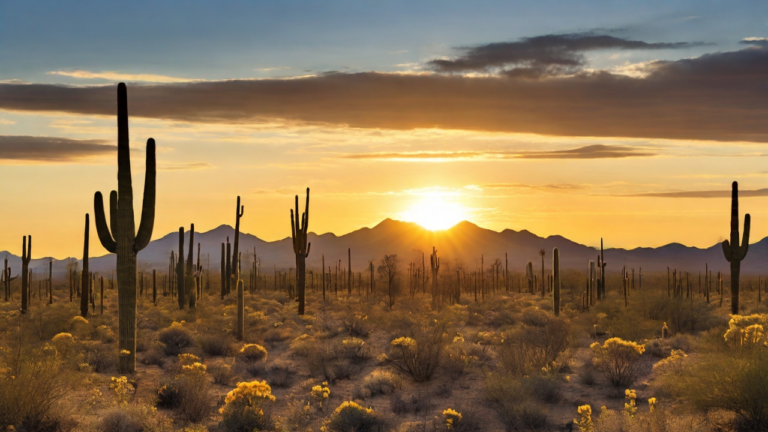
On the Mojave side of Joshua Tree, the famous Joshua tree is the signature species. On the Colorado Desert side, visitors encounter ocotillo, ironwood, palo verde, and teddy bear cholla. At higher elevations, the park supports California juniper, Muller’s oak, and pinyon pine. This shift in vegetation is one of the strongest examples of how desert ecosystems can change quickly over relatively short distances.
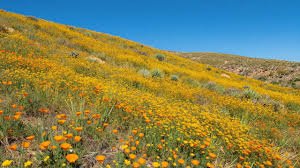
Death Valley also contains a surprising range of plant life. The National Park Service says the park has more than 1,000 described plant species, including bristlecone pines and spring wildflowers. Depending on elevation and conditions, the park also supports creosote bush, desert holly, mesquite, shadscale, blackbrush, Joshua tree, pinyon-juniper woodland, limber pine, and bristlecone pine communities.
Desert plants matter because they form the framework of the ecosystem. They shade the ground, hold moisture in the soil, provide food for insects, support birds, and create shelter for reptiles and mammals. Their adaptations are equally impressive: water storage, deep roots, reduced leaf surfaces, seasonal dormancy, and the ability to respond quickly to brief rainfall. Without these plants, the desert food web would collapse. That is one of the most important ideas to include in a strong California Desert article.
Wildlife of the California Desert
The California Desert supports a much richer wildlife community than many people expect. Many animals are nocturnal or crepuscular, meaning they are active at dawn, dusk, or night to avoid the heat. Others live in burrows, hide among rocks, or move long distances to search for water and food. Joshua Tree’s official wildlife page says the park is home to 57 mammal species, with common animals including kangaroo rats, coyotes, and white-tailed antelope ground squirrels. It also mentions rarer species such as foxes, bobcats, bighorn sheep, and mule deer, along with 16 species of bats.
Joshua Tree is also a major bird and reptile habitat. Stewardship materials for the park note approximately 270 bird species that nest or migrate through the area, around 52 mammal species, and 45 reptile species. That makes it a biologically rich desert ecosystem rather than a sparse one.
In Death Valley, wildlife survival depends on extraordinary adaptation. The National Park Service explains that the park’s plants and animals have adapted in remarkable ways to the harsh Mojave Desert environment. Some species are tiny and hidden. Others are highly specialized and closely tied to springs, seeps, and other rare water sources.
The desert tortoise is one of the most important conservation species in the region. Materials related to Mojave management stress the pressure on desert water sources and habitat, which is one reason both travel behavior and land management practices matter so much. In the desert, a small disruption can affect a habitat that took years or even decades to stabilize. That slow recovery time is one of the key ecological realities of this region.
Human History and Indigenous Heritage
The California Desert is not an empty historical background. It is a homeland with deep Indigenous presence and living cultural connections. Death Valley National Park is recognized as the homeland of the Timbisha Shoshone, and the National Park Service says the tribe and park staff work together to protect and improve the land and its resources.
That relationship changes the way the desert should be understood. These places are not only protected for scenery or recreation. They are also ancestral territories, cultural landscapes, and spaces where Indigenous Communities continue to live, remember, and practice traditions. National Park Service materials have noted that the 1996 Timbisha Shoshone demonstration challenged the idea of national parks as untouched wilderness by showing that Death Valley was already a homeland long before modern conservation language described it that way.
Modern preservation in the California Desert took a major step with the California Desert Protection Act. The National Park Service says it was signed on October 31, 1994, and it converted Death Valley and Joshua Tree into national parks, added land to both sites, and established the Mojave National Preserve. Other National Park Service materials describe the act as a landmark conservation effort that set aside more than nine million acres of wilderness.
For readers, this is a crucial point. The California Desert is protected not just because it looks beautiful, but because it holds ecological, cultural, scientific, and historical value at a scale that demands long-term public protection.
The Main Places to Visit in the California Desert
The most effective way to experience the California Desert is through its major parks and preserves. Each destination has a different character, and each one contributes something unique to a full understanding of the region.
Joshua Tree National Park
Joshua Tree National Park is one of the most recognizable desert parks in the United States. The National Park Service says it is where two deserts meet, and the park combines strong winds, occasional heavy rain, night skies, cultural history, and unusual geological formations. It is open 24 hours a day, seven days a week, all year long.
Joshua Tree is an ideal first stop for anyone learning about the California Desert because it packs so many desert features into one landscape. Visitors can see granite rock formations, Joshua tree forests, cactus communities, distinct high and low desert ecosystems, and exceptional stargazing conditions. It is both accessible and educational, which makes it one of the most valuable anchor destinations for a pillar article.
Death Valley National Park
Death Valley National Park represents the extreme edge of the desert story. The National Park Service describes it as the hottest place on Earth and the driest place in North America. It also has major geological history, unusual ecosystems, more than 1,000 described plant species, and some of the most extreme climate and topographic conditions in the country.
For travel content, Death Valley is essential because it teaches respect. Visitors have to take heat, flash floods, and long distances seriously. That means planning matters more here than in many other destinations. The park is stunning, but it is also demanding.
Mojave National Preserve
Mojave National Preserve is ideal for visitors who want a quieter, more remote desert experience. The National Park Service describes it as a place with a diverse mosaic of ecological habitats and a 10,000-year history of human connection to the desert. It also emphasizes that the preserve protects threatened desert resources and supports discovery in wild and open country.
This preserve is useful in a pillar article because it shows the less crowded side of the California Desert. It offers remote roads, open horizons, and a more contemplative desert setting for those willing to plan carefully.
Anza-Borrego Desert State Park
Anza-Borrego Desert State Park is California’s largest state park. According to California State Parks, it includes 500 miles of dirt roads, 12 wilderness areas, and many hiking trails. It also features washes, wildflower displays, palm groves, cacti, and expansive scenic views.
This park is especially useful for family trips, scenic driving, spring wildflower viewing, and backcountry exploration. It is also a powerful reminder of how vast and varied the California Desert truly is.
Travel Tips for the California Desert
Traveling in the California Desert can be deeply rewarding, but it has to be done with care. The most important rule is simple: bring more water than you think you need. Joshua Tree says drinking water is not available in the park’s interior, and visitors should carry at least one gallon per person per day during warmer months. Mojave National Preserve recommends at least one gallon per person per day, and two gallons for hikers and cyclists.
Another major rule is to avoid the hottest part of the day. Joshua Tree warns that extreme heat creates serious safety risks during summer. Mojave National Preserve advises visitors to avoid strenuous activity during intense heat, and California State Parks recommends plenty of water, protective clothing, and reduced exposure during the hottest hours.
Road conditions also matter. In remote desert areas, roads can change quickly after storms, and cell service may be weak or nonexistent. Mojave National Preserve tells visitors to check road conditions before traveling because dirt roads are not regularly monitored or maintained and may become impassable after rainfall. Joshua Tree also notes limited interior services and limited cell reception.
Simple desert safety checklist
Carry plenty of water and drink before thirst becomes strong.
Travel early or late instead of hiking during peak heat.
Check the weather and road conditions before departing.
Use sun protection such as a hat, sunglasses, sunscreen, and layered clothing.
Stay on marked roads and trails to protect fragile desert surfaces.
This last point is especially important because desert recovery is slow. Tire tracks, trampling, and off-trail use can leave visible and lasting damage.
Conservation and Environmental Issues
The California Desert is beautiful, but it is also fragile. Desert ecosystems recover slowly after disturbance, so damage from roads, development, mining, overuse, invasive species, and fire can persist for a very long time. The Bureau of Land Management and the National Park Service both emphasize that these lands need careful stewardship because they are ecologically sensitive and culturally significant.
In Joshua Tree, the National Park Service says climate change, invasive species, pollution, and mining all affect the park. That is a concise summary of the pressures facing the region today. The desert is being shaped by both environmental stress and human activity, and those pressures often overlap.
Water is one of the biggest issues. Mojave National Preserve notes that research is needed to understand threats to springs, seeps, and wildlife habitat because climate change and prolonged drought can weaken management efforts. In desert landscapes, water is not just a resource. It is the base layer of the entire ecosystem.
Energy development is another major concern. The Bureau of Land Management says California Desert National Conservation Lands are closed to energy development and that Phase I of the Desert Renewable Energy Conservation Plan added 4.2 million acres to conservation lands, including 2.89 million acres that were new to the system. This shows how the region continues to balance long-term conservation with development pressure.
Interesting Facts About the California Desert
The California Desert contains some of the most extreme environmental conditions in North America. Death Valley is the hottest place on Earth and the driest place in North America, while other parts of the region can be cold in winter and snowy at higher elevations.
Joshua Tree National Park is where two major desert ecosystems meet, and the park also includes a higher-elevation mountain zone. That makes it one of the best places to understand how distinct desert worlds transition into one another.
Anza-Borrego Desert State Park is the largest state park in California and includes 500 miles of dirt roads. That enormous road network is a strong reminder of just how expansive the California Desert region really is.
Mojave National Preserve is not only a scenic destination; it is also a conservation landscape and a place with a 10,000-year human story. That makes it especially relevant for readers interested in ecology, archaeology, public lands, and desert travel.
Pros and Cons
Pros
The California Desert has strong search interest because readers want geography, wildlife, climate, parks, and travel guidance in one place. It includes famous destinations such as Joshua Tree, Death Valley, Mojave National Preserve, and Anza-Borrego, which makes it naturally appealing for SEO. It also supports internal linking across many related topics, including ecology, safety, road trips, hiking, camping, wildlife, and conservation.
Cons
The topic is broad, so a weak article can feel scattered or repetitive. It also requires careful safety guidance because desert conditions can become dangerous very quickly in extreme heat. Finally, many existing pages cover only one part of the story, so a high-quality pillar article has to connect all the major pieces in a clear, easy-to-follow structure.
FAQs
The term usually refers to the Mojave Desert, Colorado Desert, and Great Basin Desert areas that meet or overlap within California. The best way to understand it is as a connected desert system rather than one single uniform place.
Yes. Joshua Tree National Park sits where the Mojave and Colorado deserts meet, and it also includes a higher-elevation mountain ecosystem.
Cooler months are usually the best time to go. Joshua Tree, Death Valley, and Mojave National Preserve all point visitors toward the cooler seasons and away from the most intense heat.
It contains fragile ecosystems, rare species, tribal homelands, distinctive geology, and very large public lands that recover slowly after damage. It is also tied to major land protection laws and conservation planning efforts.
Bring water, food, sun protection, appropriate footwear, layers, maps, and a clear route plan. Official park guidance repeatedly emphasizes carrying plenty of water and being ready for rapidly changing conditions.
No. It is full of geology, wildlife, tribal history, and protected public lands. Places like Joshua Tree and Death Valley show that the desert is a living landscape, not an empty one.
Conclusion
The California Desert is a dynamic and interconnected landscape shaped by climate, geology, and time. From extreme environments to rich ecosystems and protected lands, it offers both challenge and beauty. Whether exploring its national parks or learning about its ecology, Understanding the desert helps visitors appreciate and protect one of the most unique regions in North America.