
Introduction
Las Vegas is famous for its entertainment and resorts, but it is also located within the Mojave Desert, one of North America’s most unique desert regions. The desert shapes the city’s climate, scenery, wildlife, and water Resources. From the red cliffs of Red Rock Canyon National Conservation Area to the vast waters of Lake Mead National Recreation Area, the Las Vegas desert offers stunning landscapes, outdoor adventures, and a deeper understanding of how life thrives in an arid environment.
- What Desert Is Las Vegas In?
- Why the Las Vegas, Nevada Desert Matters
- Location and Geography of the Las Vegas, Nevada Desert
- Key desert landscapes near Las Vegas
- The Mojave Desert Around Las Vegas
- Climate and Weather Patterns in the Las Vegas Desert
- What the climate feels like
- Climate facts to remember
- Landscape Features: Sand Dunes, Rocks, Valleys, and Mountains
- Common landscape features near Las Vegas
- Example: Red Rock Canyon
- Example: Lake Mead area
- Flora: Plants of the Las Vegas Desert
- Common desert plants in the Las Vegas area
- Why desert plants matter
- Plant life at Springs Preserve
- Fauna: Animals, Reptiles, Insects, and Birds
- Animals you may see near Las Vegas
- Desert National Wildlife Refuge
- Why is wildlife so important in the desert
- Human History and Native Cultures
- The role of springs
- Rafael Rivera and early travel
- Why the desert-shaped settlement
- Water, Growth, and the Las Vegas Desert
- Why water matters so much here
- Best Places to Visit in the Las Vegas, Nevada Desert
- 1. Red Rock Canyon
- 2. Lake Mead National Recreation Area
- 3. Springs Preserve
- 4. Desert National Wildlife Refuge
- Quick comparison of the top desert places near Las Vegas
- Outdoor Activities in the Las Vegas Desert
- Popular things to do
- Example travel plans
- Travel Tips for the Las Vegas, Nevada Desert
- Simple desert travel tips
- Why these tips matter
- Best season to visit
- Conservation Challenges in the Las Vegas Desert
- Main conservation issues
- Why conservation matters to visitors
- Good conservation habits
- Interesting Facts About the Las Vegas Desert
- Pros and Cons
- Pros
- Cons
- FAQs
- Conclusion
What Desert Is Las Vegas In?
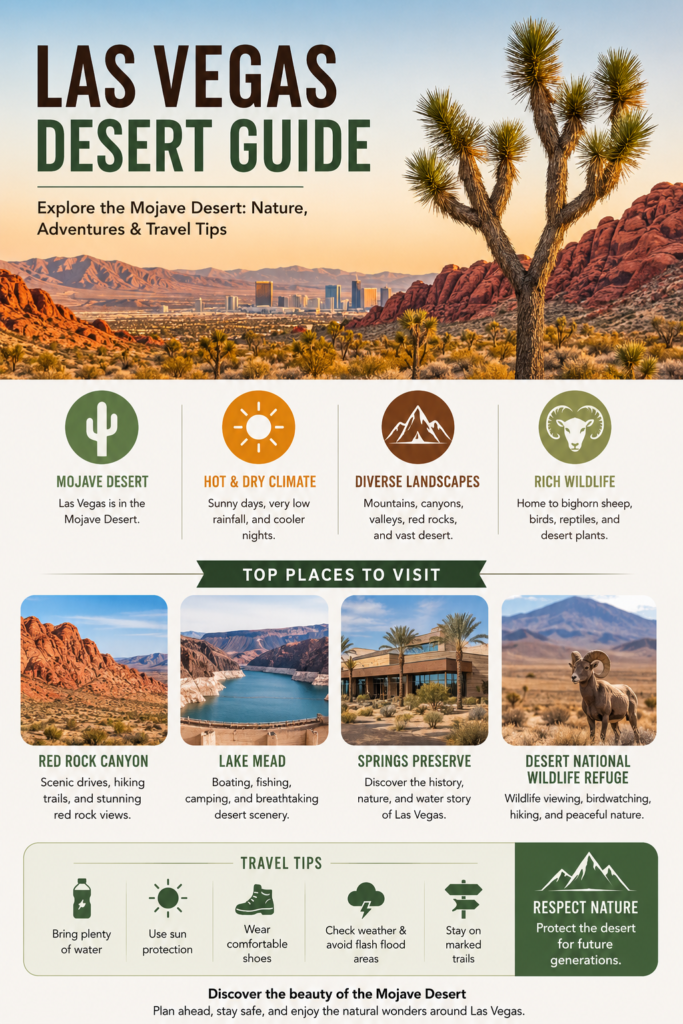
Las Vegas is in the Mojave Desert. That is the simple, accurate answer, and it matters because the Mojave is not just any desert. It is a distinct desert biome with its own climate signature, plant communities, animal life, and geological features.
The Mojave Desert is often described as the smallest and driest of the major North American deserts. It is also home to one of the most recognizable plant species in the American Southwest: the Joshua tree. That symbol alone gives the region a memorable identity and helps explain why the landscape feels so iconic.
The Las Vegas Valley is ecologically part of the Mojave Desert, which means the city is not merely near the desert; it exists inside the desert system. The landforms, heat, water dynamics, and wildlife all reflect that reality.
Many people imagine a desert as a flat, endless plain of sand. The Las Vegas desert is nothing like that. It is a varied terrain of basins, mountain ranges, dry washes, rocky ridges, canyons, and seasonal contrasts. That complexity is one of the reasons the area feels so visually compelling.
Why the Las Vegas, Nevada Desert Matters
The desert around Las Vegas matters for far more than its scenery. It helps explain:
- Why the city developed where it did
- where the water comes from
- How people and animals endure in arid conditions
- Why outdoor recreation is so popular
- Why conservation is such a serious issue
Without the desert, Las Vegas would not exist in the form we know today. Settlement, growth, and long-term survival were all tied to water availability in an otherwise harsh environment. Springs, groundwater, and later the Colorado River system made life possible in this dry basin.
At the same time, the desert is a destination in its own right. Visitors come for Red Rock Canyon, Lake Mead, Springs Preserve, Desert National Wildlife Refuge, hiking, birdwatching, geology, desert photography, and learning opportunities. The desert is therefore both a living ecosystem and a tourism engine.
Location and Geography of the Las Vegas, Nevada Desert
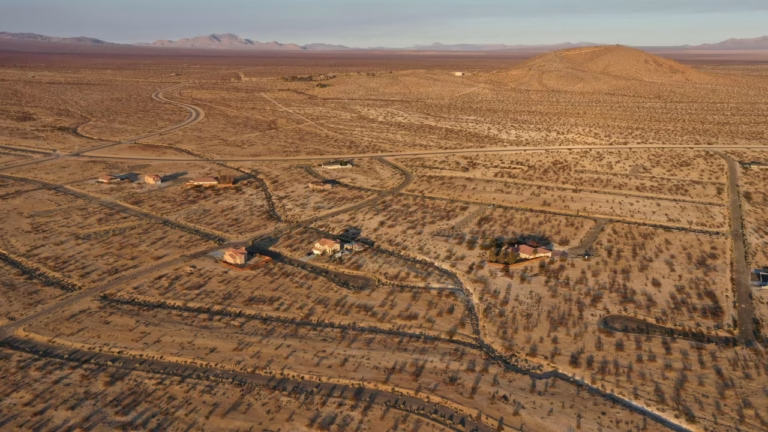
The Las Vegas Valley forms the urban core of the region. It sits within the Mojave Desert and is ringed by mountains, basins, and open desert terrain. That setting gives Las Vegas a dramatic geographic identity that stands apart from many other large American cities.
The city lies in a basin, with mountain ranges rising around it. That geometry creates sweeping views in nearly every direction and reinforces the sense that the desert is never far away. Even in the middle of the metro area, you are still inside a broader desert landscape.
Key desert landscapes near Las Vegas
| Place | Why It Matters | Key Fact |
| Las Vegas Valley | Urban heart of the region | Ecologically part of the Mojave Desert |
| Red Rock Canyon | Best nearby desert day trip | About 17 miles west of the Strip |
| Lake Mead National Recreation Area | Desert plus water on a large scale | Covers 1.5 million acres |
| Desert National Wildlife Refuge | Quiet, wild, conservation-focused desert | 1.6 million acres, the largest wildlife refuge outside Alaska |
| Springs Preserve | History and water story | Original water source for Native Americans in the area |
This geography matters because it shows that the Las Vegas desert is not a single uniform place. It is a network of interconnected landscapes. Some zones are rocky, some are open, some are tied to water, some are rich in wildlife, and some are managed for public access. That diversity is one of the reasons the region is so appealing to travelers, students, photographers, and researchers.
The Mojave Desert Around Las Vegas
The Mojave Desert is the natural home of Las Vegas. It spans portions of Nevada, California, Arizona, and Utah. It is a demanding environment, but it is also remarkably adaptive.
The Mojave is associated with:
- very dry air
- intense sunshine
- scorching summers
- cool to cold winter nights
- rocky landforms
- Joshua trees and other desert plants
- Animals adapted to limited water availability.
Even though it is dry, the Mojave is full of life. It contains nearly 2,000 unique plant species, which surprises many people who think of deserts as lifeless zones. In reality, desert ecosystems are simply highly Specialized. Life is present everywhere; it is just organized around scarcity, resilience, and adaptation.
Las Vegas sits in the middle of this system. That means the desert identity of the city is not accidental or decorative. It is structural. It is built into the environment itself.
Climate and Weather Patterns in the Las Vegas Desert
The climate in the Las Vegas desert is hot, arid, and strongly seasonal. Understanding this is essential for both visitors and residents.
Summers in Las Vegas can be extreme. Triple-digit temperatures are common in the hottest months. Sun exposure is intense, the air is dry, and shade makes a major difference in comfort. Winter is more moderate during the day, but nighttime temperatures can drop sharply.
What the climate feels like
- Summer: very hot, dry, and bright
- Winter: mild to cool days, cold nights
- Spring and fall: more comfortable, but still dry
- Rain: limited overall, but storms can trigger flash flooding
The desert climate shapes how people live, travel, hike, and plan outdoor activities. In Las Vegas, the weather is not just a background condition. It affects safety, hydration, landscaping, energy use, and the timing of recreation.
Climate facts to remember
| Climate Factor | What It Means |
| High sunshine | Strong sun exposure most of the year |
| Low rainfall | Very dry conditions overall |
| Hot summers | Heat safety is critical |
| Cold winter nights | Desert temperatures can fall quickly |
| Flash-flood risk | Storms can produce sudden water runoff in dry channels |
One common mistake is assuming that the city and the surrounding desert feel the same. They do not. The temperature, wind, and exposure can change significantly in open desert, canyon areas, and higher elevations. That is why checking conditions before heading out is always a smart move.
Landscape Features: Sand Dunes, Rocks, Valleys, and Mountains
The Las Vegas desert is not mostly about dunes. In fact, the region is far better known for canyons, cliffs, ridges, valleys, and mountains.
Common landscape features near Las Vegas
- red sandstone cliffs
- dry washes
- basins and valleys
- fault-block mountain ranges
- desert canyons
- rock formations
- springs and wetland pockets
- reservoir shorelines
This variety gives the Las Vegas desert its dramatic visual personality. The land has been shaped by erosion, uplift, faulting, and the long patience of a dry climate. Many famous scenic places near the city are rocky rather than sandy, and that gives the region a bold, colorful appearance.
Example: Red Rock Canyon
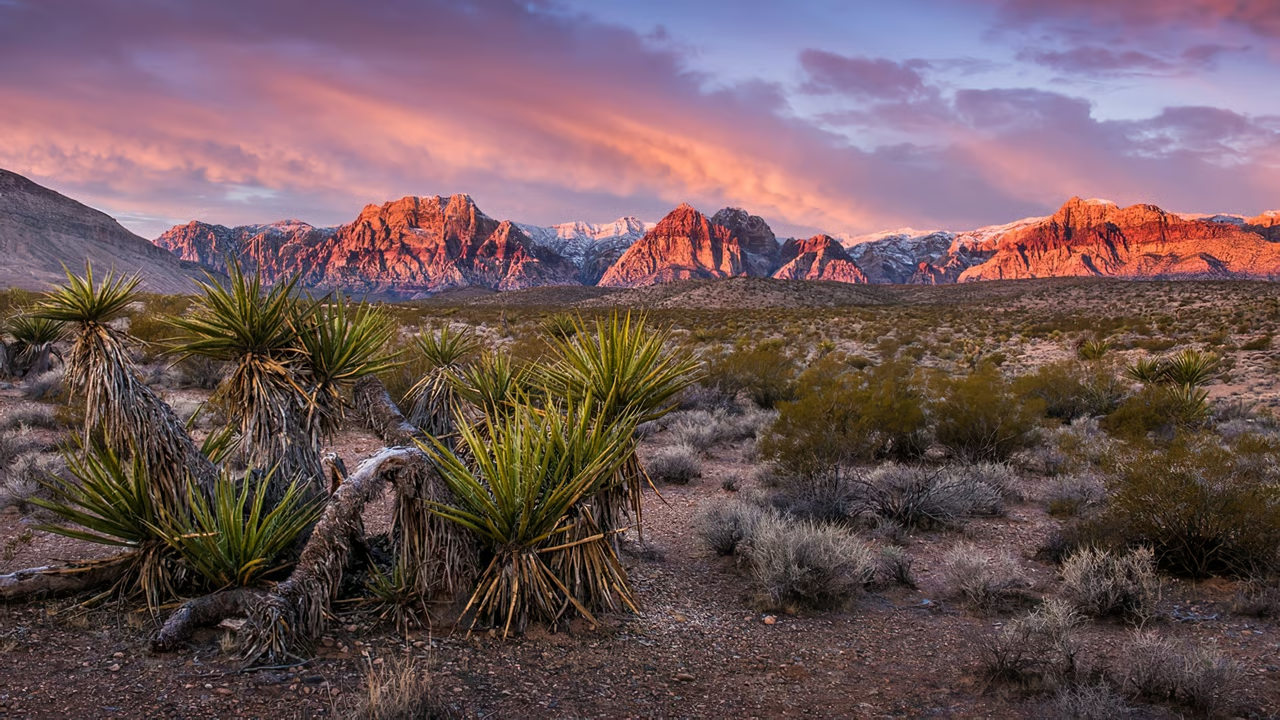
Red Rock Canyon is one of the clearest representations of the local terrain. It features red-banded cliffs, tall stone walls, scenic roads, and excellent examples of desert geology. It is one of the easiest places to see the desert up close and understand how striking the landscape can be.
Example: Lake Mead area
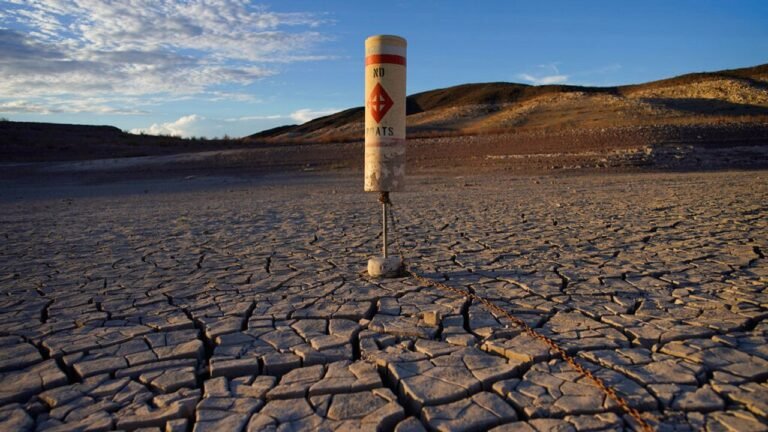
Lake Mead reveals another side of the desert experience. It combines desert terrain with a vast reservoir and recreational opportunities. The result is a landscape that feels both dry and watery at once.
That contrast is one of the region’s most fascinating qualities. The desert is not simply about absence. It is about variation, endurance, and adaptation.
Flora: Plants of the Las Vegas Desert
The plant life of the Las Vegas, Nevada, desert is more diverse than many people assume. Desert plants are specialists. They survive heat, conserve water, and thrive in difficult conditions that would weaken many other species.
The Mojave Desert is especially famous for the Joshua tree, one of its signature species and one of the most recognizable symbols of the entire region.
Common desert plants in the Las Vegas area
- Joshua trees
- creosote bush
- cacti
- yucca
- desert shrubs
- mesquite in some areas
- native grasses
- seasonal wildflowers
These plants survive by reducing water loss, developing efficient root systems, growing slowly, storing moisture, and timing their growth strategically. Some have thick stems, some have tiny leaves, and some bloom only after rare rainfall events. Others remain dormant until conditions improve.
Why desert plants matter
Desert vegetation does much more than simply stay alive. It supports the entire ecosystem by:
- providing food and shelter for animals
- reducing soil erosion
- storing or conserving water
- supporting pollinators
- creating shade and microhabitats
- stabilizing the landscape
Plant life at Springs Preserve
Springs Preserve is one of the best places to see desert plants in a practical, educational setting. Its gardens demonstrate how people can use desert landscaping in thoughtful, attractive, water-conscious ways. It also helps visitors understand that a desert garden can be both functional and beautiful.
The key takeaway is straightforward: the desert is not empty. It is alive, layered, and ecologically active in ways that are easy to miss unless you slow down and observe.
Fauna: Animals, Reptiles, Insects, and Birds
The animal life of the Las Vegas desert is another reason the region is so compelling. Many people think desert wildlife is scarce, but in reality, it is surprisingly varied.
Animals you may see near Las Vegas
- desert bighorn sheep
- coyotes
- lizards
- snakes
- rabbits
- raptors
- songbirds
- insects
- small mammals
Different elevations and habitat types support different species. That is why some areas are especially good for birds, others for reptiles, and others for mammals.
Desert National Wildlife Refuge
The Desert National Wildlife Refuge is one of the best places to understand the region’s wildlife complexity. It was originally established to protect habitat for desert bighorn sheep and now supports:
- over 500 plant species
- more than 320 bird species
- 52 mammal species
- 32 reptile species
It is also one of the best birdwatching destinations in southern Nevada. For wildlife enthusiasts, photographers, and nature lovers, it offers a quieter and more immersive experience than many better-known attractions.
Why is wildlife so important in the desert
Desert animals are resilient, but they are also highly dependent on specific environmental conditions. They rely on:
- reliable water sources
- protected habitat
- native food plants
- undisturbed land
- seasonal weather patterns
That is why conservation areas matter so deeply. They preserve the balance that allows the ecosystem to continue functioning.
Human History and Native Cultures
The desert around Las Vegas has a deep human history that long predates the modern city. Native peoples lived in the region centuries before the arrival of large-scale settlement, and the presence of water was central to their survival.
The role of springs
Springs were the foundation of life in the valley. They provided water for Native communities and later shaped patterns of travel and settlement. The name “Las Vegas” itself is tied to these natural water sources.
Rafael Rivera and early travel
In 1829, Rafael Rivera reached the valley after following the Las Vegas Wash to an area with springs and meadow-like conditions. This event is an important part of the region’s early historical narrative because it explains why the valley drew notice at all.
Why the desert-shaped settlement
In desert environments, water determines almost everything:
- where people settle
- where travel routes form
- where agriculture can happen
- where cities can expand
Las Vegas grew because water existed in an otherwise dry basin. At first, that meant springs and groundwater. Later, it became connected to the Colorado River system and Lake Mead. This is why the story of the desert is also the story of the city.
Water, Growth, and the Las Vegas Desert
Water is one of the defining themes in the Las Vegas desert story. Without water, the city could not have expanded the way it did.
Today, most of the city’s water comes from the Colorado River via Lake Mead, with the remainder coming from groundwater sources. That fact is central to understanding the region because it reveals how deeply the city depends on desert water systems.
Why water matters so much here
- It supports homes and businesses
- It supports tourism
- It supports parks and landscaping
- It influences city planning
- It shapes environmental policy
This is more than a technical issue. Water is part of the identity of Las Vegas. A city in the desert must think differently about growth, sustainability, and long-term resilience. That reality makes Las Vegas one of the clearest examples in the United States of an urban center shaped by water limits.
Best Places to Visit in the Las Vegas, Nevada Desert
The desert around Las Vegas offers a wide range of excellent places to visit. Some destinations are close to the Strip, others are expensive and remote. Some emphasize nature, while others focus on history or education.
1. Red Rock Canyon
Red Rock Canyon is the best-known close-in desert destination near Las Vegas. It is roughly 17 miles west of the Strip and is an ideal option for first-time visitors.
Why it stands out
- scenic 13-mile drive
- hiking trails
- striking red-rock geology
- camping opportunities
- wildlife viewing
- visitor center
- cultural resources
If you want a single destination that delivers the classic desert experience, this is usually the strongest choice.
2. Lake Mead National Recreation Area
Lake Mead offers a larger, more open version of the desert experience. It covers 1.5 million acres and includes mountains, canyons, valleys, and broad opportunities for water-based recreation.
Activities here include
- scenic drives
- biking
- hiking
- boating
- fishing
- camping
This destination is ideal for visitors who want a major outdoor adventure that combines desert and reservoir scenery.
3. Springs Preserve
Springs Preserve is the best place for visitors who want to understand the city’s desert roots. It connects water, history, ecology, and early settlement in one accessible location.
Best for
- families
- students
- first-time visitors
- education
- nature interpretation
- conservation learning
It is one of the most valuable locations for understanding how Las Vegas emerged and why it exists where it does.
4. Desert National Wildlife Refuge
This refuge is the best option for travelers who want a quieter, more remote desert setting.
Best for
- birdwatching
- wildlife viewing
- hiking
- camping
- photography
- learning about habitat and conservation
The refuge is vast, biologically rich, and much less crowded than many other desert destinations.
Quick comparison of the top desert places near Las Vegas
| Destination | Best For | Why It Stands Out |
| Red Rock Canyon | First-time visitors | Close to the city, scenic, easy to explore |
| Lake Mead National Recreation Area | Big outdoor trips | Huge scale, desert plus water recreation |
| Springs Preserve | History and education | Explains water, settlement, and desert living |
| Desert National Wildlife Refuge | Wildlife and quiet nature | Large, wild, and rich in birds and habitat |
This comparison makes one thing clear: the Las Vegas desert is not one experience. It is many experiences woven into one region.
Outdoor Activities in the Las Vegas Desert
There is much more to do here than most people expect. The desert supports a wide spectrum of outdoor recreation.
Popular things to do
- hiking
- scenic driving
- birdwatching
- camping
- photography
- biking
- boating
- fishing
- geology tours
- nature walks
Each activity works best in different seasons and at different locations. Hiking at Red Rock Canyon is a different experience from boating at Lake Mead. Birdwatching at the refuge is different from learning water history at Springs Preserve.
Example travel plans
1: Half-day desert trip
Visit Red Rock Canyon, take the scenic drive, walk a short trail, and return to Las Vegas by afternoon.
2: Full-day nature trip
Start at Springs Preserve, learn about water history, continue to Red Rock Canyon, and finish with sunset views.
3: Wildlife-focused trip
Spend the day at Desert National Wildlife Refuge, watch for birds and bighorn sheep, and bring plenty of water, snacks, and binoculars.
These examples show how adaptable the Las Vegas desert is for different kinds of travelers.
Travel Tips for the Las Vegas, Nevada Desert
Traveling in the desert is rewarding, but it requires preparation. The heat and terrain can be challenging if you are not ready.
Simple desert travel tips
- Go early in the day
- carry more water than you think you need
- Use sun protection
- wear comfortable shoes
- Check weather forecasts before leaving
- Watch for flash flood warnings
- Stay on marked trails
- Respect park rules and closures
Why these tips matter
The desert heat can become dangerous quickly. Trails can be longer and tougher than they appear. Water can run low faster than expected. Even a clear sky can change during storms. In the desert, preparation is not optional; it is part of safe travel.
Best season to visit
The most comfortable times to visit are usually:
- spring
- fall
- winter mornings
- early summer mornings
Summer can still work, but only with serious heat awareness and careful planning.
Conservation Challenges in the Las Vegas Desert
Conservation is one of the central issues in Las Vegas, Nevada, a desert. The region depends on a fragile balance of land, water, plants, and wildlife.
Main conservation issues
- water use
- drought
- habitat loss
- invasive species
- fire pressure
- urban growth
- tourism impact
The city relies heavily on Colorado River water, which makes long-term water planning extremely important. The ecosystem itself also needs protection because many species are adapted to narrow environmental conditions.
Why conservation matters to visitors
The desert may seem tough and unchanging, but it is actually delicate in many ways. Trails can erode. Plants may take years to recover. Wildlife can be disrupted by noise, feeding, or off-road travel. Water usage can influence the larger system.
That is why responsible tourism matters so much. It helps preserve the desert for future generations.
Good conservation habits
- Do not leave trash behind
- Stay on trails
- Do not disturb wildlife
- Keep a respectful distance from animals
- Use water carefully
- Follow park rules
- avoid driving off-road
These are simple actions, but they help protect the landscape in real ways.
Interesting Facts About the Las Vegas Desert
Here are some useful facts that make the region even more memorable:
- The Las Vegas Valley is ecologically part of the Mojave Desert.
- The Mojave is the smallest and driest of the major North American deserts.
- The Mojave is famous for Joshua trees.
- The Mojave supports nearly 2,000 unique plants.
- Red Rock Canyon is one of the easiest desert attractions to reach from the city.
- Lake Mead National Recreation Area covers 1.5 million acres.
- The Desert National Wildlife Refuge covers 1.6 million acres and is the largest wildlife refuge outside Alaska.
- Las Vegas receives most of its water from the Colorado River and Lake Mead.
- The desert around Las Vegas is a living ecosystem, not empty land.
These facts help readers understand why the region is so distinctive and why it matters beyond tourism.
Pros and Cons
Pros
- easy access to world-famous desert scenery
- a strong mix of nature, history, and recreation
- rich plant and animal life for a desert region
- great options for short outings and full-day trips
- strong educational value for families and students
Cons
- Extreme heat can become dangerous
- Very dry air can accelerate dehydration
- Flash floods can occur during storms
- Fragile areas need careful use
- Water stress is a long-term concern
This balance is important. The desert offers beauty, adventure, and education, but it also demands respect.
FAQs
Las Vegas is in the Mojave Desert.
Yes. Las Vegas sits in a desert valley and is shaped by Mojave climate, landforms, wildlife, and water systems.
Red Rock Canyon is usually the best all-around choice for first-time visitors because it is close, scenic, and easy to explore.
Summer temperatures often reach the triple digits, so heat safety is very important.
You may see desert bighorn sheep, coyotes, lizards, snakes, rabbits, birds, and insects.
Conclusion
The Las Vegas Desert is far more than a backdrop to the city. As part of the Mojave Desert, it features remarkable landscapes, diverse wildlife, and important natural resources that have shaped the region’s history and growth. Whether you’re exploring scenic canyons, learning about desert ecology, or enjoying outdoor recreation, the Las Vegas desert provides an unforgettable experience beyond the city’s bright lights.