
Introduction
The Mojave Desert is one of North America’s most striking landscapes, known for its rugged mountains, dry basins, Joshua trees, and extreme climate. Far from empty, it is a living desert filled with unique plants, wildlife, and deep human history. This guide covers the Mojave Desert’s geography, weather, natural life, travel tips, and conservation in a clear, easy-to-read way.
- Quick Facts About the Mojave Desert
- What Is the Mojave Desert?
- Mojave Desert Location and Geography
- Where Is the Mojave Desert?
- Why Geography Matters
- Water in the Desert
- Mojave Desert Climate and Weather
- A Hot, Dry Desert Climate
- Temperature Swings
- Rainfall
- Weather and Travel
- Landscape Features of the Mojave Desert
- 1. Mountain Ranges
- 2. Sand Dunes
- 3. Salt Flats and Dry Lake Beds
- 4. Volcanic Features
- 5. Joshua Tree Forests
- 6. Rocky Valleys and Washes
- Mojave Desert Quick Landscape Comparison
- Flora: Plants of the Mojave Desert
- The Famous Joshua Tree
- Creosote Bush
- Other Mojave Plants
- How Desert Plants Survive
- Why Plants Matter
- Fauna: Wildlife of the Mojave Desert
- The Desert Tortoise
- Birds
- Reptiles
- Mammals
- Insects and Arachnids
- Mojave Desert Wildlife Table
- How Animals Survive in the Mojave Desert
- Human History in the Mojave Desert
- Early Human Life
- Trade Routes
- Later Expansion and Travel
- Mining and Industry
- Why History Matters
- Mojave Desert History Timeline
- Travel Guide to the Mojave Desert
- Best Things to Do
- Famous Places to Visit
- Why People Visit
- Travel Tips for the Mojave Desert
- 1. Bring More Water Than You Think You Need
- 2. Start Early
- 3. Check Road Conditions
- 4. Carry Navigation Tools
- 5. Protect Yourself from Heat
- 6. Respect Wildlife and Plants
- 7. Plan for Fuel
- Mojave Desert Travel Tips Table
- Pros and Cons
- Pros
- Cons
- Interesting Facts About the Mojave Desert
- Conservation and Environmental Issues in the Mojave Desert
- Main Threats
- Why the Desert Is Fragile
- Why Roads Matter
- Fire and Restoration
- Conservation Efforts
- Why the Mojave Desert Matters Today
- 1. It Is a Natural Treasure
- 2. It Is a Scientific Resource
- 3. It Is a Cultural Landscape
- 4. It Is a Conservation Priority
- 5. It Inspires Travelers
- FAQs
- Conclusion
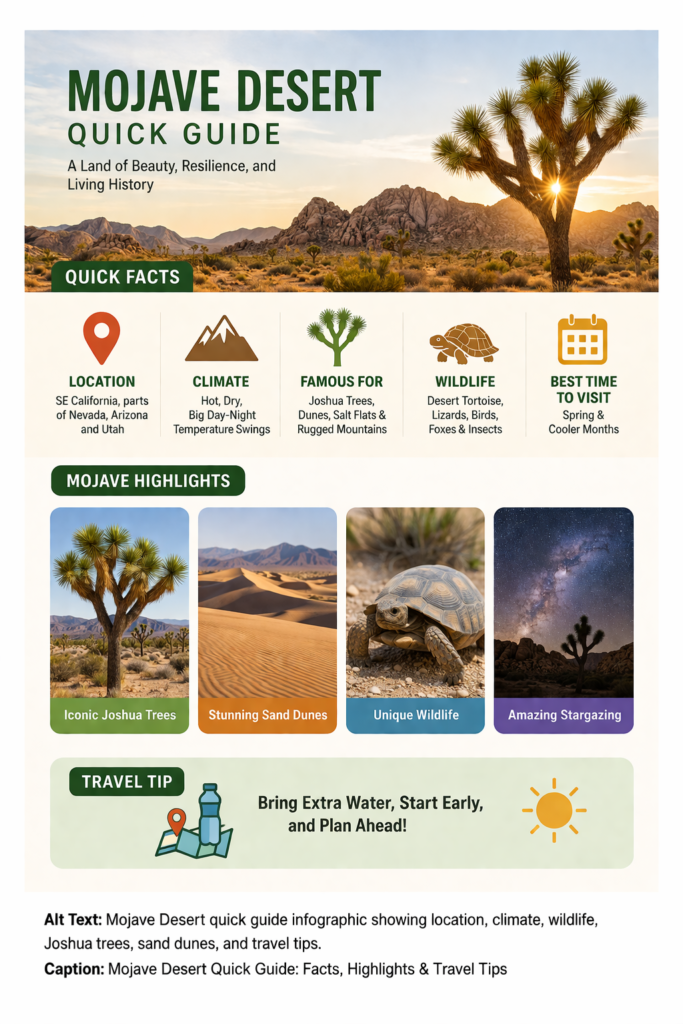
Quick Facts About the Mojave Desert
| Topic | Key Fact |
| Location | Southeastern California and parts of Nevada, Arizona, and Utah |
| Type | Arid desert with mountain-and-basin landforms |
| Known for | Joshua trees, dunes, salt flats, dry lake beds, and rugged mountains |
| Climate | Hot, dry, and extreme, with major day-night temperature shifts |
| Wildlife | Desert tortoise, lizards, birds, mammals, reptiles, and insects |
| Human history | Around 10,000 years of human connection |
| Best travel season | Spring and cooler months |
What Is the Mojave Desert?
The Mojave Desert is a large desert region in the southwestern United States. Famous for its dry atmosphere, dramatic scenery, unique geology, and specially adapted plant and animal life, the Mojave Desert is far more than a simple flat plain. Rather than being uniform, this region forms a layered and diverse landscape of mountains, basins, washes, ridges, and valleys that stretch endlessly into the horizon. Its ever-changing terrain creates a visually striking environment, where each area offers a different perspective of the desert’s depth and character.
Many people think a desert is lifeless, colorless, or unchanging. The Mojave proves the opposite. It is a living environment where survival depends on adaptation, timing, patience, and resilience. Plants here store water or limit their water loss. Animals adjust their activity to nighttime or cooler hours. People have used the desert for trade, travel, settlement, exploration, and survival for thousands of years.
The Mojave is also a place of contrast. One area may feel like a scorching open basin. Another may be cooler because of the elevation. One place may be covered with dunes, while another may hold rocky slopes, Joshua tree forests, or volcanic terrain. This diversity makes the Mojave Desert visually stunning, ecologically important, and unforgettable to visitors.
Mojave Desert Location and Geography
Where Is the Mojave Desert?
The Mojave Desert is located mostly in southeastern California, but it also extends into Nevada, Arizona, and Utah. It belongs to the broader family of North American deserts, alongside the Sonoran, Chihuahuan, and Great Basin deserts. Even though it is part of this larger desert system, the Mojave has a distinct identity shaped by its elevation, plant life, and signature landforms.
This desert occupies a wide area made up of dry basins, mountainous uplands, salt flats, dry lake beds, desert washes, and remote open spaces. Because the topography shifts from one zone to another, the Mojave is often described as a mountain-and-basin desert. That means the landscape is not uniform; it changes continuously, Sometimes within just a few miles.
Why Geography Matters
The geography of the Mojave Desert controls almost everything that happens there. It influences how water moves, where plants can survive, which animals can thrive, and how people can travel through the region. Even the look and feel of the desert depend on geography.
The Mojave contains many different micro-landscapes, including:
- Mountain slopes
- Dry lake beds
- Salt flats
- Dune fields
- Rocky ridges
- Wash corridors
- Riparian pockets near springs or seasonal streams
Each of these areas creates a different ecological niche. That is why the desert can support such a surprising range of life. A mountain slope might offer cooler conditions and more shade, while a dry basin may hold rare minerals or temporary water after rain. In the Mojave, terrain is not just scenery; it is a survival structure.
Water in the Desert
Water is scarce in the Mojave Desert, which makes it one of the most critical resources in the entire region. Some waterways exist only briefly after storms. Others disappear into the ground or flow underground for long distances. Springs, seeps, and seasonal channels become lifelines for wildlife and for human travel.
Historically, water determined where people could camp, trade, rest, or build routes across the desert. Even today, water remains the foundation of desert ecology. Where water appears, life concentrates. Birds gather, insects multiply, plants bloom, and larger animals move in to drink. A single source of water can support a whole chain of life in an otherwise dry environment.
Mojave Desert Climate and Weather
A Hot, Dry Desert Climate
The Mojave Desert is widely known for its heat, intense sunlight, and dry air. Yet its climate is more nuanced than the stereotype of “hot all the time.” Temperature, wind, rainfall, and seasonal changes all vary depending on elevation and location.
Lower elevations often experience extreme summer heat, while higher elevation areas can feel noticeably cooler, especially in winter. This means that within the same desert region, conditions may feel completely different from one valley to another. That variety is one reason the Mojave is so ecologically rich.
Temperature Swings
One of the defining features of the Mojave Desert is the dramatic difference between daytime and nighttime temperatures. During the day, the sun can create intense heat and harsh glare. After sunset, the air can cool quickly, sometimes sharply. This rapid shift is a major factor in how plants and animals survive.
For visitors, this means preparation is essential. A traveler may feel comfortable in the afternoon and then need layers after dark. Desert clothing, water, and timing matter far more here than in milder environments.
Rainfall
Rainfall in the Mojave Desert is limited, and in many areas it is extremely low. Some places receive only a small amount of precipitation each year. Higher areas may get somewhat more moisture, but the region remains fundamentally arid.
Even so, rain is incredibly important. A brief storm can trigger:
- Wildflower blooms
- Bursts of insect activity
- Animal movement
- Temporary water flow in washes
- Rapid changes in the appearance of the landscape
After rain, the desert can briefly transform. Bare soil may show color. Flowers may appear suddenly. Wildlife may become more active. Then, as the water evaporates or sinks away, the land returns to its dry state. That cycle of brief abundance followed by long dryness is central to desert life.
Weather and Travel
The weather in the Mojave Desert can be hazardous for anyone unprepared. Heat exposure, strong sunlight, remote roads, and limited services create real risk. Even a minor vehicle issue can become serious if help is far away or water is insufficient.
That is why desert travel should never be casual. Careful planning, route awareness, fuel checks, and water reserves are not optional. They are basic survival measures.
Landscape Features of the Mojave Desert
The Mojave Desert is famous not only for its climate but also for its visual diversity. It is a landscape of shape, shadow, color, and contrast. Every part of it seems to tell a different geological story.
1. Mountain Ranges
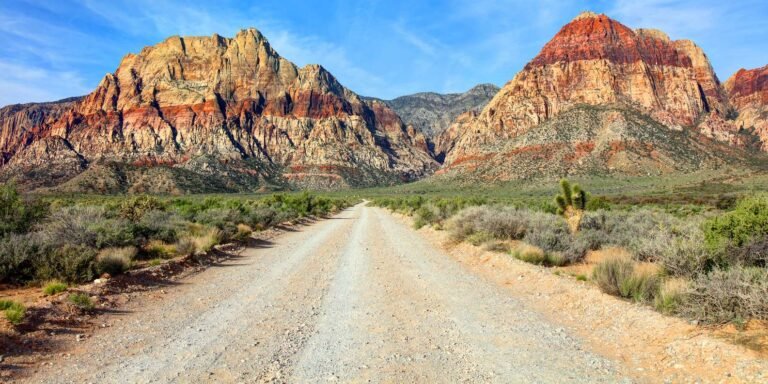
The desert contains rugged mountain chains that rise suddenly from lower basins. These mountains create dramatic silhouettes, cooler elevations, and isolated habitats. They also form important drainage patterns and influence local weather.
2. Sand Dunes
Some areas of the Mojave Desert contain sweeping dune fields that resemble golden waves. These dunes are beautiful, but they are also delicate. Wind constantly reshapes them, and very small disturbances can affect their stability.
3. Salt Flats and Dry Lake Beds
Certain parts of the Mojave are covered in flat, pale, salty surfaces that reflect light in striking ways. These are remnants of ancient water bodies that have evaporated over time. They may look stark, but they are geologically meaningful and often visually unforgettable.
4. Volcanic Features
The Mojave Desert also includes lava tubes, volcanic cones, and other ancient igneous formations. These features reveal that the region is not just old, but also geologically active in the long view of Earth’s history.
5. Joshua Tree Forests
The Joshua tree is one of the desert’s most iconic sights. These sculptural, branching plants give the Mojave a distinctive identity. They are widely associated with the region’s beauty and ecological character.
6. Rocky Valleys and Washes
Wide valleys and dry washes cut across the landscape and guide water during rare storms. These channels are essential for the movement of sediment, water, and ecological nutrients. They also serve as pathways for many animals.
Mojave Desert Quick Landscape Comparison
| Landscape Type | What It Looks Like | Why It Matters |
| Mountains | Steep, rocky, high ground | Creates elevation change and habitat variety |
| Dunes | Rolling sand hills | Support unique plants and travel challenges |
| Salt flats | White, flat, open areas | Show how water evaporates in dry basins |
| Dry lake beds | Hard, open lake floors | Important geological features |
| Washes | Dry river channels | Move water during storms |
| Joshua tree forests | Tree-dotted desert land | One of the desert’s most famous ecosystems |
Flora: Plants of the Mojave Desert
The plant life of the Mojave Desert is among the most resilient vegetation on the continent. These plants survive intense sunlight, minimal rainfall, poor soil, temperature extremes, and long dry periods. Their success depends on adaptation, efficiency, and long-term endurance.
The Famous Joshua Tree
The Joshua tree is the most iconic plant in the Mojave Desert. It is tall, unusual, and instantly recognizable. Its shape looks almost artistic, which is one reason travelers and photographers are drawn to it. Beyond its symbolic value, it is also important to the ecosystem, providing structure and habitat support in the desert environment.
Creosote Bush
The creosote bush is one of the most common and enduring shrubs in the Mojave. It is highly drought-tolerant and can spread across vast areas. Its hardiness makes it one of the core species of the desert’s plant community.
Other Mojave Plants
The Mojave Desert also supports a wide variety of other plants, including:
- Cacti
- Burroweed
- Desert grasses
- Small shrubs
- Seasonal wildflowers
- Native riparian plants near springs or streams
These plants may appear modest, but they are ecologically powerful. Some bloom quickly after rain. Others stay alive for long periods with minimal water. Many species maintain low profiles to reduce water loss and heat stress.
How Desert Plants Survive
Desert plants use a range of survival strategies. They may:
- Store water in tissues
- Reduce leaf size or lose leaves entirely
- Grow deep root systems
- Grow slowly to conserve energy
- Open and close pores carefully to limit moisture loss
These adaptations allow them to endure where less specialized plants would fail. In the Mojave, survival is not based on strength alone; it is based on efficiency.
Why Plants Matter
Plants are vital to the Mojave Desert ecosystem. They:
- Stabilize the soil
- Provide shelter for animals
- Feed insects and herbivores
- Reduce erosion
- Support biodiversity
Without vegetation, the desert would be far more vulnerable. Plant communities help hold the entire system together.
Fauna: Wildlife of the Mojave Desert
The Mojave Desert may look still and silent, but it supports a wide range of animals. Many species are nocturnal, crepuscular, or highly secretive, which means they avoid the hottest hours of the day. As a result, much of the desert’s wildlife remains hidden unless you know when and where to look.
The Desert Tortoise
The desert tortoise is one of the best-known animals in the Mojave Desert. It spends much of its life in burrows and emerges when environmental conditions are favorable. Because it is adapted to such a challenging habitat, it has become an important symbol of desert conservation.
Birds
Birdlife in the Mojave includes raptors, small songbirds, and species specially adapted to desert conditions. Birds often move according to food availability, temperature, and water access. Some hunt from the air, while others forage on the ground or among shrubs.
Reptiles
The desert is home to many reptiles, including:
- Lizards
- Snakes
- Tortoises
- Other sun-loving species
Reptiles do well in hot, dry environments because their physiology is suited to warmth and because they can conserve water more efficiently than many mammals.
Mammals
The Mojave also supports a variety of mammals, such as:
- Foxes
- Bighorn sheep
- Rabbits
- Coyotes
- Small nocturnal mammals
Many of these animals stay active at dawn, dusk, or nighttime to avoid severe heat. Their activity patterns are built around survival.
Insects and Arachnids
Even the smallest creatures play major roles. The Mojave contains:
- Beetles
- Ants
- Scorpions
- Spiders
- Other insects
These organisms recycle nutrients, pollinate plants, break down organic matter, and support larger food chains. In a desert ecosystem, tiny species can be just as important as the visible animals.
Mojave Desert Wildlife Table
| Animal Group | Examples | Main Survival Strategy |
| Mammals | Coyotes, foxes, rabbits | Night activity and burrows |
| Birds | Hawks, owls, and small desert birds | Mobility and timing |
| Reptiles | Lizards, snakes, tortoises | Heat resistance and shelter |
| Insects | Beetles, ants | Small size and hiding |
| Arachnids | Spiders, scorpions | Nocturnal behavior |
How Animals Survive in the Mojave Desert
Animals in the Mojave survive by avoiding the most extreme heat and making intelligent use of scarce resources. They may:
- Rest in underground burrows
- Hunt or forage at night
- Move during cooler hours
- Conserve water
- Eat seasonal food sources
- Use rocks, shade, and terrain for protection
This makes the Mojave Desert a fascinating study in adaptation. Life here is difficult, but it is also remarkably inventive.
Human History in the Mojave Desert
The Mojave Desert has a rich and layered human past. It is not only a place of geology and biology; it is also a landscape of movement, settlement, travel, trade, and memory.
Early Human Life
People have lived in and traveled through the Mojave Desert for thousands of years. Native communities developed extensive knowledge of the region, including water sources, edible plants, animal behavior, and seasonal routes. They did not see the desert as empty. They understood it as a homeland, a pathway, and a living environment.
Trade Routes
The desert contained important trade corridors that linked water sources, communities, and distant regions. These routes allowed people to exchange goods, traditions, and ideas long before modern highways existed. The desert was not a barrier alone; it was also a connector.
Later Expansion and Travel
As settlement and expansion increased, the Mojave became important for mail delivery, military movement, mining, homesteading, and rail travel. Roads and rail lines changed how people crossed the region, bringing both opportunity and disruption.
Mining and Industry
The Mojave Desert has long been associated with mineral extraction. Mining brought settlement, labor, infrastructure, and economic activity, but it also brought environmental pressure and landscape disturbance. In many places, mining history is still visible in the land.
Why History Matters
The history of the Mojave Desert shows that this region has always required adaptation. It has never been a dead zone. It has been a place where people, cultures, and economies responded to challenge with creativity and persistence.
Mojave Desert History Timeline
| Period | What Happened |
| Ancient times | Native people lived, traveled, and traded across the region |
| Pre-modern era | Trails connected water sources and communities |
| 1800s | Exploration, mail routes, and expansion increased |
| Railroad era | New transport routes reduced some of the older desert roads |
| Modern era | Conservation, recreation, research, and tourism became more important |
Travel Guide to the Mojave Desert
The Mojave Desert is a favorite destination for people who enjoy nature, photography, hiking, camping, geology, and open space. However, it is not a place to approach casually. Its beauty is matched by its harshness, and that combination demands awareness.
Best Things to Do
You can experience the Mojave Desert through:
- Hiking
- Camping
- Wildlife viewing
- Photography
- Birding
- Backpacking
- Scenic drives
- Stargazing
- Off-road exploration in approved areas
Famous Places to Visit
Some of the best-known places in the Mojave Desert include:
- Kelso Dunes
- Lava Tube
- Teutonia Peak
- Joshua tree forests
- Historic roadside stops
- Open wilderness trails
These destinations show different dimensions of the desert: geological, botanical, historical, and scenic. Some are ideal for quiet reflection; others are better for exploration and learning.
Why People Visit
Visitors come to the Mojave Desert for many reasons:
- Silence
- Beauty
- Adventure
- Solitude
- Learning
- Landscape photography
- Cultural history
The desert rewards patience. It is not a destination for rushed sightseeing. It is a place best experienced slowly, attentively, and respectfully.
Travel Tips for the Mojave Desert
A desert trip can be memorable and safe if it is planned properly. Preparation is not just helpful here; it is necessary.
1. Bring More Water Than You Think You Need
Water is the most important item in the desert. Always bring extra.
2. Start Early
Early morning is usually the best time for walking, driving, and exploring. The heat is lower, and the light is often better for photography.
3. Check Road Conditions
Some roads are rough, remote, or suitable only for high-clearance vehicles. Conditions can change quickly after storms or maintenance.
4. Carry Navigation Tools
Never rely only on cell service. Bring offline maps, a charged phone, and a backup navigation method.
5. Protect Yourself from Heat
Use sunscreen, a hat, sunglasses, shade, and breathable clothing. Heat exhaustion can happen quickly.
6. Respect Wildlife and Plants
Stay on trails, avoid picking plants, and keep a safe distance from animals. The desert ecosystem is fragile.
7. Plan for Fuel
Fuel stations may be far apart in remote areas. Fill up before entering isolated routes.
Mojave Desert Travel Tips Table
| Travel Need | Best Practice |
| Water | Carry extra water for each person |
| Heat | Travel early and avoid midday exposure |
| Roads | Check current road conditions before departure |
| Navigation | Use offline maps and backup tools |
| Fuel | Fill up before remote driving |
| Safety | Stay on marked routes |
| Wildlife | Observe from a distance |
Pros and Cons
Pros
The Mojave Desert offers beautiful and unusual landscapes, strong wildlife and plant diversity, excellent photography opportunities, a deep sense of history, and some of the best stargazing and quiet travel experiences in the region.
Cons
The desert also brings extreme heat, limited services in remote areas, dangerous conditions for unprepared visitors, and fragile ecosystems that can be easily damaged. Some routes also require special vehicles or extra caution.
Interesting Facts About the Mojave Desert
Here are several fascinating facts about the Mojave Desert:
- It is often described as the smallest and driest of the four major North American deserts.
- It features basin-and-range topography, meaning mountains and valleys repeat across the land.
- It contains important mineral resources, including silver, gold, tungsten, iron, and salt-related deposits.
- Some creosote plants may rank among the oldest living organisms on Earth.
- It is not empty at all; it is full of birds, reptiles, mammals, insects, and plants.
- It has a strong conservation legacy focused on tortoises, native plants, and wetland habitats.
These facts show that the Mojave is both scientifically important and emotionally powerful. It is a place where natural systems and human understanding meet.
Conservation and Environmental Issues in the Mojave Desert
The Mojave Desert may look tough and timeless, but it is actually very fragile in many ways. Desert ecosystems can recover slowly, and some damage may last for years or decades.
Main Threats
The desert faces pressure from:
- Habitat loss
- Road construction
- Off-road damage
- Invasive species
- Wildfire
- Climate stress
- Recreation pressure
- Soil disturbance
Why the Desert Is Fragile
Desert soil is often delicate and slow to regenerate. Many plants grow slowly. Some animals depend on very specific shelter. If the system is disturbed, restoration can take a long time.
Why Roads Matter
Roads can fragment habitat, interrupt animal movement, increase mortality, and open the door to further development or degradation. Even when roads appear harmless, their ecological impact can be significant.
Fire and Restoration
Fire is especially destructive in desert environments. Once native plant communities burn, recovery may be slow and incomplete. Invasive species can worsen the problem by altering fire cycles.
Conservation Efforts
Protecting the Mojave Desert means protecting:
- Native plants
- Rare animals
- Water sources
- Trail systems
- Wildlife corridors
- Fragile soil crusts
The future of the desert depends on stewardship, science, public awareness, and responsible recreation.
Why the Mojave Desert Matters Today
The Mojave Desert matters for many reasons, and its relevance is not limited to tourism or scenery.
1. It Is a Natural Treasure
Its landscapes are rare, dramatic, and visually unforgettable.
2. It Is a Scientific Resource
Researchers study its climate, geology, plants, animals, and ecological processes to understand broader natural patterns.
3. It Is a Cultural Landscape
The desert holds deep Native history, travel history, and stories of survival and adaptation.
4. It Is a Conservation Priority
Many habitats and species require active protection and careful management.
5. It Inspires Travelers
People come to the Mojave for openness, silence, inspiration, and awe.
The Mojave Desert is not simply land. It is a meaningful place shaped by nature and history alike.
FAQs
The Mojave Desert is known for its Joshua trees, mountain-and-basin geography, dry lake beds, salt flats, and strong temperature swings. It also has a distinctive combination of wildlife, vegetation, and human history.
No. The Mojave Desert has many plants, birds, reptiles, mammals, insects, and rare habitats. It only appears empty when viewed from far away.
Spring and cooler months are usually the best. Summer can be extremely hot and difficult for travel, especially in remote areas.
The desert is home to desert tortoises, birds, lizards, snakes, foxes, coyotes, rabbits, bighorn sheep, and many insects.
Because the desert has fragile soils, slow-growing plants, vulnerable wildlife, and increasing pressure from roads, development, fire, and recreation.
The most famous plants are the Joshua tree and creosote bush, along with cacti, shrubs, and seasonal wildflowers.
Carry extra water, fuel, maps, sun protection, food, and a backup navigation method. Some areas are remote and have limited services.
Conclusion
The Mojave Desert is more than a dry landscape. It is a place of beauty, resilience, and rich ecological and cultural value. From its dramatic scenery to its fragile ecosystems, the Mojave deserves both Exploration and protection.