
Introduction
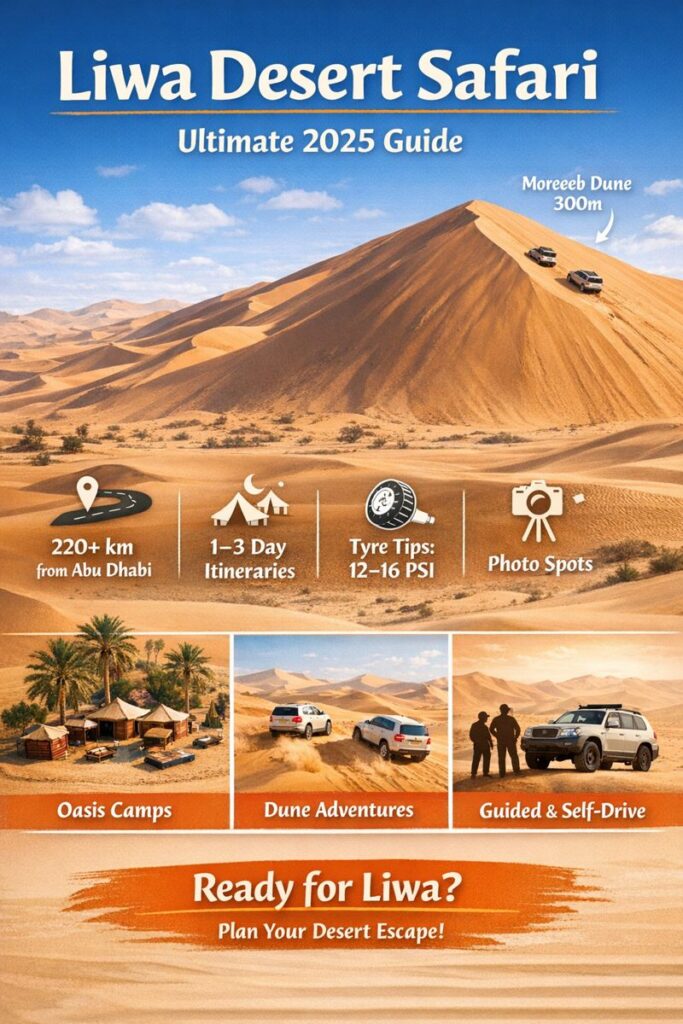
The Liwa Oasis sits on the northeastern rim of the immense Rubʿ al-Khali — the Empty Quarter — and it offers an experience that’s qualitatively different from the short, city-edge safaris sold in Abu Dhabi And Dubai. If you’re leaving the city for a genuine desert escape, Liwa offers scale, solitude, and monumental dunes — including the famous Moreeb Dune, a magnet for motorsports and creatives. This long-form guide is designed to be the only Liwa resource you need: step-by-step driving notes, reproducible 1–3 day itineraries, clear self-drive tyre and recovery guidance, where to sleep (from basic communal camps to private glamping), 2025 price brackets, photographic technique, environmental pointers, and a thorough FAQ in English. Read on to plan a secure, memorable Liwa adventure.
- Location & geography — big picture, precise notes
- Landscape features — what you’ll actually see
- Climate & weather patterns — planning with confidence
- Quick operational notes:
- Flora & fauna — modest but special
- Human history & culture
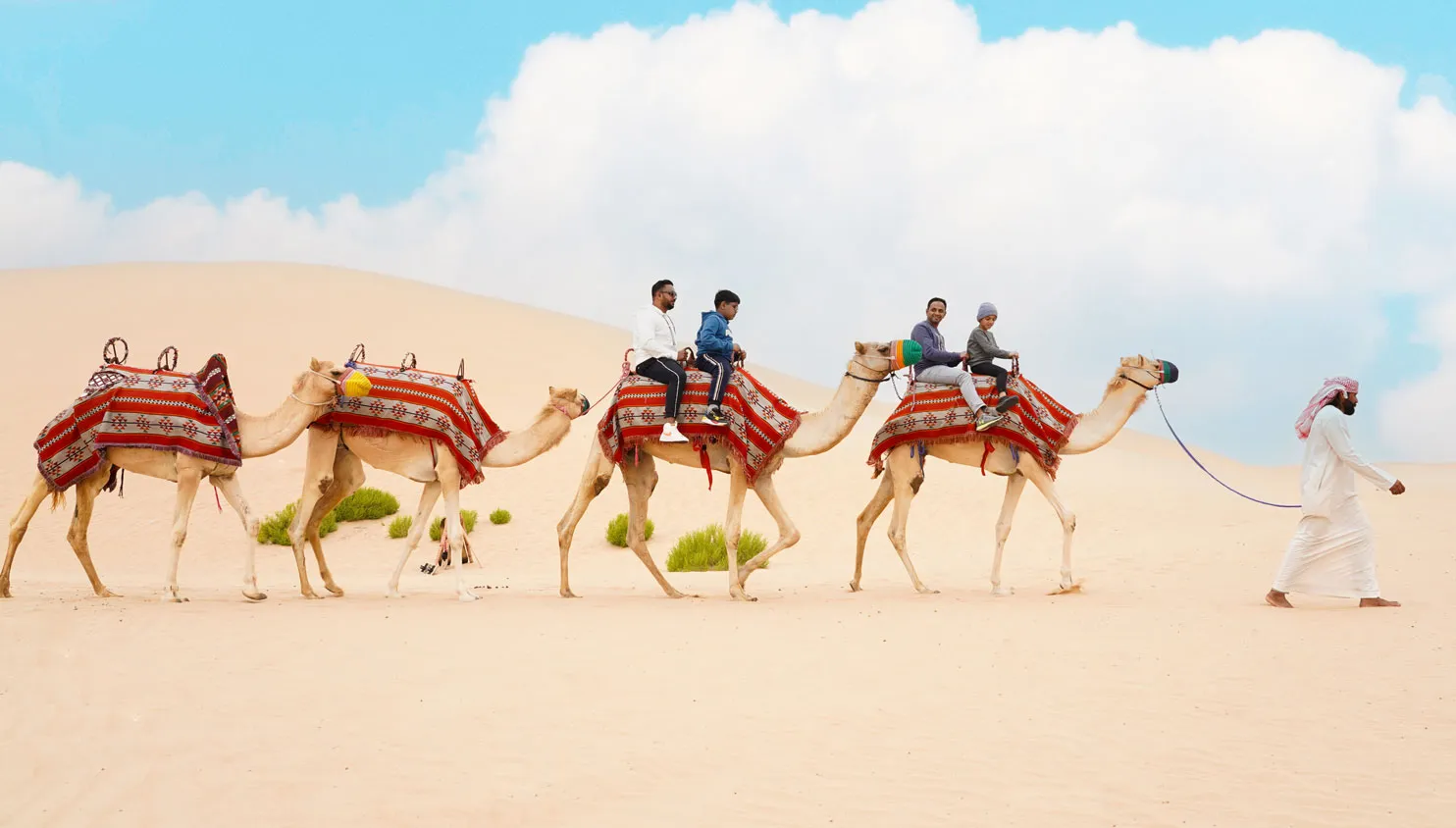
- Tour styles — how people experience Liwa
- Sample itineraries & practical pricing
- Sample 1-day — Liwa Express
- Sample 2-day — Overnight camp
- Sample 3-day — Liwa Explorer
- Indicative pricing guide (2025 — approximate)
- Self-drive vs guided — a quick comparison
- Practical safety & survival checklist
- Where to stay — camps, lodges & glamping
- Environmental issues & responsible travel — how to leave no trace
- FAQs
- Final verdict
Location & geography — big picture, precise notes
Liwa Oasis occupies the northeastern rim of the Rubʿ al-Khali, the largest continuous sand sea on Earth. The human footprint is concentrated in linear oasis clusters — date farms and small villages fed by groundwater — while beyond them the dunes run like a slow ocean. Most visitor activity centres on the Tal Moreeb / Moreeb Dune area, which sits near Liwa settlement and is visible from the access road. For practical routing, the trip from Abu Dhabi is almost entirely highway until the final stretch, where you follow local service roads and sand tracks to camps or dune parking. Expect two common approaches from Abu Dhabi: the E65/E11 feeder route (faster but with longer highway sections), or a slightly southerly route that places you nearer the Al Dhafra festival zone.
Why Liwa feels different: scale, texture, and horizon. Dunes here are large — long crests, deep slipfaces and interdunal corridors that make night sky photography and extended exploration far more rewarding than the city fringe dunes. The geological variety includes sabkha (salt pans), interdunal corridors, and the sculpted star and crescent dunes that give Liwa its cinematic look.
Landscape features — what you’ll actually see
Expect to encounter:
- Star & crescent dunes: big, complex forms with long slipfaces and multiple wind directions sculpting the sand. These are great when the sun grazes the ridges.
- Moreeb Dune: the marquee dune — steep, enormous, and often used for hill-climb events; it’s a landmark both for motorsport fans and photographers.
- Oasis pockets: clusters of date palms and irrigated farms — human green dots that provide scale and cultural interest.
- Sabkha and salt pans: shimmering white flats that contrast with warm sand tones and are useful for low-angle wide shots.
- Interdunal corridors: flatter pathways between dunes that are safer to walk and set up camp, often where the majority of camps are located.
The point of Liwa is the scale: dunes that run to the horizon, wind-formed textures that reveal direction and time of day, and light that sculpts edges in a way smaller dunes rarely do.
Climate & weather patterns — planning with confidence
When to go: the window October–March is the sweet spot. Days are comfortable (typically 20–30°C) and nights can be sharp, often dropping toward 10°C or lower — ideal for stargazing. Summer months — April through September — are extremely hot and not recommended for daytime activity beyond very early mornings or late evenings. Desert winds increase risk: afternoon gusts can whip up sand and rapidly alter dune faces, so aim for calm mornings for stable, repeatable shooting and safer driving.
Quick operational notes:
- Golden hours (sunrise/sunset) are the key sessions for photographers; arrive early to scout ridgelines.
- Afternoon winds: if a forecast shows gusts or dust, postpone sensitive activities like drone flights or long exposures.
- Check local weather and event notices before travel — festivals or motorsport events can change access and rules.
(For example, winter festivals increase local traffic and may close specific dunes for events or safety.)
Flora & fauna — modest but special
Vegetation is sparse and highly adapted: date palms around oases, low shrubs near sabkhas, and short ephemeral grasses that appear after rain. These plants help stabilise dune bases in places and are a tangible sign of human adaptation (date farming) in an otherwise stark landscape.
Animal life is similarly desert-adapted: larks and sandgrouse are common birds, small reptiles (geckos), and a scattering of rodents and nocturnal foxes. Larger mammals are rare. Insects and arachnids exist — scorpions and beetles are part of the nocturnal fauna, so exercise caution at night (don’t put your hands under rocks or in crevices).
Conservation note: Avoid trampling fragile plants and microhabitats; driving off established tracks causes erosion and damages the slow processes that build and hold dunes.
Human history & culture
Liwa’s settlements and date farms are historically Important: oasis life enabled tribal settlement, trade routes and the cultivation of date palms — a staple of Emirati culture. Over time, motorised sport and festivals have been layered on top of that heritage, so you’ll encounter both Bedouin traditions and modern event infrastructure. Respect local customs: many camps are family spaces, and certain festival events are culturally specific.
Tour styles — how people experience Liwa
There are four common ways to take in Liwa; each has tradeoffs:
A. Day trip (express / long day)
A fast, high-energy option: depart early from Abu Dhabi, a short dune run, Moreeb stop and return the same day. Efficient but long — suitable if your calendar is tight.
B. Overnight (1–2 nights — recommended for most first-timers)
Arrive late afternoon, sunset dune drive, camp dinner and sunrise shoot the next day. This gives two golden hours and a restful night; good for families and photographers wanting manageable logistics.
C. Multi-day / explorer (3+ days)
For photographers and off-roaders who want remote routes, multiple shoot windows and time to learn dunes — includes night navigation practice and deeper loops.
D. Self-drive (experienced 4×4 drivers only)
Maximum flexibility with maximum risk. Requires a full recovery kit, a buddy vehicle (strongly advised), local route knowledge or supervised training. Many operators offer supervised self-drive packages that teach sand technique.
Recommendation: If you’ve never driven dunes, choose a guided or supervised self-drive session. If you’re an experienced off-roader, travel with a buddy vehicle and consider satellite comms for remote segments.
Sample itineraries & practical pricing
Below are plug-and-play itineraries you can publish or hand to clients. Timings assume hotel pickup in central Abu Dhabi and are approximate.
Sample 1-day — Liwa Express
05:30 — Pickup from Abu Dhabi (hotel)
09:30 — Arrive Liwa dune area — orientation and safety briefing
10:00–13:00 — Dune bashing, sandboarding, short photo stops
13:00 — Lunch (picnic or café near oasis)
14:30 — Moreeb Dune photo stop — explore ridges
16:30 — Depart for Abu Dhabi
~20:30 — Arrival back in Abu Dhabi
Notes: Long day. Good for travellers who can handle extended driving and moderate dune activity. If a festival is on, plan for extra transit time.
Sample 2-day — Overnight camp
Day 1: Pickup → afternoon dune drive → sunset viewpoint → camp dinner & cultural performance.
Day 2: Sunrise photos → palm grove/camel farm visit → return to Abu Dhabi by late afternoon.
Why it works: Two golden hours and a relaxed night — ideal for families and first-timers.
Sample 3-day — Liwa Explorer
1: Transfer & introductory dunes, camp and orientation.
2: Supervised self-drive teaching, deeper dune loops, and night navigation use.
3: Sunrise shoot, backcountry loop, and come back to the main road.
Why it works: Time to practice techniques, scout the place, and capture multiple light windows.
Indicative pricing guide (2025 — approximate)
- Shared day tour (group): AED 250–450 (~$68–$122) — transport, short dune drive, snacks.
- Private day tour: AED 900–1,600 (~$245–$435) — dedicated vehicle, meals, guide.
- Overnight basic camp (per person): AED 350–700 (~$95–$190) — shared tent, dinner, breakfast.
- Glamping/luxury camp (per person): AED 900–2,000+ (~$245–$545) — private tent, ensuite options.
- Supervised self-drive/private 4×4: AED 1,200–2,500+ (~$325–$680) — includes training and recovery gear.
Tip: Festival dates and peak weekends sell out quickly; book well in advance and confirm cancellation plan.
Self-drive vs guided — a quick comparison
| Factor | Guided tour | Self-drive (experienced) |
| Safety & recovery gear | Provided | You must supply or rent |
| Navigation | Guide handles it | Requires GPS + local maps |
| Flexibility | Moderate | High |
| Cost | Moderate | Often higher (vehicle hire + gear) |
| Learning curve | Low | High — needs training |
| Best for | First-timers, families | Experienced 4×4 drivers, photographers wanting control |
Verdict: For novices and families, guided or supervised packages are the best route. For experienced off-roaders, self-driving offers freedom but demands planning and a buddy vehicle
Practical safety & survival checklist
Before you go
- Check weather and sandstorm warnings using a reliable local forecast.
- Book camps/operators with clear safety policies and verified reviews.
- Service your vehicle (suspension, fluids, battery).
- Pack at least 3–4 L of water per person per day, sun protection, a hat, sunglasses and a basic first-aid kit.
- For self-drive: carry a recovery kit (tow straps, rated shackles, hi-lift jack, shovel, traction boards), a quality air compressor, spare tyres, and a winch if possible.
- Carry a tyre gauge and a plan to reinflate before tarmac.
Tyre management
- Lower tyres to around 12–16 PSI as a starting point for soft sand; exact figures depend on tyre size and machine weight. Keep a portable compressor and reinflate before the main road.
During the trip
- Never travel alone in remote dunes — always have at least one other machine.
- Wear seatbelts and ensure babies are securely fastened.
- Maintain comms: local SIMs may be patchy; consider satellite or PLB for remote sections.
- Respect closures and avoid restricted areas during events.
If you get stuck
- Stop, don’t rev. Reduce tyre pressure further if necessary, dig sand away from wheels, use traction aids and await a tow from a buddy vehicle. Avoid high-speed or solo recoveries.
Where to stay — camps, lodges & glamping
Accommodation choices in and around Liwa range widely. Here’s a field-guide you can use when selecting lodgings for clients or visitors.
Basic desert camps
Traditional tents with shared facilities — authentic and budget-friendly. Good for travellers who want an immersive experience.
Comfort camps / mid-range glamping
Private tents or cabins with mattresses, electricity and sometimes shared bathrooms. Best for couples and small families wanting comfort without full luxury.
Luxury glamping
Personal tents with ensuite bathrooms, air con, dedicated staff and curated episode (private dunes, photography guides, gourmet meals). These are priced at the premium end but offer benefits.
Nearby lodges & guesthouses
For visitors who prefer hotel-style amenities, several lodges sit within drivable distance of the dunes; they are useful in summer months or for those who prefer predictable services.
Booking tips
- For festivals or long weekends, reserve early.
- Confirm whether transfers are included and whether the site provides shaded day areas.
- Check sustainability and waste management policies when booking — choose operators who follow low-impact practices.
Environmental issues & responsible travel — how to leave no trace
Dunes and sabkhas are fragile. Repeated vehicle tracks reshape dunes and accelerate erosion; trampling vegetation crushes slow-growing plants and harms microhabitats. Responsible travel practices protect Liwa’s delicate balance:
- Stay on established tracks and only drive in designated areas.
- Choose operators who limit group sizes and practice waste-management.
- Pack out all non-organic waste and avoid any food scraps.
- Avoid touching or unclicking plant material, archaeological features or cultural objects.
Selecting operators with a clear sustainability announcement and local hiring practices helps ensure tourism supports long-term stewardship.
FAQs
A: Roughly 220–250 km depending on route; typical driving time is 3–4 hours, depending on stops and exact Liwa destination.
A: Technically possible, but only recommended if you have 4×4 desert experience and carry recovery gear — or book a supervised self-drive course with a reputable operator. For first-timers, guided tours are safer.
A: October–March for pleasant temperatures and excellent sunrise/sunset windows. Local festivals and events typically occur in the winter months.
A: Yes — Moreeb is a major attraction and generally accessible. During festivals and motorsport events, the area may have event infrastructure and temporary closures; follow signage and local rules. Moreeb has been reported at roughly 300 metres and is one of the UAE’s highest dunes.
A: For many SUVs, 12–16 PSI is a common starting point for soft sand; some drivers use ~15–18 PSI depending on vehicle and load. Always carry a compressor and reinflate before driving on asphalt.
Final verdict
Liwa Desert Safari and Moreeb Dune represent one of the UAE’s most striking outdoor experiences: raw landscapes, enormous dunes and night skies that far outshine city-edge safaris. For photographers and travellers seeking scale and solitude, Liwa delivers. Choose guided overnight trips for convenience and safety; opt for supervised self-drive only if you have basic desert pilot skills and healing equipment. Prioritise low-impact travel and select operators who demonstrate sustainable operation.