
Introduction
The Mojave Desert is one of the most diverse desert landscapes in North America. Spanning parts of California, Nevada, Arizona, and Utah, it features dunes, mountains, Joshua trees, and striking geological formations. This guide gives a clear overview of its map, climate, wildlife, and top places to visit.
- What Is the Mojave Desert?
- Why the Mojave Desert is so unique
- Mojave Desert Map and Location
- Major places in and around the Mojave Desert
- Why the map matters for travelers
- Climate and Weather in the Mojave Desert
- Temperature swings
- Rainfall in the Mojave Desert
- Seasonal weather patterns
- Best weather for visiting
- What weather teaches us about the desert
- Landscape and Geography of the Mojave Desert
- Major landforms in the Mojave Desert
- Elevation changes shape everything.
- Why does the scenery feel so dramatic
- Famous Natural Features in the Mojave Desert
- Kelso Dunes
- Lava Tube and lava fields
- Salt flats and basins
- Mountains and canyons
- Plants of the Mojave Desert
- The Joshua tree
- Other important plants
- How desert plants survive
- Wildflowers in the Mojave Desert
- Why the plant section matters
- Wildlife in the Mojave Desert
- Desert tortoise
- Reptiles
- Birds
- Mammals
- Insects and pollinators
- Why wildlife matters in the desert
- Human History of the Mojave Desert
- Native history
- Mining and ranching history
- Railroads and transport routes
- Historic roads
- Why the human story matters
- Mojave National Preserve
- What makes the preserve special
- Why visitors like it
- Important visitor note
- Best stops in the preserve
- Best Places to Visit in the Mojave Desert
- 1. Mojave National Preserve
- 2. Joshua Tree National Park
- 3. Death Valley National Park
- 4. Lake Mead National Recreation Area
- 5. Barstow, Mojave, and nearby desert towns
- Things to Do in the Mojave Desert
- Scenic driving
- Hiking
- Stargazing
- Photography
- Wildlife viewing
- Learning about geology
- Travel Tips for the Mojave Desert
- Bring enough water
- Check your route before leaving.
- Fill up on gas early.
- Carry a paper map
- Dress for the condition.s
- Leave early if hiking.g
- Tell someone your route.e
- Safety Tips for Visiting the Mojave Desert
- Heat safety
- Cold weather safety
- Road safety
- Navigation safety
- Wildlife safety
- Emergency planning
- Best Time to Visit the Mojave Desert
- Spring
- Fall
- Summer
- Winter
- Best season by travel goal
- Mojave Desert vs Nearby Desert Destinations
- Mojave Desert vs Joshua Tree
- Mojave Desert vs Death Valley
- Mojave Desert vs Great Basin Desert
- Mojave Desert vs Sonoran Desert
- Pros and Cons
- Pros
- Cons
- Interesting Facts About the Mojave Desert
- Environmental Issues and Conservation
- Habitat loss
- Climate stress
- Road impacts
- Fire risk
- Tortoise protection
- Why conservation matters
- Why the Mojave Desert Is Important
- Mojave Desert Quick Travel Table
- FAQs
- Conclusion
What Is the Mojave Desert?
The Mojave Desert is a dry region in the southwestern United States. It is often called a high desert because many of its areas sit at elevations higher than people expect from a desert environment. That elevation matters because it changes temperature, vegetation, and even the feel of the land. The desert is not uniform. Some places are lower, hotter, and more exposed, while others are higher, cooler, and more varied in plant life and terrain.
The Mojave Desert is widely recognized for its sharp climate shifts, unusual geology, and plant communities that have developed strong survival strategies in low-water conditions. It is also one of the best-known desert regions in the country because it includes or links to iconic destinations such as Mojave National Preserve, Joshua Tree National Park, and Death Valley. These places are more than travel landmarks; they are geographic anchors that help define how people understand the desert as a whole.
This desert matters for more than tourism. It has ecological importance, historical significance, cultural depth, and practical value in areas such as conservation, Native heritage, transportation, mining history, military use, and outdoor recreation. In other words, the Mojave Desert is not a dead zone or a blank space. It is a living landscape with layered meaning.
Why the Mojave Desert is so unique
The Mojave Desert stands out because it combines:
Strong temperature swings
Very low rainfall
High elevation in many areas
A wide range of landforms in one region
Iconic plants such as the Joshua tree
Wildlife adapted to harsh conditions.
Deep natural and cultural history
This combination makes it one of the most distinctive desert systems in North America. From a content and SEO perspective, it also gives the subject strong topical breadth, because the search intent around the Mojave usually includes geography, travel, ecology, landmarks, and safety.
Mojave Desert Map and Location
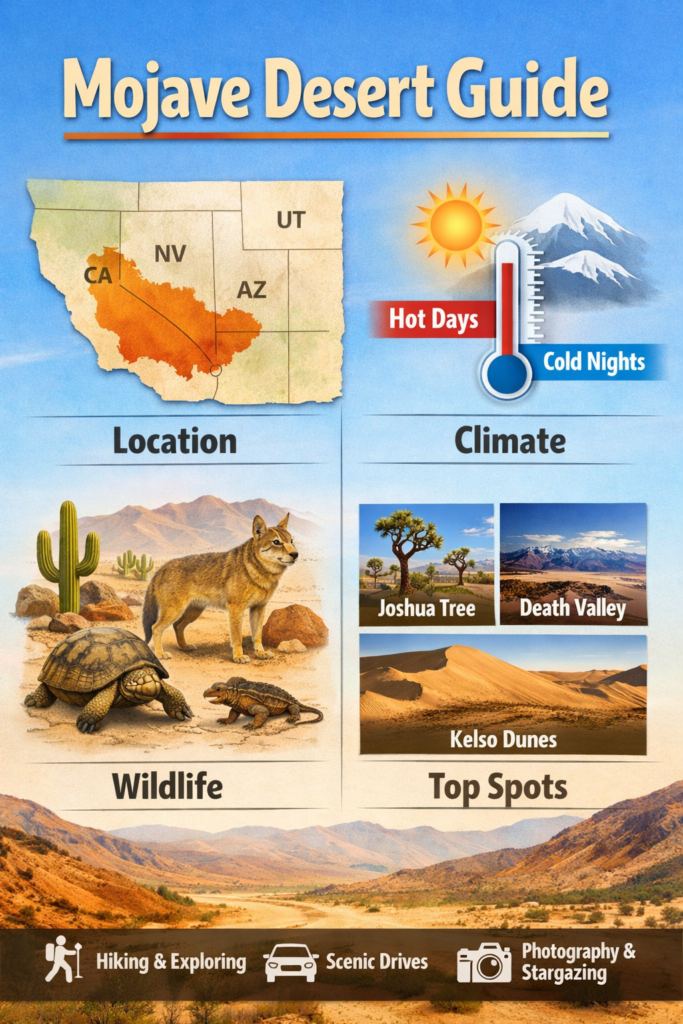
The Mojave Desert map makes the most sense when you think of the region as a transition zone rather than a fixed border. It lies mainly in southeastern California, but it also extends into southern Nevada, northwestern Arizona, and southwestern Utah. That broad footprint is part of what makes the desert both complex and fascinating.
The region is bordered and influenced by other major desert systems. It blends gradually into the Great Basin Desert to the north and the Sonoran Desert to the south and southeast. Its western edge is shaped by mountain ranges, including the San Gabriel Mountains and the San Bernardino Mountains. These boundaries are not just lines on a map; they shape wind, rain, elevation, habitat, and access routes.
For travelers, the map is not just a geography tool. It is a planning tool. It helps visitors understand where attractions sit in relation to one another, how much driving is involved, what kinds of roads are available, and how dramatically the terrain can change over short distances. In the Mojave Desert, distance matters. A short drive on paper can translate into a major shift in elevation, temperature, and road quality.
Major places in and around the Mojave Desert
Several place names help orient the region quickly:
Mojave National Preserve
Joshua Tree National Park
Death Valley National Park
Barstow
Mojave
Victorville
Lancaster
Las Vegas
These names act like semantic landmarks for anyone trying to understand the desert’s scale and travel structure. They also show that the Mojave is not remote in a simple sense; it is connected to cities, Highways, parks, and historic routes.
Why the map matters for travelers
A Mojave Desert map is important because it helps you understand:
How far are the attractions from each other
Which roads are paved, and which are rough
Where gas, food, and water may be limited
How elevation affects temperature
Why do some areas feel much hotter or cooler than others
For trip planning, this is essential. The Mojave rewards curiosity, but it also rewards preparation. Knowing the map is part of respecting the landscape.
Climate and Weather in the Mojave Desert
The Mojave Desert climate is dry, intense, and full of surprises. Many people assume deserts are always hot, but the Mojave is more nuanced. Summer can be brutally hot, yet winter can be surprisingly cold, especially after sunset and in higher-elevation areas. This daily and seasonal variability is one of the desert’s defining features.
Temperature swings
One of the most important characteristics of Mojave Desert weather is the large difference between daytime and nighttime temperatures. A day can begin with cool air, become scorching by afternoon, and then drop sharply after dark. That swing influences everything: travel planning, clothing choices, hydration needs, hiking safety, animal activity, and even photography conditions.
Rainfall in the Mojave Desert
Rainfall is limited across the Mojave. In some areas, annual precipitation is only a few inches. Yet that small amount of moisture is enough to support a surprising amount of life. Plants and animals survive by using specialized adaptations, timing their activity carefully, storing resources, or remaining dormant until conditions improve.
Seasonal weather patterns
The desert changes strongly by season:
Spring can bring wildflowers after suitable rain
Summer can be dangerous because of extreme heat and thunderstorms.
Fall often offers stable, pleasant, clear weather.
Winter can bring freezing nights, strong winds, and even snow at higher elevations.s
This seasonal variation affects the user experience, which is why travel intent around the Mojave often includes queries like “best time to visit” or “what to pack.”
Best weather for visiting
For most visitors, the best time to visit the Mojave Desert is spring or fall. Those seasons usually offer the best blend of comfort, visibility, and access. Trails are more manageable, driving is less punishing, and the landscape often looks its best under softer light.
What weather teaches us about the desert
The climate of the Mojave Desert explains much of what visitors see:
Why do plants grow slowly
Why are animals active at certain times of day?
Why roads and trails require careful planning
Why travel can become unsafe quickly
Why landscapes change with elevation
The weather is not background decoration here. It is the main force that shapes the environment.
Landscape and Geography of the Mojave Desert
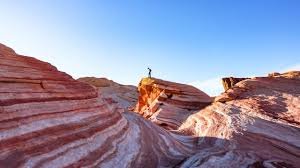
The Mojave Desert is famous for its dramatic and changing geography. It is not a flat blank region. It is a layered system of mountains, basins, valleys, dunes, dry lakebeds, volcanic remains, mesas, gravel plains, and ancient rock formations. The land itself tells a long story of pressure, erosion, fire, uplift, and time.
Major landforms in the Mojave Desert
Some of the most important desert features include:
Dunes
Rocky Mountain ranges
Dry river beds
Salt flats
Cinder cones
Lava fields
Mesas
Gravel basins
Ancient stone formations
These landforms create a landscape that feels visually rich and geologically active, even though it is dry. They also create strong search relevance because people often explore the Mojave through queries about dunes, lava tubes, canyons, and scenic drives.
Elevation changes shape everything.
Elevation is one of the most important variables in the Mojave Desert. Lower zones are hotter and drier, while higher areas can support different vegetation and cooler communities. That means the desert is not one consistent habitat but a chain of micro-environments.
A lower basin may look like open scrubland with sparse shade, while a higher ridge may carry pinyon pine, juniper, or even cooler forest-like conditions. Soil type, moisture, exposure, and altitude all contribute to the final appearance of the land.
Why does the scenery feel so dramatic
The appeal of the Mojave Desert comes from contrast. Visitors may see:
Bright sand beside dark volcanic rock
Wide basins beside steep ridges
Bare hills beside green desert shrubs
Dunes near mountain backdrops
Salt crusts under a deep blue sky
That visual opposition is what makes the region memorable. It is a place where simplicity and complexity exist at the same time.
Famous Natural Features in the Mojave Desert
The Mojave Desert includes many landscapes that stand out as destinations in their own right. These places are often the reason travelers search for the region in the first place.
Kelso Dunes
The Kelso Dunes are among the most famous natural features in the desert. They are known for their size, beauty, and classic desert atmosphere. Visitors often seek them out for open views, wide skies, and the immersive feeling of standing in a true dune system. They are a strong example of how the Mojave blends soft, shifting sand with hard, rugged geology.
Lava Tube and lava fields
The Mojave is not only about sand and shrubs. It also includes areas shaped by ancient volcanic activity. Lava fields and the Lava Tube show the desert’s fiery geological past. These formations remind visitors that the region has been shaped by movement below the surface as well as erosion above it.
Salt flats and basins
Salt flats are another signature element of the Mojave. These pale, open surfaces form where water once pooled and then evaporated, leaving minerals behind. The result is a stark and beautiful scene that feels almost lunar. Salt flats are visually strong, scientifically interesting, and highly searchable because they represent one of the clearest desert symbols.
Mountains and canyons
The Mojave Desert also contains many mountain ranges and canyon systems. These features create variety in scenery and habitat. They influence drainage patterns, microclimates, and movement corridors for wildlife. For visitors, they add texture and depth to the desert journey.
Plants of the Mojave Desert
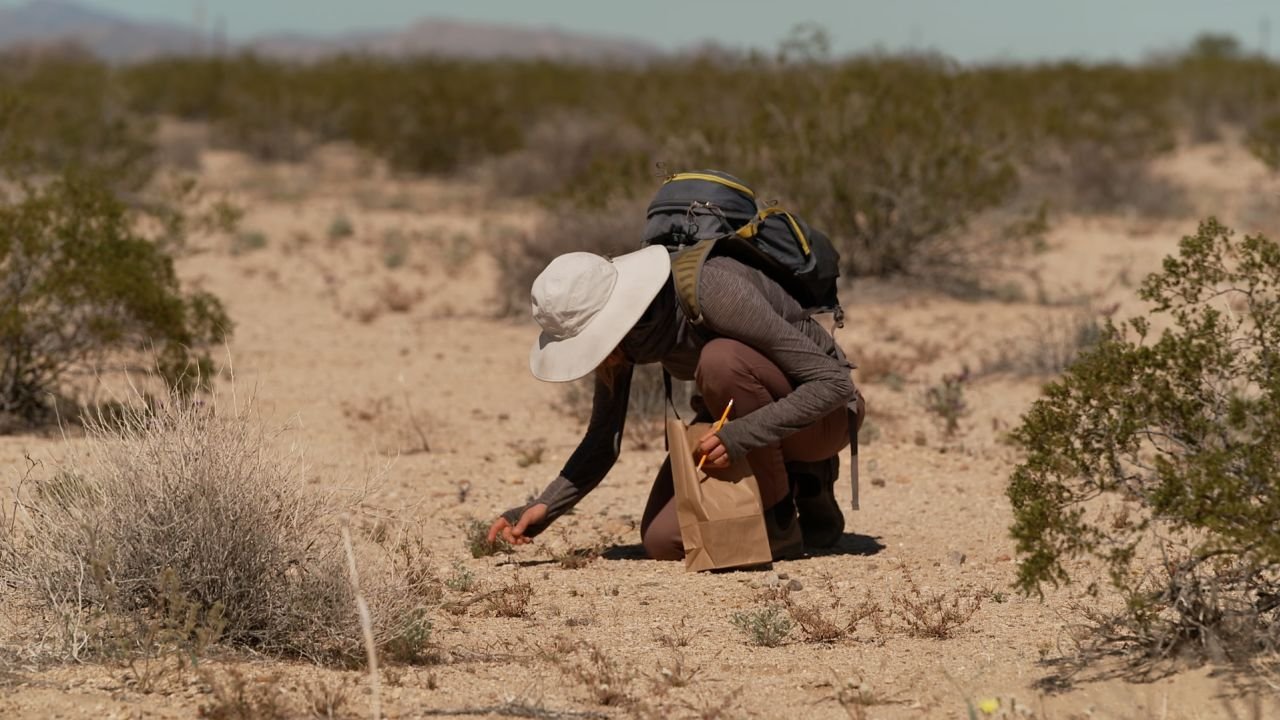
The plants of the Mojave Desert may seem sparse at first glance, but they are highly adapted and ecologically essential. The desert is a living plant system built around resilience, timing, and resource efficiency.
The Joshua tree
The Joshua tree is the best-known plant of the Mojave Desert. It has become an icon of the region and one of the strongest visual symbols of desert life in the American Southwest. Many people imagine the Mojave through the silhouette of this plant, which says a lot about its cultural and search significance.
The Joshua tree is not only striking. It also helps define the boundaries of the Mojave habitat in many areas. It is part of the region’s identity, its ecology, and its visual memory.
Other important plants
The Mojave Desert also includes:
Creosote bush
Cholla
Yucca
Pinyon pine
Juniper
White fir in higher elevations
Annual wildflowers
Cactus communities
These plants belong to different ecological niches and help make the desert more diverse than many people expect.
How desert plants survive
Plants in the Mojave use a wide range of survival strategies:
Some grow deep roots
Some store water in stems or tissues
Some bloom quickly after rain
Some keep leaves small, waxy, or reduced.
Some remain dormant until conditions are right.t
These traits reduce water loss and allow plants to persist in an environment where moisture is unpredictable. From an NLP perspective, this is an important topic cluster because people searching the Mojave often care about desert adaptation, native plants, and seasonal bloom cycles.
Wildflowers in the Mojave Desert
After winter rain or spring storms, the Mojave Desert can produce stunning wildflower displays. These blooms are not guaranteed every year, but when conditions align, they transform the landscape into a temporary burst of color. Wildflower season is one of the most searched and appreciated moments in desert travel.
Why the plant section matters
Readers often want more than a simple list of species. They want to understand:
Why do certain plants grow in certain zones
How elevation changes the plant community
Which species are most iconic
Which plants are threatened or sensitive
How the ecosystem stays alive despite low rainfall
That is why the plant section is one of the core semantic pillars of any comprehensive Mojave Desert guide.
Wildlife in the Mojave Desert
The wildlife of the Mojave Desert is more active and more diverse than many people realize. At first glance, the desert may appear empty. Once you pay closer attention, however, it reveals a rich ecosystem of birds, reptiles, mammals, insects, and other organisms adapted to dry conditions.
Desert tortoise
The desert tortoise is one of the most important animals in the Mojave. Widely recognized as a symbol of desert resilience, the desert tortoise survives harsh conditions by using burrows, conserving energy, limiting exposure, and carefully managing water. The species is also a conservation focus because habitat pressure can seriously affect its populations.
Reptiles
The Mojave Desert has many reptiles, including lizards and snakes. Reptiles are especially suited to arid habitats because they generally lose less water than many other animals and can regulate their behavior to avoid extreme heat.
Birds
Birds are another important group in the Mojave. Many species are active in the cooler hours of the day, while others move toward water sources or higher ground as needed. Bird activity adds movement and sound to a landscape that can otherwise feel very still.
Mammals
Small mammals such as rodents are also well adapted to desert life. Some survive with minimal direct water intake by extracting moisture from food. Larger mammals may be more elusive, but they remain part of the ecosystem as predators, prey, and seed spreaders.
Insects and pollinators
Insects are a critical part of the Mojave Desert ecosystem. They support pollination, decomposition, and food webs. Even though they are easy to overlook, they are essential to the survival of many plants and to the broader ecological balance.
Why wildlife matters in the desert
Desert wildlife demonstrates how life can adapt to water scarcity, heat, and extreme temperature changes. That makes the Mojave Desert not just a travel destination, but a natural classroom for ecology, adaptation, and survival.
Human History of the Mojave Desert
The Mojave Desert has a long and meaningful human history that reaches back thousands of years. It has been home to Native communities, a travel corridor for explorers, a site of mining and ranching, a place of railroad development, and a landscape shaped by both use and conservation.
Native history
Native peoples have long lived in, traveled through, and understood the Mojave Desert. Their relationship with the land includes ceremony, seasonal movement, trade, survival knowledge, and deep ecological understanding. Any serious guide to the region should recognize that human history did not begin with modern tourism.
Mining and ranching history
Later, the Mojave became important for mining, ranching, and homesteading. These activities changed the land and brought new patterns of settlement and resource use. Old mining sites and ranching traces remain part of the historical texture of the desert.
Railroads and transport routes
Railroads played a major role in shaping the desert’s towns and travel routes. They linked isolated places, moved goods, and supported the growth of desert communities. In many cases, transportation history is still visible in the layout of roads, towns, and preserved structures.
Historic roads
The Mojave Road is one of the region’s most important historic routes. It connects the desert to older systems of travel, exchange, and survival. For visitors and history-minded readers, it adds a valuable cultural layer to the landscape.
Why the human story matters
A strong Mojave Desert guide should not focus only on scenery. It should also show that the desert has always been part of human movement, adaptation, and meaning. The land is not isolated from people; it has always been shaped by them.
Mojave National Preserve
The Mojave National Preserve is one of the best places to experience the desert in a single visit. It is large, remote, and diverse, making it a powerful anchor destination for travelers and a major keyword target for desert-related search intent.
What makes the preserve special
The preserve includes:
Dunes
Lava flows
Cinder cones
Mountain ranges
Joshua trees
Dry washes
Historic roads
Backcountry areas
That variety makes it one of the best places to see the Mojave Desert in a concentrated form.
Why visitors like it
Visitors are drawn to the preserve because it offers:
Scenic drives
Short hikes
Stargazing
Solitude
Geology
Historic sites
Wide-open desert views
It is a place where people can experience both the scale and the silence of the desert.
Important visitor note
The preserve is remote, and that remoteness affects safety and logistics. Fuel, charging, water, and cell service may be limited or absent in certain areas. Good preparation is not optional; it is part of responsible travel.
Best stops in the preserve
Some of the best-known places include:
Kelso Dunes
Kelso Depot
Hole-in-the-Wall
Teutonia Peak
Lava Tube
Scenic desert roads
These destinations make the preserve one of the strongest travel highlights in the entire desert region.
Best Places to Visit in the Mojave Desert
The Mojave Desert has many destinations worth visiting. Some are iconic national parks, while others are quieter but still rewarding. Together, they create a broad travel ecosystem with different experiences for different kinds of visitors.
1. Mojave National Preserve
Best for:
Dunes
Lava fields
Scenic drives
Hiking
Stargazing
Why visit:
It offers a full desert experience with a remarkable range of landforms in one place.
2. Joshua Tree National Park
Best for:
Rock formations
Joshua trees
Hiking
Climbing
Stargazing
Why visit:
It is one of the most recognizable desert parks in the United States and a defining destination for Mojave-area travel.
3. Death Valley National Park
Best for:
Extreme scenery
Salt flats
Scenic drives
Dry basins
Photography
Why visit:
It is one of the most dramatic desert landscapes in North America and one of the strongest draws for visitors interested in superlative geography.
4. Lake Mead National Recreation Area
Best for:
Water and desert contrast
Recreation
Canyons
Scenic views
Why visit:
It offers a different side of the desert experience by combining arid land with water-based recreation.
5. Barstow, Mojave, and nearby desert towns
Best for:
Road trip stops
Local history
Travel support
Access to desert routes
Why visit:
These towns function as important connectors that help travelers move through the broader desert system.
Things to Do in the Mojave Desert
The Mojave Desert is not only a place to observe from a distance. It offers many activities for prepared visitors who want to explore, photograph, hike, or simply experience the quiet scale of the land.
Scenic driving
One of the best ways to explore the Mojave Desert is by car. Scenic roads reveal long views, open basins, dune systems, mountain silhouettes, and historic places. Driving is often the most efficient way to understand the desert’s scale and variety.
Hiking
Hiking gives visitors a closer look at the desert’s texture, plant life, and rock features. It is one of the most rewarding ways to understand how the landscape works at ground level.
Stargazing
Many parts of the Mojave are remote enough to offer excellent dark skies. Stargazing here can feel vast and immersive, especially on clear nights with little artificial light. The night sky is one of the desert’s hidden treasures.
Photography
Photographers love the Mojave because of its sharp light, long shadows, broad horizons, and dramatic contrast. The land changes character throughout the day, making it ideal for composition, color, and landscape storytelling.
Wildlife viewing
Birds, reptiles, mammals, and insects are easier to notice if you move slowly, stay quiet, and pay attention to the edges of the landscape. Wildlife viewing in the Mojave is often subtle but very rewarding.
Learning about geology
The Mojave Desert is a powerful destination for people who enjoy rocks, volcanoes, dry lakes, faulted terrain, and ancient earth history. It is one of the best natural classrooms in the Southwest.
Travel Tips for the Mojave Desert
Traveling in the Mojave Desert is memorable, but it must be approached with care. Good planning reduces risk and improves the experience.
Bring enough water
This is the most important travel rule. Desert air is dry, and dehydration can happen quickly, especially in the heat. Do not underestimate how much water you need.
Check your route before leaving.
Do not rely only on GPS. Some desert roads are rough, remote, or unsuitable for certain vehicles. Planning helps you avoid getting stuck, delayed, or stranded.
Fill up on gas early.
Fuel stations can be far apart. Whenever possible, begin your trip with a full tank and refill before entering remote areas.
Carry a paper map
Cell service may be weak or absent in remote locations. A paper map can be the difference between easy navigation and confusion if your phone loses signal.
Dress for the condition.s
Wear:
Light, breathable clothing
A hat
Sunglasses
Good walking shoes
Layers for cold evenings or winter trips
The desert can feel warm in one hour and cold in the next.
Leave early if hiking.g
Morning is usually the safest time for desert hiking because temperatures are lower and the sun is less intense.
Tell someone your route.e
This is a smart safety habit in remote areas. Letting someone know where you are going adds an extra layer of protection.
Safety Tips for Visiting the Mojave Desert
Safety should always be part of the conversation when visiting the Mojave Desert. The region is beautiful, but it can become dangerous quickly if people arrive unprepared.
Heat safety
Hot weather can be hazardous fast. Visitors should learn the signs of heat exhaustion and heat stroke and act quickly if symptoms appear.
Cold weather safety
Do not assume the desert is always hot. Nights can be cold, and winter temperatures can be surprisingly low. Pack for a range of conditions.
Road safety
Some desert roads include:
Narrow shoulders
Potholes
Loose dirt
Sand
Drop-offs
Drive carefully and slowly, especially on unfamiliar routes.
Navigation safety
Because the desert is remote, getting turned around is easier than many visitors expect. Good maps, route awareness, and preparation help reduce that risk.
Wildlife safety
Do not disturb animals. Give them space, do not feed them, and do not approach them for photos.
Emergency planning
Always carry:
Water
Snacks
First-aid basics
Map
Phone charger or power bank
Emergency contact plan
Preparedness is not overcautious in the desert; it is essential.
Best Time to Visit the Mojave Desert
The best time to visit the Mojave Desert is usually spring and fall. Those seasons give the best balance of comfort, access, and visual appeal.
Spring
Spring is one of the best seasons because the weather is often pleasant and wildflowers may bloom after rain. This is a peak period for natural color and outdoor exploration.
Fall
Fall is another comfortable season with lower heat and clearer skies. It is often ideal for road trips, scenic stops, and photography.
Summer
Summer can be beautiful, but it is also the most dangerous season because of extreme heat. Travel in summer requires extra caution, early starts, and strong heat awareness.
Winter
Winter can be quiet and scenic. It may also be cold, windy, or snowy in higher areas. For some travelers, that still makes it attractive because of the calm and the clarity.
Best season by travel goal
For comfort: spring or fall
For photography: spring, fall, or winter
For wildflowers: spring after rain
For solitude: winter or late fall
For safety and ease: spring and fall
Mojave Desert vs Nearby Desert Destinations
The Mojave Desert is part of a larger desert network. It connects to other famous regions that many travelers compare or combine into a single road trip.
Mojave Desert vs Joshua Tree
Joshua Tree is one of the best-known Mojave-region parks. It is especially famous for rock climbing, hiking, and the Joshua tree itself. It often serves as the most recognizable entry point for people learning about the broader desert.
Mojave Desert vs Death Valley
Death Valley is more extreme in reputation and is known for heat, salt flats, and low elevation. It represents the harshest edge of the desert world and is often used as a benchmark for desert intensity.
Mojave Desert vs Great Basin Desert
The Great Basin is cooler in some areas and lies north of the Mojave. The two deserts meet and blend in transitional zones, which makes the boundary ecologically interesting.
Mojave Desert vs Sonoran Desert
The Sonoran Desert lies south of the Mojave and has a different climate and plant pattern. Comparing the two helps readers understand how desert ecosystems can vary even within the same broad region.
Pros and Cons
Pros
Beautiful and diverse scenery
Great for road trips and photography
Rich geology and history
Excellent stargazing conditions
Many iconic desert landmarks
Spring wildflowers can be impressive.
Cons
Extreme heat in summer
Cold winter nights
Limited services in remote areas
Poor cell coverage in some places
Rough dirt roads
Travel requires planning
This balance is part of what makes the Mojave Desert exciting. It is rewarding, but it asks for respect.
Interesting Facts About the Mojave Desert
Here are some useful facts that help define the Mojave Desert:
The Mojave Desert, one of North America’s most famous desert regions, spans multiple states and features dramatic elevation changes. Known for its Joshua trees, dunes, lava fields, salt flats, and mountains, it supports specially adapted wildlife and carries deep Native and historical significance.
These facts show that the Mojave Desert is not just a place on the map. It is a full system of land, life, and memory.
Environmental Issues and Conservation
The Mojave Desert is beautiful, but it is also fragile. Like many desert ecosystems, it can be damaged by disturbance, development, and climate pressure.
Habitat loss
Development and land use can reduce available habitat for plants and animals. This is especially important in areas where species depend on specific terrain or vegetation.
Climate stress
Rising temperatures and shifting rainfall patterns can affect how plants grow and how animals survive. Small changes in moisture can have large ecological effects in desert systems.
Road impacts
Travel and traffic can damage sensitive land, disturb wildlife, and create fragmentation in natural areas.
Fire risk
Fire can be especially harmful in desert ecosystems where plant communities are already under stress. Recovery can be slow.
Tortoise protection
The desert tortoise remains one of the most important conservation concerns in the region. Its survival is closely tied to habitat quality and long-term protection.
Why conservation matters
Protecting the Mojave Desert helps preserve:
Wildlife
Plant life
Scenic beauty
Cultural history
Future travel experiences
A healthy desert is not just important for nature. It matters for people, too.
Why the Mojave Desert Is Important
The Mojave Desert matters for many reasons:
The Mojave Desert stands as one of the most recognizable landscapes in the United States, known for its unique wildlife, cultural significance, and strong role in tourism—proving that even dry environments can support rich life.
That is why the Mojave deserves attention, care, and thoughtful travel.
Mojave Desert Quick Travel Table
| Destination | Best For | Standout Fact |
| Mojave National Preserve | Remote drives, dunes, lava tubes, hiking | A large preserve with a major landform variety |
| Joshua Tree National Park | Rock climbing, hiking, stargazing | Where iconic desert scenery meets strong visitor access |
| Death Valley National Park | Extreme scenery, salt flats, scenic drives | One of the hottest, driest, and lowest regions nearby |
| Lake Mead National Recreation Area | Water-based desert recreation | A striking contrast of desert and water |
| Barstow and Mojave towns | Road trip support and local history | Useful access points for desert travel |
FAQs
The Mojave Desert includes some of the hottest places in North America, and the Death Valley area is one of the most extreme desert regions in the world.
The Mojave Desert covers parts of California, Nevada, Arizona, and Utah.
The best time to visit the Mojave Desert is usually spring or fall because temperatures are more comfortable.
The Joshua tree is the best-known plant of the Mojave Desert, though many other plants also grow there.
Yes, but only if you prepare well. Bring water, fuel, maps, and emergency supplies, and never assume help will be close.
The Mojave Desert is home to desert tortoises, reptiles, birds, mammals, and many insects.
It is called a high desert because many of its areas sit at higher elevations than people expect from a desert.
Conclusion
The Mojave Desert offers a unique mix of scenery, wildlife, and history. From iconic parks to remote landscapes, it remains one of the most rewarding desert regions to explore with the right planning.