
Introduction
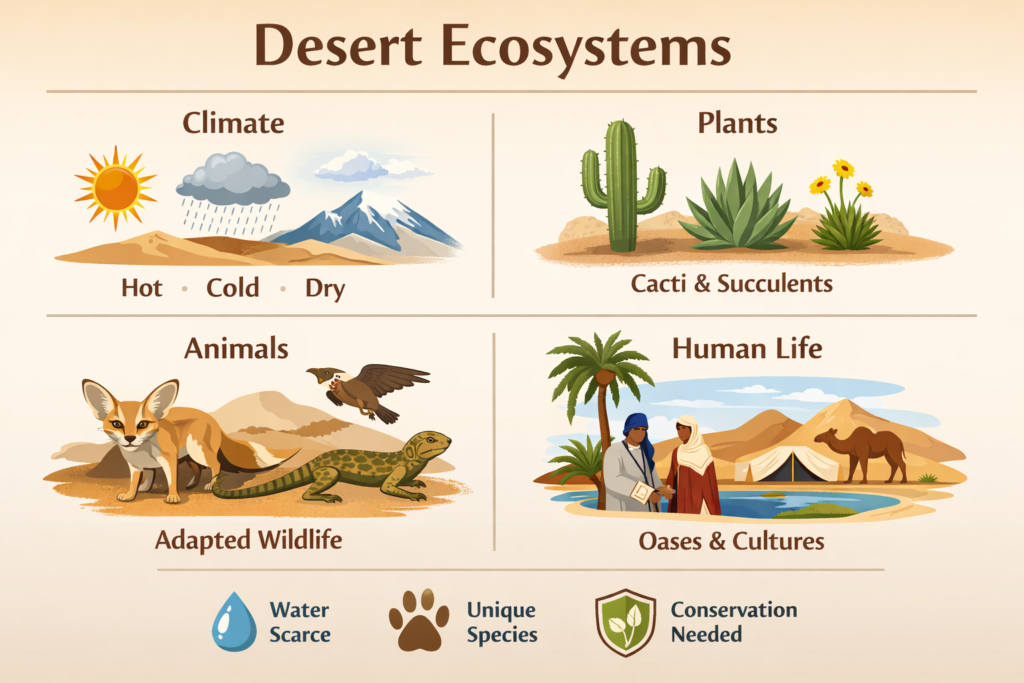
Desert ecosystems are not empty landscapes—they are dynamic environments shaped by extreme dryness and limited water. From hardy plants to specially adapted animals, life in the desert survives through unique strategies. These ecosystems reveal how nature thrives under some of the toughest conditions on Earth.
- What Is an Ecosystem in a Desert?
- Why Desert Ecosystems Matter
- Location and Geography of Desert Ecosystems
- Major desert types at a glance
- Why deserts are found where they are
- Climate and Weather Patterns in Desert Ecosystems
- The role of water
- Rainfall patterns
- Temperature swings
- Why desert weather feels so harsh
- Landscape Features: Sand Dunes, Rocks, Valleys, Salt Flats, and More
- Dunes
- Rocky slopes and basins
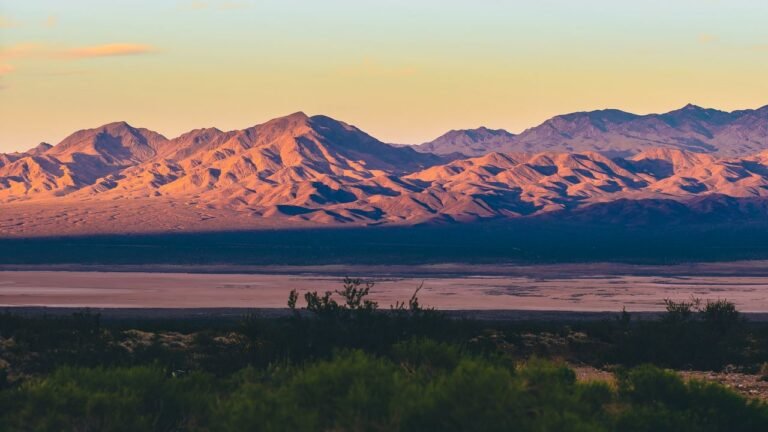
- Salt flats and dry lake beds
- Oases and springs
- Microhabitats
- Flora: Plants in Desert Ecosystems
- How desert plants survive
- Common desert plant types
- Why desert plants are important
- Fauna: Animals, Reptiles, Insects, and Birds
- Nocturnal animals
- Crepuscular behavior
- Water-saving adaptations
- Reptiles in deserts
- Insects and desert life
- Birds in deserts
- Biodiversity in desert ecosystems
- Human History and Cultures in Desert Ecosystems
- Water shaped human life
- Ancient and modern human adaptation
- Cultural landscapes
- Why human history belongs in an ecology article
- Survival Tips and Challenges in Desert Ecosystems
- Challenges for people
- Survival tips for daily life
- Survival tips for visitors
- Why timing matters
- Tourism: Attractions, Activities, and Responsible Travel
- Why do people travel to the desert?s
- Common activities in desert ecosystems
- Responsible travel in desert ecosystems
- Why desert tourism should stay low-impact
- Interesting Facts
- Environmental Issues and Conservation
- Main threats to desert ecosystems
- Why deserts are vulnerable
- Conservation approaches that work.
- What conservation really means
- Pros and Cons
- Pros
- Cons / Challenges
- FAQ
- Conclusion
What Is an Ecosystem in a Desert?
An ecosystem in a desert is a living network in which plants, animals, soil, air, and climate interact under dry conditions. The central challenge is straightforward: water is scarce. Because water is limited, every living thing in the desert must develop special ways to survive.
A desert ecosystem is not just “a place with no rain.” It is a region where precipitation is so low that water often disappears faster than it arrives. Evaporation can exceed rainfall by a wide margin. That means plants cannot rely on constant soil moisture, animals cannot count on easy drinking water, and even the ground itself behaves differently because it dries out rapidly.
The defining feature of a desert ecosystem is adaptation. Plants preserve water, animals avoid heat, microbes survive brief wet periods, and human communities build traditions around careful water use. In other words, a desert ecosystem is a complete survival system. It may appear harsh at first glance, but it is full of life strategies, timing patterns, and ecological relationships that allow organisms to endure.
Why Desert Ecosystems Matter
Desert ecosystems matter for many reasons, and their value goes far beyond scenery. First, they cover a significant portion of the Earth’s land surface. Second, millions of people live in or depend on desert regions. Third, deserts contain species that are highly specialized and often found nowhere else. Fourth, they teach us how life responds to pressure, scarcity, and environmental stress.
These ecosystems are important because they:
Support unique plants and animals adapted to arid conditions
Provide scientists with a natural laboratory for studying water use, resilience, and climate stress.
Preserve Indigenous knowledge, ancient trade routes, and cultural landscapes.
Attract tourism, outdoor education, and geological research.h
Remain highly vulnerable, making conservation especially important
Desert ecosystems remind us of a powerful truth: life does not require ideal conditions to exist. It only needs the right adaptations.
Location and Geography of Desert Ecosystems
Deserts exist on every continent. Famous examples include the Sahara, Mojave, Sonoran, Arabian, Atacama, Gobi, and Antarctic deserts. These places are very different in temperature, terrain, and ecology, but they share one basic characteristic: they receive very little moisture.
Many deserts form in predictable geographic zones. Some occur near 30° north and 30° south latitude, where descending dry air reduces rainfall. Others develop far inland, where moist ocean air rarely reaches. Some occur in the rain shadow of Mountains, where one side of a range blocks precipitation from passing through. Others form along coasts where cold currents and fog limit rainfall,l but still do not provide enough usable water.
Major desert types at a glance
| Desert Type | Climate Profile | Common Landscape Traits | Example(s) |
| Hot and dry | Intense heat, low rainfall, low humidity, strong evaporation | Dunes, gravel plains, rocky slopes, sparse shrubs | Sahara, Mojave, Arabian |
| Semiarid | Dry conditions with more seasonal moisture than classic hot deserts | Shrubs, grasses, open ground, wider seasonal variation | Parts of North America, Europe, and Asia |
| Coastal | Cooler, often foggy, but still very dry overall | Fog belts, sparse rainfall, specialized vegetation | Atacama Desert |
| Cold | Very low temperatures, low precipitation, short growing season | Stony ground, frozen surfaces, sparse shrubs, and grasses | Gobi, Antarctic Desert |
This table makes one thing clear: not all deserts are hot. Many people still imagine deserts as blazing sand seas, but that is only one type. A desert may be cold, windy, rocky, high-altitude, or foggy. Some deserts can even be covered in ice and still be classified as deserts if they receive very little moisture.
Why deserts are found where they are
Deserts are not random. Their position is usually linked to large-scale atmospheric circulation, ocean currents, mountain barriers, or distance from moisture sources. Hot deserts often form in belts where air sinks and dries. Interior deserts arise because they are far from oceans. Coastal deserts form when cool sea currents and fog limit rainfall. Cold deserts appear in high-latitude or high-altitude regions where precipitation stays low.
Geography matters because it shapes ecological rules. A coastal desert behaves differently from a continental desert. A rocky mountain desert does not function exactly like a broad lowland basin. The location of a desert helps determine how water moves, how plants grow, where animals shelter, and how people adapt. The desert land is more varied than it appears.
A desert is not one flat scene. It is often a mosaic of surfaces and microhabitats. Within a single desert region, you may find dunes, cliffs, canyons, gravel fields, rocky hills, dry lake beds, salt flats, wadis, springs, and oases.
That means a desert ecosystem is really a collection of smaller ecosystems. A shaded canyon may support different vegetation than an exposed ridge. A spring can support birds, insects, reptiles, and mammals that could not survive on the dry plain around it. Even a few meters of difference in slope, shade, or soil can create a distinct ecological niche.
Climate and Weather Patterns in Desert Ecosystems
Climate is the driving force behind desert life. In ecosystems in a desert, climate controls the availability of water, the timing of plant growth, the behavior of animals, and the long-term shape of the soil.
The role of water
The most important part of a desert climate is not temperature alone. It is the balance between moisture gained and moisture lost. If a place loses more water through evaporation than it receives through rainfall, conditions become extremely dry. That is the essence of a desert. Even when the temperature is not extreme, a lack of water can still define the ecosystem.
Rainfall patterns
Desert rainfall is usually low, uneven, and unpredictable. Some deserts receive only a small amount of rain each year. Others have short wet seasons, but the rainfall often arrives in brief, intense bursts. After that, dry conditions may return quickly.
This kind of rainfall pattern gives desert ecosystems a special rhythm. Seeds may remain dormant for months or even years, waiting for the right amount of moisture. Insects may appear rapidly after rain. Birds may breed only when temporary water is available. Wildflowers may bloom for a short period and then disappear again. In deserts, life often moves in cycles of waiting, awakening, and retreat.
Temperature swings
Deserts are famous for heat, but many also experience cold nights or freezing winters. The difference between daytime and nighttime temperatures can be dramatic. Dry air and clear skies allow heat to escape rapidly after sunset, so the ground and air cool down quickly.
These temperature swings influence everything. Plants may close their pores during the day to preserve moisture. Animals may hide underground or remain inactive during the hottest hours. People must plan work, travel, and rest around the temperature cycle. A desert climate is not simply hot; it is often extreme in both directions.
Why desert weather feels so harsh
Several features make desert weather especially difficult:
Low humidity
Intense sunlight
Little shade
Hot ground surfaces
Rapid evaporation
Wind exposure
Large day-night temperature swings
Together, these conditions make it hard for water to remain in the soil, in plant tissue, or in animal bodies. That is why desert ecosystems depend so heavily on adaptation.
Landscape Features: Sand Dunes, Rocks, Valleys, Salt Flats, and More
Deserts are often shown as endless sand, but that image captures only a small portion of reality. Desert landforms are highly varied, and each shape affects wind, runoff, shade, drainage, and habitat.
Dunes
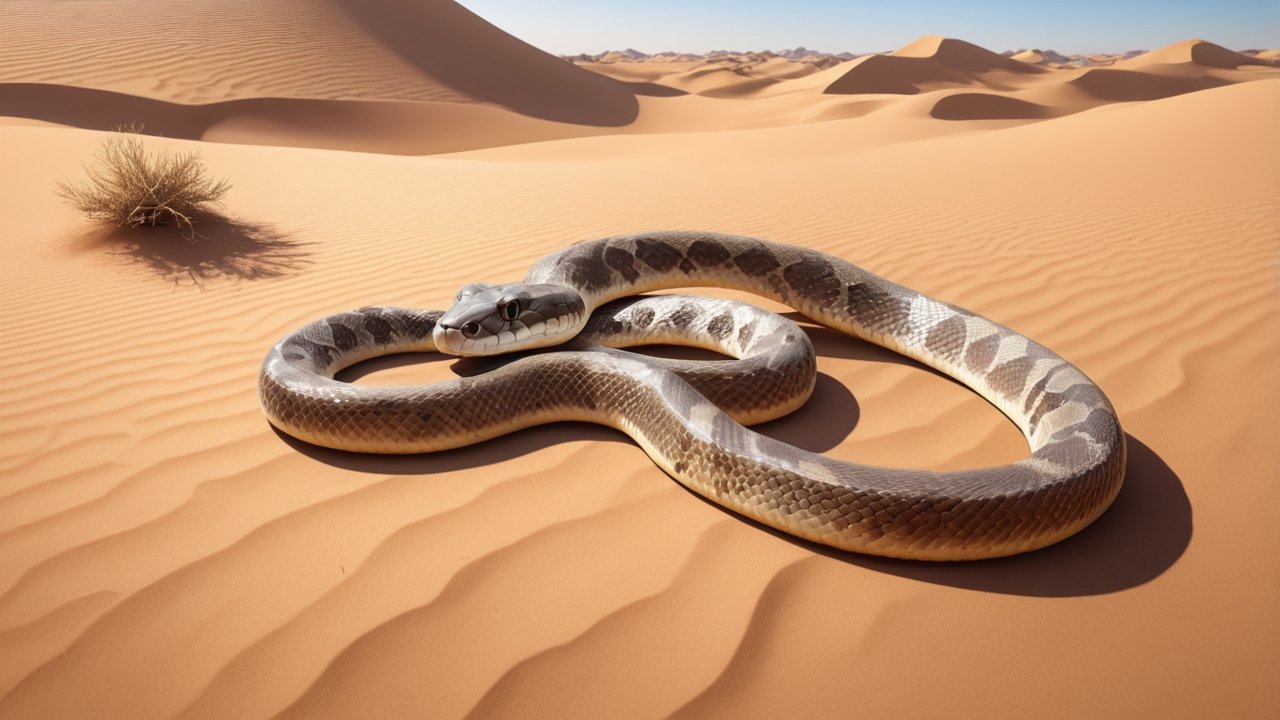
Dunes are one of the most recognizable desert features. They form when wind pushes loose sand into ridges, waves, or hills. Dunes shift over time, which makes them dynamic rather than static. Some are tall and smooth; others are smaller or more complex in shape.
Dunes may seem empty, but they can support insects, reptiles, birds, and specialized plants that know how to survive in loose, shifting sand. Their constant movement also affects where water gathers and where organisms can shelter.
Rocky slopes and basins
Many deserts are more rocky than sandy. Rocky slopes can offer shade, small crevices, and cooler microclimates that help animals survive. Because rock drains quickly, water does not remain on the surface for long. This creates a dry setting, but also one with useful shelter and temperature variation.
Basins and valleys may collect runoff after rainfall, allowing temporary bursts of life. These places can support more vegetation and animal activity than adjacent higher ground, especially after storms.
Salt flats and dry lake beds
Some desert basins once held lakes that eventually evaporated, leaving salts and minerals behind. These flat areas may look barren, yet they tell the story of ancient water movement and long-term evaporation. Salt flats and dry lake beds can provide habitat for birds, insects, and microorganisms adapted to mineral-rich environments.
Oases and springs
Oases are among the most important features in desert ecosystems. They are places where water exists in a landscape that is otherwise dry. Because of this, oases become rich pockets of life. Plants grow more densely, animals gather to drink, and people often settle nearby.
Springs, seeps, and tinajas can support an entire chain of life. In a desert, water is the center of everything. Wherever water appears, life follows.
Microhabitats
A desert can contain many small habitat zones inside one larger region. Examples include:
Dunes
Oases
Springs
Dry washes
Rocky crevices
Canyon floors
Salt flats
Shrub patches
Seasonal pools
These microhabitats matter because they create ecological variety. Variety supports biodiversity. Even in a place that looks uniform from a distance, the details reveal a highly structured environment.
Flora: Plants in Desert Ecosystems
Desert plants are among the most remarkable living organisms on Earth. They survive in harsh conditions with limited water, intense sunlight, and often poor soil. Their shapes, tissues, and growth cycles are all part of a larger survival strategy.
How desert plants survive
Desert plants use several strategies to conserve moisture and endure heat:
Desert plants have developed remarkable strategies to survive in harsh, dry environments. Water is stored in stems, leaves, or roots to ensure survival during long dry periods. Leaf size is often reduced to minimize evaporation, while waxy coatings help retain moisture. Spines or fine hairs provide protection and further reduce water loss. Instead of opening pores during the heat of the day, gas exchange occurs at night to conserve water. Root systems grow deep or spread widely to capture moisture quickly after rainfall. Growth is rapid when water becomes available, followed by dormancy during extended drought conditions.
These are not minor adjustments. They are the core of desert plant life. Every feature serves a purpose in an environment where water is the limiting factor.
Common desert plant types
Desert vegetation may include:
Cacti
Succulents
Drought-tolerant shrubs
Grasses
Herbs
Wildflowers
Small trees in wetter locations
Salt-tolerant plants near mineral-rich soils
Different desert plants use different survival paths. A cactus may store water in a thick stem and use spines instead of leaves. A shrub may keep tiny leaves to reduce water loss. A short-lived wildflower may remain dormant as a seed until rain arrives, then sprout, bloom, and set seed very quickly.
This rapid-response strategy is one reason deserts can become spectacular after rain. Dry ground may suddenly turn bright with flowers, insects, and renewed activity.
Why desert plants are important
Plants are the base of the food web. They stabilize soil, provide shade, create cover, and feed insects, birds, and mammals. Without plants, many desert animals would not survive. Plants also reduce erosion and help maintain balance in the ecosystem.
Simply put, plants are the foundation of ecosystems in a desert.
Fauna: Animals, Reptiles, Insects, and Birds
Desert animals are specialists. They must cope with heat, dryness, irregular food supplies, and long periods without easy access to water. As a result, many desert animals have unusual and highly effective adaptations.
Nocturnal animals
Many desert animals are nocturnal, meaning they are active at night. This helps them avoid the hottest part of the day and reduces water loss. Cooler night temperatures also make movement, hunting, and feeding easier.
Examples of nocturnal or partly nocturnal desert animals include:
Foxes
Bats
Owls
Rodents
Some reptiles
Insects
Small carnivores
Crepuscular behavior
Some animals are active at dawn and dusk rather than in full daylight or complete darkness. This is called crepuscular behavior. It is another smart way to avoid the harshest heat while taking advantage of the cooler parts of the day.
Water-saving adaptations
Desert animals use many water-saving strategies:
Desert animals use efficient strategies to conserve water and survive in extreme conditions. Moisture is often obtained from food sources such as seeds, leaves, or insects. Drinking is kept to a minimum and occurs only when necessary. Concentrated urine helps reduce water loss, while resting during the hottest part of the day prevents dehydration. Many species rely on burrows or shaded shelters to stay cool and conserve energy.
Some mammals can go for long periods without drinking directly. Birds and reptiles also use efficient water-conservation methods. These traits are essential to life in an arid climate.
Reptiles in deserts
Reptiles are especially successful in deserts because their bodies are well-suited to dry conditions. Many can tolerate heat, move over hot surfaces, and lose less water than some other animals. Lizards, snakes, and turtles often rely on rocks, shade, and underground shelters to regulate body temperature.
Insects and desert life
Insects may be small, but they play major roles in desert ecosystems. They pollinate flowers, break down organic matter, and provide food for birds, reptiles, and mammals. Many insects appear after brief rainfall and vanish during drought, following the seasonal pattern of the ecosystem.
Birds in deserts
Birds may live in deserts year-round or migrate through them. Some nest near water sources, while others search for seeds or insects after rain. Birds are often seen near oases, springs, canyon edges, and shaded refuges where life is more abundant.
Biodiversity in desert ecosystems
Many people assume deserts have very little biodiversity. That can seem true if one only looks at open, dry ground. But once landforms, microhabitats, and seasonal change are considered, desert ecosystems reveal surprising richness.
Deserts can contain:
High specialization
Endemic species found nowhere else
Strong seasonal variation
Hidden biodiversity around water sources
So, ecosystems in a desert may look simple from afar, but they are often biologically complex.
Human History and Cultures in Desert Ecosystems
Humans have lived in deserts for thousands of years. This is one of the most important parts of the desert story. People did not merely survive in desert environments; they built cultures, trade systems, settlements, and traditions around them.
Water shaped human life
Water was always the deciding factor. Communities settled near springs, oases, seasonal streams, and natural water storage places. People learned where water appeared, when it flowed, how long it lasted, and how to protect it.
In a desert, water knowledge is power. It determines where people can live, travel, farm, trade, and gather.
Ancient and modern human adaptation
Desert communities developed many ways to cope with dry climates:
Water storage and careful rationing
Shade planning and building design
Travel timing based on heat and distance
Clothing that protects against the sun and wind
Deep knowledge of local plants and animals
Trade routes connecting water sources
Seasonal movement in some regions
This shows that deserts are not empty or isolated. They are active cultural landscapes shaped by skill, memory, and adaptation.
Cultural landscapes
Desert ecosystems often contain petroglyphs, habitation sites, travel routes, stone tools, mortars, and ceremonial areas. These features show long-term human presence and remind us that deserts have always been part of human history.
Why human history belongs in an ecology article
A desert ecosystem is not just about wild plants and animals. It is also about people. Human activity influences water use, fire risk, habitat disturbance, tourism, and conservation. Human history belongs in any serious article on ecosystems in a desert because people are part of the ecological story.
Survival Tips and Challenges in Desert Ecosystems
Living in or visiting a desert requires planning. Conditions can change quickly, and small mistakes can become dangerous very fast. This applies to both people and wildlife.
Challenges for people
The main challenges include:
Dehydration
Sunburn
Heat exhaustion
Cold nights
Getting lost
Limited shade
Dust and wind
Sudden weather changes
Survival tips for daily life
People who live in desert regions often follow habits like these:
Conserve water carefully
Work early or late in the day.
Use shade whenever possible.e
Wear protective clothing
Learn seasonal weather patterns.
Prepare for both heat and cold.
Stay aware of distances between water sources
Survival tips for visitors
Visitors should always prepare ahead of time. A safe desert trip often includes:
Extra water
Maps or GPS
Sunscreen
A hat and sunglasses
Sturdy shoes
First aid supplies
Emergency food
Knowledge of trail distance and weather
A plan for temperature changes
Why timing matters
In deserts, timing is often as important as equipment. Many animals are active at dawn, dusk, or night because those are the cooler periods. Humans often do better with the same approach. Travel early, rest during peak heat, and avoid unnecessary risk in the hottest part of the day.
That simple rule can save water, energy, and lives.
Tourism: Attractions, Activities, and Responsible Travel
Deserts are popular travel destinations. People visit them for scenery, silence, geology, wildlife, stargazing, and cultural history. But desert tourism must be handled carefully because these environments are fragile.
Why do people travel to the desert?s
Desert regions offer:
Dramatic scenery
Wide open horizons
Distinctive landforms
Wildlife viewing
Night skies with little light pollution
Cultural heritage sites
Photography opportunities
Quiet, reflective spaces
Common activities in desert ecosystems
Visitors often enjoy:
Scenic drives
Hiking
Birdwatching
Camping
Rock viewing
Landscape photography
Stargazing
Learning about geology and history
Responsible travel in desert ecosystems
Responsible travel matters because desert soils and plants can be damaged easily. A few careless steps may leave lasting scars.
Good travel habits include:
Staying on trails
Carrying enough water
Avoiding litter
Not disturbing plants or animals
Respecting cultural sites
Watching the weather
Leaving the area as it was found
Why desert tourism should stay low-impact
Desert ground can recover slowly. Some soils heal very poorly after disturbance. Plants may take years to regrow. Off-road driving, trampling, and careless behavior can leave marks that remain for a very long time.
The best kind of tourism is the kind that allows people to enjoy the desert without harming it.
Interesting Facts
Here are some useful facts that help bring the topic to life:
Deserts are found on every continent.
They cover a large part of the Earth’s land area.
Not all deserts are hot.
Some deserts are cold and icy.
Many desert animals are nocturnal.
Desert plants often store water or reduce water loss.
Oases support far more life than the surrounding dry land.
Human beings have lived in deserts for thousands of years.
Desert biodiversity is often higher than people expect.
Desert ecosystems are highly sensitive to climate and land-use change.
These facts challenge the idea that deserts are dead places. In reality, they are active, layered, and ecologically meaningful.
Environmental Issues and Conservation
Deserts are resilient, but they are not indestructible. In fact, they can be highly vulnerable because life there already exists close to the limits of water availability.
Main threats to desert ecosystems
The biggest threats include:
Climate change
Desertification
Land degradation
Overuse of water
Habitat disturbance
Invasive species
Pollution
Off-road damage
Overdevelopment
Why deserts are vulnerable
Desert systems operate with very narrow margins. A small change in rainfall can affect flowering, seed germination, insect emergence, and food supply for animals. A small increase in heat can make survival more difficult for plants and wildlife. When water is already limited, even a modest amount of stress can have large effects.
Conservation approaches that work.
Effective conservation includes:
Protecting habitats
Restoring damaged land
Using water wisely
Reducing soil disturbance
Supporting Indigenous and local knowledge
Monitoring climate change
Educating the public
Limiting harmful development
What conservation really means
Conservation is not about freezing deserts in time. It is about keeping them healthy, balanced, and capable of supporting life. That includes plants, animals, people, and cultural heritage.
Ecosystems in a desert need protection because they are both beautiful and fragile.
Pros and Cons
Pros
Desert ecosystems show extraordinary adaptation.
Home to specialized plants and animals
Rich in cultural history and traditional knowledge
Valuable for science, education, and tourism
Defined by unique landforms and varied microhabitats
Cons / Challenges
Water scarcity makes survival difficult.
Soils and vegetation can be fragile.
Heat, cold, and daily temperature swings can be dangerous.
Climate change and land degradation pose major threats.
Recovery from damage can be slow.
This balanced view helps readers understand both the beauty and the difficulty of desert life.
FAQ
The main difference is water availability. Deserts receive very little rainfall and have a moisture deficit, so plants and animals must survive with much less water than in most other ecosystems.
No. Deserts can be hot, cold, coastal, semiarid, rocky, gravelly, or even icy. Many deserts are not dominated by sand at all.
Night activity helps animals avoid extreme daytime heat and reduce water loss. Cooler temperatures also make it easier to move, feed, and hunt.
The biggest threats are climate change, desertification, land degradation, invasive species, water overuse, and human disturbance.
Because deserts are not empty land. They are living systems, cultural landscapes, and natural laboratories that teach us about resilience, adaptation, and conservation.
They survive by storing water, reducing leaf size, using waxy coatings, growing deep roots, or living fast after rain.
Yes. People have lived in deserts for thousands of years. Many communities have strong traditions built around water management, travel, trade, and local survival knowledge.
Conclusion
Desert ecosystems show how life adapts to scarcity and extremes. Though fragile, they support unique biodiversity and human cultures. Protecting these environments is essential for preserving their balance and long-term survival.