
Introduction
The Nevada Desert is not just one desert. Most of the state lies in the Great Basin Desert, while southern Nevada reaches into the Mojave Desert. This gives Nevada a mix of cold high desert, warm low desert, mountains, basins, and striking rock landscapes. In this guide, you will learn where Nevada’s deserts are, what the climate is like, which plants and animals survive here, and the best places to explore.
- What Is the Nevada Desert?
- Where Is the Nevada Desert? Location and Geography
- The Great Basin Desert
- The Mojave Desert
- The Basin and Range Province
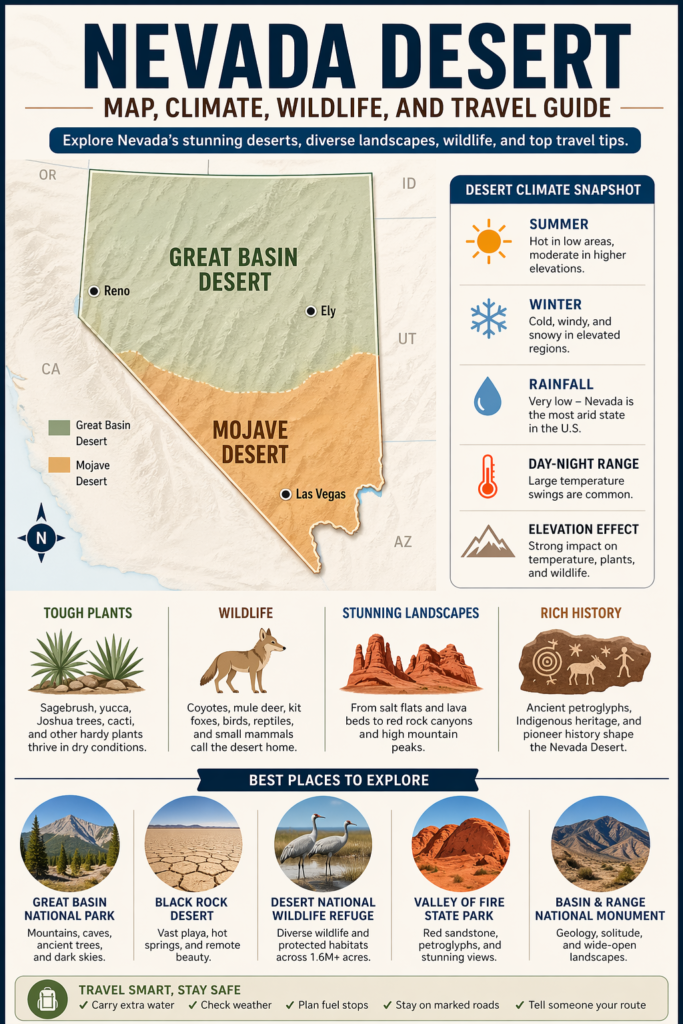
- Nevada Desert Map and Boundaries
- Simple boundary idea
- Great Basin Desert vs. Mojave Desert in Nevada
- Why this difference matters
- Climate and Weather in the Nevada Desert
- Why is Nevada so dry?
- Nevada desert weather is not the same everywhere.
- Climate snapshot
- Landscape Features of the Nevada Desert
- Common landscape features
- Black Rock Desert
- Valley of Fire
- Cathedral Gorge and other eroded formations
- Why the landscape matters
- Flora: Plants That Live in the Nevada Desert
- Common Nevada desert plants
- Plant life by elevation
- Great Basin National Park is a plant showcase
- Fauna: Animals of the Nevada Desert
- Common wildlife in the Nevada desert regions
- Desert National Wildlife Refuge
- Why can wildlife survive here?
- Human History and Cultures in the Nevada Desert
- Early human life
- Indigenous history
- Petroglyphs and rock art
- Later settlement
- Environmental Issues and Conservation
- Water scarcity
- Habitat protection
- Recreation pressure
- Safety and Survival Tips for the Nevada Desert
- Basic safety rules
- Why water matters most
- Roads can be remote
- Elevation can surprise you.
- Safety table
- Tourism: Best Places to See the Nevada Desert
- Great Basin National Park
- Black Rock Desert
- Desert National Wildlife Refuge
- Valley of Fire State Park
- Basin and Range National Monument
- Best places table
- Best Roads and Scenic Routes Through Nevada Desert Country
- Great Basin Highway
- Why is it a strong road-trip route
- Southern Nevada scenic routes
- Road-trip advice
- Interesting Facts About the Nevada Desert
- Pros and Cons
- Pros
- Cons
- FAQs
- Conclusion
What Is the Nevada Desert?
The Nevada Desert is not the official name of one isolated desert. It is an umbrella phrase used to describe the desert regions that cover much of Nevada, especially the Great Basin Desert in the north and center, and the Mojave Desert in the south.
This distinction matters because different parts of Nevada feel dramatically different. A traveler in northern Nevada may encounter cold desert basins, sagebrush plains, and distant mountain chains. A traveler near Las Vegas will experience lower elevations, greater heat, and a more classic Southwest desert atmosphere. Both are in Nevada, but they are not the same desert environment.
Nevada’s desert landscapes are shaped by three major forces:
- Low precipitation
- High elevation
- Basin and Range geography
Together, these conditions create a state where dry valleys sit between long mountain chains, and water usually drains into closed basins instead of flowing to the sea. That is why the state contains salt flats, playas, alkali sinks, dry lake beds, and broad open basins.
Nevada is also frequently described as a high-desert state. This means many areas are dry, but not all are low and hot. Some places are cool, windy, and even snowy in winter. Others are arid and warm. This mix is one of the most distinctive traits of the Nevada Desert and one of the reasons it deserves a deeper, more nuanced explanation.
Where Is the Nevada Desert? Location and Geography
Nevada borders Oregon, Idaho, Utah, Arizona, and California. Its desert lands spread across most of the state, but the broadest geographic divide is between the Great Basin and the Mojave.
The Great Basin Desert
The Great Basin Desert covers most of Nevada. It extends across a large part of the broader Great Basin region and continues into neighboring states. This desert is known for:
- enclosed basins
- parallel mountain ranges
- dry lake beds
- sagebrush plains
- cold winters
- internal drainage systems
The Great Basin is not one single basin. It is a vast region made up of many small basins and range systems. Water does not flow outward to the ocean. Instead, it gathers in low points, evaporates, or sinks into arid ground. That internal drainage is one of the primary reasons the region is so dry.
The Mojave Desert
The Mojave Desert reaches into southern Nevada. It is lower in elevation, warmer overall, and closer to the desert image most people recognize from movies and road-trip travel. This region includes the Las Vegas area and other southern desert zones.
Nevada’s Mojave side feels different because the lower Elevation allows more intense heat. It also offers more of the red rock, scrubland, and open desert scenery associated with the American Southwest.
The Basin and Range Province
Most of Nevada sits within the Basin and Range Province, one of the clearest and most important physical features in the western United States. This landscape consists of alternating mountain ranges and broad valleys. Instead of one continuous flat desert, Nevada follows a repeating sequence:
mountain, valley, mountain, valley
That pattern shapes transportation, climate, settlement, water flow, wildlife movement, and human travel. It also gives the Nevada Desert its dramatic visual identity. The land feels open, but it is never truly empty. It is structured, segmented, and geologically active.
Nevada Desert Map and Boundaries
A simple way to understand the Nevada Desert map is this:
- Central and northern Nevada = Great Basin Desert
- Southern Nevada = Mojave Desert
This is not a perfect scientific line on every map, but it is the most practical and reader-friendly way to visualize Nevada’s desert regions.
The Great Basin covers the majority of the state and extends beyond Nevada into other western states. The Mojave covers the southern edge and links Nevada to a hotter desert system shared with California, Arizona, and Utah.
Simple boundary idea
| Region | Main Desert Type | General Feel |
| Northern Nevada | Great Basin Desert | Cold desert, sagebrush, basins, mountains |
| Central Nevada | Great Basin Desert | High desert, long valleys, dry plains |
| Southern Nevada | Mojave Desert | Hotter desert, red rock, lower valleys |
This boundary matters for travel planning. It explains why Nevada can feel like multiple desert worlds in a single road trip. A drive from Reno to Las Vegas, for example, may pass through changing elevations, shifting vegetation zones, and very different scenic conditions.
Great Basin Desert vs. Mojave Desert in Nevada
The Great Basin Desert and the Mojave Desert are both central to Nevada’s identity, but they are not interchangeable. Each has its own climate pattern, elevation profile, and ecological character.
| Feature | Great Basin Desert in Nevada | Mojave Desert in Nevada |
| Climate | Cold desert with snowy winters | Hotter desert with warmer lowlands |
| Elevation | Higher in many places | Lower in many areas |
| Landscape | Basins, mountain ranges, sagebrush | Red rock, scrub, open valleys |
| Main feel | Quiet, broad, cold nights | Warm, dramatic, classic Southwest |
| Well-known examples | Great Basin National Park, Black Rock Desert | Las Vegas Valley, Valley of Fire, Desert National Wildlife Refuge |
Why this difference matters
The Great Basin Desert shows Nevada’s high-desert character. It highlights the cooler, thinner-air, elevation-driven side of the state. The Mojave Desert gives Nevada its lower, warmer, more iconic southern desert identity. Taken together, these two systems create the full story of the Nevada Desert.
Climate and Weather in the Nevada Desert
The climate of the Nevada Desert is defined by dryness, but dry does not mean simple. Nevada’s weather patterns are shaped by topography, altitude, and seasonal variation.
Nevada is widely recognized as the most arid state in the United States. In many regions, yearly precipitation is extremely low. Water scarcity has always been a major part of life here, from ancient migration patterns to modern settlement and land management.
Why is Nevada so dry?
One major reason is the rain shadow effect. Moist air moves inland from the Pacific Ocean, rises over the Sierra Nevada, cools, and releases much of its moisture there. By the time the air reaches Nevada, it has already lost a large share of its water content.
That is why Nevada remains a desert state even though it contains mountains, snowfields, forests, and rivers in some places. The overall climate remains dry, and the arid conditions dominate the landscape.
Nevada desert weather is not the same everywhere.
One of the biggest mistakes visitors make is assuming every desert behaves the same way. In Nevada, that assumption fails quickly.
Valley floors can become hot.
High desert plateaus can stay mild or cool.
Nights can drop sharply in temperature.
Winter can bring snow.
Wind can be strong across open basins.
Climate snapshot
| Condition | Typical Nevada Desert Experience |
| Rainfall | Very low |
| Summer | Hot in low areas, moderate in higher desert zones |
| Winter | Cold, windy, and snowy in elevated regions |
| Day-night range | Large temperature swings are common |
| Elevation effect | Extremely strong |
This is why Nevada is best understood as a landscape of contrast, not a place defined only by heat.
Landscape Features of the Nevada Desert
Nevada’s desert scenery is so memorable because it is highly varied. It is not a single sea of sand. Instead, the state contains a wide spectrum of landforms shaped by erosion, faulting, volcanism, and long-term dryness.
Common landscape features
- mountain ranges
- basins
- salt flats
- dry lake beds
- playas
- lava fields
- red sandstone formations
- canyons
- hoodoos
- rocky passes
- alkali plains
This diversity is what makes Nevada so appealing for road trips, outdoor photography, geology, and remote exploration.
Black Rock Desert
The Black Rock Desert is one of Nevada’s most iconic arid landscapes. It is known for its:
- lava beds
- alkali flats
- vast playa surface
- old trail routes
- hot springs
- remote, open atmosphere
The Black Rock Desert feels expansive, silent, and elemental. It is the kind of place that makes the sky seem larger than the land itself.
Valley of Fire
The Valley of Fire reveals an entirely different desert mood. It is famous for its brilliant red sandstone, sculpted rock forms, and ancient petroglyphs. It is one of the best places in Nevada to see how light, erosion, and geological time combine to create dramatic scenery.
Cathedral Gorge and other eroded formations
Some desert places in Nevada are less famous but just as visually compelling. Cathedral Gorge, for example, is known for its eroded fins, narrow passageways, and unusual clay-like rock shapes. It is a strong reminder that wind and water can slowly shape even the driest landscapes.
Why the landscape matters
The Nevada Desert is not important only because it is vast. It is valuable because it is visually, geologically, and ecologically rich. It includes places that feel ancient, fragile, wild, quiet, and monumental all at once. That complexity is one of its greatest strengths.
Flora: Plants That Live in the Nevada Desert
Plants in the Nevada Desert must survive intense sunlight, limited moisture, poor soil, wind, and wide temperature variation. As a result, desert vegetation tends to be resilient, efficient, and deeply adapted to harsh conditions.
Common Nevada desert plants
- sagebrush
- creosote bush
- greasewood
- mesquite
- yucca
- Joshua trees
- cacti
- mountain mahogany
- pine
- fir
- spruce
- juniper
Plant communities change with elevation. Lower, warmer regions support different species than cooler mountain slopes. That elevation layering makes Nevada a remarkable example of a vertical desert ecosystem.
Plant life by elevation
| Elevation Zone | Typical Plants |
| Low desert | Creosote, yucca, mesquite, cacti |
| Mid-elevation desert | Sagebrush, greasewood, hardy shrubs |
| High desert and mountain edges | Juniper, pine, fir, spruce |
| Alpine areas | Bristlecone pine and cold-adapted species |
Great Basin National Park is a plant showcase
Great Basin National Park is one of the best places to see this transition in action. Within one park, visitors can move from sagebrush flats to high mountain forests, which makes it one of the strongest examples of Nevada’s ecological range.
Fauna: Animals of the Nevada Desert
Many people imagine deserts as empty or lifeless. In reality, the Nevada Desert supports a surprisingly broad array of animals. The challenge is not the absence of life, but the need for adaptation.
Common wildlife in the Nevada desert regions
- black-tailed jackrabbits
- cottontail rabbits
- kangaroo rats
- mule deer
- coyotes
- bobcats
- kit foxes
- desert birds
- reptiles
- amphibians in protected habitat zones
Desert National Wildlife Refuge
The Desert National Wildlife Refuge is one of the clearest examples of how biologically rich the Nevada Desert can be. It supports a wide range of birds, mammals, reptiles, and amphibians across different habitat zones.
That matters because it shows one simple truth: a desert is not dead land. It is a functioning, interdependent ecosystem.
Why can wildlife survive here?
Animals in the Nevada desert country survive by adapting to heat, dryness, and food scarcity. Many species are nocturnal, while others live underground or roam widely. Others conserve water with extraordinary efficiency.
| Animal Group | Examples | Adaptation |
| Mammals | Coyotes, foxes, mule deer, kangaroo rats | Night activity, water conservation |
| Birds | Hawks, owls, desert songbirds | Mobility, nesting in protected areas |
| Reptiles | Lizards, snakes | Heat tolerance, shelter use |
| Small animals | Rabbits, rodents | Burrows and fast movement |
The Nevada Desert is harsh, but it is far from barren. It is alive in quiet, specialized, highly adapted ways.
Human History and Cultures in the Nevada Desert
The Nevada Desert has a long and meaningful human history. People have lived in, traveled through, hunted across, and mapped these lands for thousands of years.
Early human life
Nevada contains archaeological evidence of early settlement, including old habitation sites and rock art. This demonstrates that desert terrain was never simply an obstacle. It was also a home, a travel corridor, and a seasonal resource landscape.
Indigenous history
The Great Basin and surrounding desert regions are connected to many Indigenous communities. Nevada is home to federally recognized tribes such as:
- Washoe
- Northern Paiute
- Western Shoshone
- Southern Paiute
These communities have deep, enduring relationships with desert water sources, plant life, wildlife patterns, migration routes, and seasonal land use.
Petroglyphs and rock art
One of the most powerful signs of this history is the petroglyphs. Locations such as the Valley of Fire preserve rock carvings that are more than 2,000 years old. These are not merely decorative marks. They are cultural records, spiritual expressions, and part of the land’s living memory.
Later settlement
Mining, ranching, railroads, highways, and tourism later transformed the region. But even as towns expanded, the desert continued to shape where people could live, work, and move. In Nevada, geography has always been destiny to some degree. Distance, heat, elevation, and water availability all influenced human history.
Environmental Issues and Conservation
The Nevada Desert may appear immense and durable, but it is also fragile. One of the greatest challenges facing the region is water.
Water scarcity
Nevada is one of the driest states in the country, so every source of water matters. Rivers, springs, groundwater, snowmelt, and seasonal rainfall all contribute to survival. In a desert state, water is not a secondary issue. It is the central issue.
Habitat protection
Protected areas such as the Desert National Wildlife Refuge, Great Basin National Park, and Basin and Range National Monument matter because they preserve wildlife habitat, geological features, and slow-recovering landscapes.
Recreation pressure
Some Nevada desert regions are remote, beautiful, and tempting for recreation. But they are also vulnerable. Off-road driving, unmanaged camping, litter, and heavy visitation can damage delicate soils, plant communities, and wildlife corridors.
That is why conservation and responsible travel belong together. The same land that provides beauty and adventure also requires stewardship.
Safety and Survival Tips for the Nevada Desert
Travel in the Nevada Desert can be extraordinary, but it also demands planning and caution. Conditions can shift fast, distances are large, and help may be far away.
Basic safety rules
- Carry extra water
- Check the forecast before you leave
- Refuel early
- Do not depend only on cell service
- Bring a real map or offline navigation
- Tell someone your route
- Pack for heat, cold, and wind
- Respect changes in elevation
Why water matters most
In desert travel, water comes first. Nevada is dry, remote, and expensive. A minor delay can become serious if you are underprepared. Even short excursions deserve careful planning.
Roads can be remote
Many Nevada desert roads pass through long stretches of open land with few services. A mechanical issue, tire problem, or wrong turn can become dangerous if no one knows where you are.
Elevation can surprise you.
Many people assume deserts are always hot. In Nevada, that is not true. High desert areas can be cold, especially after sunset or in winter. Some routes also climb quickly into mountain conditions.
Safety table
| Risk | Why It Matters | What To Do |
| Dehydration | Desert air is dry and exhausting | Carry more water than you think you need |
| Getting lost | Remote roads and weak signals | Use GPS and a paper map together |
| Weather change | Hot days and cold nights are common | Check forecasts and dress in layers |
| Altitude | Higher elevations can affect breathing and energy | Move slowly and rest when needed |
| Road trouble | Long gaps between services | Keep fuel, tools, and emergency supplies |
A safe journey is almost always a better journey in the desert.
Tourism: Best Places to See the Nevada Desert
The best way to understand the Nevada Desert is to visit the places where it becomes most visible, varied, and memorable.
Great Basin National Park
This park is one of the strongest all-around examples of desert life in Nevada. It includes:
- Wheeler Peak
- bristlecone pines
- caves
- hiking trails
- dark skies
- mountain-and-desert scenery
It is ideal for visitors who want a mix of elevation, ecology, and scenic depth.
Black Rock Desert
This is the place for silence, remoteness, and enormous open space. The playa, hot springs, and rugged setting make it a powerful destination for people who appreciate solitude and dramatic desert scale.
Desert National Wildlife Refuge
This refuge is one of the best places to understand the Nevada desert conservation and wildlife. It is especially important for bird habitat and protected ecological zones.
Valley of Fire State Park
This is one of Nevada’s most recognizable scenic destinations. It is known for:
- red sandstone
- petroglyphs
- striking rock formations
- easy access from Las Vegas
- short hikes and photography opportunities
Basin and Range National Monument
This monument is ideal for geology enthusiasts, hikers, and backcountry explorers. It reveals the enormous scale and structure of Nevada’s basin-and-range terrain.
Best places table
| Destination | What Makes It Special | Best For |
| Great Basin National Park | High desert, caves, dark skies | Hiking, stargazing, mountain scenery |
| Black Rock Desert | Playa, history, remoteness | Camping, off-roading, photography |
| Desert National Wildlife Refuge | Large protected habitat | Wildlife viewing |
| Valley of Fire State Park | Red rock and petroglyphs | Day trips, short hikes |
| Basin and Range National Monument | Geology and solitude | Quiet exploration |
These destinations turn the Nevada Desert from an abstract idea into a direct, physical experience.
Best Roads and Scenic Routes Through Nevada Desert Country
One of the best ways to explore the Nevada Desert is by road. Nevada’s long, open highways are part of the travel experience itself.
Great Basin Highway
The Great Basin Highway is one of Nevada’s most rewarding desert road-trip routes. It links destinations such as:
- Valley of Fire State Park
- Cathedral Gorge State Park
- Ely
- Great Basin National Park
This route works especially well because it shows multiple desert landscapes in one journey. Travelers can move from red rock to high desert to mountain scenery without losing the sense of arid expansiveness that defines the state.
Why is it a strong road-trip route
- It connects major destinations.
- It displays different desert landscapes.
- It includes historic towns and scenic stops.
- It rewards slower, more intentional travel.
Southern Nevada scenic routes
In southern Nevada, roads around the Valley of Fire and the Las Vegas valley provide some of the easiest ways to experience the Mojave side of the state. These routes are especially useful for day trips and short scenic drives.
Road-trip advice
- Start early
- Do not rush
- Plan fuel stops
- Pack snacks and water
- Watch for closures
- Do not underestimate distance
Nevada may look open and simple on a map, but travel time can be longer than it appears.
Interesting Facts About the Nevada Desert
Here are several memorable facts that help explain why the Nevada Desert stands apart:
- Nevada is the most arid state in the United States.
- Most of Nevada lies in the Great Basin.
- The Great Basin is not one basin but many enclosed basins and mountain ranges.
- The Desert National Wildlife Refuge Complex covers more than 1.6 million acres.
- Great Basin National Park rises to high mountain elevations and includes Wheeler Peak.
- Black Rock Desert is known for lava beds and alkali flats.
- Valley of Fire contains more than 40,000 acres of bright red sandstone and ancient petroglyphs.
These facts help readers understand Nevada as a complex desert state rather than a one-note landscape.
Pros and Cons
Pros
- Huge variety of scenery
- Excellent stargazing
- Strong wildlife and geology value
- Many public lands and parks
- Excellent road-trip potential
Cons
- Intense dryness
- Long distances between services
- Harsh weather shifts
- Remote roads
- Need for careful planning
The Nevada Desert rewards preparation. It is not difficult to appreciate, but it does require respect.
FAQs
No. Nevada is mostly desert and semiarid land, but it also includes mountain ranges, forests, alpine zones, and river corridors. Most of the state is part of the Great Basin, and southern Nevada extends into the Mojave Desert.
Las Vegas is in southern Nevada, which is part of the Mojave Desert. That is why it feels hotter and lower in elevation than the high desert regions of central and northern Nevada.
The Great Basin Desert is the cold desert of Nevada. It has high elevation, dry air, and cold winters, even though it remains an arid region.
Great Basin National Park, Black Rock Desert, Valley of Fire State Park, Desert National Wildlife Refuge, and Basin and Range National Monument are all excellent places to experience the Nevada desert scenery.
Yes. Nevada is one of the best states for a desert road trip because it combines scenic highways, remote public lands, historic towns, and striking desert landscapes.
Conclusion
The Nevada Desert is a land of contrast, where high desert basins, red rock scenery, wildlife, and remote roads create a unique landscape. Whether you are planning a road trip or simply want to Understand Nevada’s geography, this desert region offers far more variety than most people expect.