
Introduction
Mojave National Preserve is one of California’s most striking desert destinations. It is a vast and peaceful landscape filled with dunes, lava fields, Joshua trees, canyon trails, wildlife, and rich history. Unlike many crowded parks, this preserve offers a quieter and more immersive experience for travelers who enjoy open space, scenic drives, hiking, and camping. This guide covers the most important details you need before visiting, including the map, climate, wildlife, camping, safety tips, and top attractions.
- Mojave National Preserve Overview
- Mojave National Preserve Map and Location
- Where is Mojave National Preserve?
- Why the map matters
- Quick planning table
- Best way to read the preserve map
- Mojave National Preserve Climate and Weather
- What is the climate like?
- Best time to visit
- Weather tips for visitors
- Mojave National Preserve Landscape and Geography
- Major landscape features
- Why the landscape matters
- Plants and Flora in Mojave National Preserve
- Main plant life
- Best places to see Joshua trees
- Plant viewing tip
- Wildlife in Mojave National Preserve
- Animals you may see
- Wildlife viewing tips
- Human History and Cultural Value
- Indigenous history
- Railroad history
- Mining and settlement
- Zzyzx Road
- Camping in Mojave National Preserve
- Camping options
- Popular camping areas
- Camping safety tips
- Why camping is worth it
- Things to Do in Mojave National Preserve
- 1. Hike the Kelso Dunes
- 2. Walk the Teutonia Peak Trail
- 3. Explore Hole-in-the-Wall
- 4. Visit the Lava Tube
- 5. Stop at Kelso Depot
- 6. Drive Kelbaker Road
- 7. Visit Zzyzx Road
- 8. Watch the sunset and stars
- Activity table
- Best Travel Tips for Mojave National Preserve
- Travel tips that help a lot
- Why these tips matter
- Safety Tips and Survival Awareness
- Main risks to understand
- Important safety habits
- How to think about the desert
- Interesting Facts About Mojave National Preserve
- Pros and Cons
- Pros
- Cons
- Sample Itinerary for Mojave National Preserve
- 1-hour visit
- 2–3 hour visit
- 1-day visit
- 2-day visit
- Itinerary table
- FAQs
- Conclusion
Mojave National Preserve Overview
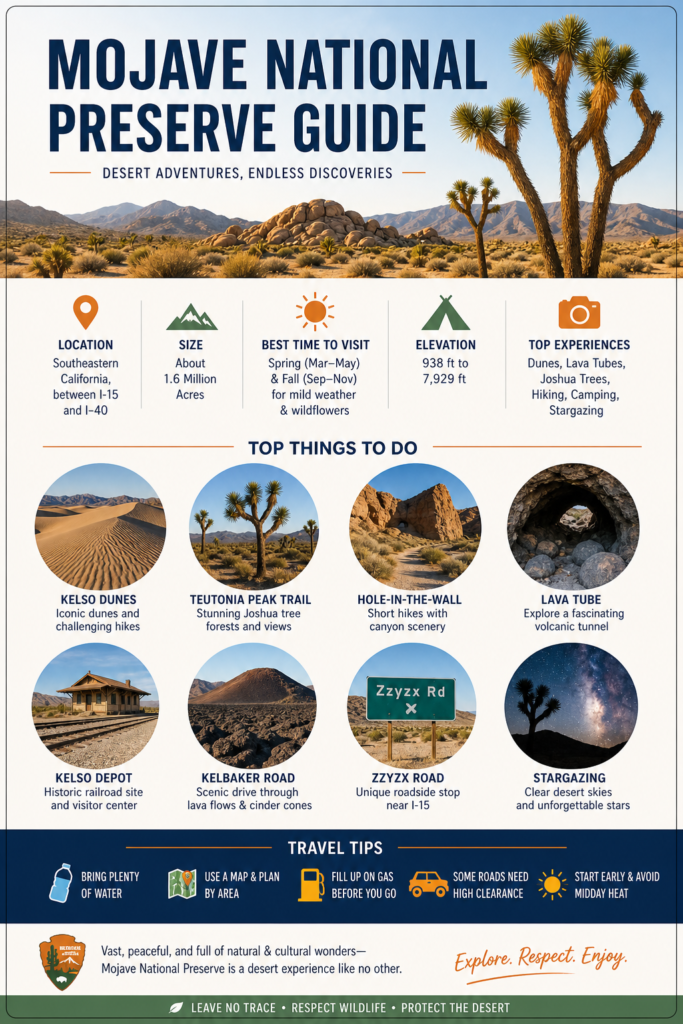
The Mojave National Preserve is one of the largest protected desert areas in the United States. It spans roughly 1.6 million acres in southeastern California, which means it is not a small roadside stop or a quick afternoon detour. It is a large, layered landscape that rewards preparation, patience, and curiosity. If you plan well, the experience becomes smoother, safer, and much more rewarding.
The preserve sits in the eastern part of the Mojave Desert, between Interstate 15 and Interstate 40. That location makes it accessible by car, but the internal distances are wide,e and the roads can stretch out for miles without major services. You may drive for a long time and still feel surrounded by open space. That sense of emptiness is not a drawback. For many visitors, it is exactly the appeal. The silence, the long horizon, and the absence of crowds create a rare feeling of openness.
What makes this preserve remarkable is its variety. In one protected region, you can encounter:
- towering dunes
- dark lava fields
- Joshua tree woodlands
- desert basins
- canyon trails
- historic rail buildings
- mountain slopes
- active desert wildlife
This diversity gives the preserve real depth. It is not just scenic; it is educational and immersive. The landscape helps visitors understand the interplay of geology, ecology, and human history. Every ridge, canyon, and plain tells a different story.
Mojave National Preserve Map and Location
Where is Mojave National Preserve?
The preserve is located in southeastern California in the high desert region. It lies near Barstow, Needles, Baker, and the Nevada border area. Because it covers such a wide territory, different parts of the preserve feel very different from one another. Some areas are lower, hotter, and more exposed. Others sit at high elevations and feel cooler and more wooded. Some roads are easy, while others require caution, patience, or a high-clearance vehicle.
This is one of the reasons the preserve map matters so much. You cannot treat it like a compact city park where every attraction is close together. Distances are broad, road conditions vary, and travel time often matters more than the mileage shown on paper. A route that looks short may take far longer if the road is rough, sandy, or unpaved.
Why the map matters
A Mojave National Preserve map is essential before you go. Without one, you may spend more time driving than exploring. The preserve is best experienced by grouping nearby sights together instead of trying to cover everything at once.
A smart way to think about the preserve is by zones:
- The Kelso area for history, dunes, and the visitor center
- Cima area for Joshua trees and Teutonia Peak
- Hole-in-the-Wall area for hiking and canyon scenery
- The Kelbaker Road area for lava flows and volcanic features
- Zzyzx area for a quick roadside stop near Interstate 15
Quick planning table
| Stop | Why is it worth seeing | Access notes |
| Kelso Dunes | Massive dunes and a classic desert hike | Gravel road access; no water at the trailhead |
| Teutonia Peak Trail | Excellent Joshua tree scenery | Paved Cima Road access |
| Hole-in-the-Wall / Rings Trail | Short hike with canyon views | Convenient trail hub |
| Lava Tube | Distinctive volcanic tunnel | Rough dirt road; high-clearance recommended |
| Kelso Depot | Historic railroad center and visitor hub | Best stop for orientation |
| Cinder Cones / lava flows | Volcanic landscape and scenic drive | Best reached from Kelbaker Road |
| Zzyzx Road | Memorable desert road and roadside stop | Easy add-on near I-15 |
Best way to read the preserve map
When you look at a Mojave National Preserve map, do not think only about distance. Think about road type, temperature, fuel, time of day, and trail difficulty. A short road can still take a while if it is rough or unpaved. Some stops are also better in the morning or late afternoon, when the light is softer, and the heat is less intense.
A map is more than a navigation tool here. It is a planning tool that helps you design a better, safer, and more efficient visit.
Mojave National Preserve Climate and Weather
What is the climate like?
The climate in Mojave National Preserve is dry, sunny, and often extremely hot in summer. Still, the weather is more varied than many people expect. This is a desert with sharp day-to-night swings. It can feel warm or hot in the Afternoon, then become surprisingly cold after sunset. That wide temperature range is one of the defining qualities of desert travel.
Rainfall is scarce. Most areas receive only a small amount of precipitation each year. Because of that, plants and animals have developed specialized ways to conserve water and survive in a difficult environment. Visitors need that same mindset. The desert is beautiful, but it demands preparation and respect.
Best time to visit
The best time to visit is usually spring, especially from March through May. During those months, temperatures are generally more comfortable, skies are often clear, and wildflowers may bloom after winter rain. Spring is ideal for hiking, driving, photography, and camping.
Fall is also a strong season to visit. The temperatures are usually milder than in summer, and the air often feels crisp and clear. It is a comfortable time for outdoor exploration.
Summer can be dangerous if you are unprepared. Heat can become severe, especially in the lower parts of the preserve. If you go in summer, begin early, carry extra water, and avoid strenuous midday hikes.
Winter brings its own beauty. The preserve can feel peaceful and dramatic, but nights become very cold. Higher elevations may even see frost or snow.
Weather tips for visitors
- Start early in the day
- Carry more water than you think you will need
- Wear layers because desert temperatures shift quickly
- Avoid long hikes during the hottest part of the day
- Check road and weather conditions before entering the preserve
The weather is one of the defining parts of the desert experience. With the right preparation, it becomes part of the adventure rather than a problem.
Mojave National Preserve Landscape and Geography
The landscape of the Mojave National Preserve is one of its strongest attractions. It is not a flat, empty desert. It is a dramatic terrain of contrast, texture, color, and elevation. Within the same preserve, you can move from soft dunes to dark volcanic rock to tree-covered mountain slopes.
Major landscape features
Kelso Dunes
The Kelso Dunes are one of the preserve’s most iconic features. They rise boldly above the surrounding desert floor and create a striking silhouette from afar. Hiking the dunes is both beautiful and demanding. The sand is soft, deep, and energy-sapping, which means every step requires more effort than on a normal trail. Even so, the experience is unforgettable. The views, the scale, and the shifting texture of the landscape make it one of the most powerful scenes in the preserve.
Cinder Cones and lava flows.
Along Kelbaker Road, visitors can see volcanic landforms such as cinder cones and lava fields. These dark surfaces stand in sharp contrast to the lighter desert terrain around them. The area reveals the force of ancient volcanic activity and gives the preserve a rugged, geologic character.
Lava Tube
The Lava Tube is one of the most unusual features in the preserve. It is a volcanic tunnel created by an old lava flow. Exploring this area gives visitors a very different kind of desert encounter. It feels isolated, fascinating, and a little mysterious, which makes it especially memorable.
Hole-in-the-Wall
Hole-in-the-Wall presents a rougher, rockier desert setting. It includes canyon walls, narrow passages, and a more rugged outdoor atmosphere. Hikers especially appreciate this area because it combines accessibility with striking scenery.
Cima Dome and Joshua Tree forests
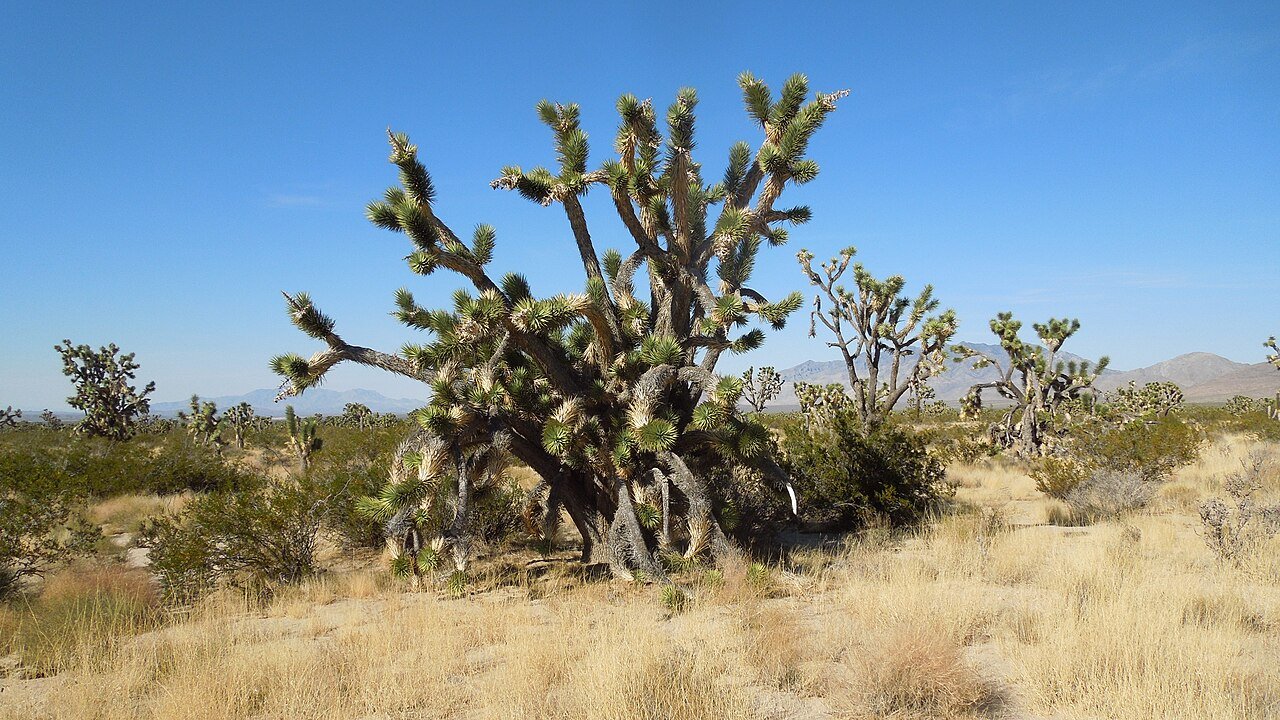
The Cima Dome area is famous for its dense Joshua tree forest. This is one of the most classic Mojave scenes and one of the best places to experience the preserve’s signature trees in large numbers. The area feels almost surreal in places, with unusual tree forms scattered across open desert ground.
Why the landscape matters
The preserve is not only beautiful. It is also a living lesson in geology and deep time. Mountains, basins, dunes, lava fields, and rock layers all reveal the Earth’s long history. When you explore the preserve, you are not just sightseeing. You are reading the land.
Plants and Flora in Mojave National Preserve
The plant life in the preserve is one of the best reasons to slow down and pay attention. Desert plants may appear sparse at first, but they are resilient, adaptive, and full of subtle detail. The more closely you look, the more interesting they become.
Main plant life
Joshua trees
The Joshua tree is the most recognizable plant in the preserve. It is the symbol most people picture when they think of the Mojave Desert. These trees grow in the lower desert and form a landscape that feels unmistakably wild and iconic. Their branching shape and tall, sculptural forms make them one of the preserve’s most distinctive visual features.
Yucca and cholla
Yucca and cholla appear throughout many parts of the preserve. They add variety to the landscape and help define the desert’s visual identity. Their forms are spiky, architectural, and uniquely suited to harsh conditions.
Pinyon pine, juniper, and white fir
At higher elevations, the preserve changes dramatically. The vegetation becomes more forest-like, with pinyon pine, juniper, and in some places white fir. This elevation shift is one of the reasons the preserve feels so diverse. The same protected area can contain both low desert plants and mountain woodland species.
Creosote and desert shrubs
Lower basins often contain creosote bush and other hardy shrubs that thrive in heat and dryness. These plants may seem ordinary at a glance, but they are among the desert’s most successful survivors.
Wildflowers
After rainfall, the preserve can burst into bloom. Wildflower displays often appear in late winter and spring, especially from March through May. The exact display depends on precipitation, temperature, and timing. Some years are modest, while others are spectacular. When flowers do appear, they create a striking contrast against the dry terrain.
Best places to see Joshua trees
The Teutonia Peak Trail area near Cima Dome is one of the best places to see large concentrations of Joshua trees. It is one of the strongest stops for anyone who wants the classic Mojave look.
Plant viewing tip
Do not rush through the scenery. The desert becomes far more rewarding when you notice the smaller details: a flower after rain, a twisted branch, a patch of green in a dry wash, or a plant growing from what seems like impossible ground. Those details give the landscape life.
Wildlife in Mojave National Preserve
The preserve supports a wide range of animal life. Many species are elusive, and some are active mostly at dawn, dusk, or after dark when temperatures are lower. Patience and quiet observation make a big difference in what you may see.
Animals you may see
Desert tortoise
The desert tortoise is one of the preserve’s most important species. It is slow-moving, threatened, and deeply connected to the health of the desert ecosystem. If you see one, observe it respectfully from a distance and do not touch it.
Desert bighorn sheep
Bighorn sheep live in steep, rocky areas where they can move with impressive agility. They are powerful climbers and are often associated with rugged mountain terrain.
Roadrunners
The roadrunner is one of the easiest and most entertaining animals to spot. It is fast, alert, and strongly associated with the desert’s identity.
Bobcats, coyotes, and mountain lions
These animals live in the region, but they are more difficult to see. Mountain lion sightings are rare, though possible. Coyotes and bobcats are more likely to leave traces than to appear for long.
Snakes and lizards
Reptiles are common throughout the preserve. Many blend perfectly into their surroundings, so visitors need to watch where they step and stay alert on trails.
Birds
The preserve is also excellent for birdwatching. Golden eagles, cactus wrens, and many other desert birds can appear in the right conditions. Open sky, cliffs, shrubs, and canyon edges create a range of bird habitats.
Wildlife viewing tips
- Go out early in the morning or near sunset
- Drive slowly and watch the road edges carefully
- Use binoculars for birds and distant animals
- Stay on trails and roads
- Keep pets controlled and away from wildlife
Good wildlife viewing often comes from patience rather than speed. The quieter you move, the more the desert reveals itself.
Human History and Cultural Value
The preserve is not only a natural environment. It is also a place shaped by deep and lasting human history. People have lived in, crossed, mined, worked, and remembered this desert for thousands of years.
Indigenous history
The land has a human story stretching back about 10,000 years. Indigenous peoples lived in and used this desert long before modern roads, signage, or visitor centers existed. Their connection to the land is part of the preserve’s long cultural record.
Railroad history
One of the most visible historic landmarks is the Kelso Depot. It once served railroad workers and travelers, and today it functions as the preserve’s main visitor center. The building helps visitors understand the rail era and the role transportation played in shaping development across the desert.
Even though the last passenger train crossed the tracks in 1997, freight trains still move through the area. That means the railroad is not only history; it remains part of the living, working landscape.
Mining and settlement
Mining, ranching, and desert travel all influenced the region. People searched for resources, built routes, and tried to adapt to a difficult and demanding environment. These activities left behind roads, structures, and stories that still matter today.
Zzyzx Road
Zzyzx Road is one of the preserve’s most unusual and memorable cultural stops. The name itself is unusual enough to capture attention, and the route leads to a desert research area with its own history. It adds a quirky and fascinating layer to the overall experience.
The human history of the preserve gives the land greater depth. It reminds visitors that this is not an empty place. It is a landscape of memory, movement, labor, adaptation, and continuity.
Camping in Mojave National Preserve
Camping is one of the best ways to experience the preserve fully. At night, the quiet becomes profound, the temperature drops, and the sky opens wide above you. The stars can be dazzling, and the desert feels larger and more intimate at the same time.
Camping options
The preserve offers developed campgrounds and also allows some backcountry and roadside camping in designated areas. This gives visitors flexibility depending on how rugged or comfortable they want their trip to be.
Popular camping areas
Mid Hills Campground
This campground is a strong choice for visitors who want a cooler, higher-elevation camping experience. It offers a quieter desert feel and works well for people seeking a less intense climate than the lower basin areas.
Hole-in-the-Wall Campground
This campground is popular because it sits near hiking trails and rocky scenery. It is especially useful for visitors who want to combine camping with outdoor exploration.
Primitive and backcountry camping
Backcountry camping is possible in some designated areas, but it requires excellent preparation. There is little water, limited shade, and minimal support if something goes wrong. Visitors should know their route, bring enough supplies, and be ready for changing conditions.
Camping safety tips
- Bring all the water you will need
- Expect cold nights in winter and hot nights in summer
- Check road conditions before driving in
- Keep food secure
- Leave no trace
- Prepare for wind, dust, and sudden temperature shifts
Why camping is worth it
Camping allows you to feel the preserve rather than just see it. Day visitors often experience only a small slice of the landscape. Campers get sunrise, sunset, nighttime silence, and the rare feeling of waking up inside the desert instead of merely passing through it.
Things to Do in Mojave National Preserve
The preserve offers many ways to explore and enjoy the land. You can hike, drive, photograph, study geology, watch wildlife, learn history, or simply sit with the openness of the place.
1. Hike the Kelso Dunes
The Kelso Dunes hike is one of the top experiences in the preserve. The dunes are beautiful, dramatic, and physically demanding in a surprising way. The sand makes the climb harder than it looks, but the reward is worth the effort.
2. Walk the Teutonia Peak Trail
This is one of the preserve’s best all-around trail experiences. It combines Joshua trees, wide views, and a classic desert atmosphere. It is a very good choice for first-time visitors and returning travelers alike.
3. Explore Hole-in-the-Wall
Hole-in-the-Wall offers a more rugged canyon-like side of the desert. The area is ideal for visitors who want a trail system that feels rocky, scenic, and slightly more adventurous.
4. Visit the Lava Tube
The Lava Tube is unusual and memorable. It brings a volcanic dimension to the trip and creates a very different mood from the surrounding desert.
5. Stop at Kelso Depot
Kelso Depot is the best place for history and orientation. It helps visitors understand the railroad legacy and provides a useful starting point for the rest of the trip.
6. Drive Kelbaker Road
Kelbaker Road is a scenic route that passes volcanic landforms, open desert views, and stretches of quiet landscape. It is an excellent way to experience the preserve without committing to long hikes.
7. Visit Zzyzx Road
This is a quick but enjoyable stop. The name is famous, the setting is unusual, and it adds a sense of curiosity and fun to the trip.
8. Watch the sunset and stars
The preserve is one of the best places for open-sky viewing. Sunsets can be intense and beautiful, while the night sky often appears exceptionally clear. If you stay overnight, stargazing should be part of the experience.
Activity table
| Activity | Best for | Difficulty |
| Kelso Dunes hike | Adventurous visitors | Moderate to hard |
| Teutonia Peak Trail | Scenic walkers | Moderate |
| Hole-in-the-Wall / Rings Trail | Short hikes and canyon scenery | Easy to moderate |
| Lava Tube visit | Geology fans | Easy to moderate |
| Kelso Depot visit | History lovers | Easy |
| Scenic driving | Road trippers | Easy |
| Stargazing | Everyone | Easy |
Best Travel Tips for Mojave National Preserve
The preserve is beautiful, but it asks for preparation. Good travel habits can make the difference between a smooth, memorable visit and a stressful one.
Travel tips that help a lot
1. Use a real map
Do not depend only on phone GPS. Download offline maps before entering the preserve.
2. Plan by area
Choose one region per day instead of zigzagging across the whole preserve. This saves time, fuel, and energy.
3. Fill up on gas before entering
There are no gas stations inside the preserve. Fuel up before you arrive.
4. Bring plenty of water
This is one of the most important rules of all. Desert heat can dehydrate you very quickly.
5. Start early
Morning is cooler and better for hiking, driving, and wildlife viewing.
6. Check road conditions
Some roads are rough, sandy, or not appropriate for low-clearance vehicles.
7. Carry layers
The desert changes fast, especially between day and night.
8. Respect the land
Stay on trails, avoid disturbing wildlife, and do not remove rocks or plants.
Why these tips matter
The preserve rewards visitors who prepare well. When you plan intelligently, you spend more time enjoying the scenery and less time dealing with avoidable problems.
Safety Tips and Survival Awareness
The desert is striking and serene, but it can also be hazardous. Safety is not an optional part of a Mojave National Preserve trip; it is one of the foundations of a successful visit.
Main risks to understand
- heat exhaustion
- dehydration
- getting lost on dirt roads
- soft sand or rough washboard roads
- snakes and wildlife
- cold nights in winter
- limited cell service
Important safety habits
- Tell someone your route
- carry extra water
- wear sunscreen and a hat
- Keep your fuel tank full
- Do not push your vehicle onto roads it cannot handle
- Avoid hiking alone in extreme heat
- Monitor the weather before entering the preserve
How to think about the desert
The preserve is not trying to intimidate visitors. It simply requires respect. The more prepared you are, the more enjoyable the experience becomes. Sound judgment is one of the most important tools you can bring.
Interesting Facts About Mojave National Preserve
Here are some helpful and fascinating facts that show how rich this place really is:
- It covers about 1.6 million acres.
- It is one of the largest protected desert landscapes in the country.
- Its elevations range from roughly 938 feet to 7,929 feet.
- Cima Dome is known for its dense Joshua tree forest.
- The preserve has a human history stretching back about 10,000 years.
- Kelso Depot is the main visitor center.
- Many dirt roads require high clearance and sometimes 4WD.
- The last passenger train crossed the tracks in 1997.
- Freight trains still run through the preserve.
- The preserve includes dunes, lava flows, canyons, and mountain terrain in one region.
These facts show how layered and diverse the preserve really is.
Pros and Cons
Pros
- huge and dramatic desert scenery
- strong mix of nature, history, and geology
- excellent for road trips, hiking, and camping
- far less crowded than many famous California destinations
- strong educational value
- beautiful sunrise, sunset, and stargazing opportunities
Cons
- long distances between attractions
- limited services inside the preserve
- rough roads in many areas
- weak or absent cell service
- Summer heat can be dangerous
- Some sites require more planning to reach
The advantages are powerful, but the challenges are real. That is why preparation matters so much.
Sample Itinerary for Mojave National Preserve
1-hour visit
- Kelbaker Road lava flows
- Teutonia Peak viewpoint
Best for: a quick scenic stop
2–3 hour visit
- Kelso Depot
- Rings Trail
- Kelso Dunes
Best for: a short but rewarding trip
1-day visit
- Teutonia Peak
- Kelso Depot
- Kelso Dunes or Hole-in-the-Wall
Best for: first-time visitors
2-day visit
- Teutonia Peak
- Kelso Depot
- Lava Tube
- Zzyzx Road
- overnight camping
Best for: a fuller desert experience
Itinerary table
| Time | Best plan | Why it works |
| 1 hour | Kelbaker Road or Teutonia Peak viewpoint | Fast scenic stop |
| 2–3 hours | Kelso Depot + Rings Trail or Kelso Dunes | Mix of history and hiking |
| 1 day | Teutonia Peak, Kelso Depot, and one more major stop | Balanced first visit |
| 2 days | Add Lava Tube, Zzyzx Road, and a campground night | Best full experience |
FAQs
No. The official name is Mojave National Preserve. Many people search for it as a national park, but it is managed as a preserve.
The best time is usually spring, especially March through May, when the weather is more comfortable, and wildflowers may bloom after rain.
Not for every area. Some main stops are reachable by paved roads or easier routes, but many backcountry roads require high clearance, and some are best suited to 4WD.
Yes. The preserve has developed campgrounds and also allows some backcountry and roadside camping in approved areas.
Cell service is limited and unreliable in many parts of the preserve.
Conclusion
Mojave National Preserve is a place of beauty, space, and surprising variety. From its dramatic dunes and volcanic formations to its wildlife, history, and star-filled skies, it offers a memorable desert experience for every kind of traveler. With the right preparation, your visit can be safe, rewarding, and unforgettable.