
Introduction
The Mojave Desert is a major desert region in the southwestern United States. It lies mostly in southeastern California and southern Nevada, with smaller parts in Arizona and Utah. Known as a high desert, it stands out for its dry climate, rugged landscapes, Joshua trees, and dramatic day-night temperature changes.
- Quick Answer: Where Is the Mojave Desert?
- Where Is the Mojave Desert Located on the Map?
- What States Is the Mojave Desert In?
- Mojave Desert Map and Boundaries
- Mojave Desert vs. Great Basin Desert vs. Sonoran Desert
- How Big Is the Mojave Desert?
- Why the Mojave Desert Is Called a High Desert
- Climate and Weather Patterns
- A simple way to think about Mojave weather
- Landscape Features of the Mojave Desert
- Famous Places in the Mojave Desert
- Flora: Plants of the Mojave Desert
- Important Mojave plants
- Why plants matter here
- Fauna: Animals of the Mojave Desert
- How desert animals survive
- Why is wildlife a strong search topic
- Human History and Native American Connections
- Travel, Roads, and Visitor Experience
- Best times to visit the Mojave Desert
- What people do there
- Environmental Issues and Conservation
- Why invasive grasses are such a problem
- Why habitat fragmentation matters
- Interesting Facts About the Mojave Desert
- Pros and Cons
- Pros
- Cons
- FAQs
- Conclusion
Quick Answer: Where Is the Mojave Desert?
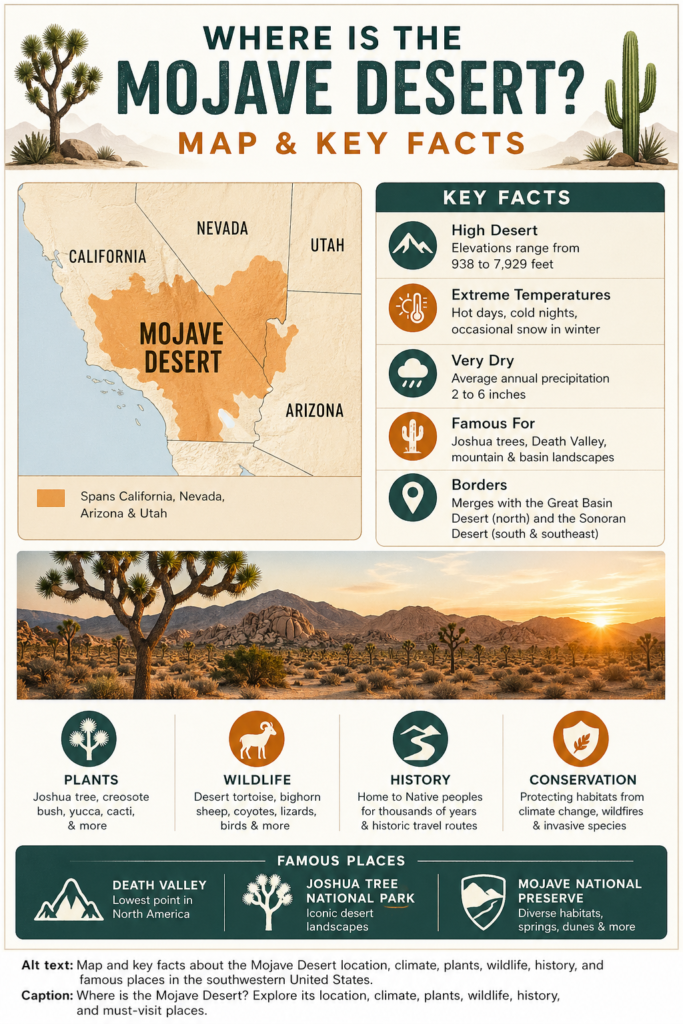
The Mojave Desert is located mainly in California and Nevada, with smaller parts in Arizona and Utah. Britannica describes it as an arid region of southeastern California and portions of Nevada, Arizona, and Utah. It also explains that the desert stretches from the Sierra Nevada range toward the Colorado Plateau and blends into the Great Basin Desert to the north and the Sonoran Desert to the south and southeast.
In plain language, the Mojave is an inland desert of the American Southwest. It does not have a single razor-sharp border. Instead, it exists as a large ecological region where one desert gradually gives way to another. That is why the answer to where the Mojave Desert is is less like a dot and more like a wide zone.
Where Is the Mojave Desert Located on the Map?
On a map of the western United States, the Mojave Desert sits inland, east of much of coastal California and south of the Great Basin. It reaches into the dry interior of the Southwest and lies between mountain systems, basins, and other desert landscapes. Britannica notes that it abuts the San Gabriel and San Bernardino mountains in the southwest, reaches toward the Sierra Nevada in the west, and stretches eastward toward the Colorado Plateau.
That location matters because it explains the Mojave’s personality. The mountains block moisture. The inland position keeps it dry. The elevation creates colder nights and cooler highland zones. The desert, therefore, acts like a geographic crossroads between mountain country, basin country, and neighboring desert ecosystems.
Mojave National Preserve offers an especially useful way to picture the region. The preserve lies in a place where three of North America’s major deserts are found nearby or overlap in influence: the Mojave, Great Basin, and Sonoran. Its mixture of elevations and soil types produces many microhabitats, which is why the scenery changes so much over relatively short distances.
What States Is the Mojave Desert In?
The Mojave Desert spans four states: California, Nevada, Arizona, and Utah. California contains the largest share, while Nevada also holds a substantial portion. Arizona and Utah include smaller sections. This four-state description is widely used in geography references and gives a clear sense of the desert’s regional scale.
That broad reach is one reason people search for it in different ways. A traveler may think of it as a California desert. A geographer may think of it as a broader Southwest desert system. Both are accurate. The Mojave is tied to state borders only in a political sense; ecologically, it continues across lines drawn on maps.
Mojave Desert Map and Boundaries
The boundaries of the Mojave Desert are best understood as natural transitions rather than hard-edged lines. Britannica says the desert merges with the Great Basin Desert to the north and the Sonoran Desert to the south and southeast. That means the Mojave does not end abruptly. Instead, its climate, plant life, elevation, and terrain slowly shift until another desert becomes more dominant.
This is why different sources sometimes describe the Mojave in slightly different ways. Some focus on southeastern California and southern Nevada. Others extend the description outward into Arizona and Utah. They are not contradicting one another. They are simply drawing attention to different parts of the same ecological continuum.
So when people ask where the Mojave Desert is, the best answer is that it occupies a broad inland zone of the Southwest, with fuzzy ecological edges and a core region centered in southeastern California and southern Nevada.
Mojave Desert vs. Great Basin Desert vs. Sonoran Desert
| Desert | Main location | Simple climate idea |
| Mojave Desert | Mostly southeastern California and southern Nevada, with parts of Arizona and Utah | High desert with very dry air and large day-night temperature swings |
| Great Basin Desert | Mostly Nevada and western Utah | Cooler, higher desert is often treated as a cold desert |
| Sonoran Desert | Southwestern Arizona, southeastern California, and northwestern Mexico | Hotter desert with stronger summer monsoon influence |
This comparison helps because the Mojave is often discussed alongside its neighbors. It is not isolated. It is part of a wider desert network across the Southwest, and each desert has a distinct character. The Mojave is the middle ground in many ways: hot, but not always scorching; dry, but still varied; rugged, but far from empty.
How Big Is the Mojave Desert?
The desert’s size depends on how the boundary is drawn. Britannica says the Mojave occupies more than 25,000 square miles. Mojave National Preserve science materials also describe it as the smallest of the North American deserts. Those statements work together because desert regions are often defined in different ways by different sources, and ecological borders are never perfectly fixed.
What matters is the scale. The Mojave is large enough to contain mountain ranges, salt flats, basins, lava fields, dunes, canyons, and long travel routes. It is also large enough that weather, habitat, and travel conditions can shift greatly from one area to another. A visitor can drive only a short distance and feel like they have entered an entirely different landscape.
Why the Mojave Desert Is Called a High Desert
The Mojave is called a high desert because much of it sits at relatively high elevation. Mojave National Preserve reports that elevations in the region range from 938 feet to 7,929 feet, and that height strongly affects the climate and vegetation. Higher elevations are cooler and can support different plant communities than lower, hotter basins.
This is important because it changes the way people imagine the desert. The Mojave is not one flat, endless heat zone. It is layered. It includes cooler uplands, warmer valleys, rocky slopes, and open basins. The Differences in elevation create differences in plant life, animal habitat, and even travel conditions.
That is why the phrase where is the Mojave Desert is closely linked to the phrase high desert. The Mojave is not just a desert by rainfall; it is a desert shaped by altitude.
Climate and Weather Patterns
The Mojave Desert is dry, but its climate is more complex than simply “hot and empty.” Britannica notes that the desert experiences extreme daily temperature variation, frequent winter frosts, and average annual precipitation of only 2 to 6 inches. That means a single place can feel very different from day to night and from one season to the next.
Mojave National Preserve adds more local detail. Summer temperatures may average from 90 to more than 105 degrees, while winter lows can drop into the 20s, and snow can occur at higher elevations. The preserve also says mountain areas receive around 9 inches of rain per year, while lower areas near Baker average roughly 3.37 inches.
Nearby Joshua Tree National Park shows the broader direction of climate stress in the region. The National Park Service says that from 1895 to 2016, annual precipitation fell by 39 percent and average temperature rose by 3°F (2°C). That does not define the entire Mojave by itself, but it does show how warming and drying trends can reshape desert ecosystems.
A simple way to think about Mojave weather
The Mojave can be chilly in the morning, warm by afternoon, breezy later in the day, and cold again after sunset. In some places, it can even snow. That wide swing in temperature is one reason the desert is so beautiful and so challenging at the same time.
Landscape Features of the Mojave Desert
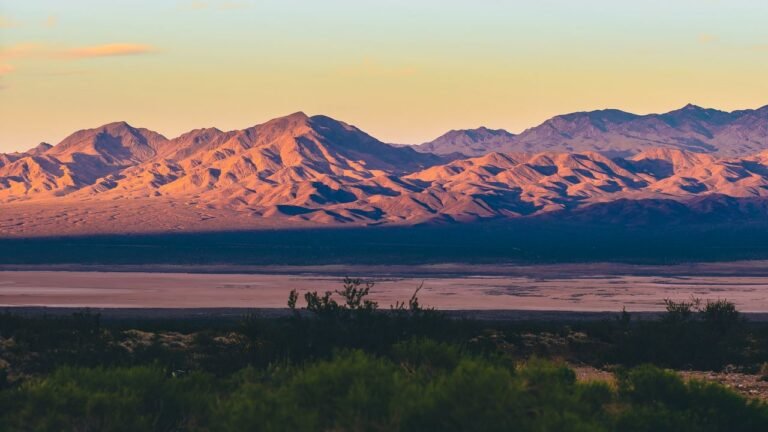
The Mojave Desert is not just dunes, despite what many people imagine. Britannica describes a landscape of mountain-and-basin topography, sand and gravel basins, and central salt flats. It also notes that minerals such as borax, potash, and salt have been mined from those flats.
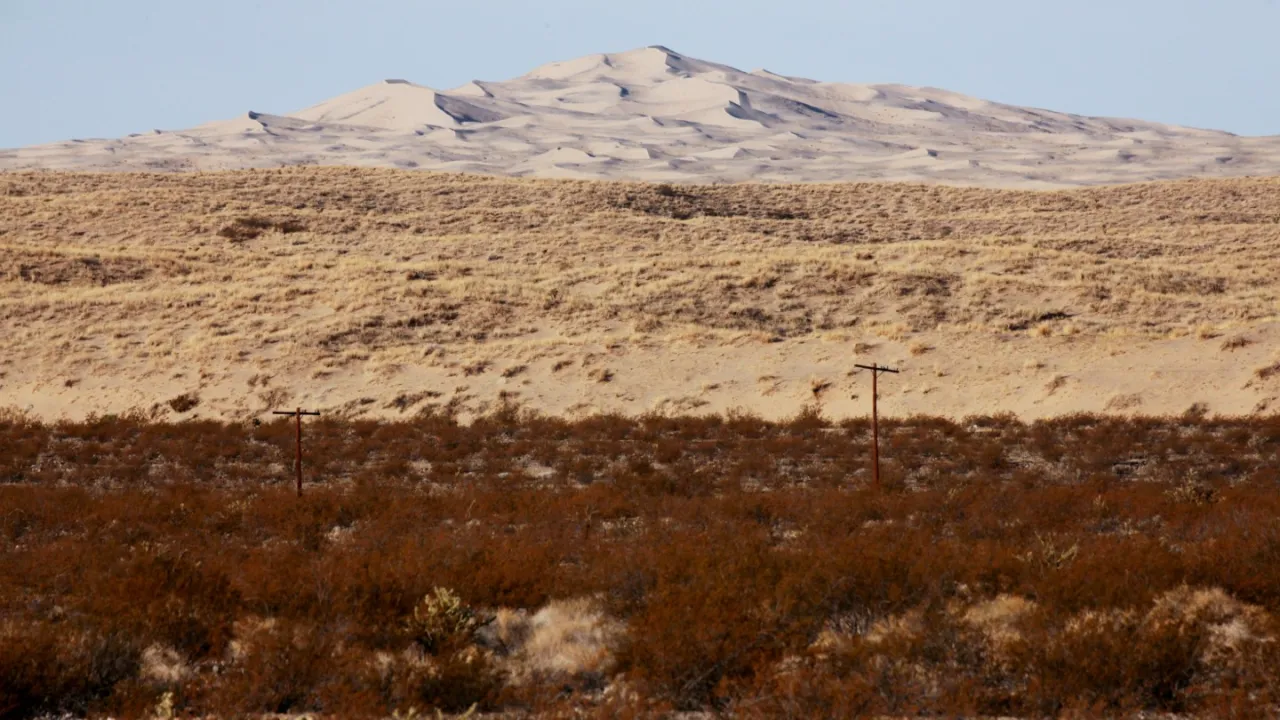
Mojave National Preserve expands that picture further. Its landscape includes mountain ranges, dry streambeds, mesas, dunes, cinder cones, domes, and lava flows. The area also contains ancient rocks, some dating back billions of years, which reveal how geologically deep and diverse the region is.
That variety is part of the desert’s identity. A visitor may expect only flat sand and open heat, but instead they encounter rocky ridges, broad basins, volcanic terrain, and dramatic mountain walls. The Mojave feels stark, but it is not simple.
Famous Places in the Mojave Desert
Several of the Mojave’s most famous locations are among the most recognized desert landscapes in the United States.
Death Valley is one of the most iconic. Britannica places it near the undefined Great Basin–Mojave boundary and identifies it as the lowest point in North America. That alone gives the region enormous geographic significance.
Mojave National Preserve is another major landmark. It protects an unusually diverse mix of habitats, including the largest and densest Joshua tree forest in the area, along with springs, dunes, volcanic features, and historic travel routes. The National Park Service explains that the preserve contains many microhabitats created by seeps, springs, altitude, and soil variation.
Joshua Tree National Park is also strongly associated with the Mojave because it sits on the boundary between the Mojave and the Colorado Desert. Britannica says the park lies on that border and is known for desert plants such as Joshua tree, creosote bush, and Mojave yucca.
These places help answer where the Mojave Desert is in a practical sense, because they give the desert a visible identity.
Flora: Plants of the Mojave Desert
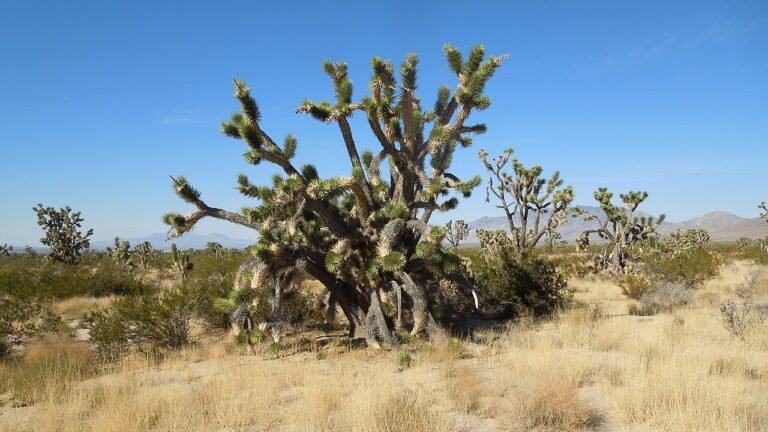
The plant life of the Mojave may appear sparse at first glance, but it is more varied than most visitors expect. Britannica lists creosote bush, Joshua tree, burroweed, and occasional cacti as part of the desert’s vegetation. Mojave National Preserve also emphasizes the Joshua tree as a symbol of the region and notes that it provides habitat for birds and other animals.
Joshua trees are among the clearest markers that you are in Mojave country. The National Park Service says they grow at elevations between 3,000 and 7,000 feet and typically live around 150 years. Young Joshua trees often depend on nurse plants, which help them survive harsh conditions during early growth.
Elevation strongly influences the desert’s vegetation. Higher areas can support white fir, juniper, and pinyon pine. Lower areas are more likely to have yuccas, Joshua trees, cholla, and creosote. Many annual plants also rush through short life cycles during the winter and spring rainy season before the desert dries out again.
Important Mojave plants
Some of the key plant names associated with the Mojave Desert include Joshua tree, creosote bush, Mojave yucca, blackbrush, and several drought-tolerant cacti. Creosote bush is especially widespread and is one of the toughest and most resilient shrubs in the desert.
Why plants matter here
Plants are not just decoration. They stabilize soil, shade the ground, feed wildlife, reduce erosion, and reveal subtle changes in elevation and moisture. In the Mojave, a change in plant community often signals a change in the land itself.
Fauna: Animals of the Mojave Desert
The Mojave Desert is far more biologically active than it appears from a distance. Mojave National Preserve says the region supports 50 documented mammal species, more than 200 bird species, 36 reptile species, three amphibian species, three fish species, and countless insects and arachnids. That is a remarkable level of biodiversity for such a dry environment.
Many desert animals are easy to miss because they avoid heat, bright light, and open ground. The Mojave is often busiest at times when humans are not looking. Cooler hours bring out birds, lizards, rodents, bats, and other wildlife. Many larger animals move through rocky slopes, shaded washes, or remote areas where water and shelter are available.
Some of the most familiar Mojave animals include the desert tortoise, desert bighorn sheep, coyotes, kangaroo rats, jackrabbits, lizards, and bats. These species are widely linked with the region’s ecological identity and help make the desert feel alive rather than empty.
How desert animals survive
Many desert animals stay active at night, hide in burrows, remain close to springs, or move between microhabitats with slightly cooler conditions. Reptiles reduce water loss through thick scaly skin, while other species are adapted to obtain water from food or conserve it through reduced activity. Survival in the Mojave is all about timing, shelter, and efficiency.
Why is wildlife a strong search topic
People searching for where the Mojave Desert is often also want to know what lives there. Wildlife is not a side issue; it is a major part of the desert’s identity. Animals explain why the region is fragile, fascinating, and worth protecting.
Human History and Native American Connections
The Mojave Desert has a long and complex human history. The National Park Service says Native Americans lived in the region for thousands of years, with artifacts around Lake Mojave dating back at least to 5,000 B.C. and evidence suggesting people lived there even earlier, around 10,000 years ago.
The Mojave people developed trade routes across the desert and along reliable water sources. NPS explains that they established routes from the Colorado River to the California coast and marked trails between springs to make travel safer. One of those travel corridors later became part of the Mojave Road.
That history matters because the Mojave was never empty land. It was a route, a homeland, a trade network, and a survival landscape. Water sources shaped where people moved, where they stayed, and how they exchanged goods. The desert’s human geography is inseparable from its natural geography.
The Mojave Road is one of the clearest symbols of that connection. The National Park Service says it was used by Indigenous people, later by American settlers traveling west, and eventually as a military and mail route. It was improved with congressional funding between 1857 and 1860.
This gives the desert a deeper meaning. It was both barrier and passage, both harsh and useful, both difficult and necessary. That dual role is part of why the Mojave continues to matter so much.
Travel, Roads, and Visitor Experience
The Mojave is a major travel region, but it is not a place to approach casually. The National Park Service says the Mojave Road is about 150 miles long, runs east-west between the Colorado River and the Mojave River area near Wilmington, California, and is not regularly maintained. Some sections are rough and sandy, so a 4×4 vehicle is recommended.
The same guidance warns travelers to check road conditions before heading out. Seasonal issues such as water on Soda Lake, washouts from summer monsoon storms, and winter snow or ice can make routes impassable. In other words, desert travel changes with the season.
Mojave National Preserve also emphasizes the need for preparation. Long distances, limited services, and rapidly changing weather make planning essential. The remoteness is part of the attraction, but it is also part of the risk.
Best times to visit the Mojave Desert
For most visitors, the best time to explore the Mojave is during the cooler months. Summer heat can be severe, while winter conditions may be cold or snowy at higher elevations. Milder seasons usually provide the safest and most comfortable experience.
What people do there
People visit the Mojave for hiking, photography, camping, stargazing, road trips, geology, and history. Because the region includes dunes, lava flows, Joshua tree woodlands, canyons, and old travel corridors, it offers a wide range of experiences in one vast desert setting.
Environmental Issues and Conservation
The Mojave faces several serious environmental pressures. The National Park Service says the area has become hotter and drier over the past century, and that climate change is affecting landscapes, species, and visitors. It also warns that Joshua tree habitat may shrink sharply under future warming conditions.
Fire is another major threat. NPS says that in the Mojave, fires create open space for invasive plants, which then promote larger and more frequent fires. It also reports that the Dome Fire in Mojave National Preserve burned 43,000 acres and more than one million Joshua trees in the summer of 2020.
A Mojave National Preserve science newsletter adds that the desert’s vegetation does not recover easily after large wildfires and that non-native grasses such as red brome can increase fine fuels, making fire spread even more likely. That is a major problem because desert ecosystems are not built to rebound quickly after intense burns.
Why invasive grasses are such a problem
Invasive grasses spread rapidly, dry out quickly, and create a connected fuel layer across the landscape. Native desert plants are not adapted to that kind of fire pattern. Once grass invasion becomes widespread, the result can be a damaging cycle of more grass, more fire, and less native habitat.
Why habitat fragmentation matters
The Mojave may look open and uninterrupted, but roads, utilities, and development can break up movement corridors for wildlife. Species such as desert bighorn sheep can be affected by barriers and fragmented habitat. That is why conservation in the Mojave must happen at a large scale, not in isolated patches alone.
Interesting Facts About the Mojave Desert
One major fact is that the Mojave includes the lowest point in North America: Death Valley. That makes the region one of the most famous and geographically important desert areas on the continent.
Another surprising fact is that the desert is far more biologically active than it first appears. Mojave National Preserve’s wildlife counts show that it supports a wide range of mammals, birds, reptiles, amphibians, fish, insects, and arachnids. It is a functioning ecosystem, not an empty void.
A third important fact is that water has always directed movement here. Springs, seeps, and known water sources shaped Indigenous travel routes, settlement patterns, ranching, and later military roads. In the Mojave, water is not just a natural feature. It is the central force behind geography, history, and survival.
Pros and Cons
Pros
The Mojave offers dramatic scenery, famous parks, massive skies, excellent stargazing, and a unique mix of geology, wildlife, and history. It is one of the most rewarding desert regions in the United States for anyone who enjoys wide landscapes and open space.
Cons
The desert can be extremely hot, very dry, and far from services. Roads may be rough, weather can shift quickly, and wildlife habitats are sensitive to fire and careless tourism. Anyone visiting should bring water, fuel, maps or GPS, and a flexible itinerary.
FAQs
It is mostly in southeastern California and southern Nevada, with smaller sections in Arizona and Utah.
Yes. California contains the largest share of the Mojave Desert.
Because much of it lies at high elevation. Mojave National Preserve ranges from 938 to 7,929 feet, and elevation strongly influences temperature and vegetation.
It is famous for Joshua trees, Death Valley, salt flats, mountain-and-basin scenery, and sharp day-night temperature changes.
The Mojave supports desert tortoises, bighorn sheep, coyotes, kangaroo rats, birds, reptiles, bats, and many insects. Mojave National Preserve alone reports 50 mammal species, over 200 bird species, and 36 reptile species.
Common Mojave plants include Joshua tree, creosote bush, Mojave yucca, cholla, and other drought-adapted shrubs and cacti. Joshua trees usually grow between 3,000 and 7,000 feet and are one of the clearest markers of Mojave habitat.
The safer and more comfortable season is usually the cooler part of the year. Desert travel becomes more demanding in extreme heat, winter cold, snow, or rough road conditions.
Conclusion
The Mojave Desert is more than a point on a map. It is a vast high desert shaped by elevation, climate, wildlife, and history. Mostly found in California and Nevada, it remains one of the most distinctive desert landscapes in North America.