
Introduction
When people think of a desert ecosystem, they often imagine endless sand and very little life. In reality, deserts are active, highly adapted environments shaped by extreme dryness, intense sunlight, and limited water Availability. Plants, animals, microbes, and people all survive here by developing special ways to conserve resources and cope with harsh conditions.
A desert is defined by low rainfall, not just high temperatures. That means deserts can be hot, cold, rocky, or coastal, but they all share one key feature: water scarcity. This guide explains how desert ecosystems work, from climate and landforms to plants, animals, food webs, and conservation.
- What Is the Ecosystem of a Desert?
- Simple Definition
- Why the Ecosystem of a Desert Is So Unique
- Location and Geography of Desert Ecosystems
- Main Geographic Causes of Deserts
- Climate and Weather Patterns in a Desert
- Table: Main Climate Features of a Desert
- Hot Deserts vs Cold Deserts
- Hot Deserts
- Cold Deserts
- Desert Landforms and Landscape Features
- Main Desert Landforms
- Why Landforms Matter
- Abiotic and Biotic Factors in the Desert Ecosystem
- Abiotic Factors
- Biotic Factors
- Table: Abiotic vs Biotic Factors
- Flora: How Desert Plants Survive
- Main Desert Plant Adaptations
- Common Desert Plants
- Example
- Fauna: Animals of the Desert Ecosystem
- Common Desert Animals
- Main Survival Strategies of Desert Animals
- Example: The Camel
- Example: Desert Tortoise
- Microbes, Fungi, and Soil Life in Desert Ecosystems
- Desert Food Chains and Food Webs
- Main Levels in a Desert Food Web
- Simple Desert Food Chain Example
- Why the Desert Food Web Is Fragile
- Table: Desert Food Web Example
- How Plants and Animals Survive Together
- Desert Survival Timing
- Human Life in the Desert Ecosystem
- Desert Cultures and Traditions
- Modern Pressures on Desert Communities
- Why the Ecosystem of a Desert Matters
- Interesting Facts About the Ecosystem of a Desert
- Environmental Problems in Desert Ecosystems
- Main Threats
- Why Damage Is So Serious
- Conservation of the Desert Ecosystem
- Main Conservation Methods
- Table: Conservation Actions and Their Benefits
- Tourism in Desert Ecosystems
- Why Desert Tourism Must Be Careful
- Practical Travel Tips
- Pros and Cons
- Pros
- Cons
- FAQs
- Conclusion
What Is the Ecosystem of a Desert?
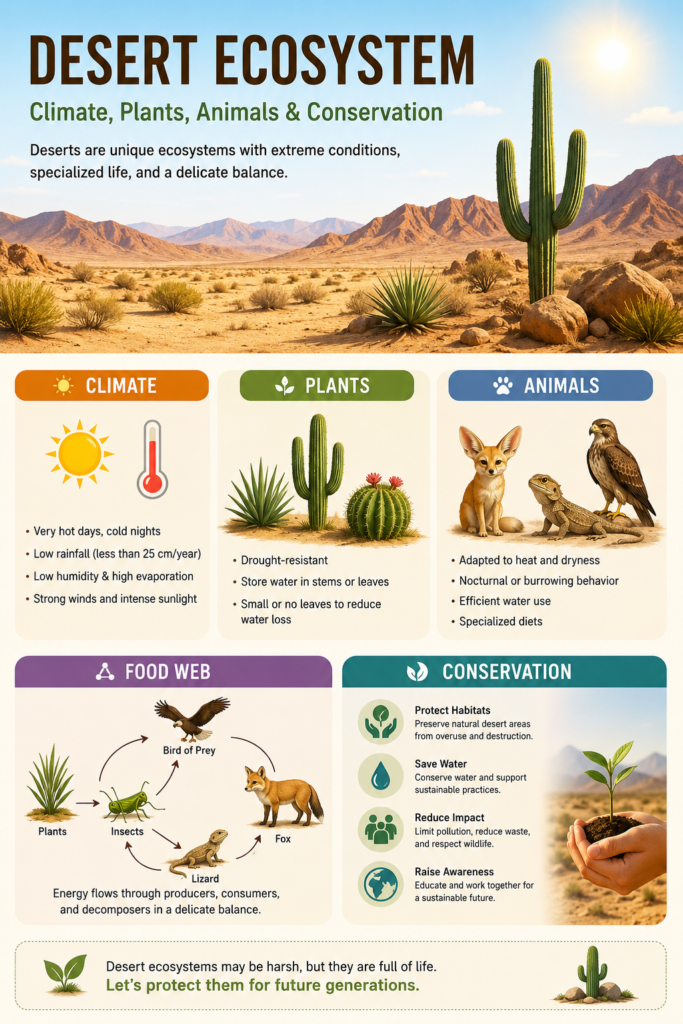
A desert ecosystem is a community of living organisms and non-living environmental factors that interact in a very dry environment. The living components include plants, animals, fungi, bacteria, and people. The non-living components include sunlight, temperature, wind, rocks, soil, and the extremely limited supply of water.
The most important point is this: a desert is not empty. It may appear quiet from a distance, but it is full of ecological activity. Much of that activity happens at night, below ground, or during short rainy periods. Many desert organisms survive by entering dormancy during harsh conditions and reactivating when moisture becomes available.
The desert ecosystem is governed by one overriding principle: precipitation is scarce, and evaporation is high. That reality influences plant growth, animal behavior, nutrient cycling, and human settlement patterns. It also makes deserts highly specialized and often fragile.
Simple Definition
A desert ecosystem is the balance between life and dryness in a region that receives very little rainfall.
Why the Ecosystem of a Desert Is So Unique
The ecosystem of a desert stands out because it operates under intense environmental pressure. In wetter biomes, life can spread rapidly. In deserts, every organism must adapt carefully to survive.
Here are some of the defining characteristics:
Water is limited.
Sunlight is intense.
Temperatures may swing dramatically between day and night.
Wind can be persistent and powerful.
Soil may be dry, salty, rocky, or nutrient-poor.
Living things often grow slowly and in patches.
Because of these conditions, desert organisms tend to be highly specialized. Desert plants are often xerophytic, meaning they are adapted for dry conditions. Desert animals are often nocturnal, burrowing, or highly efficient at conserving water. Even the soil surface, including biological crusts, plays a major ecological role.
This is why deserts are frequently described as fragile ecosystems. A small disturbance in rainfall, grazing, groundwater use, or land management can trigger a larger ecological ripple effect.
Location and Geography of Desert Ecosystems
Deserts exist on every continent. Some of the most famous include the Sahara, Arabian Desert, Gobi Desert, Atacama Desert, Mojave Desert, and the arid regions of Australia. Antarctica is also a desert because it is exceptionally dry.
Deserts appear in different geographic settings. Many are coastal. A few are continental interiors. Some lie in rain shadows behind mountain ranges. any sit on plateaus. Some are polar. Because of this, desert landscapes vary widely and are not all sand-filled or uniformly hot.
Main Geographic Causes of Deserts
1. Subtropical High-Pressure Belts
In many regions, air descends in the subtropics. When air sinks, it warms and dries, which suppresses cloud formation and reduces rainfall.
2. Rain Shadow Effect
Mountain ranges can block moist air masses. One side receives rain, while the leeward side remains dry. That dry side may develop into a desert.
3. Coastal Currents
Cold ocean currents can cool the air above nearby land. This reduces rainfall and contributes to coastal desert formation.
4. Distance from Moisture Sources
Some deserts are far from oceans, lakes, or other sources of moisture. These are called interior or continental deserts.
5. Polar Dryness
Polar regions receive very low levels of precipitation. As a result, they are classified as cold deserts.
Climate and Weather Patterns in a Desert
Climate is the foundation of the desert ecosystem. Everything begins with limited rainfall and intense evaporation.
Deserts generally experience:
very low annual precipitation
high evaporation rates
dry air
strong solar radiation
large day-night temperature variation
long periods of drought
occasional sudden storms
In many deserts, rain does not fall gently and steadily. Instead, it may arrive in short, powerful bursts. Water then runs across the surface quickly, Causing flash floods or briefly filling dry channels called wadis. Much of that water disappears just as fast as it arrives.
Table: Main Climate Features of a Desert
| Climate Feature | What It Means | Effect on the Ecosystem |
| Low rainfall | Very little precipitation falls each year | Limits plant growth and surface water |
| High evaporation | Water is lost rapidly to the atmosphere | Soil dries quickly |
| Strong sunlight | Solar radiation is intense for long periods | Increases heat stress |
| Wide temperature range | Days may be hot and nights cool or cold | Forces special survival strategies |
| Wind | Air movement can be frequent and strong | Shapes dunes and spreads dust |
Hot Deserts vs Cold Deserts
Not all deserts are hot. That is one of the biggest misconceptions about the ecosystem of a desert.
Hot Deserts
These are the deserts most people imagine. They have bright sunlight, low humidity, and little rainfall. The Sahara and Arabian Desert are classic examples.
Cold Deserts
These deserts may be frozen or snowy for much of the year, but they still receive extremely low precipitation. Antarctica is the largest desert on Earth because it is so dry.
This distinction matters because the ecosystem of a desert should be understood as a dryness-based biome, not simply a hot landscape.
Desert Landforms and Landscape Features
A desert is much more than dunes. In fact, dunes make up only a portion of many desert regions. Large desert areas are rocky, gravel-covered, mountainous, or flat with salt deposits.
Main Desert Landforms
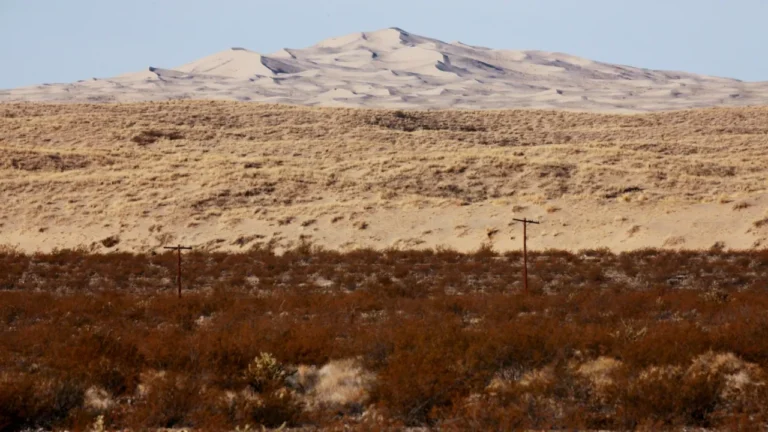
Sand Dunes
These are wind-shaped mounds or ridges of sand. They are iconic, but they represent only one desert habitat type.
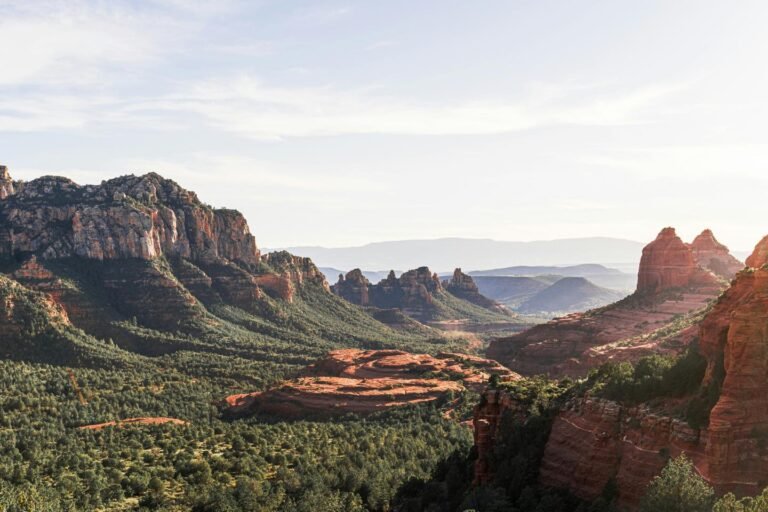
Rocky Deserts
These landscapes contain exposed stone, cliffs, and rugged surfaces. Many animals use rocks for shelter and shade.
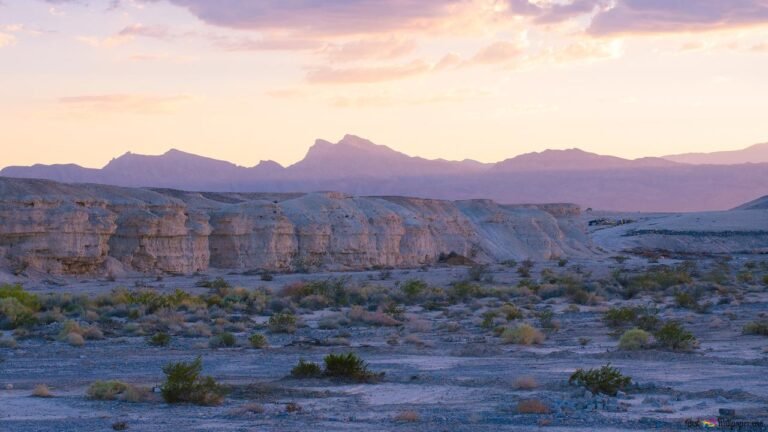
Gravel Plains
These broad surfaces are covered with pebbles and coarse fragments. They may seem plain, but they occupy vast areas.
Salt Flats
These form when water evaporates and leaves mineral residue behind.
Mountains and Valleys
Desert mountains and canyons create microclimates that are cooler, more protected, or slightly moister than nearby open land.
Why Landforms Matter
Landforms shape how life survives. A shady canyon may support more vegetation than an exposed plain. A crevice in a rock may protect a reptile from predators and temperature extremes. A salt basin may support only highly tolerant halophytic plants.
This means the ecosystem of a desert is not one uniform environment. It is a mosaic of microhabitats, each with its own ecological conditions.
Abiotic and Biotic Factors in the Desert Ecosystem
Every ecosystem has two broad categories of components:
Abiotic factors: non-living elements
Biotic factors: living elements
In a desert, abiotic forces are especially important because water limitation is so severe.
Abiotic Factors
These include:
sunlight
heat
cold
wind
soil texture
salinity
rainfall
evaporation
rocks
sand
drought
Biotic Factors
These include:
desert plants
insects
reptiles
birds
mammals
fungi
bacteria
humans
Table: Abiotic vs Biotic Factors
| Factor Type | Examples | Role in the Desert |
| Abiotic | Sun, wind, rainfall, soil, salinity | Controls where life can persist |
| Biotic | Plants, animals, fungi, microbes, humans | Builds the food web and nutrient cycle |
The interaction between these two categories determines the structure, resilience, and biodiversity of the desert ecosystem.
Flora: How Desert Plants Survive
Desert plants are masters of conservation. They have evolved remarkable strategies to retain water, reduce transpiration, and survive long dry spells.
Some people assume deserts have no plant life. That is incorrect. Deserts may include shrubs, grasses, wildflowers, cacti, succulents, and hardy trees. These plants may not look lush, but they are highly adapted and ecologically important.
Main Desert Plant Adaptations
1. Water Storage
Some plants store water in stems, leaves, or roots. Cacti and many succulents are famous examples.
2. Small Leaves or Spines
Smaller leaves lose less moisture. In some species, leaves are modified into spines.
3. Deep Root Systems
Certain plants send roots deep into the ground to access underground moisture.
4. Shallow, Wide Roots
Other species spread roots near the surface so they can absorb brief rainfall quickly.
5. Waxy Cuticles
A waxy coating on leaves and stems reduces evaporation.
6. Dormancy
Many desert plants become inactive during harsh periods and resume growth after rainfall.
7. Rapid Life Cycles
Some annual plants germinate, flower, set seed, and die very quickly after rain.
Common Desert Plants
cactus
agave
aloe
sagebrush
creosote bush
desert grasses
saltbush
date palm in oasis regions
Example
After a rare rainfall, parts of the desert can burst into color for a short time. Wildflowers bloom, insects emerge, birds arrive, and the landscape becomes unexpectedly vibrant. This is a powerful reminder that the ecosystem of a desert is often waiting rather than being lifeless.
Fauna: Animals of the Desert Ecosystem
Desert animals face a major challenge: they must avoid overheating while surviving on very little water. Their bodies and behaviors reflect these demands.
Many desert animals are nocturnal. Others remain underground during the day. Some become active only during cool mornings or evenings.
Common Desert Animals
camels
foxes
kangaroo rats
desert tortoises
lizards
snakes
scorpions
beetles
hawks
owls
roadrunners
jackrabbits
Main Survival Strategies of Desert Animals
Nocturnal Behavior
Many desert creatures come out at night to avoid the daytime heat.
Burrowing
Some species live underground, where temperatures are more stable, and humidity may be slightly higher.
Water Conservation
Many desert animals produce concentrated urine, sweat very little, or lose minimal water through breathing.
Moisture from Food
Some animals get enough hydration from seeds, insects, or succulent vegetation.
Light Coloring
Pale fur, scales, or feathers can help reflect sunlight and reduce heat absorption.
Body Shape Adaptations
Certain species have large ears, long legs, or other traits that help dissipate heat.
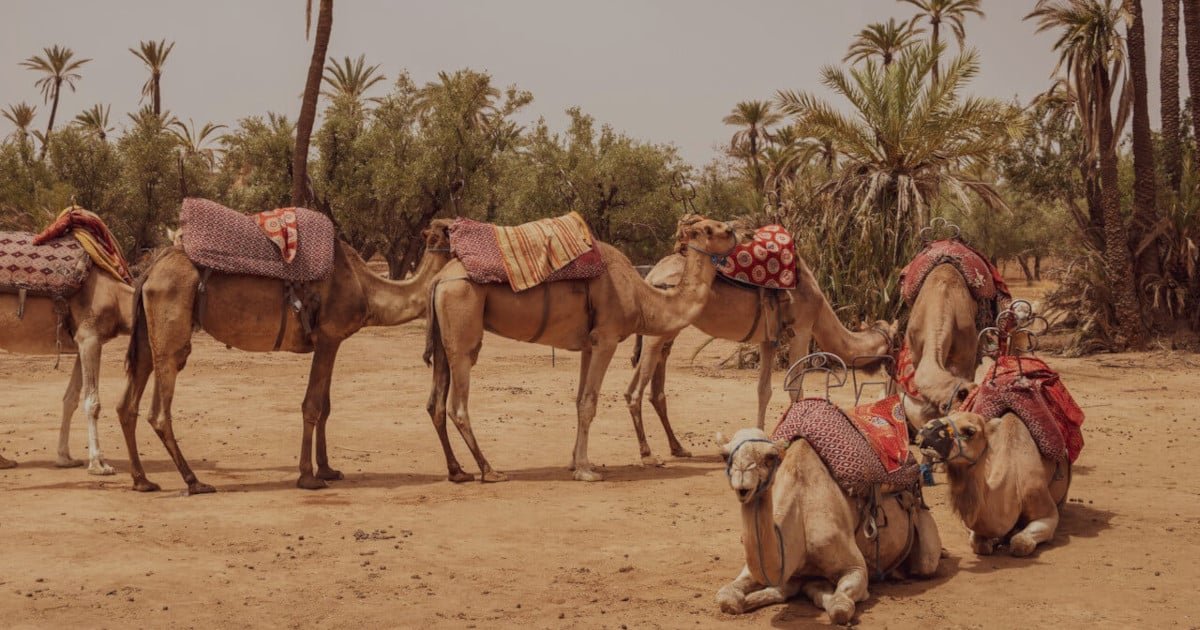
Example: The Camel
The camel is one of the most famous desert animals. It can travel long distances with little water, survive heat stress, and store energy in its body. It is not just a transport animal; it is a symbol of endurance in arid landscapes.
Example: Desert Tortoise
A desert tortoise survives by conserving water and spending much of its time in burrows. This helps it avoid heat, dehydration, and predators.
Microbes, Fungi, and Soil Life in Desert Ecosystems
The smallest organisms in the ecosystem of a desert are often overlooked, but they are essential.
Soil microbes and fungi help:
decompose organic matter
recycle nutrients
support root systems
improve soil structure
stabilize the ground
Some desert soils contain biological soil crusts made of algae, lichens, mosses, fungi, and bacteria. These crusts help prevent erosion, capture moisture, and support ecosystem function.
This hidden biological layer is extremely important because desert soil is delicate. Once it is damaged by off-road vehicles, construction, or overgrazing, recovery may take a very long time.
Desert Food Chains and Food Webs
A desert food chain shows how energy passes from one organism to another. A desert food web gives a fuller picture because most species eat multiple things and have multiple predators.
At the base of the food web are producers, the plants that capture energy from sunlight through photosynthesis.
Main Levels in a Desert Food Web
Producers
of desert shrubs
grasses
cacti
wildflowers
salt-tolerant plants
Primary Consumers
insects
rodents
rabbits
grazing mammals
Secondary Consumers
lizards
snakes
small birds
small mammals
Tertiary Consumers
hawks
owls
foxes
coyotes
larger predators
Simple Desert Food Chain Example
Sun → Desert shrub → Insect → Lizard → Hawk
This is a simplified chain. Real desert ecosystems are far more interconnected. A fox might eat a rodent, a bird, or an insect. A hawk might feed on lizards or rabbits. Energy moves through many channels, which is why the food web is a better model than a single chain.
Why the Desert Food Web Is Fragile
The ecosystem of a desert depends heavily on rainfall timing. Whenever rain falls, plants grow. After plants grow, insects multiply. When insects increase, birds and reptiles find more food. Once the dry season returns, the entire system contracts.
That means the desert food web is adaptive but vulnerable. It can respond quickly to rain, yet it may also collapse or weaken rapidly during prolonged drought.
Table: Desert Food Web Example
| Level | Example Organisms | Role |
| Producer | Shrub, cactus, grass | Makes food using sunlight |
| Primary consumer | Insect, rabbit, rodent | Eats plants |
| Secondary consumer | Lizard, snake, small bird | Eats plant-eaters |
| Tertiary consumer | Hawk, fox, owl | Eats smaller animals |
How Plants and Animals Survive Together
The ecosystem of a desert is not merely about individual survival. It is about ecological timing.
Seeds may remain dormant for months or years. Rain triggers germination. Plants emerge. Insects hatch. Birds arrive. Predators follow prey populations. Then drought returns, and many organisms slow down again or retreat underground.
This seasonal rhythm creates a dynamic but highly constrained ecological cycle.
Desert Survival Timing
seeds remain dormant.
Rain activates growth
Insects increase quickly
Birds and reptiles feed
Predators move in
dry conditions return
This pattern shows that desert life is not random. It is highly coordinated with climate pulses and resource availability.
Human Life in the Desert Ecosystem
Humans have lived in deserts for thousands of years. Over time, they developed practical knowledge about water, shelter, movement, and land use.
People in desert regions often depend on:
oases
wells
seasonal grazing
animal herding
trade routes
shade structures
water-sharing traditions
Desert Cultures and Traditions
Desert communities often possess deep knowledge of:
water management
navigation
animal care
shelter construction
heat adaptation
seasonal mobility
These cultural systems are part of the ecosystem of a desert because people are also shaped by water scarcity, temperature extremes, and fragile soils.
Modern Pressures on Desert Communities
Today, desert life is changing because of:
urban expansion
mining
roads
irrigation
tourism
climate change
These forces can create jobs and access, but they may also increase habitat loss, water stress, and ecosystem fragmentation.
Why the Ecosystem of a Desert Matters
Some people mistakenly think deserts have little value because they appear empty. That is a major misunderstanding.
The ecosystem of a desert matters because it supports:
biodiversity
specialized habitats
soil stabilization
carbon storage
grazing land
cultural heritage
scientific research
tourism economies
Deserts also teach us how life adapts to scarcity. They show how organisms persist under pressure, conserve resources, and survive environmental extremes. In an era of climate instability and water stress, that knowledge is deeply valuable.
Interesting Facts About the Ecosystem of a Desert
Here are some memorable facts that help explain the topic more clearly:
Deserts exist on every continent.
Antarctica is the world’s largest desert.
Not all deserts are hot.
Dunes represent only a small part of many deserts.
Many desert species are nocturnal.
Rain can transform a desert landscape quickly.
Desert soils are often fragile.
Microbial life is essential in drylands.
Human cultures have long adapted to desert living.
These facts reinforce a key idea: the ecosystem of a desert is richer and more dynamic than most people assume.
Environmental Problems in Desert Ecosystems
Desert ecosystems are vulnerable not only because of natural dryness, but also because of human pressure and climate stress.
Main Threats
1. Desertification
Desertification is land degradation in dry regions. It is not simply the natural spread of deserts. It is a process of ecological decline caused by climate variability, overuse, and poor land management.
2. Overgrazing
Too many grazing animals can remove vegetation, expose soil, and accelerate erosion.
3. Water Overuse
Groundwater extraction and inefficient irrigation can reduce water availability and damage vegetation.
4. Habitat Disturbance
Road building, off-road driving, and construction can harm fragile surfaces and destroy native plants.
5. Climate Change
Rising temperatures and stronger drought patterns intensify stress on desert life.
6. Mining and Urban Expansion
These activities can fragment habitat, pollute land, and alter drainage patterns.
Why Damage Is So Serious
Recovery in deserts is slow. Plants grow slowly. Soil develops slowly. Biological crusts are delicate. When damage occurs, restoration may take years or even decades. That is why conservation is so important.
Conservation of the Desert Ecosystem
Protecting the ecosystem of a desert means preserving the balance between dryness and life.
Main Conservation Methods
Sustainable Grazing
Livestock should be managed carefully so native vegetation is not overused.
Water Management
Water must be conserved and used efficiently in dry regions.
Native Plant Protection
Native vegetation helps anchor soil and support wildlife.
Habitat Restoration
Damaged areas can sometimes be repaired through long-term restoration projects.
Protected Areas
Nature reserves and conservation zones help safeguard biodiversity.
Responsible Tourism
Tourism should generate income without damaging soils, vegetation, or wildlife.
Community Involvement
Local communities should help lead conservation because they know the land, seasons, and risks best.
Table: Conservation Actions and Their Benefits
| Conservation Action | Benefit |
| Controlled grazing | Protects vegetation |
| Water conservation | Reduces pressure on dry ecosystems |
| Native planting | Helps habitat recovery |
| Protected areas | Safeguards wildlife |
| Responsible tourism | Supports income with less damage |
| Community-led planning | Improves long-term success |
Tourism in Desert Ecosystems
Deserts attract tourists because they are dramatic, peaceful, and visually stunning. Their landscapes are often associated with adventure, silence, and open skies.
Tourists visit deserts for:
dune drives
camel rides
camping
stargazing
hiking
wildlife watching
cultural experiences
photography
Why Desert Tourism Must Be Careful
Tourism can support local economies, but it can also damage fragile terrain. A single vehicle can disturb soil crusts. Heavy foot traffic can weaken plants. Disturbance can also stress wildlife.
Practical Travel Tips
carry enough water
Travel in the right season.
wear sun protection
Stay on marked paths.
respect local regulations
Use local guides when possible, and
avoid disturbing wildlife
Responsible tourism helps maintain the health of the ecosystem of a desert while still allowing people to experience its beauty.
Pros and Cons
Pros
Unique biodiversity
Strong cultural heritage
Important ecosystem services
Beautiful landscapes
Tourism value
Scientific importance
Cons
Very little water
Fragile food webs
Slow recovery from damage
High temperature stress
Desertification risk
Difficult farming conditions
These strengths and limitations show that deserts are both valuable and vulnerable.
FAQs
The ecosystem of a desert is the interaction of plants, animals, microbes, soil, climate, and water conditions in a very dry place. The main feature is a lack of rainfall.
No. Some deserts are hot, but others are cold, coastal, or polar. Antarctica is the largest desert in the world because it is extremely dry.
It is fragile because water is limited and recovery is slow. Small changes can affect plant cover, animal food, and soil stability.
Common desert plants include cactus, agave, aloe, sagebrush, creosote bush, saltbush, grasses, and date palms in oasis areas.
Desert animals include camels, foxes, lizards, snakes, scorpions, owls, hawks, rodents, tortoises, and many insects.
Conclusion
The desert ecosystem is much richer than it first appears. Beneath the dry surface, there is a complex balance of life, climate, soil, and water that supports specially adapted plants, animals, and human communities. Every part of the system depends on survival strategies built around scarcity.
Deserts are fragile, valuable, and important to study and protect. Understanding how they work helps us appreciate not only their beauty but also their role in biodiversity, culture, and conservation.