
Introduction
The average temp for a Desert is not the same Everywhere. Some deserts are extremely hot, while others stay cool, cold, or even frozen. What makes a desert a desert is not heat alone, but very low rainfall. This is why desert temperatures can change a lot from day to night and from one season to another.
- What Is a Desert?
- Why “Average Temp for Desert” Is a Tricky Question
- Quick Answer: What is the Average Temp fora desertt?
- Desert Types and Their Temperature Patterns
- 1. Hot Deserts
- 2. Cold Deserts
- 3. Coastal Deserts
- 4. Polar Deserts
- Average Temp for Desert by Type
- How Hot Do Deserts Really Get?
- Why Desert Temperatures Change So Much
- 1. Low Humidity
- 2. Clear Skies
- 3. Limited Vegetation
- Day-Night Temperature Swings in Deserts
- Seasonal Temperature Patterns in Deserts
- In Hot Deserts, summer can be extremely hot
- Inside Cold Deserts
- In Coastal Deserts
- In Polar Deserts
- Average Temp for Desert by Month and Season
- Hot Desert in Summer
- Hot Desert in Winter
- Cold Desert in Winter
- Cold Desert in Summer
- Coastal Desert in Summer
- Coastal Desert in Winter
- Geography: Where Deserts Are Found
- Subtropical Belts
- Rain Shadows
- Continental Interiors
- Coastal Regions
- Polar Regions
- Famous Deserts and Their Temperature Style
- Sahara Desert
- Arabian Desert
- Gobi Desert
- Atacama Desert
- Namib Desert
- Antarctica
- Landscape Features in Deserts
- Table: Desert Features and What They Mean
- Flora: Desert Plants That Survive on Very Little Water
- Common Desert Plant Adaptations
- Examples of Desert Plants
- Fauna: Desert Animals, Reptiles, Insects, and Birds
- Common Desert Animal Adaptations
- Desert Animals You May Find
- Why Reptiles Do So Well in Deserts
- Why Insects Matter
- Human History in Desert Regions
- How Desert Communities Adapted
- Why the Average Temp for Desert Matters to Travelers
- Travel Risks in Deserts
- Travel Benefits of Knowing Desert Temperature
- Survival Tips for Desert Conditions
- 1. Drink More Water Than You Think You Need
- 2. Use Sun Protection
- 3. Dress in Layers
- 4. Avoid Midday Heat
- 5. Carry Navigation Tools
- 6. Check the Weather Before You Go
- 7. Bring Extra Water and Snacks
- Tourism: Why Deserts Are So Popular
- Popular Desert Activities
- Why Desert Tourism Works So Well
- What to Pack for a Desert Trip
- Pros and Cons
- Pros
- Cons
- Interesting Facts About Deserts
- 1. Deserts Are Defined by Dryness
- 2. Deserts Can Be Freezing
- 3. Desert Temperatures Shift Fast
- 4. Deserts Are Not Empty
- 5. Desert Landforms Are Unique
- Environmental Issues and Conservation
- Why Conservation Matters
- Main Conservation Goals
- When Is the Best Time to Visit a Desert?
- Common Mistakes People Make About Desert Temperature
- FAQs
- Conclusion
What Is a Desert?
A desert is a region that receives very little precipitation. In many cases, a desert gets less than 25 cm (10 inches) of rain or snowfall per year. That dryness is the core reason it qualifies as a desert.
Many people picture a desert as a place filled with endless dunes. That image is incomplete. A desert can be:
- sandy
- rocky
- gravel-covered
- salty
- icy
- windy
- flat
- mountainous
The key feature is dryness, not sand. Not heat. Dryness.
This is why Antarctica is also considered a desert. It is covered in ice, but it receives very little precipitation. The same principle explains why some deserts are cold instead of hot. If the land is dry enough, it can be a desert even when the temperature never feels like a classic “hot desert” scene.
So when someone asks, “What is the average temp for a desert?”, the correct answer depends on which kind of desert they mean. A desert in the Sahara is very different from a desert in the Gobi or Antarctica.
Why “Average Temp for Desert” Is a Tricky Question
The term average can be misleading.
Do you mean:
- The average temperature during the day?
- The average temperature at night?
- The annual average?
- The hottest month?
- The coldest month?
All of those can produce very different answers in a desert.
For example, one desert may have a warm yearly average but still become chilly after sunset. Another may be cold most of the year, yet still meet the definition of a desert because it receives almost no precipitation. A coastal desert may feel moderate and breezy even though it remains extremely dry. A high-altitude desert may stay cool because elevation influences the climate more strongly than latitude alone.
That is why any useful desert temperature guide should include:
- desert type
- daily temperature range
- seasonal pattern
- elevation and location
- rainfall and humidity
Without those details, a single number can be incomplete or even deceptive.
Quick Answer: What is the Average Temp fora desertt?
There is no single average temp for desert because deserts vary widely.
Still, here is a simple general guide:
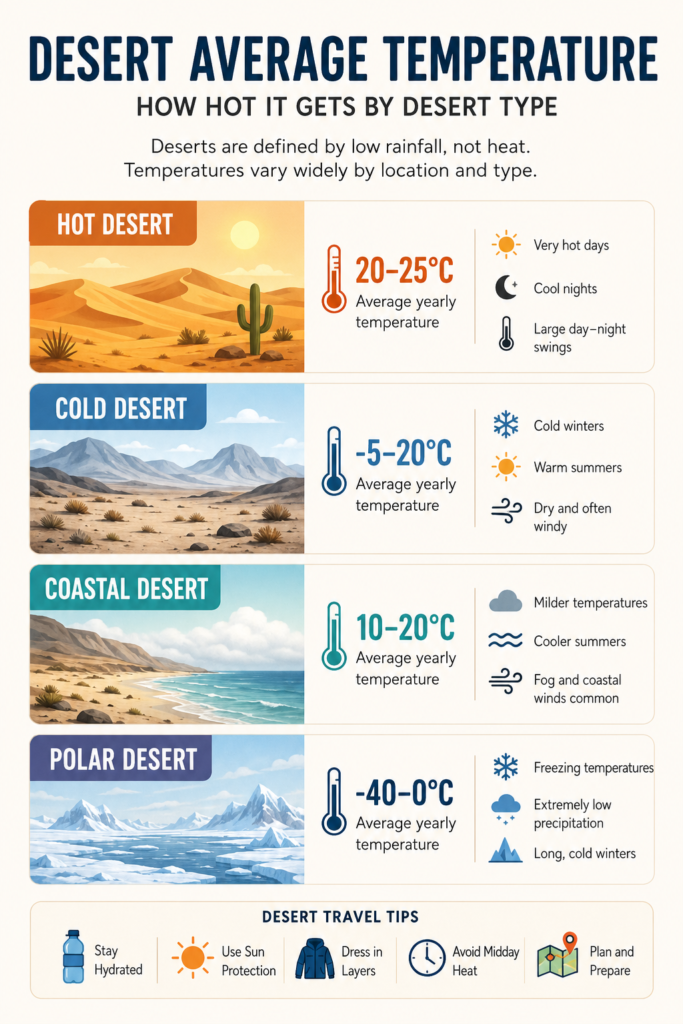
- Hot deserts: often around 20–25°C average yearly temperature
- Cold deserts: may have cold winters and warm summers
- Coastal deserts: usually milder, with smaller swings
- Polar deserts: extremely cold, but still dry
If you want one plain-language answer, the average temp for the desert often falls in the warm range overall, but the actual temperature can shift sharply between day and night, and it can change again from one season to another.
Desert Types and Their Temperature Patterns
Not all deserts behave the same way. To understand desert temperature properly, you need to look at the major desert categories.
1. Hot Deserts
Hot deserts are what most people imagine first. These are the classic deserts with intense sunlight, dry air, and very warm afternoons.
Examples include:
- Sahara Desert
- Arabian Desert
- parts of the Sonoran Desert
- parts of the Thar Desert
Typical pattern:
- very hot days
- cooler nights
- strong solar radiation
- low humidity
- large seasonal differences in some regions
Hot deserts can feel extreme because sunlight heats the ground very quickly, but that same heat also escapes quickly once the sun goes down. The result is a climate that can feel almost theatrical in its contrast: fierce warmth by day and a noticeable chill by night.
2. Cold Deserts
Cold deserts are dry, but they are not hot year-round. They may have harsh winters and warm or even pleasant summers.
Examples include:
- Gobi Desert
- Great Basin Desert
- parts of Patagonia
Typical pattern:
- cold winters
- mild to warm summers
- Snowfall can occur
- dry air
- wide temperature oscillation
A cold desert can surprise people because it does not match the popular image of dunes and heat waves. But it still fits the desert definition because the amount of rainfall is low.
3. Coastal Deserts
Coastal deserts are located near oceans. They are often more temperate than inland deserts because nearby water bodies help moderate the climate.
Examples include:
- Atacama Desert
- Namib Desert
Typical pattern:
- mild temperatures
- cooler summers
- cool nights
- very low rainfall
- Fog and coastal winds can influence conditions.
These deserts are fascinating because they may not seem especially hot, yet they remain extremely dry. The ocean softens the temperature extremes, but it does not necessarily bring enough rainfall to create a humid environment.
4. Polar Deserts
Polar deserts are cold, icy, and dry.
Examples include:
- Antarctica
- parts of the Arctic
Typical pattern:
- freezing temperatures
- extremely low precipitation
- snow and ice rather than rain
- long cold seasons
- short, weak summers
Polar deserts remind us that a desert is defined by the absence of moisture, not the presence of heat.
Average Temp for Desert by Type
Here is a simple comparison to make the differences easier to understand.
| Desert Type | Typical Temperature Pattern | What It Feels Like |
| Hot Desert | Average yearly temperatures are often around 20–25°C; daytime heat can rise far higher | Strong sun, dry air, and large day-night changes |
| Cold Desert | Cold winters and warm summers; temperatures may fall below freezing in winter | Dry, chilly, and often windy |
| Coastal Desert | Milder temperatures with smaller extremes | Less severe, but still dry |
| Cold | Icy, harsh, and moisture-starved |
This table shows why the phrase average temp for the desert can be misleading if it is not tied to the desert type. A desert is not a single climate. It is a family of climates sharing one main trait: low rainfall.
How Hot Do Deserts Really Get?
Many hot deserts can become extremely warm during the day. In some regions, summer temperatures can climb above 40°C, and exceptional heat events can go even higher. The ground may feel scorching under direct sunlight, especially where there is little shade or vegetation.
But here is the important part: deserts do not stay that hot all day and all night. Once the sun sets, the temperature can fall rapidly.
That means desert life is shaped by two opposing forces:
- intense daytime heat
- fast nighttime cooling
The ground absorbs solar energy quickly during the day because cloud cover is limited and moisture in the air is scarce. After sunset, that stored heat radiates away just as fast. The result is a landscape that can go from burning hot to Surprisingly chilly in a matter of hours.
So when people ask how hot deserts really get, the answer is:
- very hot in the afternoon
- much cooler at night
- different depending on season and location
Why Desert Temperatures Change So Much
Deserts are known for rapid temperature change because of three major factors.
1. Low Humidity
Dry air does not retain heat as effectively as moist air. Humid air acts like a thermal blanket, but desert air lacks that insulating moisture. As a result, heat disappears quickly after sunset.
2. Clear Skies
Many deserts have clear skies for long stretches of the year. Clear skies mean strong sunlight during the day, followed by quicker heat loss at night once the sun goes down.
3. Limited Vegetation
Plants help shade the ground and hold some moisture in the soil. In deserts, there is often very little vegetation, so the ground absorbs direct sunlight without much protection.
Because of these three conditions, desert temperatures can swing dramatically over a single 24-hour cycle.
Day-Night Temperature Swings in Deserts
This is one of the most important characteristics of a desert climate.
A desert can feel hot enough to drain your energy in the day, then cool enough to make you reach for a jacket after dark. That happens because:
- The air is dry
- Clouds are sparse
- The ground heats quickly
- The ground cools quickly
The difference between daytime and nighttime temperatures can be substantial, especially in inland deserts.
For travelers, that means packing only for daytime heat is a mistake. A desert morning may call for layers, while the afternoon may require sun protection and breathable clothing. This sharp contrast is one reason the phrase average temp for the desert is more useful when paired with time-of-day details.
Seasonal Temperature Patterns in Deserts
Deserts also change with the seasons.
In Hot Deserts, summer can be extremely hot
- Spring and autumn may remain warm
- Winter can be mild or cool
- Nighttime temperatures may still drop sharply
Inside Cold Deserts
- Winter is often severe and bitterly cold
- Summer may be comfortable or warm
- Snowfall can occur
- The yearly average remains low
In Coastal Deserts
- The ocean helps reduce extreme heat
- Summers are often cooler than in inland deserts
- winters may be mild or simply chilly
- Fog may create moisture even when rainfall is rare
In Polar Deserts
- Winter lasts a long time
- Summer is short and weak
- Temperatures stay low for most of the year
- Precipitation is very limited
This is why a serious desert guide should never talk about only one average temperature. Desert climate is dynamic, layered, and shaped by location, altitude, and air movement.
Average Temp for Desert by Month and Season
A desert’s monthly temperature often matters more than its yearly average. A single annual figure can hide the real experience.
Hot Desert in Summer
- very high daytime temperatures
- intense sunlight
- dry heat
- cooler nighttime air
Hot Desert in Winter
- warm days in some areas
- cold nights
- a more comfortable season for many travelers
Cold Desert in Winter
- freezing or near-freezing conditions
- possible snowfall
- dry but extremely cold air
Cold Desert in Summer
- can feel warm and pleasant
- still dry
- strong day-night contrast
Coastal Desert in Summer
- moderate warmth
- lower extremes
- winds and fog may influence comfort
Coastal Desert in Winter
- cool rather than freezing in many places
- milder than inland desert regions
The most useful lesson here is simple: desert temperature should be read as a pattern, not a single number.
Geography: Where Deserts Are Found
Deserts exist all over the world, and they form for different reasons.
Subtropical Belts
Many hot deserts occur near the subtropics, where descending air suppresses cloud formation and limits rainfall.
Rain Shadows
Some deserts form on the leeward side of mountains. The mountains force moisture-bearing air upward, causing rain to fall on one side while the other side stays dry.
Continental Interiors
Far inland areas may receive very little humidity because ocean moisture cannot reach them easily.
Coastal Regions
Cold ocean currents can stabilize the air and reduce rainfall, creating coastal deserts.
Polar Regions
Cold air holds little moisture, which is why polar regions can also qualify as deserts.
This geographical variety explains why the average temp for a desert can change so much from one region to the next.
Famous Deserts and Their Temperature Style
Sahara Desert
The Sahara is the world’s most iconic hot desert. It is famous for brilliant sunlight, intense heat, and dry air. In many areas, summer temperatures can become exceptionally high.
Arabian Desert
The Arabian Desert is known for strong heat and arid conditions, especially in inland regions where the land receives very little moisture.
Gobi Desert
The Gobi is a cold desert. Winters can be harsh, and summers can be warm. It is dry, but not always hot.
Atacama Desert
The Atacama is a coastal desert in South America. It is one of the driest places on Earth and is known for its moderate temperatures in many zones.
Namib Desert
The Namib is another coastal desert. It is dry, windy, and cooler than many inland deserts.
Antarctica
Antarctica is the largest desert on Earth. It is dry, frozen, and extremely cold.
Each of these deserts proves the same point: desert temperature is not one universal pattern.
Landscape Features in Deserts
Deserts are not all dunes. They can contain a surprising range of landforms.
Common desert features include:
- dunes
- rocky plateaus
- gravel plains
- dry valleys
- canyons
- salt flats
- playas
- salt pans
- barren mountain ranges
Some deserts are famous for their endless dunes, while others are best known for cliffs, stone, or flat basins. The appearance of a desert depends on wind, water, erosion, geology, and time.
This matters because climate shapes the land. Low rainfall and strong wind carve landscapes that look very different from wetter environments.
Table: Desert Features and What They Mean
| Feature | What It Is | Why It Forms |
| Dunes | Hills of sand | Wind moves loose sediment |
| Salt Flat | White, flat surface of salt | Water evaporates and leaves minerals behind |
| Playa | Dry lake bed | Water collects after rain and then vanishes |
| Rock Plateau | High, flat rocky terrain | Erosion shapes the land over time |
| Canyon | Deep cut in stone | Water and wind slowly wear away the surface |
This table shows that deserts are far more diverse than the stereotype of endless golden sand.
Flora: Desert Plants That Survive on Very Little Water
Desert plants are masters of adaptation. They do not waste water. They store it, conserve it, or use it only when conditions allow.
Common Desert Plant Adaptations
- thick stems that store moisture
- small leaves that reduce water loss
- waxy outer surfaces
- deep root systems
- wide, spreading roots
- rapid growth after rainfall
- dormant seeds waiting for water
Examples of Desert Plants
- cacti
- succulents
- drought-tolerant shrubs
- seasonal wildflowers
- thorny bushes
- salt-tolerant plants in coastal deserts
At first glance, desert plants may look plain, sparse, or even fragile. In reality, they are highly specialized survival systems. A small change in leaf shape, stem structure, or root depth can determine whether a species thrives or fails in dry conditions.
After a rare rain, a desert may bloom suddenly. That transformation is one of the most spectacular moments in nature. A landscape that appears silent and bare for months can burst into color in a short time when moisture finally arrives.
Fauna: Desert Animals, Reptiles, Insects, and Birds
Desert animals are equally resourceful. They do not fight the desert; they adapt to it.
Common Desert Animal Adaptations
- being active at night
- burrowing underground
- conserving body water
- staying in the shade
- Reducing activity during heat
- moving over wide distances
Desert Animals You May Find
- camels
- foxes
- rodents
- lizards
- snakes
- beetles
- birds
- insects
- coyotes in certain dry regions
Why Reptiles Do So Well in Deserts
Reptiles are often well-suited to desert environments because they can tolerate heat and regulate exposure to sunlight carefully. Many are most active at dawn or dusk rather than during peak afternoon heat.
Why Insects Matter
Insects may seem minor, but they play a huge ecological role. After rainfall, many appear rapidly and become an important food source for birds, reptiles, and mammals. They are a crucial part of the desert food web.
Desert ecosystems are fragile, but they are also active, interconnected, and resilient in their own way.
Human History in Desert Regions
People have lived in deserts for a very long time. Human communities learned to survive with:
- limited water
- strong sun
- long travel distances
- hot days
- cold nights
How Desert Communities Adapted
- traveling during cooler parts of the day
- building shade and thick walls
- storing water carefully
- wearing clothing that protects against the sun and sand
- moving with seasonal conditions
- depending on trade, herding, and careful resource use
Many desert cultures became exceptionally skilled at reading weather, locating water, and navigating vast dry terrain. These abilities were not optional—they were essential for survival.
Today, millions of people still live in desert regions. Deserts are not empty places. They are inhabited, culturally rich, and historically significant landscapes.
Why the Average Temp for Desert Matters to Travelers
If you plan to visit a desert, temperature is not a minor detail. It is one of the most important things to understand.
A desert may look warm on a map, but the real experience depends on the hour, the season, and the type of desert.
Travel Risks in Deserts
- heat exhaustion
- dehydration
- sunburn
- abrupt nighttime cooling
- poor visibility due to dust
- flash floods in dry washes
- slippery salt crusts
- rocky terrain and foot injuries
Travel Benefits of Knowing Desert Temperature
- better packing
- safer hiking
- smarter sunrise and sunset planning
- fewer weather surprises
- improved trip timing
The more accurately you understand the average temp for the desert, the better prepared you are to enjoy the trip safely.
Survival Tips for Desert Conditions
Whether you are a visitor, writer, student, or planner, these habits help.
1. Drink More Water Than You Think You Need
Dry air removes moisture from your body faster than many people expect.
2. Use Sun Protection
Wear sunscreen, sunglasses, a hat, and light, protective clothing.
3. Dress in Layers
Desert mornings and nights can be cool even when the afternoon is hot.
4. Avoid Midday Heat
The middle of the day is often the hottest and least forgiving period.
5. Carry Navigation Tools
Some desert regions are vast, open, and easy to misread.
6. Check the Weather Before You Go
Wind, temperature, and even cold snaps can matter on the same day.
7. Bring Extra Water and Snacks
Do not count on finding supplies in remote terrain.
Tourism: Why Deserts Are So Popular
Deserts attract travelers because they are dramatic, peaceful, and visually unforgettable.
Popular Desert Activities
- scenic drives
- stargazing
- sunrise watching
- sunset photography
- short hikes
- wildlife viewing
- geology trips
- dune exploration
- camping
Why Desert Tourism Works So Well
Deserts often have huge skies, crisp light, and striking colors. At sunrise and sunset, the landscape can look gold, crimson, orange, or violet. That is why photographers and nature lovers are drawn to deserts so strongly.
But desert travel is best when you plan around the temperature. Early morning and late afternoon are often the most comfortable times. Midday is usually the harshest period in hot desert environments.
What to Pack for a Desert Trip
A practical desert packing list includes:
- water bottle or hydration pack
- sunscreen
- sunglasses
- wide-brim hat
- light long-sleeve clothing
- warm layers for night
- sturdy shoes
- snacks
- map or GPS
- basic first aid supplies
The idea is simple: prepare for heat and cool air at the same time. That dual preparation is one of the smartest habits a desert traveler can have.
Pros and Cons
Pros
- gives a quick sense of the climate
- helps compare one desert to another
- useful for travel planning
- good as a starting point for students and readers
Cons
- hides day-night swings
- ignores the desert type
- can be misleading for hot, cold, coastal, and polar deserts
- does not clearly show seasonal variation
So the phrase average temp for desert is useful, but only when you combine it with desert type, season, and daily temperature shift.
Interesting Facts About Deserts
Here are a few facts that make deserts even more fascinating:
1. Deserts Are Defined by Dryness
A desert is not a desert because it is hot. It is a desert because it is dry.
2. Deserts Can Be Freezing
A desert can be cold, icy, and still meet the definition of a desert.
3. Desert Temperatures Shift Fast
The same location can be intensely hot in the day and cool or cold at night.
4. Deserts Are Not Empty
They support plants, animals, and many human communities.
5. Desert Landforms Are Unique
Dunes, salt flats, rock canyons, and dry basins all appear in desert environments.
These facts help explain why readers searching for the average temp for a desert often learn much more than they expected.
Environmental Issues and Conservation
Deserts are delicate ecosystems.
They can be affected by:
- climate change
- overgrazing
- poor water management
- soil damage
- land development
- habitat loss
Why Conservation Matters
Desert ecosystems recover slowly because water is scarce. If plants, soil, or wildlife are damaged, restoration can take a very long time.
Main Conservation Goals
- Protect water sources
- reduce habitat destruction
- support native species
- prevent erosion
- manage tourism responsibly
Deserts may appear tough, but they need protection just as much as forests, wetlands, and grasslands.
When Is the Best Time to Visit a Desert?
That depends on the desert type, but in general:
- Early morning is often ideal for cooler air and softer light
- sunset is excellent for comfort and photography
- Winter may be better for hot deserts
- Spring or autumn often works well in many inland dry regions
Avoid the most intense midday heat in hot desert areas unless you are properly prepared.
Common Mistakes People Make About Desert Temperature
Many people assume that:
- All deserts are hot
- Deserts are always sandy
- desert nights stay warm
- desert climates are the same everywhere
- average temperature tells the whole story
These ideas are incomplete or incorrect.
The truth is much richer and more interesting. Desert climate changes with latitude, altitude, ocean influence, wind patterns, and rainfall. That is why a strong article on the average temp for desert should always explain the different desert types and how they behave.
FAQs
There is no single average because deserts are different. Many hot deserts have yearly average temperatures around 20–25°C, while cold deserts, coastal deserts, and polar deserts can be much cooler.
No. Deserts can be hot, cold, coastal, or polar. The main feature of a desert is low rainfall, not heat.
Deserts cool quickly after sunset because the air is dry and there are often few clouds. Heat escapes rapidly into the atmosphere.
Some of the hottest desert regions are found in the Sahara and parts of the Arabian region. Certain desert surfaces can also reach extreme temperatures in satellite measurements.
Pack water, sun protection, layered clothing, sturdy shoes, and a way to navigate. Desert temperatures can change quickly from day to night.
Conclusion
There is no single average temperature for all deserts. Some are hot, some are cold, and some are mild, but all deserts share one thing: dryness. Understanding the type of desert, the season, and the time of day gives the clearest picture of its true climate.