
Introduction
Deserts are not just hot, sandy places—they are defined by extreme dryness. These environments appear in predictable global patterns, shaped by climate, wind circulation, ocean currents, and geography. Deserts can be hot, cold, coastal, or even polar, and they exist on every continent. Understanding where deserts are located helps explain how Earth’s climate system works.
- Quick Answer: Where Are Deserts Located?
- What Is a Desert, Really?
- Desert definition in simple words
- Where Are Deserts Located on the World Map?
- Why Are Many Deserts Near 30 degrees latitude?
- Simple explanation of the process
- Why Do Some Deserts Form on Western Edges of Continents?
- Why this matters
- Why Do Mountains Create Deserts?
- Common rain-shadow desert examples
- Hot Deserts vs Cold Deserts
- Hot deserts
- Cold deserts
- Key difference
- Types of Deserts and Where They Are Found
- Deserts by Continent
- Africa
- Asia
- North America
- South America
- Australia
- Antarctica
- Arctic
- The Largest Deserts in the World
- The largest desert overall
- The largest hot desert
- Other major deserts
- What Do Desert Landscapes Look Like?
- Common desert landforms
- Why deserts look so different
- Important idea
- Why Are Sand Dunes So Famous?
- Plants That Grow in Desert Regions
- Common survival strategies
- Examples of desert plants
- Why desert plants matter
- Animals That Live in Deserts
- Common animal survival strategies
- Examples of desert animals
- Why are desert animals important
- How Do People Live in Desert Areas?
- Common ways people adapt
- Important point
- Why Do Deserts Matter to Human History?
- Tourism in Desert Regions
- Popular desert activities
- Famous desert destinations
- Why deserts are popular for tourism
- Desert Travel Tips and Safety
- Main risks
- Simple travel safety tips
- Interesting Facts About Desert Location
- Pros and Cons
- Pros
- Cons
- Environmental Issues and Conservation
- Common threats
- Why conservation matters
- Good conservation practices
- Why Deserts Are Important for Science
- Where Are Deserts Located? Final Map Logic
- 1. Subtropical belt
- 2. Western continental margins
- 3. Mountain rain shadows
- 4. Continental interiors
- 5. Polar regions
- FAQs
- Conclusion
Quick Answer: Where Are Deserts Located?
Deserts are located in several major parts of the world:
- Near the subtropics, around 15° to 30° latitude north and south of the equator
- Along the western sides of continents, where cold ocean currents reduce rainfall
- On the leeward side of mountain ranges in rain shadow regions
- Deep inside continental interiors, rs where moist air rarely reaches
- In polar regions, where precipitation is extremely low, even though temperatures are cold
That is why deserts are present in Africa, Asia, Australia, North America, South America, Antarctica, and the Arctic. They are not only hot, but they are also not always sandy. They are dry regions shaped by climate, circulation, and landforms.
What Is a Desert, Really?
A desert is an area that receives very little precipitation. In simple terms, it is a place where rain, snow, sleet, or other forms of moisture are scarce. Many educational sources use a common benchmark of roughly 250 mm, or 10 inches, of precipitation per year, although the exact cutoff can vary by definition.
That distinction matters because deserts are often reduced to a stereotype: hot, empty, and covered in sand. Yet a desert can be cold, icy, stony, gravelly, coastal, or high-altitude. The surface may differ dramatically, but the underlying principle stays the same: water is limited, and life must adapt to that limitation.
Desert definition in simple words
A desert is:
- A very dry place
- A region with low annual rainfall
- An environment where plants and animals need specialized adaptations to survive
- A place that may be hot, cold, coastal, inland, rocky, or icy
That is what makes deserts so remarkable. They are not all visually alike, but they all share one central trait: water scarcity.
Where Are Deserts Located on the World Map?
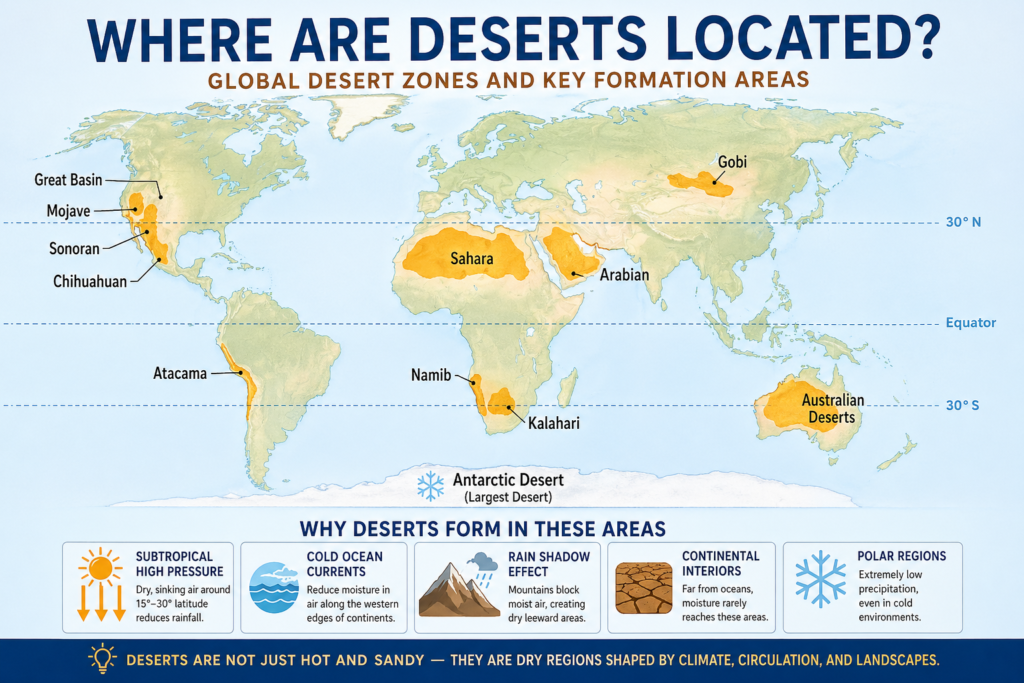
If you examine a world map, deserts appear in recognizable global patterns. Many of the best-known hot deserts lie near the Tropics of Cancer and Capricorn, where descending air discourages cloud formation and precipitation. This subtropical belt is one of the most important desert-producing zones on the planet.
You will find major deserts in:
- North Africa: the Sahara
- The Middle East: the Arabian Desert
- Southwestern North America: the Mojave, Sonoran, Chihuahuan, and Great Basin deserts
- South America: the Atacama
- Southern Africa: the Namib and parts of the Kalahari
- Australia: vast interior desert regions
- Central and East Asia: the Gobi and other dry basins
- Polar regions: the Arctic and Antarctic deserts
The map of deserts seems patterned because it is patterned. Atmospheric circulation, mountain barriers, ocean Temperatures, and continental position all help determine where dry climates can persist.
Why Are Many Deserts Near 30 degrees latitude?
This is one of the core ideas in desert geography.
Around 30° north and 30° south latitude, air that originally rose near the equator has already shed much of its moisture through rainfall. When that air moves poleward and descends in the subtropics, it becomes warmer and drier. Warm, descending air inhibits cloud development, and without clouds, rainfall remains limited.
This circulation pattern creates broad high-pressure zones associated with dry weather. That is why many of the planet’s largest deserts lie in this latitude belt.
Simple explanation of the process
- Warm air rises near the equator.
- It cools as it rises.
- Cooling air releases moisture as rain.
- The air moves toward the subtropics.
- It sinks back down around 30° latitude.
- Sinking air warms and dries out.
- Clouds become less common.
- Rainfall becomes sparse.
- Desert conditions develop and persist.
This is why the world’s desert belt is so stable and so extensive.
Why Do Some Deserts Form on Western Edges of Continents?
Many deserts sit on the western margins of continents. This pattern is closely related to cold ocean currents.
Cold currents reduce evaporation from the sea surface. With less evaporation, the nearby air contains less moisture. If prevailing winds move that dry air inland, the surrounding land receives minimal rainfall.
Two classic examples are:
- The Namib Desert in southwestern Africa
- The Atacama Desert in Chile and Peru
These deserts are extraordinarily dry, partly because the adjacent ocean is cold. The sea does not supply much atmospheric moisture, so rain clouds rarely develop in meaningful quantities over land.
Why this matters
This shows that deserts are shaped not only by heat, but also by the interaction of:
- Ocean temperatures
- Wind direction
- Coastal layout
- Moisture supply
- Atmospheric stability
Why Do Mountains Create Deserts?
Mountains can block moist air and create a rain-shadow desert.
Here is how the mechanism works:
- Moist air blows toward a mountain range.
- The air rises along the windward slope.
- As it rises, it cools.
- Cooling air releases rain or snow.
- By the time the air crosses the mountain crest, much of its moisture is gone.
- The air descends on the leeward side.
- Descending air warms and dries.
- A dry region emerges.
The dry side of the mountain is called the rain shadow.
Common rain-shadow desert examples
- Parts of the Great Basin
- Dry basins in Central Asia
- Some arid zones in South America
- Leeward valleys near major mountain systems
Rain-shadow deserts demonstrate that mountains can influence climate as powerfully as oceans can.
Hot Deserts vs Cold Deserts
Many people assume deserts are always hot, but that is incorrect. A desert is defined by dryness, not by temperature.
Hot deserts
Hot deserts are usually associated with subtropical zones. They often feature:
- Intense solar radiation
- Very high daytime temperatures
- Cooler nights
- Extremely low rainfall
Examples include:
- Sahara
- Arabian Desert
- Mojave Desert
- Sonoran Desert
- Namib Desert
Cold deserts
Cold deserts occur in high-latitude or high-elevation environments. They often have:
- Low precipitation
- Cold winters
- Short growing seasons
- Seasonal snow or frozen ground
Examples include:
- Gobi Desert
- Antarctic Desert
- Arctic Desert
- Great Basin Desert
Key difference
Hot deserts are dry and warm.
Cold deserts are dry and cold.
Both are deserts because both receive very little moisture.
Types of Deserts and Where They Are Found
Deserts come in several forms. Their appearance depends on climate, geology, elevation, winds, and geographic position.
| Desert Type | Where It Is Commonly Found | Why It Forms | Example |
| Hot subtropical desert | Around 15°–30° latitude | Sinking dry air suppresses rainfall | Sahara, Arabian, Mojave |
| Coastal desert | Western continental margins | Cold ocean currents reduce moisture | Namib, Atacama |
| Rain-shadow desert | Leeward side of the mountains | Mountains block wet air | Great Basin, parts of Asia |
| Interior desert | Deep continental interiors | Far from ocean moisture | Gobi, Turkestan |
| Polar desert | Arctic and Antarctic regions | Extremely low precipitation in cold air | Antarctic Desert, Arctic Desert |
This table makes one thing obvious: deserts are not created by a single process. Different physical forces generate different types of dry landscapes.
Deserts by Continent
Deserts are found on every continent. That makes deserts a global biome rather than a regional oddity.
Africa
Africa contains some of the most iconic desert regions on Earth.
Major deserts include:
- Sahara Desert in North Africa
- The Namib Desert in the southwest
- Kalahari Desert in southern Africa
The Sahara is the largest hot desert in the world and occupies a huge portion of northern Africa.
Asia
Asia contains vast desert systems across the Middle East and Central Asia.
Examples include:
- Arabian Desert
- Gobi Desert
- Thar Desert
- Turkestan Desert
These deserts range from scorching to cold and from coastal to inland.
North America
North America has several famous desert ecosystems, especially in the southwestern United States and northern Mexico.
Examples include:
- Mojave Desert
- Sonoran Desert
- Chihuahuan Desert
- Great Basin Desert
These regions are known for dry heat, cacti, rocky terrain, and dramatic skies.
South America
South America contains one of the driest places on Earth.
Major example:
- Atacama Desert
The Atacama is famous for its extreme dryness and its coastal desert environment.
Australia
Australia contains extensive desert and semi-desert regions in its interior.
These arid zones cover a major share of the continent and influence settlement, ecology, and transportation.
Antarctica
Antarctica is the largest desert on Earth in climatic terms.
Even though it is covered in ice, it receives extremely little precipitation. That is why it is still classified as a desert.
Arctic
The Arctic is also a desert system. It may look snowy and frozen, but precipitation remains very low in many areas.
The Largest Deserts in the World
When people ask where deserts are located, they often also want to know which deserts are the largest.
The largest desert overall
Antarctica is the largest desert on Earth.
The largest hot desert
The Sahara Desert is the largest hot desert.
Other major deserts
- Arabian Desert
- Gobi Desert
- Great Victoria Desert
- Kalahari Desert
- Sonoran Desert
- Atacama Desert
These deserts matter because they demonstrate that dry climates can exist on a massive continental scale.
What Do Desert Landscapes Look Like?
Deserts are not only sand seas. They can look very different depending on local climate and geology.
Common desert landforms
- Dunes
- Rocky plateaus
- Gravel plains
- Salt flats
- Dry riverbeds
- Canyons
- Badlands
- Dry valleys
- Stony pavements
Why deserts look so different
A desert’s appearance depends on:
- Wind
- Water history
- Soil type
- Bedrock
- Temperature
- Elevation
- Time
Some deserts are formed by windblown sand. Others are sculpted by erosion. Others reflect ancient lake beds, saline deposits, or volcanic surfaces.
Important idea
A desert is not one single landscape type. It is a dry climate zone that can produce many different visual forms.
Why Are Sand Dunes So Famous?
Dunes receive a lot of attention because they are visually striking and easy to identify. Wind moves sand into ridges and hills, and over time, these dunes can grow into enormous features.
But dunes are only one part of desert geography.
Many deserts contain:
- More rock than sand
- More gravel than dunes
- More bare stone than loose sediment
That is why it is misleading to imagine every desert as a sea of dunes. Many deserts are rugged, flat, broken, or even frozen.
Plants That Grow in Desert Regions
Desert plants are among the hardiest organisms on Earth. They survive with little water, intense light, poor soil, and wide temperature swings.
Common survival strategies
Desert plants often:
- Store water in stems or leaves
- Develop deep or far-reaching root systems
- Grow small leaves or needles
- Shed leaves during dry periods
- Grow slowly to conserve energy
- Open stomata at night
- Develop waxy surfaces to reduce evaporation
Examples of desert plants
- Cactus
- Joshua tree
- Ocotillo
- Bristlecone pine
- Desert poppy
- Sagebrush
- Succulents
- Acacia
- Mesquite
These plants prove that deserts are not empty. They are specialized ecosystems filled with organisms adapted to moisture stress.
Why desert plants matter
They:
- Stabilize soil
- Provide food and shelter for animals
- Retain precious moisture
- Shape ecological structure
- Support human life in dry regions
Animals That Live in Deserts
Desert animals are equally impressive. They must cope with heat, cold, scarcity, and water loss.
Common animal survival strategies
Desert animals often:
- Are nocturnal
- Live in burrows
- Use water efficiently
- Have light-colored coats or scales
- Avoid heat during the day
- Travel long distances when necessary
- Eat a wide variety of foods
Examples of desert animals
- Desert tortoise
- Desert iguana
- Gila monster
- Kangaroo rat
- Desert pupfish
- Fennec fox
- Camel
- Scorpion
- Many lizard species
- Desert birds
Why are desert animals important
They show how life adapts to extreme conditions. Deserts are not lifeless voids; they are ecosystems full of organisms designed for survival under pressure.
How Do People Live in Desert Areas?
Humans have lived in deserts for thousands of years. Life there is challenging, but it is fully possible.
Common ways people adapt
People in desert regions often:
- Build near water sources
- Use shade and thick walls
- Travel with great caution
- Farm near oases or rivers
- Move seasonally with herds
- Rely on traditional knowledge to locate food and water
Important point
Desert regions are not just physical spaces. They are cultural landscapes as well.
Deserts have shaped:
- Trade routes
- Settlement patterns
- Architecture
- Clothing styles
- Farming systems
- Travel history
Human life in deserts is a story of adaptation, resilience, and ingenuity.
Why Do Deserts Matter to Human History?
Deserts have played a major role in commerce, migration, and civilization.
For example:
- Caravans crossed desert corridors to trade goods.
- Oasis settlements became vital stopping points.
- Desert communities developed expert knowledge of navigation and survival.
- Ancient routes connected distant cultures across dry land.
That is why deserts are not empty spaces. They are often strategic and historical crossroads.
Tourism in Desert Regions
Deserts attract travelers because they are beautiful, unusual, and powerful.
Popular desert activities
- Hiking
- Stargazing
- Photography
- Off-road driving
- Wildlife observation
- Cultural tours
- Camping
- Scenic touring
Famous desert destinations
- Sahara
- Namib
- Atacama
- Mojave
- Sonoran
- Gobi
Why deserts are popular for tourism
Deserts offer:
- Wide, open horizons
- Clear skies
- Striking rock formations
- Silence and solitude
- Strong visual contrast
- Rare wildlife
Travelers are drawn to deserts because they feel unlike nearly every other environment on the planet.
Desert Travel Tips and Safety
Deserts are beautiful, but they can also be hazardous.
Main risks
- Dehydration
- Sunburn
- Heat exhaustion
- Cold nights
- Getting lost
- Limited shade
- Strong winds
- Scarcity of water
Simple travel safety tips
- Carry more water than you think you need
- Wear sun protection
- Avoid midday travel in extreme heat
- Stay on marked routes
- Check the weather before leaving
- Bring food and backup supplies
- Never assume a desert is safe just because it looks calm
Even cold deserts can be dangerous because shelter and water remain limited.
Interesting Facts About Desert Location
Here are some quick but useful facts:
- Deserts are found on every continent.
- Deserts are defined by low precipitation, not by sand.
- The Antarctic Desert is the largest desert on Earth.
- The Sahara is the largest hot desert.
- Many deserts lie near 30° latitude.
- Some deserts form because of cold ocean currents.
- Some deserts form because of rain shadows.
- Desert ecosystems can support rich plant and animal life.
These facts help reveal that deserts are far more diverse than they first appear.
Pros and Cons
Pros
- Beautiful and dramatic landscapes
- Unique flora and fauna
- Strong tourism and photography appeal
- Valuable for climate and scientific study
- Rich cultural and historical significance
Cons
- Very little water
- Extreme heat or extreme cold
- Difficult farming conditions
- Fragile ecosystems
- Travel safety risks
- Limited resources in some areas
Deserts are valuable environments, but they are also demanding ones.
Environmental Issues and Conservation
Although deserts may appear permanent and unchanging, they are often fragile.
Common threats
- Climate change
- Overgrazing
- Water diversion
- Habitat loss
- Off-road vehicle damage
- Heavy tourism pressure
- Soil disturbance
Why conservation matters
Desert soils and plants often recover very slowly. A small disturbance can last for years or even decades. That is why desert conservation is essential.
Good conservation practices
- Protect water sources
- Respect wildlife habitats
- Stay on established trails
- Reduce vehicle damage
- Support protected areas
- Avoid damaging fragile soil crusts and plants
Deserts need stewardship, even when they appear harsh and bare.
Why Deserts Are Important for Science
Deserts are powerful natural laboratories. Scientists study them to understand better:
- Climate patterns
- Water cycles
- Erosion
- Soil development
- Plant survival strategies
- Animal adaptation
- The impacts of climate change
Because deserts are so dry, even small environmental shifts can be easy to detect. That makes them extremely useful for scientific observation and long-term research.
Where Are Deserts Located? Final Map Logic
If you want a simple mental model for a desert location, remember this pattern:
1. Subtropical belt
Many deserts are located near 15° to 30° north and south latitude.
2. Western continental margins
Some deserts occur along cold ocean currents on the west side of continents.
3. Mountain rain shadows
Some deserts form behind mountains where moist air has already dropped its water.
4. Continental interiors
Some deserts lie far inland, beyond the reach of ocean moisture.
5. Polar regions
Some deserts exist in the Arctic and Antarctic, where precipitation is very low.
That is the easiest way to understand where deserts are located on a world map.
FAQs
No. Many deserts are hot, but others are cold, polar, coastal, or high-altitude. The Arctic and Antarctic are both deserts because they receive very little precipitation.
Because air sinks in the subtropics, cloud formation decreases, and rainfall becomes scarce. That is why many large deserts sit near 15° to 30° north and south.
No. Many deserts are rocky, gravelly, salty, or icy. Dunes are only one possible desert landscape.
The Antarctic Desert is the largest overall. The Sahara is the largest hot desert.
Cold ocean currents reduce evaporation and limit atmospheric moisture. That is why some coastal deserts occur on the western margins of continents.
Yes. Deserts support many specialized plants and animals that are adapted to dry conditions.
Yes. Deserts have supported trade, travel, settlement, culture, science, and tourism for thousands of years.
Yes. A desert is defined by low precipitation, not by temperature or the amount of snow visible on the ground.
Conclusion
Deserts are found in specific regions such as Subtropical belts, rain-shadow zones, coastal margins, continental interiors, and polar areas. Their locations are not random but driven by global climate patterns. By recognizing these patterns, it becomes easier to understand both desert distribution and the broader workings of our planet.