
Introduction
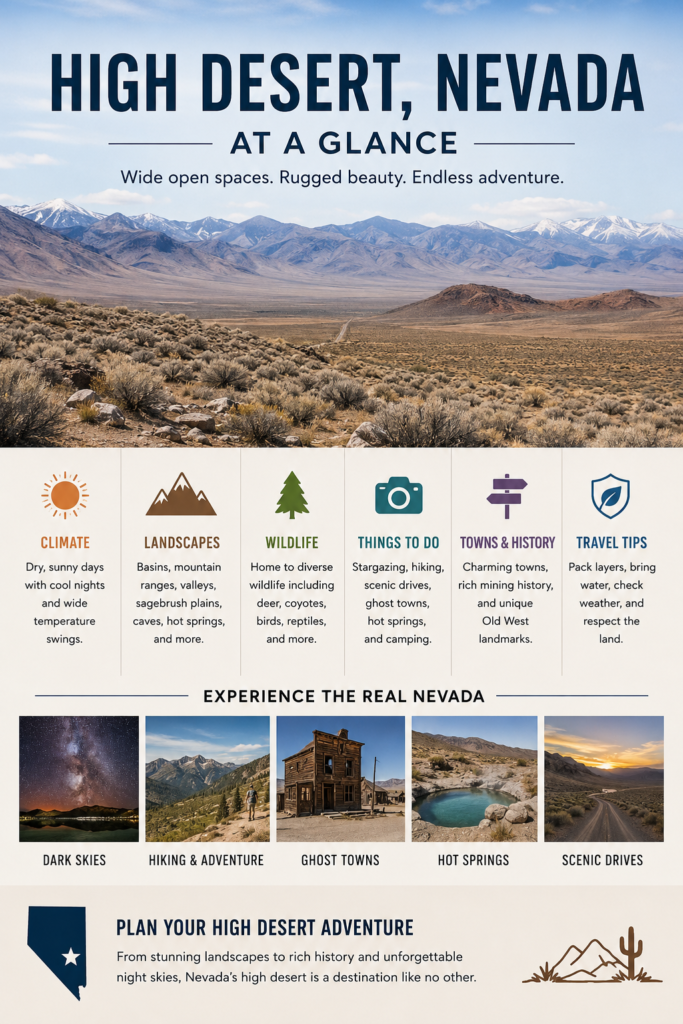
High Desert, Nevada, is a striking landscape of open basins, mountain ranges, sagebrush flats, and wide skies. Shaped by elevation, dry climate, and rich history, it offers a mix of scenery, wildlife, small towns, and outdoor adventure. This guide covers the key things to know about the region, including its climate, geography, attractions, and travel tips.
- What Is High Desert, Nevada?
- High Desert, Nevada at a Glance
- Location and Geography of High Desert, Nevada
- Why the landscape feels so dramatic
- Climate and Weather Patterns in High Desert, Nevada
- The main climate traits
- Why Nevada feels so dry
- Temperature swings
- Best time to visit High Desert, Nevada
- Seasonal travel table
- Landscapes You Will See in High Desert, Nevada
- 1. Basins and valleys
- 2. Mountain ranges
- 3. Playas and dry lakebeds
- 4. Rocky slopes and ridges
- 5. Caves and underground systems
- 6. Hot springs
- 7. Ghost towns and mining areas
- Why the landscape matters
- Flora: Plants of High Desert, Nevada
- Main plant communities
- Why plant life matters
- Simple plant examples
- Fauna: Animals of High Desert, Nevada
- Mammals
- Birds
- Reptiles and insects
- Why is wildlife important here?
- Wildlife viewing tips
- Human History and Culture in High Desert, Nevada
- Indigenous heritage
- Mining and settlement history
- Why this matters to visitors
- Towns and Communities in High Desert, Nevada
- Reno
- Carson City
- Elko
- Ely
- Tonopah
- Winnemucca
- Smaller historic towns
- Towns and their strengths
- Things to Do in High Desert, Nevada
- 1. Stargazing
- 2. Hiking
- 3. Scenic drives
- 4. Ghost towns and mining history
- 5. Hot springs
- 6. Camping
- 7. Wildlife watching
- 8. Photography
- Best Places to Experience High Desert, Nevada
- Great Basin National Park
- Black Rock Desert
- Tonopah Stargazing Park
- Reno high-desert areas
- Remote conservation and public land areas
- Travel Tips for High Desert, Nevada
- Pack the right gear
- Check the weather
- Plan for distance
- Stay on prepared roads.
- Respect the land
- Pros and Cons
- Pros
- Cons
- Conservation and Environmental Issues
- Why conservation matters
- What helps protect the region
- Why visitors should care
- Interesting Facts About High Desert, Nevada
- Why High Desert, Nevada, Deserves More Attention
- FAQs
- Conclusion
What Is High Desert, Nevada?
The phrase high desert refers to arid land located at a relatively elevated altitude. It does not mean an endless sea of dunes. Instead, it usually describes open country with basins, plains, plateaus, mountain ranges, rocky slopes, and very limited rainfall. In Nevada, this setting is closely tied to the Great Basin, one of the most defining geographic regions in the western United States.
The Great Basin is a vast inland region shaped by north-south mountain blocks and valleys. Water often stays within the basin rather than flowing to the ocean, which is part of what makes the area environmentally and geographically distinctive. The result is a dry but varied landscape where altitude, rain shadow effects, and soil conditions influence nearly everything: vegetation, wildlife, settlement, travel, and recreation.
Nevada’s high desert is known for:
- dry air
- wide temperature ranges
- expansive views
- sagebrush flats
- rugged mountain chains
- basins and valleys
- night skies
- remote roads
- ghost towns and mining heritage
Many people imagine deserts as flat, empty, and lifeless. That image does not fit Nevada. Here, the land changes quickly and often. One drive can take you from a low basin into a mountain pass, then into a historic town, then into a wilderness area. The scenery may appear quiet at first glance, but it is filled with texture, movement, adaptation, and ecological meaning.
High Desert, Nevada at a Glance
| Topic | What It Means | Why It Matters |
| Climate | Dry, sunny, and often cool at night | Helps visitors pack and plan well |
| Geography | Basins, ranges, valleys, and mountain blocks | Explains the region’s dramatic scenery |
| Public land | A large share of Nevada is public land | Makes outdoor travel more accessible |
| Wildlife | Birds, mammals, reptiles, insects, and more | Proves the desert is alive, not empty |
| Travel appeal | Stargazing, hiking, hot springs, ghost towns | Turns curiosity into real trip ideas |
Location and Geography of High Desert, Nevada
Nevada sits squarely in the Great Basin, and that is the main reason the state carries such a strong high-desert identity. The landscape is built from long mountain ranges and broad valleys, a pattern often called basin and range topography. The mountains run like parallel ridges across the state, while the basins between them open into wide, sunlit expanses.
This geography matters because elevation changes the experience of the land. A lower valley may feel warm and dry, while a mountain area only a short drive away may feel cooler, windier, and in some seasons even snowy. That contrast is one of the defining characteristics of Nevada. It is not one uniform desert zone. It is a mosaic of microenvironments, each with its own character and ecological role.
You will often encounter:
- dry valleys filled with sagebrush
- alluvial fans spread at mountain bases
- rocky slopes and ridgelines
- playas and dry lakebeds
- pinyon-juniper woodlands
- snow-covered high peaks
- caves, springs, and volcanic formations
This range of landforms is one reason the region feels so visually powerful. The open space creates dramatic perspective, long sunsets, and a strong sense of scale. In an age where many landscapes feel crowded or overbuilt, the high desert feels spacious, resilient, and unfiltered.
Why the landscape feels so dramatic
The High Desert, Nevada, feels dramatic because of the contrast. Pale hills can sit beside dark volcanic rock. Silver-gray sagebrush may stretch below blue mountain silhouettes. A huge sky often dominates the scene, especially at Sunrise and sunset. Fewer trees in the lower basins make the terrain feel extra open, while higher elevations introduce more green, shade, and structure.
A strong example is Great Basin National Park, where sagebrush foothills, cave systems, mountain forests, and high peaks exist within a single protected setting. That combination captures the essence of Nevada’s high desert: diversity, elevation, and contrast within one broad ecological story.
Climate and Weather Patterns in High Desert, Nevada
Climate is central to understanding the high desert. Nevada is dry, sunny, and often extreme in both directions. Daytime sunlight can feel strong, while evening temperatures may drop sharply, especially at higher elevations. These weather patterns shape the land, the plants, the wildlife, and the way people live and travel.
The main climate traits
The high desert climate usually includes:
- low rainfall
- clear skies
- intense sunlight
- dry air
- cool nights
- Snow in higher elevations
- hot summers in some areas
- large seasonal variation
This climate influences nearly every part of the region. It determines which plants can survive, which animals thrive, how towns develop, and when travelers are most comfortable visiting.
Why Nevada feels so dry
Nevada lies in the rain shadow of the Sierra Nevada and other mountain ranges. Moist air loses much of its water before reaching many parts of the state. As a result, large areas receive very little rainfall. That aridity is one reason the High Desert, Nevada, is dominated by sagebrush, drought-tolerant shrubs, and open land rather than thick forests.
Temperature swings
One of the most important things to know about the high desert is the difference between daytime and nighttime temperatures. It can feel warm in the sun and cold in the shade. It can be pleasant in the afternoon and chilly after sunset. This is especially noticeable in spring and fall. Even during warmer months, higher elevations can cool rapidly once the sun goes down.
That is why layering matters. In the high desert, a light jacket can be as important as sunscreen.
Best time to visit High Desert, Nevada
The best time to visit depends on the kind of experience you want.
Spring is one of the best seasons for hiking and sightseeing. Temperatures are often mild, and some areas may bloom with wildflowers.
Summer offers long daylight hours and clear skies, but some places become extremely hot. Higher elevations are more comfortable during this season.
Fall is another excellent time to visit. The air is crisp, the light is beautiful, and road trips feel especially rewarding.
Winter can be scenic, especially in the mountains and park areas, but visitors need to prepare for snow, ice, and colder travel conditions.
Seasonal travel table
| Season | Travel Feel | Best For | Caution |
| Spring | Mild and fresh | Hiking, photography, road trips | The weather can change quickly |
| Summer | Bright and hot | Stargazing, mountain travel, long days | Heat and sun exposure |
| Fall | Cool and comfortable | Scenic drives, camping, sightseeing | Nights can be cold |
| Winter | Quiet and scenic | Snow views, dark skies, fewer crowds | Snow, ice, and road limits |
Landscapes You Will See in High Desert, Nevada
The high desert is not one single type of landform. It is a mix of multiple terrain features that interact with each other. That complexity is one of the reasons the region is so compelling for travelers, photographers, geographers, and outdoor enthusiasts.
1. Basins and valleys
These are large open spaces between mountain ranges. They often contain sagebrush, grasses, and dry soil. Some basins are so wide that they create an almost horizonless feeling.
2. Mountain ranges
Nevada has many mountain ranges, and they run in long, repeating lines. These ranges give the state a rugged, rhythmic appearance and create visual depth across the horizon.
3. Playas and dry lakebeds
A playa is a flat basin where water may collect after rain but later evaporates. These spaces may appear cracked, pale, and empty, yet they are important parts of the desert system and support unique ecological processes.
4. Rocky slopes and ridges
Higher terrain often includes rock outcrops, steep inclines, and shallow soil. These environments support hardy vegetation and offer some of the best panoramic views in the region.
5. Caves and underground systems
Nevada also contains caves and subsurface formations, especially in limestone regions. This adds another dimension to the high desert experience. You are not only seeing what sits on the surface; you are also encountering a hidden underground landscape.
6. Hot springs
Hot springs are a memorable part of Nevada’s outdoor identity. They create a striking contrast between dry surroundings and geothermal warmth, which makes them attractive to travelers seeking relaxation and novelty.
7. Ghost towns and mining areas
The high desert is rich in mining history. Some towns boomed during silver or gold rushes and later declined after the mineral economy shifted. Today, these ghost towns serve as powerful historical markers and atmospheric travel destinations.
Why the landscape matters
The landscape is not merely scenery. It shapes settlement, transportation, water use, recreation, and wildlife patterns. It also supports a surprising amount of biodiversity, much of it adapted to harsh but stable environmental conditions.
Flora: Plants of High Desert, Nevada
The plant life of the high desert is tough, efficient, and highly adapted to stress. Desert plants in Nevada must cope with heat, wind, cold nights, thin soil, and long dry stretches. Their survival strategies make them a fascinating subject for ecology, travel writing, and environmental education.
Main plant communities
Sagebrush is one of the most important plants in the Great Basin. It covers vast areas and supports a wide array of wildlife. For many readers, sagebrush is one of the strongest botanical symbols of Nevada’s high desert.
Grasses grow in many basins and valleys. These are often short, hardy, and adapted to sparse moisture and grazing pressure.
Pinyon pine and juniper appear in slightly cooler or wetter places, especially at higher elevations. Their presence adds vertical structure, shade, and a more wooded feel to the landscape.
Wildflowers may appear after seasonal rain or snowmelt, especially in spring. Their brief bloom period can transform a muted landscape into a colorful display.
Drought-tolerant shrubs and other resilient species help stabilize soil, provide cover for animals, and anchor fragile ecosystems.
Why plant life matters
Plants in High Desert, Nevada, do more than decorate the land. They support insects, birds, mammals, soil stability, and water retention. Sagebrush communities are particularly important because many species depend on them for shelter and food. When these habitats are degraded, wildlife populations can decline as well.
Simple plant examples
- sagebrush in open valleys
- Juniper on rocky slopes
- pinyon pine in cooler uplands
- wildflowers after spring moisture
- durable grasses in dry flats
The desert may appear severe, but its plants are among the most impressive survivors in North America.
Fauna: Animals of High Desert, Nevada
The wildlife of the high desert is richer than many people expect. From a distance, the land can seem empty. Up close, it reveals tracks, movement, calls, nests, burrows, and seasonal activity. The ecosystem is full of life, especially in the cooler hours of the day.
Mammals
You may encounter:
- mule deer
- kangaroo rats
- jackrabbits
- foxes
- coyotes
- mountain lions
- bighorn sheep in some areas
- pygmy rabbits in sagebrush habitat
These animals survive by being alert, mobile, and highly adapted to dry conditions.
Birds
Birds are one of the best reasons to slow down in the high desert. Open country creates excellent conditions for soaring, nesting, and long-range visibility. You may see:
- sage grouse
- prairie falcons
- pinyon jays
- black rosy-finches
- sage thrashers
- hawks and eagles
Birdwatching is especially rewarding here because the open terrain makes movement easier to spot against the sky and the brush.
Reptiles and insects
The high desert also supports lizards, snakes, butterflies, beetles, bees, and many other small creatures. These species are easy to miss, but they are vital to pollination, food webs, and soil health.
Why is wildlife important here?
The desert is not empty. It only appears that way from a distance. Once you pause, you notice tracks, movement, nesting behavior, insect activity, and subtle signs of life everywhere. That sense of discovery is part of the appeal of the High Desert, Nevada.
Wildlife viewing tips
- Go early in the morning or near sunset.
- Move slowly and quietly.
- Watch the edges of the brush and the rock.
- Bring binoculars.
- Be patient.
Wildlife is easier to observe when the air is cool and the landscape is calm.
Human History and Culture in High Desert, Nevada
The human story of Nevada’s high desert is deep, complex, and essential to any complete guide. Long before highways, mines, and rail lines, Indigenous peoples lived across the region and understood the land intimately. Their knowledge of water, plants, seasons, migration, and survival in a dry environment shaped life in the high desert for generations.
Indigenous heritage
The region has long been home to Native peoples, including Paiute and Shoshone communities. Their relationship with the land is grounded in deep ecological knowledge and cultural continuity. They knew where to find water, edible roots, berries, pine nuts, game animals, and seasonal camp locations.
This heritage is central to Nevada’s identity and should always be treated with respect and care.
Mining and settlement history
Mining transformed much of the state in later centuries. Silver and gold discoveries brought waves of newcomers into the desert. Boom towns grew quickly, some becoming permanent communities while others faded into ghost towns once the rush ended.
This history still appears throughout the region in:
- old buildings
- mining ruins
- rusted equipment
- abandoned roads
- historic districts
- museum collections
- ranching sites
- railroad corridors
Ranching also became a major force in the region, as did rail transport. These systems helped connect remote desert settlements to larger economic networks.
Why this matters to visitors
When you travel through High Desert, Nevada, you are not just seeing nature. You are also moving through layers of human story. Every old town, trail, ruin, and roadside marker adds context to the broader regional narrative.
Towns and Communities in High Desert, Nevada
Towns help define the region because they provide access, services, culture, and orientation. Some are large and modern. Others are historic, remote, or closely tied to the state’s mining past.
Reno
Reno is one of the most important gateway cities in the region. It sits in a high-desert setting near the Sierra Nevada and combines urban convenience with fast access to mountains, trails, and scenic drives. Many travelers use Reno as a base for road trips, hiking, skiing, and sightseeing.
Carson City
Carson City, the state capital, is another key hub. It offers easy access to history, government landmarks, nearby mountains, and outdoor recreation.
Elko
Elko serves as a northern Nevada center with a strong Western character. It is a practical and cultural stop for road trippers crossing the state.
Ely
Ely is a classic high-desert town with access to remote scenery and outdoor travel. It is also a useful gateway to the Great Basin country.
Tonopah
Tonopah is strongly associated with mining history and dark skies. It carries a vivid Old West atmosphere and remains a favorite stop for long-distance travelers.
Winnemucca
Winnemucca is an important highway town in northern Nevada. It functions as a convenient stop for fuel, food, lodging, and route planning.
Smaller historic towns
Nevada also contains many smaller towns and ghost towns that retain the feel of the mining era. These places are often less crowded and more atmospheric, which gives them special value for travelers seeking character and quiet.
Towns and their strengths
| Town | Best Known For | Traveler Use |
| Reno | City access and high-desert gateway | Base for regional trips |
| Carson City | Capital, history, and nearby nature | Short stays and touring |
| Elko | Northern travel hub | Road trip stop |
| Ely | Remote desert access | Adventure travel |
| Tonopah | History and stargazing | Scenic overnight stop |
| Winnemucca | Highway convenience | Fuel, food, and lodging |
Things to Do in High Desert, Nevada
This is one of the most important sections for travel intent because it turns geographic information into practical value. The high desert is not only something to observe. It is something to experience.
1. Stargazing
Nevada is famous for dark skies in many rural areas. Dry air, open land, low population density, and limited light pollution create excellent conditions for observing stars, planets, and the Milky Way.
Why stargazing is so strong here:
- low light pollution
- clearer air
- wide horizons
- high elevation in many areas
Bring a warm layer because desert nights can become surprisingly cold.
2. Hiking
The high desert offers many hiking styles, from short nature walks to demanding mountain routes. Some trails pass through sagebrush valleys, while others enter canyons, forests, ridges, or high peaks.
Possible hiking styles include:
- ridge walks
- canyon trails
- short nature loops
- long mountain climbs
- backcountry routes
3. Scenic drives
Road trips are one of the best ways to experience High Desert, Nevada. Open highways, long views, quiet byways, and shifting elevations create a strong sense of movement and scale.
What makes the drives special:
- huge skies
- long sightlines
- historic stops
- changing terrain
- remote beauty
4. Ghost towns and mining history
Nevada has some of the best ghost-town experiences in the American West. These places reveal how boom-and-bust economics shaped settlements and altered the landscape.
You may see:
- old saloons
- broken structures
- abandoned mines
- historic markers
- dusty roads
- desert silence around forgotten streets
5. Hot springs
Hot springs add a relaxing and memorable dimension to the desert. They create a rare contrast between geothermal warmth and dry open country.
6. Camping
Camping is one of the best ways to connect with the region. The stillness, the stars, the open horizon, and the evening air can make an overnight stay unforgettable.
7. Wildlife watching
If you enjoy nature, take time to look carefully. Birds, deer, lizards, and other creatures often appear more actively in the morning and evening.
8. Photography
The high desert is an excellent subject for photography because of its light, distance, texture, and atmosphere.
Best photo subjects include:
- sunset skies
- sagebrush valleys
- mountain silhouettes
- old mines and ghost towns
- wildflowers
- dry lakebeds
- star trails at night
Best Places to Experience High Desert, Nevada
If you want the strongest examples of the region, begin with places that combine scenery, ecology, and travel value.
Great Basin National Park
This is one of the most complete examples of the high desert. It includes high peaks, caves, forests, foothills, and some of the darkest night skies in the Lower 48.
Black Rock Desert
This area is known for immense openness and dramatic desert character. It feels remote, powerful, and visually unforgettable.
Tonopah Stargazing Park
A strong choice for night-sky enthusiasts.
Reno high-desert areas
Reno offers a city base with quick access to mountain and desert landscapes.
Remote conservation and public land areas
These areas deliver the spacious, untamed feeling that many people associate with Nevada’s high desert.
Travel Tips for High Desert, Nevada
Traveling in the high desert is rewarding, but it requires preparation.
Pack the right gear
Bring:
- water
- sunscreen
- a hat
- layers
- snacks
- sturdy shoes
- fuel
- a map or downloaded directions
Check the weather
The weather can shift quickly with elevation. A sunny valley may not match the conditions of a mountain pass. Snow, wind, heat, and sudden cold all matter.
Plan for distance
Services can be far apart. Never assume the next gas station or store is close.
Stay on prepared roads.
Some routes require high-clearance vehicles or cautious driving. Always check road conditions before going into remote areas.
Respect the land
Nevada’s desert is beautiful but fragile. Stay on roads and trails, and avoid disturbing wildlife or vegetation.
Pros and Cons
Pros
- huge open space
- powerful stargazing
- striking scenery
- deep history
- excellent hiking and road trips
- abundant public lands
- strong wildlife diversity
Cons
- dry air and heat
- cold nights
- long distances between services
- remote roads
- changing weather
- limited shade in some places
That balance is part of the experience. The high desert is not always easy, but its challenge is part of its lasting appeal.
Conservation and Environmental Issues
The high desert is resilient, but it is not indestructible. Sagebrush ecosystems face pressure from invasive species, wildfire, grazing impacts, development, and climate stress. These issues matter because so many plants and animals depend on healthy habitats.
Why conservation matters
If the land is damaged, wildlife is affected. Birds lose nesting habitat. Plants can be displaced. Soil erodes. Water sources become more vulnerable. Over time, the entire ecological network changes.
What helps protect the region
- responsible land management
- trail and road protection
- invasive species control
- wildlife habitat protection
- careful tourism
- public awareness
Why visitors should care
Travelers are part of the solution. When people visit thoughtfully and respectfully, they help preserve the region’s beauty and ecological value for the future.
Interesting Facts About High Desert, Nevada
Here are several facts that make the region stand out:
- Nevada is known for its very dry conditions and clear skies.
- The state includes a large amount of public land.
- The Great Basin contains both high mountain country and desert basins.
- The region supports a surprising range of wildlife.
- Ghost towns are an important part of Nevada’s desert identity.
- Many high-desert locations are excellent for stargazing.
- The landscape can shift dramatically with elevation.
These facts make the High Desert, Nevada, more than just a travel destination. It is also a place of geography, ecology, and history.
Why High Desert, Nevada, Deserves More Attention
Many people underestimate desert landscapes. They assume all deserts are identical or that they are empty, hot, and simple. Nevada proves that assumption wrong.
This landscape is:
- visually rich
- ecologically important
- historically layered
- rewarding for travel
- full of contrast
- easy to explore in parts, but impossible to fully exhaust
That is why a strong pillar page on High Desert, Neva, can perform well. It answers what readers actually want: clarity, depth, practical guidance, and a stronger sense of place.
FAQs
Nevada is called a high desert because much of the state is dry land and elevated terrain. The region is shaped by the Great Basin, mountain ranges, and low rainfall.
Yes. Reno sits in a high-desert setting near the Sierra Nevada and is one of the main gateway cities for exploring the region.
Great Basin National Park is one of the best places because it combines mountains, sagebrush, caves, dark skies, and high-desert landscapes in one area.
Yes. The clear air, dry weather, and low light pollution in many rural areas make the region excellent for stargazing.
Pack water, layers, sunscreen, sturdy shoes, food, fuel, and a map or GPS. The weather can
Conclusion
High Desert, Nevada, is more than a dry landscape. It is a place of dramatic scenery, deep history, and unforgettable outdoor Experiences. From stargazing and hiking to ghost towns and mountain views, it offers something memorable for every kind of traveler.