
Introduction
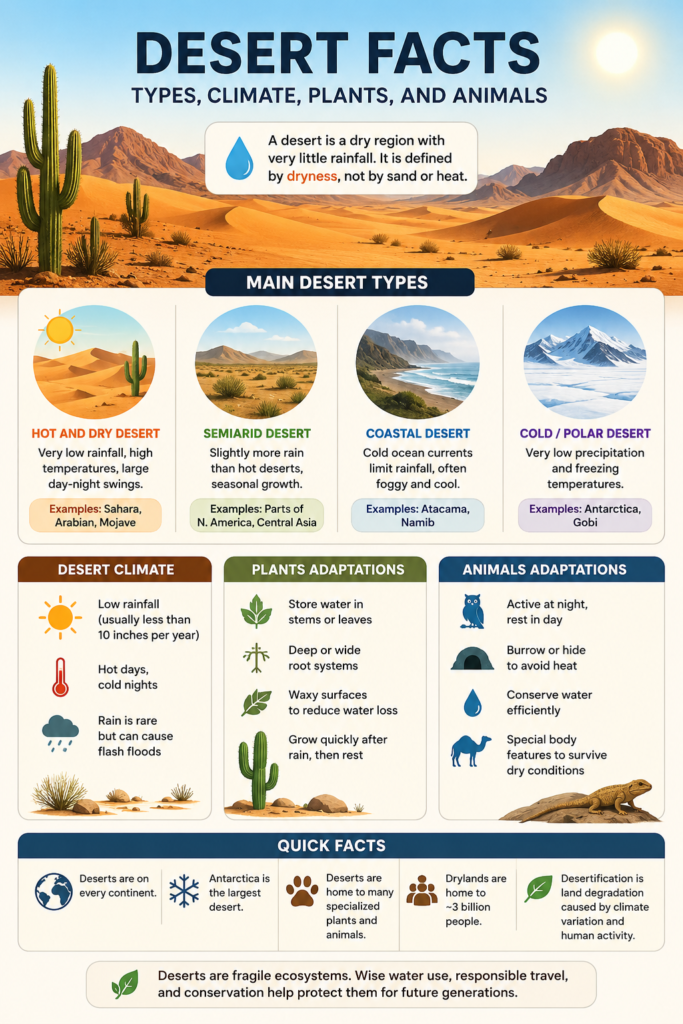
A desert is a dry region with very little rainfall. It is not defined by sand alone or by heat alone. Deserts can be hot, cold, rocky, coastal, or covered with ice. What they all share is a lack of available water. Even so, Deserts Support Plants, animals, and people that have adapted to survive in harsh conditions. In this guide, you will learn the definition of a desert, its main types, climate, landforms, plants, animals, and famous examples around the world.
- What Is a Desert?
- Why Are Deserts So Dry?
- Where Are Deserts Found?
- Main Desert Types
- Desert Climate and Weather
- Desert Landforms and Landscape Features
- Desert Soil and Water
- Desert Plants: How Flora Survives
- Common Desert Plant Adaptations
- Desert Animals: How Fauna Survive
- Examples of Desert Animals
- Famous Desert Examples Around the World
- Human History in Deserts
- Desert Life and Human Adaptation
- Desert Tourism: Why People Visit
- Why Deserts Are Important
- Environmental Problems Facing Deserts
- Desert Conservation and Restoration
- Interesting Facts About Deserts
- Desert vs. Dryland: What Is the Difference?
- Key Terms Related to Desert
- Quick Facts Table
- FAQs
- Conclusion
What Is a Desert?
Scientifically, a desert is a region where precipitation is so low that water loss often exceeds water gain. In simpler language, more moisture leaves the land through evaporation, transpiration, and wind-driven drying than enters through rain, snow, or fog. Britannica describes deserts as extremely dry areas with sparse vegetation, while National Geographic notes that places receiving less than 10 inches, or about 25 centimeters, of rain per year are generally considered deserts. USGS likewise emphasizes that deserts are characterized by meager rainfall and sparse plant cover.
It is also important to understand that desert definitions are not perfectly identical across all authorities. Some definitions rely heavily on rainfall thresholds, while others focus on vegetation, climate, or geography. USGS explains that deserts can be classified in several ways and that no single classification system fits every desert equally well. That is why a place can be called a desert even if it is icy, rocky, or coastal rather than sandy.
The simplest and clearest idea to keep in mind is this: deserts are moisture-deficient ecosystems. They are not defined by sand alone, and they are not defined by heat alone. They are defined by dryness.
Why Are Deserts So Dry?
Deserts are dry because of broad atmospheric and geographic patterns that limit how much moisture reaches the land. Any deserts sit under persistent high-pressure systems that discourage cloud formation and suppress rainfall. Some lie far inland, where ocean moisture cannot travel effectively. Some are found behind mountain ranges, where moist air drops rain on one side and descends as dry air on the other. Coastal deserts can form where cold ocean currents reduce evaporation and limit cloud development.
In other words, deserts are better understood as regions of water deficit than as regions of sand. The wind, the sea, the mountains, and the global circulation of air all shape desert climate. The result is a landscape that receives very little precipitation and often loses moisture faster than it can regain it. National Geographic describes this as a moisture deficit.
The dry climate also creates many of the dramatic features people associate with deserts. Long periods without rain are sometimes interrupted by short, intense storms. A desert may remain dry for months and then receive a sudden burst of rain that causes flash floods, runoff, and rapid changes in the terrain. So even though deserts may look quiet from a distance, they are active systems shaped by rare but powerful weather events.
Where Are Deserts Found?
Deserts are found on every continent. They are not limited to Africa or the Middle East. They occur in North America, South America, Asia, Australia, Europe, and Antarctica. National Geographic says deserts cover more than one-fifth of Earth’s land area, while USGS notes that deserts may cover about one-third of the Earth’s land surface, depending on how the term is used. That difference reflects how broad the desert and dryland categories can be.
Many of the world’s hot deserts are located near 30 degrees north and 30 degrees south latitude. These belts are linked to global air circulation patterns that reduce rainfall. Other deserts are formed in the interior of continents or in mountain rain shadows. Polar deserts, by contrast, are cold and dry rather than hot and sandy. Antarctica is the largest desert on Earth because it receives extremely little precipitation, even though it is covered in ice and snow.
Main Desert Types
The word desert covers several climate and geography patterns. Different sources classify deserts in slightly different ways, but the most practical method is to group them by climate and cause. USGS classifies deserts by dominant weather patterns, while National Geographic and many educational sources divide them into broad ecological categories.
Here is a simple overview of the main types.
| Desert type | Main cause | Typical features | Examples |
| Hot and dry desert | Strong heat and very low rainfall | Dunes, rocky plains, intense sunlight, and large day-night temperature swings | Sahara, Arabian, Mojave |
| Semiarid desert | Dry climate with slightly more rain than hot deserts | Shrubs, grasses, seasonal growth | Parts of North America and Central Asia |
| Coastal desert | Cold ocean currents limit evaporation and rainfall | Fog, cool air, sparse but specialized vegetation | Atacama, Namib |
| Cold or polar desert | Very low precipitation and freezing temperatures | Ice, snow, dry winds, little liquid water | Antarctica, Gobi |
This table reflects the way desert classification is often explained across USGS and National Geographic sources, while still aligning with the broader ecological idea used by Britannica: deserts are defined by dryness, not by a single landform or climate stereotype.
Desert Climate and Weather
The most important desert climate rule is simple: deserts are dry first and hot second. Some deserts are scorching, but others remain cold for much of the year. The real issue is that there is not enough moisture for most plants and animals to thrive without specialized adaptations. National Geographic describes deserts as dry regions with a moisture deficit, and Britannica explains that deserts are extremely dry ecosystems.
Desert air is often very low in humidity, which allows temperatures to change quickly. During the day, the ground may heat up rapidly. At night, it can cool down just as fast. This creates large diurnal temperature swings, a classic feature of arid regions. In many deserts, weather also arrives in brief bursts. Rain may be rare, but when it arrives, it can be sudden and heavy. That is why flash flooding is a serious hazard in desert environments.
Desert climate is shaped by four major factors: global air circulation, distance from the sea, mountain barriers, and ocean currents. Coastal deserts often form where cold currents keep the air stable and dry. Rain-shadow deserts form when mountains block moist air. Interior deserts are dry because oceanic moisture cannot easily reach them. These climate controls create the conditions that define desert ecosystems.
Desert Landforms and Landscape Features
Deserts are much more than dunes. Many deserts are Dominated by rock, gravel, bedrock, mountain slopes, basins, dry valleys, salt flats, and plains. Britannica notes that desert terrain can include rugged mountains, high plateaus, broad plains, and mountain-rimmed basins. USGS also emphasizes that desert landscapes vary widely depending on geology, topography, and climate history.
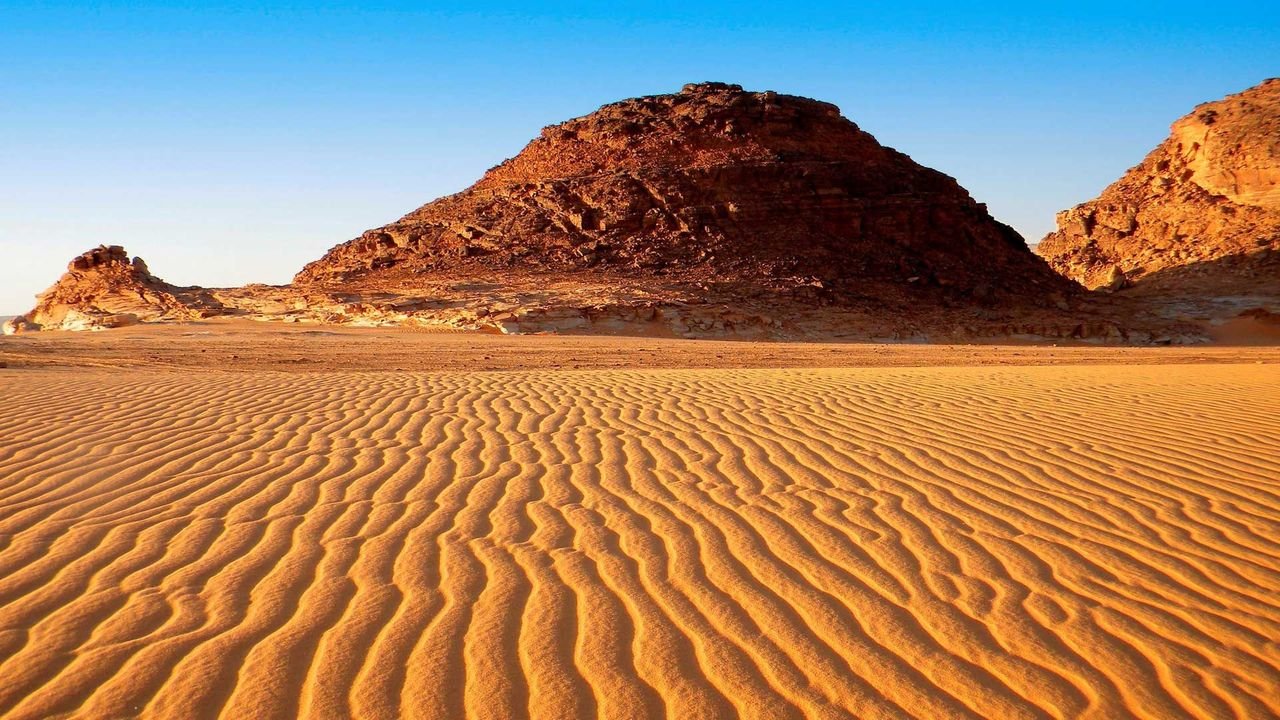
Dunes are iconic, but they are only one landform among many. Some deserts contain vast dune fields. Others contain very little sand at all. Some are better described as stone deserts or salt deserts. This is why the word desert should be treated as a climatic term rather than a sand-only label.
Water still shapes desert landscapes, even when water is scarce. Dry riverbeds, oases, springs, playas, and ancient lake beds often become focal points for plants, animals, and human activity. Wherever water appears, life tends to cluster. That is why settlements, migration routes, and wildlife corridors in desert regions often form around the few dependable water sources.
Desert Soil and Water
Desert soil often contains low organic matter because there is limited moisture to support continuous plant growth and decay. That does not mean desert soil is useless. It means its fertility depends heavily on rare rain events, groundwater, and careful water management. In dry regions, the greatest challenge is often not the absence of soil, but the absence of water that makes the soil productive.
Water can appear in deserts in several forms. Some deserts rely on seasonal rainfall. Others depend on aquifers, springs, rivers that originate outside the desert, or melting snow from nearby mountains. Because rainfall is so limited, even small changes in water supply can have major effects on farming, wildlife, settlement, and transportation. This is why desert water systems are often fragile and highly valuable.
Desert Plants: How Flora Survives
Desert plants survive by conserving water, storing water, or completing their life cycles quickly after rain. Britannica explains that desert plants often use water-storage organs, deep roots, and reduced or reflective leaves to cope with drought. National Geographic and USGS also emphasize that deserts are home to specialized life rather than empty land.
Many desert plants are succulents, such as cacti and agaves. These species store water in thick stems or leaves. Other plants have waxy coatings that reduce evaporation. Some have tiny leaves or spines instead of broad foliage. Some send taproots deep into the soil, while others spread shallow roots widely near the surface to catch quick rainfall before it disappears.
Desert plants also use a very intelligent survival strategy: they are not always active. Many remain dormant for long periods and then grow rapidly when rain arrives. After rare storms, a desert can suddenly bloom with flowers, shoots, and fresh green growth. This is one of the clearest examples of how desert life is built around timing, resilience, and efficient resource use rather than abundance.
Common Desert Plant Adaptations
Desert plants use several main survival strategies.
Already store water in stems or leaves.
Them develop deep taproots or broad root systems.
They use waxy surfaces to reduce water loss.
Many reduce leaf size or replace leaves with spines.
They grow quickly after rainfall and then return to dormancy.
These adaptations are not just fascinating. They are the reason desert ecosystems can function at all.
Desert Animals: How Fauna Survive
Desert animals survive through behavior, body design, and timing. Many are nocturnal, meaning they are active at night and rest during the hottest part of the day. Others burrow underground, hide in shade, or stay near rare water sources. Berkeley and USGS both note that desert life is often structured around conserving energy and minimizing water loss.
Reptiles are especially common in deserts. Lizards and snakes often tolerate heat and dryness well. They can burrow, camouflage themselves, and move during cooler hours. Insects, spiders, and scorpions also thrive because they can shelter in cracks, under rocks, or beneath soil during the hottest part of the day.
Mammals in deserts use different survival mechanisms. Camels are the most famous example. National Geographic explains that camels conserve fluids efficiently and can drink large amounts when water becomes available. Smaller mammals, such as rodents and foxes, often remain underground during daylight and feed at night, which helps them avoid heat stress and reduce dehydration.
Birds in deserts often depend on oases, wetlands, river corridors, and seasonal food sources. Some eat insects. Others hunt reptiles. Others feed on seeds, fruits, or desert vegetation. Because water is patchy and rainfall can be irregular, bird populations may shift quickly as conditions change.
Examples of Desert Animals
Some well-known desert animals include camels, desert tortoises, Gila monsters, kangaroo rats, desert iguanas, bighorn sheep, foxes, lizards, snakes, insects, and many species of birds. USGS lists many of these species as part of desert biodiversity, showing clearly that deserts are far from lifeless.
Famous Desert Examples Around the World
The Sahara Desert is the world’s largest hot desert and one of the most famous desert regions on Earth. The Arabian Desert is another major hot desert, shaped by extreme aridity and vast open terrain. The Mojave Desert is a famous North American desert known for heat, distinctive vegetation, and dramatic scenery.
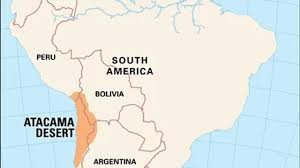
The Atacama Desert is well known for being extremely dry, with coastal desert conditions influenced by the Pacific Ocean. The Namib Desert is another coastal desert with a long and distinctive geological history. The Gobi Desert shows that deserts can also be cold. It is an interior desert with harsh seasonal conditions and a mix of dry valleys, gravel plains, and rocky terrain.
Then there is Antarctica, which is the world’s largest desert by area because it receives so little precipitation. This is one of the most surprising facts about deserts. It proves again that a desert is defined by dryness rather than by heat or sand.
Human History in Deserts
Human life in deserts is older and richer than many people realize. National Geographic notes that people have adapted to desert life for thousands of years. More than one billion people live in desert regions, and drylands more broadly support billions more. These regions are not empty. They are inhabited cultural landscapes.
Deserts have supported trade routes, oasis farming, pastoralism, migration, pilgrimage, and settlement around water sources. In many places, people learned to build for heat and dryness with thick walls, shaded courtyards, ventilation, and careful water use. Desert survival is not only a matter of nature. It is also a matter of culture, knowledge, adaptation, and continuity.
Desert regions also cross political borders. The Thar Desert, for example, stretches across India and Pakistan. That shows that deserts are geographic systems rather than political units. Their ecosystems, water systems, and cultural networks often span multiple nations.
Desert Life and Human Adaptation
People living in deserts have developed practical ways to manage heat stress and water scarcity. These include storing water, traveling during cooler hours, choosing drought-tolerant crops, raising animals that can handle arid conditions, and using architecture that reduces thermal load. Over time, such practices become part of daily life and local identity.
In desert settings, water is usually the most valuable resource. A well, spring, river, or reservoir can shape where people live, how they farm, and how towns develop. When water becomes less reliable, the whole social and ecological system becomes more vulnerable. That is why deserts are often central to conversations about migration, agriculture, resilience, and sustainability.
Desert Tourism: Why People Visit
Deserts attract travelers because they offer dramatic scenery, clear horizons, open space, and a sense of stillness that is rare in many other landscapes. Visitors often come for dune riding, trekking, stargazing, wildlife viewing, photography, and visits to oases or rock formations. In some deserts, the dry air also makes astronomy especially appealing because skies are often clear and dark.
Desert tourism is best when it is responsible. Desert soils and biological crusts can be fragile. Off-road vehicles, litter, unnecessary water use, and careless movement can damage the land quickly. Staying on marked paths and traveling with local guides can help preserve the environment while also supporting local communities.
Travelers should also respect the risks. Sun exposure, high temperatures, long distances, and sudden weather shifts can be dangerous. Even a beautiful desert trip requires planning, sufficient water, and awareness of local conditions. In deserts, safety is part of good travel, not an optional extra.
Why Deserts Are Important
Deserts matter because they are not barren. They are highly specialized ecosystems with plants and animals adapted to extreme conditions. USGS describes deserts as biodiversity-rich ecosystems, and Britannica notes that they support distinctive communities of flora and fauna.
Deserts also matter because they teach us about adaptation, efficiency, and resilience. When water is scarce, life must become intelligent in how it uses energy and moisture. That makes deserts important for ecology, geology, climate science, evolutionary biology, and human survival studies. They show how organisms and societies solve the same fundamental problem in different ways: how to live with less water.
Deserts also matter for the global economy. Drylands support a large share of agriculture and livestock production, and they are home to about three billion people,e according to the IPCC. That means desert and dryland regions are tightly connected to food security, livelihoods, trade, and global stability.
Environmental Problems Facing Deserts
Deserts may look durable, but many are actually fragile. Human pressure, overgrazing, poor water management, invasive species, off-road driving, mining, land conversion, and climate change can all damage desert ecosystems. UNCCD and the IPCC both connect desertification to a combination of human activity and climate variation.
Desertification is not the same thing as a natural desert. It is land degradation in drylands. UNCCD defines it as land degradation in arid, semi-arid, and dry sub-humid areas caused by climate variation and human activity. The IPCC uses the same basic framework and notes that desertification has expanded in some dryland areas in recent decades.
This is a serious issue because desertification affects soil, water, crops, biodiversity, and human well-being. The IPCC says climate change and desertification can reduce ecosystem services, weaken crop and livestock productivity, and increase risks to communities. In many places, land degradation also deepens poverty, migration pressure, and resource conflict.
Desert Conservation and Restoration
Conservation in deserts usually focuses on protecting water, limiting soil damage, restoring native vegetation, managing grazing, and reducing pressure on vulnerable habitats. UNCCD’s broader goal is to avoid, reduce, and reverse desertification, while international frameworks emphasize land degradation neutrality and sustainable land management.
The IPCC also stresses that land degradation and climate change interact strongly in drylands. That means conservation cannot be separated from climate action. Better land use, smarter water use, and stronger ecosystem care all matter at the same time.
In practical terms, desert conservation means respecting the land’s limits. It means using water carefully, reducing unnecessary disturbance, protecting native species, and supporting communities that have lived with dry conditions for generations. A desert is not useless land. It is land that demands wise stewardship.
Interesting Facts About Deserts
One surprising fact is that Antarctica is the world’s largest desert. It is not large because of the sand. It is large because it is exceptionally dry. That single fact reshapes how many people think about deserts.
Another fact is that deserts exist on every continent. This makes the desert biome global, not regional. It also shows how many different climate systems can produce aridity.
A third fact is that deserts are biologically rich. They may look empty, but they support unique plants and animals that are specially adapted to survive with very little water.
A fourth fact is that drylands are deeply connected to people. The IPCC notes that drylands are home to roughly three billion people, and UNCCD-related reporting shows that drylands support a major share of agriculture and livestock. That means desert regions are part of the world’s living economy.
Desert vs. Dryland: What Is the Difference?
The words desert and dryland are related, but they are not always identical. A desert is usually the driest category of land, with very low precipitation and sparse vegetation. Drylands are a broader group that includes arid, semi-arid, and dry sub-humid areas. National Geographic treats deserts as part of a wider dryland system, and the IPCC uses the same broad dryland framework.
This distinction matters because some regions are dry but still support more plant life than a true desert. Drylands can include grasslands, shrublands, and semi-arid landscapes that are more productive than a classic desert. So while the terms are often used loosely in everyday speech, a more careful understanding improves ecology, land management, and climate literacy.
Key Terms Related to Desert
Here are the main SEO and semantic terms that naturally fit the topic of desert: desert climate, desert plants, desert animals, drylands, arid region, hot desert, cold desert, polar desert, dunes, oasis, rain shadow, desertification, land degradation, water scarcity, and desert ecosystem. These terms help the article remain comprehensive, relevant, and search-friendly without sounding artificial.
Quick Facts Table
| Fact | Simple explanation |
| Deserts are dry ecosystems | They are defined by low moisture, not only by heat. |
| Low precipitation can happen in frozen place,s too. | You can find them in Africa, Asia, North America, South America, Australia, Europe, and Antarctica. |
| Some deserts are cold | Desert life is specialized. |
| Antarctica is a desert | It is the largest desert because it is extremely dry. |
| Desertification is not a natural desert. | Plants and animals use storage, burrowing, nocturnal behavior, and other adaptations. |
| Low precipitation can happen in frozen places,s too. | It is land degradation in drylands caused by climate variation and human activity. |
This summary reflects the main points emphasized by Britannica, USGS, National Geographic, UNCCD, and the IPCC.
FAQs
A desert is a very dry region that receives very little precipitation and supports sparse vegetation. Deserts can be hot, cold, sandy, rocky, or icy, but dryness is the main defining feature.
No. Some deserts are hot, but others are cold deserts or polar deserts. Antarctica is the largest desert in the world because it receives extremely little precipitation.
Desert plants survive by storing water, using deep roots, having waxy surfaces, reducing leaf size, and growing quickly after rainfall. These adaptations help them conserve every possible drop of moisture.
Desertification is land degradation in arid, semi-arid, and dry sub-humid areas caused by climate variation and human activity. It is not the same as a natural desert, and it can damage land, crops, wildlife, and people.
Deserts are important because they support unique life, teach us about adaptation, and play a major role in human culture, food systems, and climate studies. Drylands are also home to billions of people and support large areas of agriculture and livestock.
Famous examples include the Sahara, Arabian, Mojave, Atacama, Namib, Gobi, and Antarctica. Each one shows a different side of what a desert can be.
Conclusion
Deserts are more than empty stretches of sand. They are diverse dry ecosystems shaped by climate, geography, and water scarcity. From the Sahara to Antarctica, each desert shows how life can adapt to extreme conditions. Understanding deserts helps us appreciate their beauty, value, and fragility, especially as climate change and land degradation increase pressure on dry regions.