
Introduction
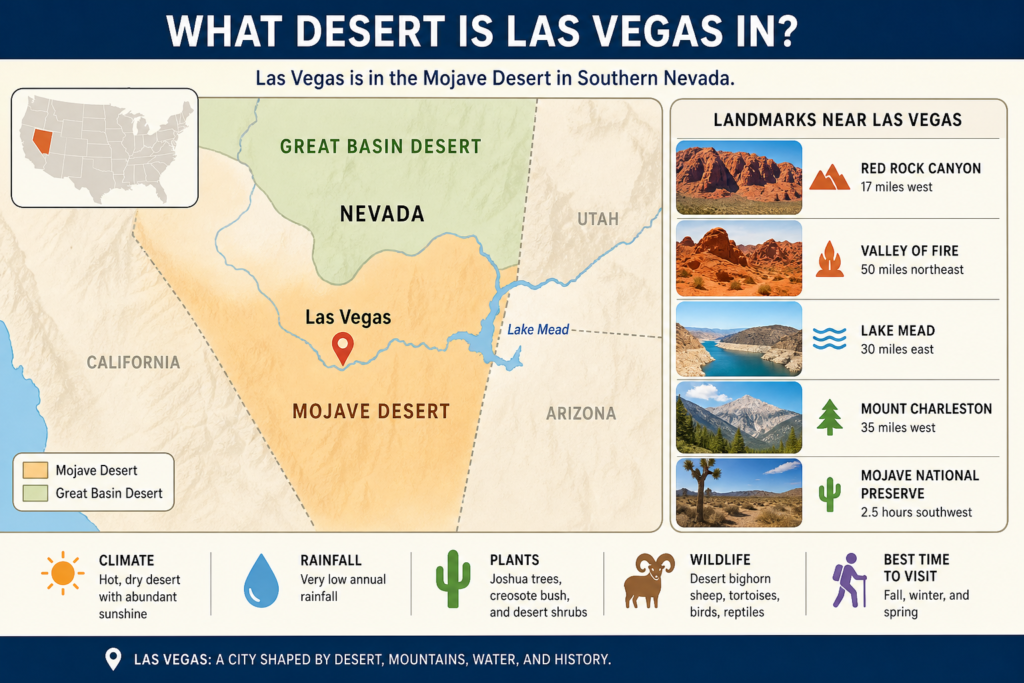
Las Vegas is in the Mojave Desert in southern Nevada. That is the direct answer, and it satisfies the core user intent behind the query. But the full picture is much more nuanced, because Las Vegas is not just a point on a map; it is a geographically embedded city whose identity is shaped by desert ecology, basin-and-range topography, water scarcity, seasonal weather patterns, and centuries of human adaptation.
The city sits inside the Las Vegas Valley, a broad desert basin surrounded by mountain ranges. That valley structure is not a minor detail. It is one of the defining geographic signals that explains why Las Vegas feels so strongly like a desert city, even with its tall buildings, artificial lights, freeway corridors, and dense development. The valley has limited natural water availability, intense solar exposure, dry air, and a landscape formed by alternating basins and ranges, with occasional flash-flood channels and seasonal storm systems.
Las Vegas is not a flat sea of sand. It belongs to a living desert region with canyons, mountains, springs, wildlife corridors, protected lands, and major nearby landmarks like Red Rock Canyon, Valley of Fire, Lake Mead, and Mojave National Preserve. That is why a good article about this topic must do more than label the region. It must explain the land, the climate, the biodiversity, the environmental pressures, the historical layers, and the way people have lived in this area for a long time.
This guide is designed to help readers understand exactly what desert Las Vegas is in, where it sits on the map, what borders it, what the climate is really like, and why the region matters for travel, ecology, and history. It also uses a more “NLP-friendly” content structure, meaning the article is organized around natural search intent, semantic relationships, and related entities that help search engines understand topical depth.
- Quick Answer: What Desert Is Las Vegas In?
- Table of Key Facts
- Location and Geography of Las Vegas
- Why the Valley Shape Matters
- The Great Basin and the Mojave Around Las Vegas
- Mojave Desert vs. Great Basin Desert Around Las Vegas
- Simple Comparison Table
- Why This Comparison Matters
- Climate and Weather Patterns in Las Vegas
- What the Climate Feels Like
- The Role of Mountains
- Monsoon Season and Flash Flooding
- Heat Island Effect
- Landscape Features: Valleys, Rocks, Canyons, and Desert Edges
- The Las Vegas Valley
- Red Rock Canyon National Conservation Area
- Lake Mead National Recreation Area
- Spring Mountains and Mount Charleston
- Valley of Fire State Park
- Mojave National Preserve and Death Valley
- Plants of the Mojave Desert Around Las Vegas
- Joshua Trees and Desert Identity
- Creosote Bush and Other Common Desert Plants
- Riparian Areas and Spring Zones
- Plant Communities Change With Elevation
- Wildlife and Animals in the Desert Around Las Vegas
- Desert Bighorn Sheep
- Desert Tortoise
- Birds, Mammals, Reptiles, and Amphibians
- Why Wildlife Matters for Travelers
- Human History and Cultures of the Las Vegas Desert
- Southern Paiute History
- Springs and Early Settlement
- Old Las Vegas Mormon Fort
- Why History Matters in a Desert Article
- Conservation and Environmental Issues
- Invasive Plants and Fire
- Urban Growth and Habitat Loss
- Water Pressure
- Why Conservation Matters to Readers
- Tourism and Travel in the Las Vegas Desert
- Best Nearby Desert Attractions
- Why Red Rock Canyon Stands Out
- Why Valley of Fire Is Special
- Why Lake Mead Belongs in the Desert Story
- Best Times to Explore
- Practical Travel Tips for the Las Vegas Desert
- Stay Hydrated
- Protect Yourself From the Sun
- Watch for Flash Flooding
- Respect Desert Wildlife
- Check Conditions Before You Go
- Interesting Facts About the Las Vegas Desert
- Why Las Vegas Is More Than a Casino City
- FAQs
- Is Las Vegas in the Mojave Desert?
- Is Las Vegas part of the Great Basin Desert?
- What is the closest major desert attraction to Las Vegas?
- What kind of desert climate does Las Vegas have?
- What animals live in the desert around Las Vegas?
- Conclusion
Quick Answer: What Desert Is Las Vegas In?
Las Vegas is in the Mojave Desert.
More specifically, the city is part of the Las Vegas Valley, which lies in southern Nevada and belongs ecologically to the Mojave Desert. The Great Basin Desert begins not far to the north, so Las Vegas sits close to a transition zone. That is why the city can feel like a desert crossroads rather than a single, isolated desert outpost.
This matters because a lot of searchers are not only asking for a name. They want a map-based classification, a geographical explanation, and a sense of how Las Vegas fits into the wider desert system of the American Southwest.
Table of Key Facts
| Quick Fact | What It Means for Las Vegas |
| Desert region | Las Vegas is ecologically part of the Mojave Desert |
| Valley shape | The city lies in a broad desert basin known as the Las Vegas Valley |
| Surrounding mountains | The valley is framed by several mountain ranges that shape the weather and runoff |
| Nearby water edge | Lake Mead lies to the east beyond mountain barriers |
| Border with the Great Basin | The southern limit of the Great Basin is north of the city |
| Desert climate | Hot summers, low rainfall, strong sunshine, and cool winter nights |
Location and Geography of Las Vegas
Las Vegas sits in a classic basin-and-range landscape. In simple terms, that means a low basin is enclosed by mountain ranges. The city is not stretched across one endless, level desert floor. Instead, it occupies a valley that is boxed in by rugged terrain on nearly every side.
This geography affects almost everything people notice about Las Vegas. It influences wind flow, temperature variation, rainfall distribution, drainage patterns, visibility, road routes, and even how neighborhoods expand over time. In geographic terms, the valley functions like a natural container, shaping how water moves and how people have used the land.
The Las Vegas Valley is wide and open, but it is not empty. It is bordered by mountain systems such as the Spring Mountains, Sheep Range, Bird Spring Mountain Range, McCullough Mountain Range, and Black Mountain. These ranges create a strong visual frame and help explain why the city feels tucked into the desert rather than simply placed on top of it.
The valley floor is relatively low, while nearby peaks rise dramatically above it. That elevation difference produces sharp contrasts in temperature, vegetation, and atmospheric conditions. A traveler can move from hot lowland streets to cooler foothills or higher mountain air within a short drive. That is one of the most important ecological and Experiential features of the Las Vegas region.
Why the Valley Shape Matters
The valley shape is one of the most important reasons Las Vegas developed where it did. Settlement in desert regions is rarely random. Water sources, travel routes, shelter, and topographic advantage all matter. In arid environments, a valley with spring-fed water is a natural place for people to stop, gather, farm, and eventually settle.
Las Vegas also grew within a region shaped by alternating basins and ranges. That gives the surrounding desert a visual and ecological diversity that many visitors do not expect. One drive can take you from urban core to red rock cliffs, from open desert flats to spring-fed mountain forests, and from dry washes to shoreline views near Lake Mead.
The Great Basin and the Mojave Around Las Vegas
Las Vegas is best understood as a Mojave Desert city that sits near the edge of the Great Basin Desert.
The Mojave is the desert most people picture when they think of Las Vegas-area desert travel, with Red Rock Canyon, Joshua trees, canyons, rocky slopes, and warm low-elevation desert scenery. The Great Basin becomes more relevant as you travel north and west into higher, colder, and more sagebrush-dominated terrain.
That boundary matters because it shows that Las Vegas is not locked into one simple desert identity. It belongs to a transition landscape where different desert systems meet. That transition helps explain why the region has such a varied set of landforms, climate signals, and plant communities.
Mojave Desert vs. Great Basin Desert Around Las Vegas
To understand the desert around Las Vegas, imagine a geographic spectrum instead of a hard border. On one side is the warmer, lower, more iconic Mojave landscape. On the other side is the cooler, higher Great Basin environment.
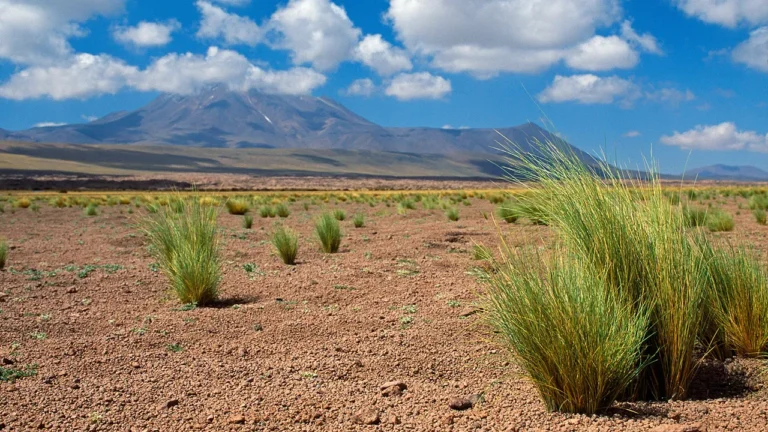
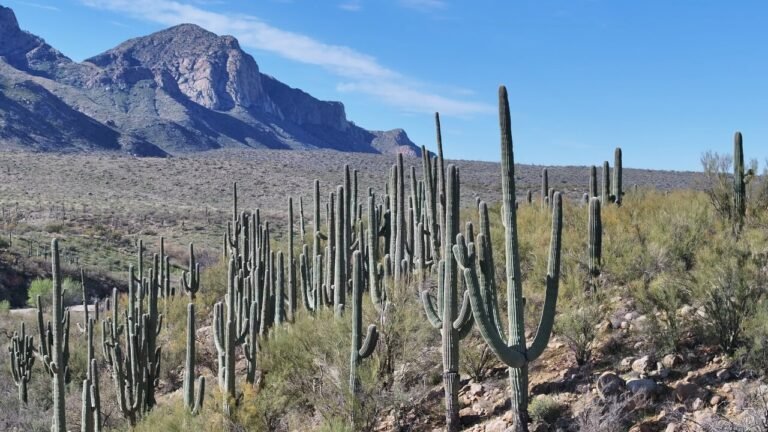
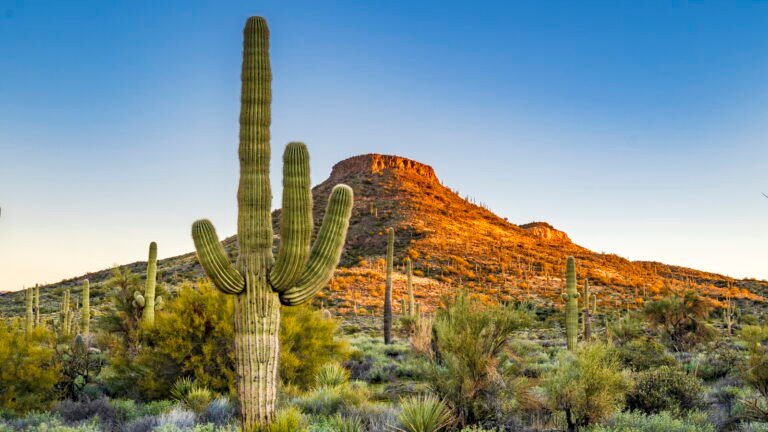
The Mojave Desert includes the area where Las Vegas sits. It is warmer, lower in elevation, and associated with classic desert imagery such as Joshua trees, creosote bush, rocky ridges, dry washes, and canyon scenery.
The Great Basin Desert begins north of the city and generally brings higher elevations, cooler conditions, more winter cold, and a plant community dominated by sagebrush and related cold-desert species.
Simple Comparison Table
| Feature | Mojave Desert | Great Basin Desert |
| Main location near Las Vegas | South and around the city | North of the city |
| Elevation | Lower | Higher |
| Climate | Hotter and drier | Cooler and colder in winter |
| Common plant image | Joshua tree, creosote bush | Sagebrush and cold-desert plants |
| Landscape feel | Rockier and warmer | Broader and more cold-desert-like |
Why This Comparison Matters
A lot of search queries ask what desert Las Vegas is in because the user wants a short answer. But the better answer is more complete:
Las Vegas is in the Mojave Desert, and it sits close to the Great Basin Desert.
That means the city is part of a transition zone rather than a single static landscape. Once readers understand that, they can better interpret the climate, the wildlife, the vegetation, and the travel geography around the city. This also improves topical relevance because the content matches related entities and search intent more precisely.
Climate and Weather Patterns in Las Vegas
Las Vegas is widely associated with heat, but the climate is more complex than the phrase “hot and dry” suggests. The city experiences strong sunshine, low annual precipitation, scorching summers, and cool winter nights. It is a desert climate in the full ecological sense, not just a place that feels warm.
The climate is central to why the region qualifies as a desert. Water is scarce, evaporation is high, solar radiation is intense, and seasonal swings can be significant.
What the Climate Feels Like
In summer, temperatures can climb into the triple digits. In winter, nighttime temperatures may drop sharply, sometimes into the 20s. Air humidity is usually low, which makes the dryness more noticeable than in many other cities.
The weather is not always serene, though. Seasonal storms can bring gusty winds, lightning, rain bursts, and flash flooding. That is especially relevant during monsoon season, when atmospheric moisture from the south can move into the Mojave and create unstable conditions.
The Role of Mountains
The mountains around Las Vegas do more than create a scenic skyline. They influence airflow, block some moisture, and shape how storms move through the valley. They also create microclimates, so conditions can differ noticeably from one neighborhood, elevation band, or trail system to another.
In practical terms, the mountains help keep the valley dry and also make the region topographically complex. The result is a city where desert conditions and mountain conditions can sit surprisingly close together.
Monsoon Season and Flash Flooding
One of the biggest misconceptions about deserts is that they are always dry in a harmless way. That is not true.
During monsoon season, moisture can surge into the region and create thunderstorms, strong wind bursts, and sudden rain. In dry washes and low points, flash flooding can occur rapidly. Water can move through the landscape with speed and force, even if the ground looked completely dry a short time earlier.
This is one of the most important safety and geography lessons in the Las Vegas desert story. Dry land can still become dangerous wet land in a short time.
Heat Island Effect
The urban core is often warmer than the surrounding open desert because of the heat island effect. Concrete, asphalt, buildings, and vehicle traffic absorb and retain heat. As a result, the city can stay warmer than nearby undeveloped land, especially at night.
This means Las Vegas is shaped not only by desert climate, but also by the thermal footprint of urban development. That interaction is essential to understanding the place as both a city and a desert environment.
Landscape Features: Valleys, Rocks, Canyons, and Desert Edges
Las Vegas is surrounded by a broad range of desert landscapes. It is not one uniform region with a single visual identity. Instead, it contains valley floors, rocky slopes, canyon walls, dry drainage corridors, and mountain backdrops. This variety is one reason the area is so attractive to hikers, photographers, road-trippers, and nature-focused travelers.
The Las Vegas Valley
The Las Vegas Valley is the main geomorphic feature behind the city. It is a desert basin where settlement, economic development, transportation corridors, and tourism have all concentrated over time.
The valley contains urban development, but it also includes natural desert edges, washes, and sightlines toward nearby mountain ranges. It is a landscape of contrast: human-built density in one direction and raw desert textures in another.
Red Rock Canyon National Conservation Area
One of the clearest examples of Mojave Desert terrain near Las Vegas is Red Rock Canyon National Conservation Area.
It lies about 17 miles west of the Las Vegas Strip and covers a large tract of desert land. The scenic drive, hiking routes, climbing areas, and striking red sandstone formations make it one of the best places to see the desert up close.
Red Rock Canyon is especially useful for readers because it turns abstract geography into a visible reality. It reveals the geology, color palette, slope structure, and plant life that many people associate with the Mojave.
Lake Mead National Recreation Area
To the east of Las Vegas lies Lake Mead National Recreation Area, one of the most important outdoor landscapes in the region.
This area combines mountains, canyons, reservoirs, and recreation zones. It also shows that the desert around Las Vegas is not empty or unused. It includes water, wildlife, visitor access, and major environmental management concerns.
Lake Mead is especially important because it ties Las Vegas into the broader western water system, which is a central issue in the American Southwest.
Spring Mountains and Mount Charleston
The Spring Mountains rise west of the city and create a dramatic elevation contrast with the valley floor. Mount Charleston stands far above the desert basin and offers cooler temperatures, hiking trails, and winter recreation opportunities.
This is a strong example of how desert regions can include multiple environmental zones within a short distance. A visitor can move from intense valley heat to cool mountain air in less than an hour, depending on route and conditions.
Valley of Fire State Park
Valley of Fire is another essential landmark in the desert around Las Vegas.
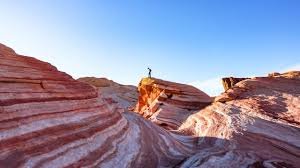
It is known for red sandstone, ancient dunes, and dramatic erosion patterns. The park helps people see how wind, sediment, time, and geologic processes shaped the region long before the modern city emerged.
For travel readers, Valley of Fire is one of the best visual answers to the question: What does the Mojave Desert near Las Vegas actually look like?
Mojave National Preserve and Death Valley
Farther away, Mojave National Preserve and Death Valley National Park extend the story outward.
These areas are not next door, but they help readers understand that Las Vegas belongs to a much larger desert system. They expand the regional map and show that the Mojave is not just a city-adjacent environment; it is a vast ecological and geological zone.
Plants of the Mojave Desert Around Las Vegas
The vegetation around Las Vegas is adapted to aridity. This is a low-rainfall environment with intense sunlight, hot summers, cool winters, and sporadic precipitation. Plants must conserve water, survive heat stress, and exploit short wet windows whenever they appear.
The result is a desert plant community that may look sparse at first glance but is actually highly specialized and ecologically important.
Joshua Trees and Desert Identity
If one plant symbolizes the Mojave Desert, it is the Joshua tree.
Joshua trees are one of the strongest visual signs that you are in Mojave country. They thrive in a climate with cold winters, hot summers, and limited rainfall. That makes them an iconic signal of desert identity around Las Vegas.
For many readers, Joshua trees are also a useful geographic cue. If they appear in the landscape, the area is often within a Mojave-type setting or close to one.
Creosote Bush and Other Common Desert Plants
Another major plant in the region is the creosote bush. It is one of the most widespread and recognizable shrubs in the Mojave.
Other desert plants survive by storing water, spreading deep root systems, minimizing leaf surface area, or timing growth bursts around rainfall. Some species bloom very quickly after rain, while others remain dormant through extended dry periods. That adaptive flexibility is one reason the Mojave ecosystem is resilient in some ways and fragile in others.
Riparian Areas and Spring Zones
Not every plant zone in the desert is equally dry. Areas near springs, washes, and runoff corridors support a different mix of vegetation than exposed slopes or basin floors.
These moister strips are known as riparian areas, and they matter greatly in the Las Vegas region because water is scarce. They support greater plant diversity and often draw more wildlife. In desert ecology, these linear water-linked habitats are among the most valuable biological corridors.
Plant Communities Change With Elevation
Vegetation changes as elevation changes.
At lower elevations, the plant world is more classic Mojave. In the mountains, temperatures fall and moisture patterns shift, allowing different species to appear. That elevation gradient is part of what makes the Las Vegas region ecologically layered rather than flat or uniform.
Wildlife and Animals in the Desert Around Las Vegas
The desert around Las Vegas is alive with wildlife. It is not barren, and it is not empty. The region supports mammals, birds, reptiles, amphibians, insects, and many other living organisms. Protected lands help preserve this biodiversity even as the metropolitan area continues to grow.
Desert Bighorn Sheep
The desert bighorn sheep is one of the best-known animals in the Las Vegas desert region.
It is strongly associated with rocky habitat and rugged mountain terrain. Seeing one in the wild is memorable because it reveals how well-adapted this species is to harsh desert conditions.
Desert Tortoise
The Mojave desert tortoise is another important species.
Its habitat includes sandy flats, rocky foothills, washes, and canyon edges. That makes it closely tied to the broader desert around Las Vegas. Because it is vulnerable to disturbance, it also serves as a symbol of conservation responsibility in the region.
Birds, Mammals, Reptiles, and Amphibians
The desert is home to far more species than many visitors expect.
Protected areas such as Desert National Wildlife Refuge support a wide variety of wildlife, including birds, mammals, reptiles, and amphibians. The landscape includes multiple habitat zones, which is one reason the region is biologically rich despite its arid reputation.
Birdwatching is especially rewarding in spring zones, wash corridors, and protected habitat areas. Raptors, desert songbirds, and water-associated species all appear in the larger ecological network.
Why Wildlife Matters for Travelers
Wildlife is not just an optional bonus for outdoor visitors. It helps define the type of desert this really is.
A healthy desert ecosystem is active, interconnected, and layered. When readers understand the animals of the Mojave around Las Vegas, they gain a more accurate mental model of the region and its ecological identity.
Human History and Cultures of the Las Vegas Desert
The story of Las Vegas did not begin with neon signs, hotel towers, or interstate interchanges. It began with water, travel, survival, and Indigenous land use.
Southern Paiute History
The Southern Paiute have lived in the desert Southwest for a very long time.
In an arid country, water determines settlement, travel, food gathering, and farming possibilities. Springs and dependable water sources were central to life. That is why the Las Vegas Valley mattered long before the modern city existed.
Springs and Early Settlement
Las Vegas began as a water stop.
Spring-fed land made the valley one of the rare places where travelers could rest in the middle of a dry landscape. The area was used along the Old Spanish Trail, and later Mormon settlers established a fort near the creek in the 1850s.
The existence of water was the critical settlement factor. Without it, the city would not have developed in the same way or at the same scale.
Old Las Vegas Mormon Fort
The Old Las Vegas Mormon Fort was the first permanent non-native settlement in the valley.
It was built along a spring-fed creek where water could support travel and irrigation. This detail matters because it shows how directly the city’s origin story is tied to the desert environment and its hydrology.
Why History Matters in a Desert Article
A strong pillar article should not treat the desert as a decorative background. It should show how land, water, and people shaped each other.
In Las Vegas, that means recognizing Indigenous history, settlement history, transportation history, and the long relationship between aridity and survival. That historical layer gives the article more semantic depth and more real-world context.
Conservation and Environmental Issues
The desert around Las Vegas is strikingly beautiful, but it is also under pressure.
Urban growth, invasive species, wildfire risk, and water stress all affect the landscape. That makes conservation a major part of the Las Vegas desert story.
Invasive Plants and Fire
One of the biggest threats to Mojave ecosystems is the spread of invasive grasses.
These grasses can alter fire behavior and increase fire frequency in landscapes where natural fire cycles once looked very different. That can damage native vegetation and destabilize ecosystem balance.
Urban Growth and Habitat Loss
Las Vegas continues to expand, and that growth affects nearby desert land.
As development spreads, wildlife habitat can become fragmented. Native plants may be disturbed, and sensitive ecological zones can become more vulnerable. This is one of the clearest examples of how urbanization intersects with desert conservation.
Water Pressure
Water is one of the most important environmental issues in the Las Vegas region.
The city depends heavily on the Colorado River and Lake Mead, along with groundwater and regional water infrastructure. When supply conditions tighten or demand increases, the effects can reach both people and ecosystems.
Why Conservation Matters to Readers
Conservation is not merely a science topic. It also helps readers understand why the desert around Las Vegas deserves respect and protection.
This is not a dead landscape. It is a functioning ecosystem that supports wildlife, plants, cultural history, recreation, and regional identity. In search-intent terms, conservation content also adds topical completeness, which strengthens the article’s authority.
Tourism and Travel in the Las Vegas Desert
One reason this topic performs well in search is that many people want to combine Las Vegas with outdoor exploration.
The city is famous for entertainment, but it is also one of the most useful launch points for desert travel in the United States. That dual identity is part of its appeal.
Best Nearby Desert Attractions
Here are some of the most useful nearby places to visit:
| Attraction | Why It Matters |
| Red Rock Canyon | Closest iconic desert scenery and an easy day trip |
| Valley of Fire | Famous red sandstone and desert geology |
| Lake Mead | Water, recreation, canyons, and wide desert views |
| Spring Mountains | Cooler mountain escape with strong elevation contrast |
| Mojave National Preserve | Deep Mojave landscape and broader desert experience |
Why Red Rock Canyon Stands Out
Red Rock Canyon is often the first place people should visit if they want to understand the Mojave near Las Vegas.
It is close, accessible, and visually rich. The cliffs, colors, rock formations, and trails provide one of the clearest real-world examples of Mojave Desert geography.
Why Valley of Fire Is Special
Valley of Fire is ideal for travelers who want dramatic desert scenery.
Its red sandstone and ancient formations make the desert feel geologically deep and visually powerful. It is not simply a scenic stop; it is an outdoor geology lesson with extraordinary color and texture.
Why Lake Mead Belongs in the Desert Story
Lake Mead matters because it reminds visitors that the desert around Las Vegas is not only dry land.
It is also a place where water storage, recreation, environmental management, and regional planning all intersect. This water dimension is crucial to understanding the city’s long-term sustainability.
Best Times to Explore
The best time to explore the desert around Las Vegas is usually during the cooler parts of the year or the cooler parts of the day.
Early morning and late afternoon are generally ideal for hiking, scenic driving, and photography because temperatures are lower and the light is softer. That makes outdoor experience safer and more enjoyable.
Practical Travel Tips for the Las Vegas Desert
A desert visit is always better when you prepare for conditions honestly.
Even a short outing can become uncomfortable or risky if you ignore heat, dehydration, or sudden weather changes. Desert travel rewards planning and respect.
Stay Hydrated
Always carry water.
The dry climate can drain energy quickly, especially in summer. Even short hikes or scenic stops can become harder than expected if hydration is neglected.
Protect Yourself From the Sun
Wear sun protection, comfortable clothing, and appropriate footwear.
The sun is intense in the Mojave, and shade is limited in many outdoor areas. This is especially true on exposed trails, roadside overlooks, and open desert basins.
Watch for Flash Flooding
Do not assume dry washes are safe during storm season.
Flash flooding can happen quickly, especially after upstream rainfall. If storms are moving through the area, avoid low-lying routes and stay alert to changing conditions.
Respect Desert Wildlife
Do not disturb animals or sensitive habitats.
Stay on designated trails where required, and avoid damaging plants or handling wildlife. Desert ecosystems recover slowly from disturbance, so low-impact behavior matters.
Check Conditions Before You Go
Weather, road conditions, and park access can change.
Before any desert outing, check local alerts, trail status, and seasonal guidance. This matters even more in summer and during storm periods.
Interesting Facts About the Las Vegas Desert
Here are some facts that make this topic even more useful for readers.
- Las Vegas is not simply “in the desert.” It is in a basin where mountains shape the weather, visibility, and drainage.
- The city’s historic core began around springs and meadows, which is why the name Las Vegas refers to “meadows.”
- The region includes a rare combination of urban density, public lands, wildlife habitat, and mountain scenery.
- The desert around Las Vegas includes both hot valley terrain and cooler mountain ecosystems.
- The area is one of the best places in the country to observe how water, geology, and urban growth interact in a desert setting.
These facts add semantic breadth to the article and help reinforce the topic cluster around desert geography, Nevada, ecology, and travel.
Why Las Vegas Is More Than a Casino City
A lot of people know Las Vegas only as a nightlife destination or entertainment capital.
That view is incomplete.
Las Vegas is a city built inside one of the most interesting desert landscapes in North America. It includes springs, mountains, dry washes, wildlife refuges, conservation lands, and major travel landmarks. Its identity is tied to environmental constraints and geographic opportunity at the same time.
That is why the question What desert is Las Vegas in? is so useful. It opens the door to a much deeper understanding of the city.
Las Vegas is not separate from the desert. It is a city shaped by it.
FAQs
Is Las Vegas in the Mojave Desert?
Yes. Las Vegas sits in the Mojave Desert in southern Nevada.
Is Las Vegas part of the Great Basin Desert?
Not mainly. The city itself is ecologically part of the Mojave Desert, while the Great Basin Desert begins north of the city.
What is the closest major desert attraction to Las Vegas?
Red Rock Canyon is one of the closest major desert attractions.
What kind of desert climate does Las Vegas have?
Las Vegas has a hot desert climate with abundant sunshine, limited rainfall, triple-digit summer heat, and cool winter nights.
What animals live in the desert around Las Vegas?
The desert supports animals such as desert bighorn sheep, desert tortoise, many birds, reptiles, mammals, and amphibians.
Conclusion
So, what desert is Las Vegas in?
Las Vegas is in the Mojave Desert.
But that answer is only the entry point.
The city sits in the Las Vegas Valley, a basin shaped by surrounding mountain ranges, limited water, intense sun, and a long history of human settlement. it is landscape includes Red Rock Canyon, Valley of Fire, Lake Mead, Mount Charleston, Desert National Wildlife Refuge, and many other Important desert landmarks. Its climate is hot, dry, and variable. It has ecosystem supports native plants, wildlife, and sensitive habitats. Its history stretches from the Southern Paiute to early settlement routes, spring-fed survival, and modern metropolitan growth.
That is why Las Vegas is one of the most interesting desert cities in the United States. It is not just located in the desert. It is defined by it.