
Introduction
The Mojave Desert Tortoise is one of the most remarkable reptiles in North America. Built for life in harsh desert conditions, it survives heat, drought, and limited food by relying on burrows, slow movement, and careful energy use.
In this guide, you will learn how to identify the Mojave Desert tortoise, where it lives, what it eats, and the main threats it faces today. You will also see why this species matters so much to the desert ecosystem and why conservation efforts are so important.
- Quick Facts About the Mojave Desert Tortoise
- Mojave Desert Tortoise Identification
- What does it look like?
- Main identification features
- How big is the Mojave Desert tortoise?
- How to tell it apart from other desert reptiles
- Where the Mojave Desert Tortoise Lives
- Main range
- Favorite habitat types
- Why burrows matter so much
- Creosote bush communities
- Landscape features that help the species
- Climate and Weather Patterns
- Seasonal activity
- Why rain matters
- How the tortoise handles dry weather
- Climate change and risk
- What the Mojave Desert Tortoise Eats
- Main foods
- Why plant diversity matters
- How it finds food
- Why invasive grasses are a problem
- Diet and water connection
- Flora That Supports the Mojave Desert Tortoise
- Important plant communities
- Why creosote bush habitats matter
- The danger of habitat change
- Plant health and tortoise survival
- Fauna That Shares the Mojave With the Tortoise
- Other animals that use tortoise burrows
- Predators and threats
- Why the tortoise matters for the full ecosystem
- Human History and Cultural Importance
- Indigenous connections
- Why this matters
- Traditional use of tortoises
- A symbol of desert life
- Survival Tips and Special Adaptations
- Burrowing behavior
- Water conservation
- Seasonal dormancy
- Slow life, strong survival
- Why is it called a survivor
- Threats Facing the Mojave Desert Tortoise
- Habitat loss
- Habitat fragmentation
- Wildfire from invasive grasses
- Disease
- Road mortality
- Predation on eggs and hatchlings
- Human disturbance
- Climate stress
- Conservation Status and Environmental Issues
- Federal protection
- State-level concern
- Why the status matters
- What conservation groups focus on
- Why this species is an environmental indicator
- Comparison: Mojave Desert Tortoise vs. Sonoran Desert Tortoise
- Why this comparison helps
- Main lesson
- What to Do If You See One in the Wild
- General rule
- Why you should not handle it
- When moving, it is okay.
- What not to do
- Best visitor behavior
- Interesting Facts About the Mojave Desert Tortoise
- It can live for decades.
- It spends most of its life underground.d
- It is built for digging.
- It is easier to seeafter thee rain.
- Its burrows help other animals.
- It is slow, but not weak.
- Pros and Cons
- Strengths
- Vulnerabilities
- Why the Mojave Desert Tortoise Matters
- It helps the ecosystem.
- It shows us environmental health.
- It connects nature and conservation.
- It teaches us about survival.
- Best Practices for Protecting the Mojave Desert Tortoise
- Stay respectful in the tortoise habitat.
- Do not feed wild tortoises
- Keep dogs under control
- Drive carefully
- Protect native plants
- Support conservation efforts
- FAQs
- Conclusion
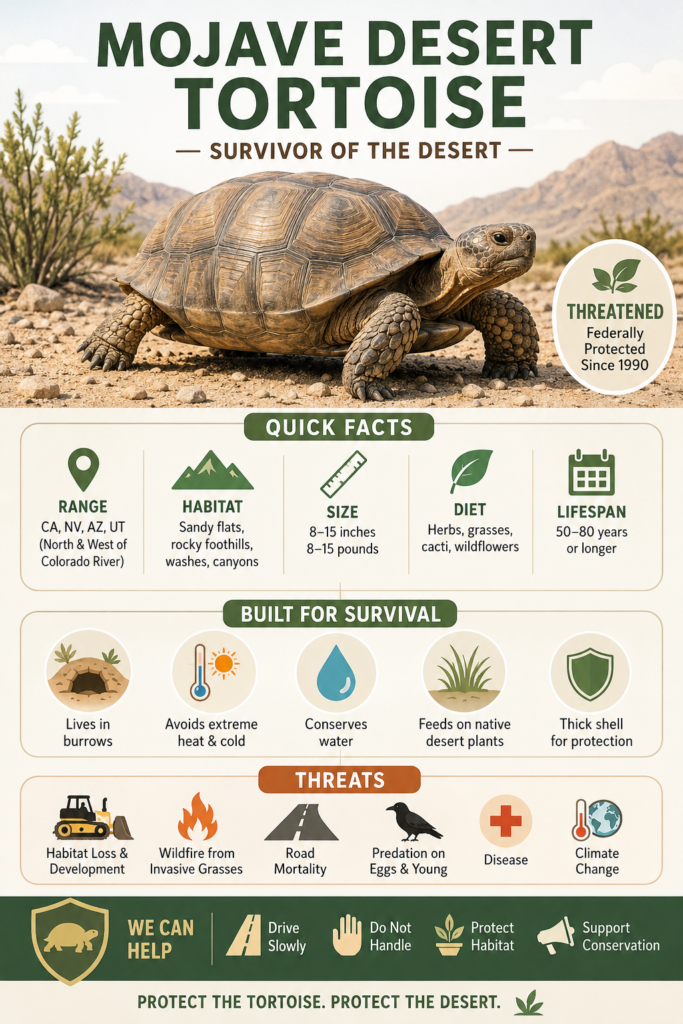
Quick Facts About the Mojave Desert Tortoise
| Quick Fact | Detail |
| Scientific name | Gopherus agassizii |
| Common names | Mojave tortoise, Mohave desert tortoise, Agassiz’s desert tortoise |
| Range | North and west of the Colorado River in California, Nevada, Arizona, and Utah |
| Habitat | Sandy flats, rocky foothills, alluvial fans, washes, canyons |
| Size | Shell length about 8–15 inches; adults about 8–15 pounds |
| Lifespan | About 50–80 years, sometimes longer |
| Diet | Herbs, grasses, cacti, wildflowers |
| Status | Federally threatened since 1990; California review table lists February 2024 endangered determination |
Mojave Desert Tortoise Identification
One of the first questions people ask is how to identify the Mojave Desert tortoise in the wild. It is not a flashy animal, but it has a very recognizable shape, posture, and set of behaviors.
What does it look like?
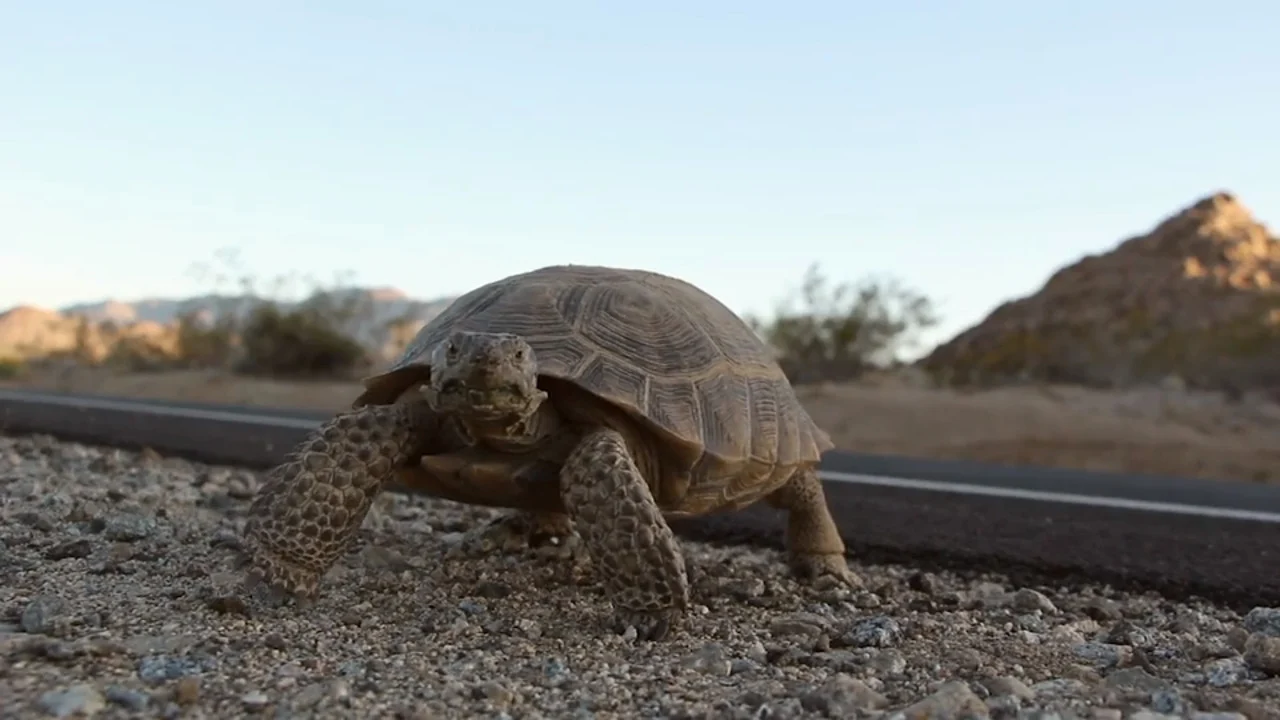
The Mojave Desert tortoise has a high-domed shell, thick legs, and a solid, heavy body. Its shell is commonly brown, tan, or grayish, which helps it blend into the desert floor. This camouflage is especially useful in open, sunlit habitats where concealment matters.
Its front legs are broad and shovel-like, which makes digging easier. Its back legs are stout and elephant-like, giving the tortoise a strong foundation for slow, steady movement over rough terrain and for burrowing into hard, dry ground.
Main identification features
Here are the simplest ways to recognize a Mojave Desert tortoise:
High-domed shell
Thick, sturdy legs
Front limbs designed for digging
Brown, tan, or grayish shell color
Slow movement
Desert habitat
Frequent burrow use
The shell shape is especially important. A tortoise shell is not flat like a turtle’s. It is rounded, heavy, and protective. That form shields the animal from predators and from many environmental dangers.
How big is the Mojave Desert tortoise?
Adults usually measure about 8 to 15 inches in shell length. They can weigh roughly 8 to 15 pounds, though size varies with age, sex, health, and environmental conditions.
Young tortoises are much smaller and more fragile. They are also far harder to spot in the wild because they stay hidden and face intense predation pressure.
How to tell it apart from other desert reptiles
The Mojave Desert tortoise is sometimes confused with lizards or other desert animals, but there are clear differences:
The tortoise has a shell, while lizards do not. The tortoise moves slowly and steadily.This species spends much of its life in burrows.The animal has thick, rounded limbs rather than thin, extended legs.Unlike many desert reptiles, the tortoise does not move quickly.
If you see a large, shell-covered reptile in Mojave Desert country, there is a strong chance it is a desert tortoise.
Where the Mojave Desert Tortoise Lives
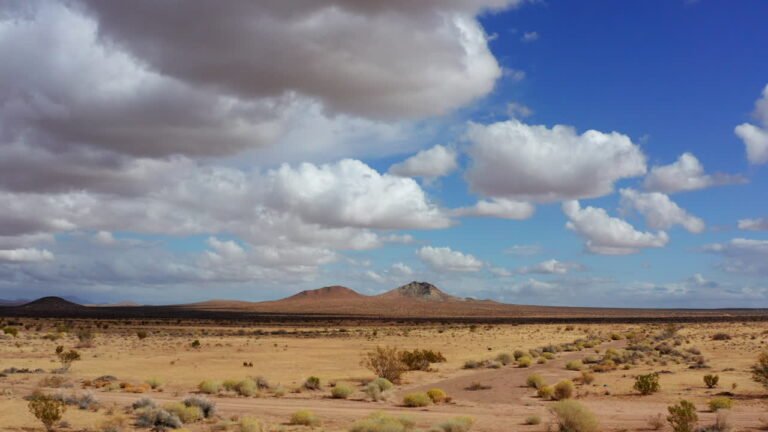
The Mojave Desert tortoise habitat is highly specific. It does not live in every dry environment. It depends on particular desert landscapes that provide burrows, forage plants, and open terrain.
Main range
The Mojave population lives north and west of the Colorado River in portions of:
California
Nevada
Arizona
Utah
That means it is closely tied to the Mojave Desert and adjacent desert regions. It is not the same as every desert tortoise in the Southwest.
Favorite habitat types
The Mojave Desert tortoise is often found in:
Sandy flats
Rocky foothills
Alluvial fans
Washes
Canyons
These landscapes give the tortoise open ground for moving, digging, and feeding. They also provide soil conditions that are Useful for burrow construction.
Why burrows matter so much
The burrow is the center of tortoise life. The Mojave Desert tortoise uses burrows to escape heat, avoid predators, and survive long dry periods. It also relies on them during colder months and during summer inactivity.
A burrow is not just a shelter. It is a life-preserving refuge. Underground temperatures are more stable, and water loss is reduced. That is one reason this species can persist where many animals would struggle.
Creosote bush communities
One of the most important habitat types for the Mojave Desert tortoise is the creosote bush community. These areas often contain open spaces with shrubs, grasses, and wildflowers that tortoises can eat.
This habitat provides both food and cover. It gives the tortoise space to move while still supplying the vegetation needed for everyday survival.
Landscape features that help the species
The best tortoise habitat usually includes:
Loose soil for digging
Native plants for food
Open space for movement
Nearby shelter
Low disturbance from people and vehicles
When these features are damaged, fragmented, or removed, the tortoise becomes much harder to sustain.
Climate and Weather Patterns
The Mojave Desert is severe, but the Mojave Desert tortoise has adapted in a remarkably strategic way. It does not stay active all year long. Instead, it uses seasonal timing to survive.
Seasonal activity
The tortoise is most active:
From March to June
Again, from September to October
During periods that are very hot, cold, or dry, it spends much more time underground in burrows.
Why rain matters
Rain is extremely important for this species. After rainfall, tortoises often emerge to feed, drink, and move. They can also retain water in their bodies following a storm.
That is one reason people often notice more tortoises after rain. Moisture stimulates activity, and the desert briefly becomes more supportive.
How the tortoise handles dry weather
The Mojave Desert tortoise has several survival traits that help it endure arid conditions:
That reduces water loss
He stores water in its blade.r
She stays underground during severe weather.
They time activity around favorable seasons.
It uses shade and burrows to avoid overheating.g
This is a powerful example of desert adaptation. The tortoise survives not by outrunning danger, but by conserving energy and using the environment wisely.
Climate change and risk
Climate change adds another layer of pressure. Higher temperatures, lower moisture, and more extreme weather patterns can make life harder for the species. If the desert becomes too hot or too dry for too long, tortoises have fewer safe windows for feeding, mating, and moving.
That is why the climate is not just background information. It is a major factor in the tortoise’s survival story.
What the Mojave Desert Tortoise Eats
The Mojave Desert tortoise diet is simple, but it depends on a healthy and varied desert plant community.
Main foods
The tortoise eats:
Herbs
Grasses
Cacti
Wildflowers
It may also feed on other native desert plants when they are available.
Why plant diversity matters
The tortoise needs a broad mix of native plants. Different plants become available at different times. Some offer moisture. Others provide fiber or nutrients. If the habitat loses botanical diversity, the tortoise loses food options as well.
How it finds food
The Mojave Desert tortoise usually feeds near its burrow or in nearby open areas. It is not a predator tracking prey. Instead, it slowly grazes on the plants within its home area.
Its feeding behavior is strongly tied to rainfall. After wet periods, fresh growth appears, and tortoises take advantage of that seasonal abundance.
Why invasive grasses are a problem
Invasive grasses are a major threat because they alter the desert’s fire regime. Native desert systems are not built for frequent fire. But invasive annual grasses can spread flames quickly and widely.
That leads to less native food, less protective cover, and more damaged habitat. When fire becomes more common, the desert becomes much less safe for the Mojave Desert tortoise.
Diet and water connection
The tortoise gets some water from the plants it eats. This is another reason native vegetation is so important. Healthy plants support both nutrition and hydration.
Flora That Supports the Mojave Desert Tortoise
The plants of the Mojave Desert are not merely decorative. They are part of the tortoise’s life-support system.
Important plant communities
The Mojave Desert tortoise depends on plant communities such as:
Creosote bush
Native grasses
Wildflowers
Shrubs
Cacti
These plants create a balanced desert landscape that supports feeding, shelter, and movement.
Why creosote bush habitats matter
Creosote bush habitats are especially valuable because they often provide the right blend of open ground and plant cover. That lets tortoises move safely while still accessing food.
The danger of habitat change
When invasive plants spread, they can outcompete native species. This reduces food resources and makes the landscape more fire-prone. Repeated fires can convert a functioning desert habitat into a far poorer environment.
Plant health and tortoise survival
A strong tortoise population depends on:
Native plant cover
Seasonal rainfall
Low fire risk
Limited disturbance
Healthy soil
When plant communities decline, tortoise populations often decline as well.
Fauna That Shares the Mojave With the Tortoise
The Mojave Desert tortoise is part of a much larger desert ecosystem. Its burrows and habitat support many other animals.
Other animals that use tortoise burrows
Some desert animals use tortoise burrows for shelter, safety, or temperature regulation. These may include:
Burrowing owls
Roadrunners
Gila monsters
Collared peccaries
Other small desert wildlife
This is one reason the tortoise is regarded as a keystone species. It helps sustain life around it.
Predators and threats
Adult tortoises do not have many natural enemies, but eggs and hatchlings are highly vulnerable. Young tortoises are at elevated risk from:
Ravens
Coyotes
Other predators
Habitat disturbance
Egg and hatchling survival is one of the most difficult stages in the life cycle.
Why the tortoise matters for the full ecosystem
The tortoise is not just another reptile. It is a habitat engineer. When its burrows remain active, other species benefit as well. That means protecting the tortoise also protects the broader desert community.
Human History and Cultural Importance
The Mojave Desert is not empty land. It has a deep human history, and the Mojave Desert tortoise is part of that history too.
Indigenous connections
Many Indigenous communities have lived in and around the Mojave Desert for thousands of years. These communities developed extensive knowledge of the land, the seasons, and the animals that live there.
Why this matters
Understanding the tortoise also means understanding the desert as a living cultural landscape. It is not only a wildlife zone. It is a homeland, a travel corridor, and a place of memory and identity.
Traditional use of tortoises
In the past, desert communities knew tortoises well. They used them in different ways, including for food, tools, and cultural objects. This reflects how long humans have interacted with this species.
A symbol of desert life
Today, the tortoise is also a symbol of conservation. It represents the fragile balance of the Mojave Desert and reminds us that desert ecosystems deserve respect and protection.
Survival Tips and Special Adaptations
The Mojave Desert tortoise survives because it is exceptionally well-adapted to its environment.
Burrowing behavior
The tortoise spends much of its life underground. Burrows help protect it from:
Extreme heat
Cold weather
Predators
Water loss
This is one of the species’ most vital survival tools.
Water conservation
The tortoise has several ways to conserve water:
Thick skin
Slow metabolism
Water storage in the bladder
Underground shelter
Reduced activity during harsh periods
These adaptations allow it to survive long dry intervals.
Seasonal dormancy
When conditions are too hot or too cold, the tortoise may become inactive for extended periods. This is a smart survival strategy. It waits for better conditions instead of trying to resist the desert’s extremes.
Slow life, strong survival
The tortoise does not depend on speed. It depends on patience, timing, and protection. This slower life strategy works well in an environment where water and energy are precious.
Why is it called a survivor
The Mojave Desert tortoise can survive in severe terrain because it relies on:
Burrows
Seasonal timing
Plant-based food
Water-saving biology
Long lifespan
That makes it one of the most specialized reptiles in North America.
Threats Facing the Mojave Desert Tortoise
Even though it is highly adapted, the Mojave Desert tortoise still faces numerous serious threats.
Habitat loss
One of the biggest threats is the destruction of natural habitat. Development, roads, energy projects, and other disturbances reduce the space tortoises need to live and move.
Habitat fragmentation
Even when the habitat is not fully destroyed, it may be broken into smaller pieces. This is called fragmentation. It makes it harder for tortoises to travel, find mates, and use safe burrows.
Wildfire from invasive grasses
Invasive grasses increase the likelihood of fire. Desert plants are often not able to recover quickly from repeated burning. Over time, this can cause severe habitat decline.
Disease
Disease is another major concern. Sick tortoises can spread illness through populations, and disease can further weaken already stressed animals.
Road mortality
Roads are dangerous because tortoises move slowly. They can be hit by vehicles, and road construction can also destroy habitat and burrows.
Predation on eggs and hatchlings
Eggs and young tortoises face very high mortality. In some areas, predators such as ravens create substantial survival challenges for juvenile tortoises.
Human disturbance
People can accidentally harm tortoises by:
Picking them up
Moving them too much
Disturbing burrows
Taking them home
Releasing captive tortoises into the wild
Even actions that seem helpful can be harmful.
Climate stress
Heat, drought, and shifting rainfall patterns add more pressure yet. The desert is becoming harder to survive in, and the tortoise’s margin for error is shrinking.
Conservation Status and Environmental Issues
The Mojave Desert tortoise conservation status is one of the most important aspects of its story.
Federal protection
The Mojave population of the desert tortoise has been listed as threatened under the Endangered Species Act since 1990. That shows how long conservation concern has remained active.
State-level concern
California’s current review and regulatory process also indicates that the species remains a significant conservation concern at the state level. This is a sign that protective efforts are still urgent.
Why the status matters
A threatened or endangered status is not just a label. It means the species is under genuine pressure from environmental change and human activity. It also means recovery work must continue.
What conservation groups focus on
Conservation efforts often include:
Habitat protection
Raven management
Translocation
Restoration work
Population monitoring
Careful planning around development
These steps help improve the odds of survival.
Why this species is an environmental indicator
The tortoise reflects the health of the desert. If tortoise numbers decline, it often signals that the ecosystem is stressed too. That is why the Mojave Desert tortoise matters so much in environmental discussions.
Comparison: Mojave Desert Tortoise vs. Sonoran Desert Tortoise
Many readers search for “desert tortoise” without realizing there are different populations and species. A comparison helps clear up that confusion.
| Feature | Mojave Desert Tortoise (Gopherus agassizii) | Sonoran Desert Tortoise (Gopherus morafkai) |
| Main range | Mojave region: CA, NV, AZ, UT, north/west of the Colorado River | Sonoran Desert: Arizona and northwest Sonora, Mexico |
| Typical habitat | Sandy flats, rocky foothills, alluvial fans, washes, canyons | Steeper rocky slopes, bajadas, incised washes, shelter-rich terrain |
| Activity pattern | Most active in spring and early fall | Moreis is shaped by monsoon rains and summer activity |
| Shelter style | Mostly self-dug burrows | Rock shelters, burrows, woodrat middens, shrubs |
| Main takeaway | Adapted to open Mojave desert conditions | Adapted to more rocky, shelter-heavy Sonoran terrain |
Why this comparison helps
This comparison is useful because it prevents confusion. The two tortoises are closely related, but they live in different desert settings and respond to different environmental patterns.
Main lesson
The Mojave Desert tortoise is best suited to the open, dry, and seasonal conditions of the Mojave. The Sonoran species is more closely linked to monsoon-influenced desert habitats.
What to Do If You See One in the Wild
If you ever see a Mojave Desert tortoise in the wild, the best response is simple: leave it alone.
General rule
Do not touch it, pick it up, or move it unless it is in immediate danger.
Why you should not handle it
Handling can stress the tortoise. In some cases, it may cause the animal to release water from its bladder, which can be dangerous. That water may be vital for its survival in the desert.
When moving, it is okay.
If the tortoise is in immediate danger of being hit by a car, it may be gently moved off the road in the direction it was already heading. After that, place it down carefully and leave it alone.
What not to do
Never:
Take it home
Keep it as a pet
Move it far from where you found it.
Put it into a different area.
Disturb the burrow
Best visitor behavior
If you are in tortoise country:
Stay on roads and trails
Drive slowly after the rain.
Watch for wildlife near roads.
Respect protected areas
Report injured wildlife when appropriate.e
These basic actions can save lives.
Interesting Facts About the Mojave Desert Tortoise
The Mojave Desert tortoise is full of remarkable facts that make it even more impressive.
It can live for decades.
This is a long-lived reptile. Many sources place its lifespan around 50 to 80 years, and some say it can live even longer.
It spends most of its life underground.d
The tortoise may spend around 95% of its life in burrows. That is an enormous part of its survival strategy.
It is built for digging.
Its front legs are powerful and shaped for excavation. This helps it create burrows and move through compact desert soil.
It is easier to seeafter thee rain.
Rain often brings tortoises out of their burrows. That is when they are more likely to feed and drink.
Its burrows help other animals.
The tortoise is not only helping itself. It also provides shelter to other desert species, which is one reason it matters so much to the ecosystem.
It is slow, but not weak.
Its slow movement is not a flaw. It is part of a survival system that has worked for a long time in severe desert conditions.
Pros and Cons
Strengths
Strong desert adaptations
Long lifespan
Important ecosystem role
Excellent burrow builder
Very efficient water conservation
Vulnerabilities
Slow reproduction
High risk to young tortoises
Sensitive to habitat destruction
Threatened by roads and wildfire
Affected by disease and human disturbance
This balance is what makes the species so important. It is resilient, but not invincible.
Why the Mojave Desert Tortoise Matters
The Mojave Desert tortoise matters for several reasons.
It helps the ecosystem.
Its burrows, feeding habits, and long-term presence all support the larger desert community.
It shows us environmental health.
When tortoise populations decline, it often signals that the desert is under stress.
It connects nature and conservation.
The species is both a wildlife icon and a conservation warning. It shows how fragile desert life can be.
It teaches us about survival.
The tortoise survives through patience, timing, and adaptation. That makes it one of the clearest examples of desert resilience.
Best Practices for Protecting the Mojave Desert Tortoise
Protecting this species is not only the responsibility of scientists and conservation groups. Everyone can help.
Stay respectful in the tortoise habitat.
If you are hiking, camping, or driving in desert areas, be careful not to disturb wildlife.
Do not feed wild tortoises
Human food can harm them and can also alter their natural behavior.
Keep dogs under control
Pets can stress or injure wildlife, especially in sensitive desert areas.
Drive carefully
Roads are one of the biggest dangers. Slower driving in desert habitats can reduce mortality.
Protect native plants
Native vegetation supports tortoises through food and shelter. Damaging plants harms the entire ecosystem.
Support conservation efforts
You can help by supporting habitat protection, responsible recreation, and public education.
FAQs
Federally, the Mojave population of the desert tortoise is listed as threatened under the Endangered Species Act. California also continues to treat it as a major conservation concern.
They often live about 50 to 80 years, and some may live longer. They grow slowly and reach maturity late in life.
They eat herbs, grasses, cacti, and wildflowers. Their diet depends on native desert plants and seasonal rainfall.
Burrows help them avoid heat, cold, predators, and dehydration. They are a key survival structure in the desert.
Only move it if it is in immediate danger of being hit. Gently place it off the road in the direction it was heading, then leave it alone.
Conclusion
The Mojave Desert tortoise is a powerful example of desert survival, but it is also a species under real pressure. Habitat loss, wildfire, roads, disease, and climate stress continue to threaten its future. Protecting native habitat and treating tortoises with care in the wild can make a real difference.
By understanding this species better, we also learn more about the health of the Mojave Desert itself.