
Introduction
The Mojave Desert is one of North America’s most remarkable landscapes, known for its dry climate, rugged terrain, and surprising ecological diversity. Stretching across southeastern California and parts of Nevada, Arizona, and Utah, it is a rain shadow desert shaped by elevation, geology, and extreme weather.
This guide covers the Mojave Desert’s geography, climate, plants, animals, history, travel safety, and conservation concerns. It gives you a complete overview of why this desert is both beautiful and ecologically important.
- Mojave Desert at a Glance
- What Is the Mojave Desert?
- Location and Geography
- Why the Mojave Is Called a Rain Shadow Desert
- Climate and Weather
- Best time to visit
- A simple weather picture
- Landscape Features: Mountains, Valleys, Salt Flats, and Dunes
- Examples of Mojave landforms
- Plants of the Mojave Desert
- The Joshua tree
- Creosote bush and white bursage
- Why Mojave plants matter
- Animals of the Mojave Desert
- Common Mojave animals
- The desert tortoise
- Birds, reptiles, and small creatures
- How Mojave animals survive
- Human History and Cultures in the Mojave
- Trails, trade, and travel
- Mining, ranching, and modern use
- Why the human story matters
- Travel Tips and Safety in the Mojave Desert
- Why water matters so much
- When to avoid low-elevation hiking
- Good desert habits
- Best Places to Experience the Mojave Desert
- Death Valley National Park
- Joshua Tree National Park
- Mojave National Preserve
- What to do there
- Interesting Facts About the Mojave Desert
- Environmental Issues and Conservation
- Why wildfire is such a big problem
- Why Joshua trees are under pressure
- Why habitat fragmentation matters
- Conservation in one sentence
- Pros and Cons
- Pros
- Cons
- FAQs
- Conclusion
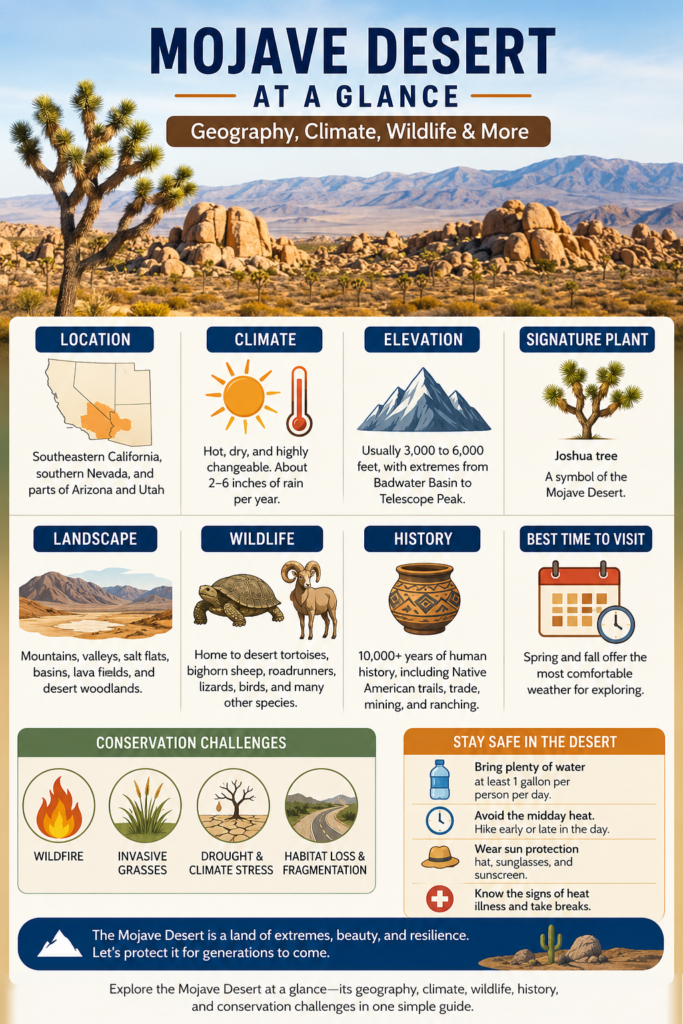
Mojave Desert at a Glance
| Topic | Key detail |
| Location | Southeastern California, southern Nevada, and parts of Arizona and Utah |
| Desert type | Rain shadow desert shaped by mountains, elevation, geology, and indicator plants |
| Rainfall | About 2 to 6 inches per year in many areas |
| Elevation | Usually 3,000 to 6,000 feet, with extremes from Badwater Basin to Telescope Peak |
| Signature plant | Joshua tree |
| Famous parks | Death Valley National Park, Joshua Tree National Park, Mojave National Preserve, and nearby desert recreation areas |
| Main conservation concerns | Habitat loss, wildfire, invasive grasses, drought, climate stress, and land fragmentation |
What Is the Mojave Desert?
The Mojave Desert is an arid region of the American Southwest. Britannica places it mainly in southeastern California, with portions extending into Nevada, Arizona, and Utah. It belongs to the wider North American Desert system and connects to other drylands such as the Sonoran Desert and the Great Basin. That means it is not only a distinct desert, but also a transitional ecological zone where different desert systems overlap.
What makes the Mojave special is not just the lack of rainfall. Its identity comes from the combined influence of latitude, altitude, geology, and plant communities. Joshua Tree National Park explains that the Mojave is defined by those interacting factors rather than by a single feature. As a result, one section may appear as a rocky shrubland, while another looks like a salt flat, a basin, or a Joshua tree woodland.
The desert is also known for extremes. It includes Death Valley, home to Badwater Basin, the lowest point in North America, as well as nearby mountain summits like Telescope Peak. The National Park Service notes that the broader Mojave landscape can range from below sea level to very high mountain terrain, and that variation is a major reason the region supports so many habitats.
Location and Geography
The Mojave Desert lies primarily in southeastern California and southern Nevada, with smaller portions reaching into Arizona and Utah. Britannica describes it as stretching from the Sierra Nevada range toward the Colorado Plateau, while also blending with the Great Basin Desert to the north and the Sonoran Desert to the south and southeast.
Its physical geography is shaped by basins and ranges. In other words, the land is organized into mountain chains, dry valleys, gravel fans, sandy flats, salt pans, and open basins. The National Park Service explains that Mojave geology includes many rock types and a long history of geologic transformation, which is why the scenery changes so dramatically from one location to another. The desert is not flat, and it is certainly not uniform. It is broken into layers of terrain that create a highly varied visual and ecological mosaic.
The Mojave also has a strong human geography component. Cities, highways, and travel corridors sit near its margins, and the region supports recreation, ranching, mining, military training, and renewable-energy planning. The Nature Conservancy notes that the Mojave’s 20 million acres support many uses, but those resources are limited and vulnerable. That tension between development and protection is one of the desert’s most important long-term issues.
Why the Mojave Is Called a Rain Shadow Desert
The Mojave is dry because mountain ranges block moisture-bearing air. Joshua Tree National Park explains that wet air masses from the west rise over high mountains, cool down, and drop precipitation before they can reach the desert. By the time the air flows into the Mojave, much of its moisture has already been released. That is the basic mechanism of a rain shadow desert.
This matters because rainfall in the Mojave is not evenly distributed. Some storms, especially those influenced by late-summer tropical moisture, can bring heavy rain in a short burst. Even so, the yearly total remains low. That is why the Mojave can experience sudden flash floods while still being one of the driest major deserts in North America.
Climate and Weather
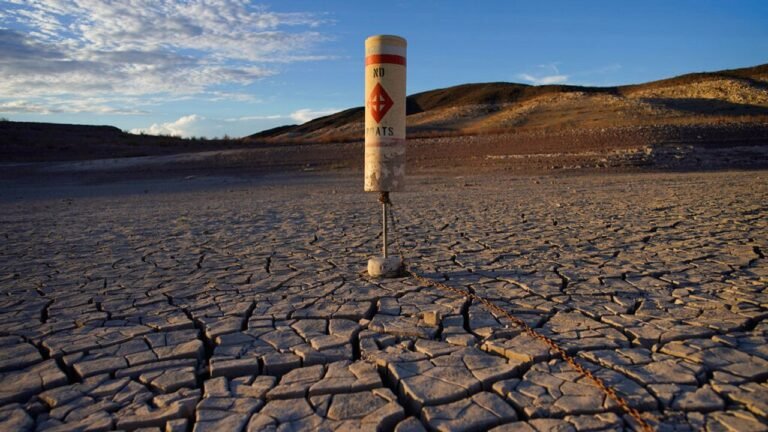
The Mojave Desert climate is hot, dry, and highly changeable. Britannica says the region experiences sharp day-night temperature swings and frequent winter frosts, with average annual precipitation of around 2 to 6 inches. Summer afternoons can be intensely hot, while winter nights may drop below freezing in some areas.
Elevation has a major effect on temperature. Low basins are much warmer, while higher terrain is cooler and may even receive snowfall. Joshua Tree National Park explains that the Mojave’s temperatures are influenced by both latitude and altitude. It also points out that Death Valley has recorded the highest maximum temperature in the region, 134°F, while higher elevations remain considerably cooler.
For travelers, this means the Mojave weather is complex rather than simple. One section of the desert may feel brutally hot, another may feel comparatively moderate, and a single trip can include dry heat, strong winds, chilly nights, and intense sun exposure. That is why seasonal timing matters so much for camping, hiking, photography, and long-distance driving.
Best time to visit
The safest and most comfortable seasons are usually the cooler months. Joshua Tree National Park notes that spring and fall are the most pleasant periods, while summer heat brings danger. Death Valley guidance also recommends outdoor activity during cooler seasons rather than in the severe heat of low-elevation summer.
A simple weather picture
A helpful way to understand the Mojave is this: hot summers, cool winters, dry air, and substantial differences between low and high elevations. That one pattern influences nearly everything else in the desert, from vegetation to wildlife to the way people travel through it.
Landscape Features: Mountains, Valleys, Salt Flats, and Dunes
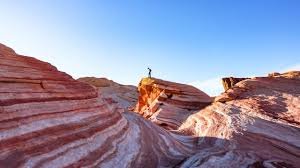
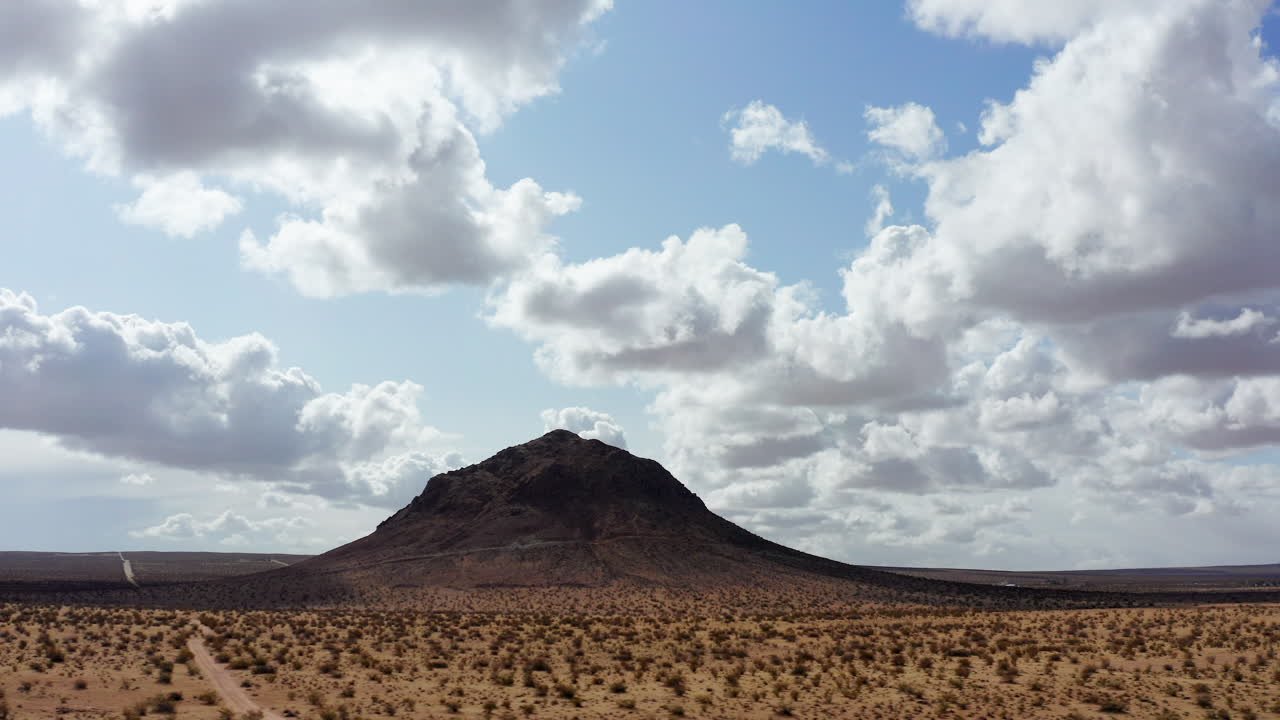
The Mojave is famous for much more than sand. Its landscape includes rugged hills, dry basins, broad alluvial fans, salt flats, mountain ranges, lava fields, and open high-desert valleys. Britannica describes it as a mountain-and-basin environment with sand and gravel basins that drain into central salt flats.
Death Valley offers one of the most striking examples of Mojave topography. It contains an extreme low point and nearby towering peaks, making it possible to see dramatic relief within the same region. Britannica notes that the basin lies below sea level while Telescope Peak rises sharply above it. That contrast is part of what gives the Mojave such visual power.
Many of the landforms were shaped by water, even though water is scarce today. Ancient lakes, seasonal runoff, erosion, and climate shifts over long time spans all helped form the basins and drainage networks that still define the region. Historical material on the Mojave Road also shows that travelers depended heavily on known water sources, proving that water has always been central to movement through the desert.
Examples of Mojave landforms
Some of the most recognizable features include Badwater Basin, Death Valley, Telescope Peak, broad salt flats, basin-and-range slopes, lava fields, and Joshua tree woodlands. These are the kinds of scenes that attract photographers, hikers, road-trippers, and geology enthusiasts from around the world.
Plants of the Mojave Desert
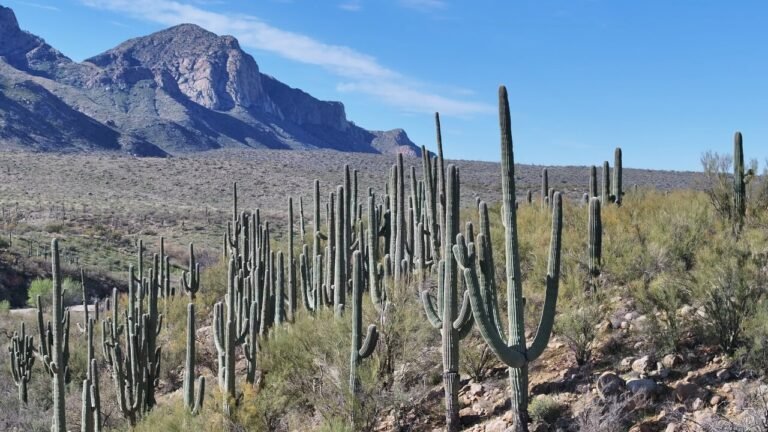
Mojave Desert plants may appear sparse when compared with wetter ecosystems, but they are highly specialized, resilient, and often rare. Joshua Tree National Park says Mojave vegetation is dominated by low, widely spaced shrubs. Britannica identifies creosote bush, Joshua tree, burroweed, and several cacti among the region’s common plant life.
One of the most significant facts about Mojave flora is endemism. The National Park Service says nearly one quarter of all Mojave Desert plants are endemics, meaning they naturally occur here and nowhere else. That makes the Mojave especially important from a conservation standpoint because the loss of habitat here can mean the loss of an entire species’ natural range.
The Joshua tree
The Joshua tree is the signature plant of the Mojave. It is not merely a symbol; it is a structural part of the ecosystem. The National Park Service explains that Joshua trees provide shelter and nesting opportunities for wildlife. Their reproductive cycle is also tied to the yucca moth, which helps with pollination.
Joshua Tree National Park also notes that the desert contains endemic plants such as Parry saltbush and Mojave sage. In the northern Mojave, vegetation often resembles that of the Great Basin Desert, while the southern portion shares features with the Sonoran Desert. This gives the flora a layered identity that changes depending on where you stand.
Creosote bush and white bursage
The creosote bush is among the most widespread plants in the desert. Joshua Tree National Park says it dominates large areas and often grows alongside white bursage. The Nature Conservancy also emphasizes that the Mojave provides a broad ecological shelter for plant life, which is a reminder that desert vegetation may look thin, yet still supports immense biological value.
Why Mojave plants matter
These plants do much more than survive. They stabilize soil, provide shade, support insects and small mammals, and create nesting and feeding spaces for birds. In a desert ecosystem, one shrub can function like an entire neighborhood. That is why plant loss can quickly ripple through the whole food web.
Animals of the Mojave Desert
Mojave Desert animals are adapted to heat, drought, and long stretches with little water. Many are nocturnal, many hide underground, and many avoid daytime heat by resting in shade or burrows. Reptiles are particularly visible in desert environments, and Joshua Tree National Park documents dozens of reptile species in the area.
Joshua Tree National Park says the park supports 57 mammal species, 46 reptile species, and more than 250 bird species. That is strong evidence that the Mojave is not empty at all. It simply conceals much of its life during the hottest part of the day.
Common Mojave animals
Some of the best-known species include the desert tortoise, desert bighorn sheep, mule deer, greater roadrunner, cactus wren, many lizards and snakes, and a broad range of insects and other invertebrates. The Nature Conservancy also highlights bighorn sheep, desert tortoise, mule deer, and other animals that depend on connected desert mountain systems.
The desert tortoise
The Mojave desert tortoise is one of the region’s most iconic and important species. It survives extreme conditions by spending much of its life in burrows and minimizing exposure to heat. The National Park Service and The Nature Conservancy both treat it as a major conservation priority because its future depends on intact habitat, low disturbance, and stable land stewardship.
Birds, reptiles, and small creatures
Birds are a major part of the Mojave ecosystem. Joshua Tree National Park lists year-round residents such as the greater roadrunner, cactus wren, verdin, Le Conte’s thrasher, red-tailed hawk, and American kestrel. Reptiles are also numerous, and the open desert terrain makes them easier to observe than in dense vegetation.
Small animals matter just as much. Insects, beetles, crickets, and other invertebrates pollinate plants, transfer energy through the food chain, and help recycle organic matter. A strong Mojave article should never focus only on large mammals. The smallest organisms are part of what keeps the system alive.
How Mojave animals survive
Most desert animals use a few reliable strategies: they are active at night, shelter in burrows, stay in shade, and conserve water carefully. The Mojave’s hot, dry climate does not eliminate life. It simply shapes life into efficient, resourceful forms. That is one of the most fascinating truths about desert ecology.
Human History and Cultures in the Mojave
Human history in the Mojave reaches back thousands of years. Mojave National Preserve says the region carries a 10,000-year history of human connection. The Mojave Road and Old Spanish Trail history materials explain that Native American communities lived in the desert for millennia, with evidence near Lake Mojave dating back at least to 5,000 B.C. and possibly as far as 10,000 years.
This matters because the Mojave was never vacant. People used the desert for movement, trade, adaptation, and survival. The Mojave people created travel corridors between water sources so that passage through the dry terrain could be possible. They also developed agriculture near the Colorado River and exchanged goods with coastal and inland communities.
Trails, trade, and travel
The desert’s routes were carefully chosen, not random. The National Park Service explains that the Mojave people used reliable water sources and established trade networks extending to the California coast. Later, those same pathways guided Spanish and Anglo-American travelers across the region. That shows how deeply desert geography and human history are intertwined.
Mining, ranching, and modern use
In later centuries, the Mojave became associated with mining, ranching, military activity, road travel, and tourism. Britannica mentions minerals such as borax, potash, salt, silver, tungsten, gold, and iron. The Nature Conservancy notes that the region also supports ranching, mining, military training, and recreation today.
Why the human story matters
A complete Mojave guide should never treat the desert as just a scenic backdrop. It is a place of Indigenous continuity, practical knowledge, ancient trails, and ongoing land-use pressure. That long history makes the region more meaningful and, at the same time, more vulnerable.
Travel Tips and Safety in the Mojave Desert
The Mojave is a beautiful place to explore, but it demands respect and preparation. The National Park Service recommends carrying at least one gallon of water per person per day at Joshua Tree and advises doing outdoor activities during cooler hours, especially before 10 a.m. or after 4 p.m.
Here is a simple desert travel checklist:
Carry plenty of water and never assume you will find it on the road.
Start hikes early or late in the day, not during the hottest period.
Eat salty snacks and replace electrolytes in hot weather.
Watch for symptoms of heat illness such as dizziness, weakness, heavy sweating, or confusion.
Check weather and road conditions before departure.
Why water matters so much
In the desert, water is not a minor detail. It is the central safety issue. Joshua Tree National Park warns that extreme summer heat can be dangerous, and it also notes that some visitor services are limited or available only in certain areas. A short walk can become risky very quickly if someone is unprepared.
When to avoid low-elevation hiking
Low-elevation zones can become extremely dangerous in summer. Death Valley and Joshua Tree both caution against hot-weather hiking because heat illness can escalate fast. For that reason, many visitors choose spring, fall, winter, or very early morning hours during summer months.
Good desert habits
Smart travelers leave an itinerary with someone else, carry offline maps or navigation tools, and keep enough fuel and backup supplies for long stretches without services. Desert roads can be remote, and mobile coverage is not reliable everywhere. Preparation is not optional in this environment.
Best Places to Experience the Mojave Desert
The Mojave is not one single tourist site. It is a broad region with several major destinations, each offering a different kind of desert experience.
Death Valley National Park
Death Valley is the Mojave’s most famous and extreme landscape. It is known for its low elevation, heat records, salt flats, broad basins, and dramatic geology. The National Park Service says the park contains species adapted in remarkable ways, and Britannica identifies Death Valley as the location of the lowest point in North America.
Joshua Tree National Park
Joshua Tree National Park is the place many people picture first when they hear “Mojave Desert.” It is known for its Joshua trees, massive boulder fields, desert wildlife, and the scenic meeting point of the Mojave and Colorado Deserts. The National Park Service also notes that it is a rain shadow desert with a high concentration of endemic plants.
Mojave National Preserve
Mojave National Preserve offers a quieter, more remote desert experience. The National Park Service says it protects a varied mosaic of habitats and a 10,000-year record of human connection with the land. It is an excellent destination for travelers seeking solitude, open horizons, and a strong sense of desert scale.
What to do there
Popular activities include scenic driving, stargazing, short hikes, geology viewing, photography, birdwatching, and visiting historic locations. With the right season and the right preparation, the Mojave can feel quiet, expansive, and unforgettable.
Interesting Facts About the Mojave Desert
The Mojave is full of details that make it stand out from other desert regions. Britannica says it covers more than 25,000 square miles and contains salt flats where borax, potash, and salt have been extracted. That means the desert is not only scenic; it has also been economically significant.
Another striking fact is its elevation range. Joshua Tree National Park notes that the desert includes both Telescope Peak and Badwater, showing how one desert can contain extreme high and low points. That dramatic relief is one reason the Mojave contains so many different habitats.
A third fact is the level of plant uniqueness. Nearly one quarter of Mojave plants are endemic, which is remarkably high for a desert ecosystem. This is one reason scientists and conservation organizations pay such close attention to the region.
A fourth fact is the human dimension. The desert has supported Indigenous travel, trade, farming, military routes, mining, ranching, and tourism for thousands of years. The Mojave is not a dead place. It is a living corridor with a deep memory.
Environmental Issues and Conservation
The conservation story of the Mojave is urgent because desert ecosystems recover slowly. The Nature Conservancy describes the region as finite and fragile, while the National Park Service identifies climate change, invasive plants, wildfire, and habitat pressure as serious problems.
Why wildfire is such a big problem
In the Mojave, invasive grasses can spread fire across the landscape much more quickly than native vegetation typically would. Joshua Tree National Park explains that warmer, drier conditions and invasive species like red brome have increased wildfire risk, and Joshua trees often do not recover well after burns.
Why Joshua trees are under pressure
Joshua trees are especially vulnerable because they depend on specific climate conditions, and climate change can reduce the amount of suitable habitat. The National Park Service says they are losing habitat because of rising temperatures, prolonged drought, fire, and invasive grasses. That means protecting the Joshua tree is about more than saving one plant. It is about preserving the desert’s future ecological identity.
Why habitat fragmentation matters
Roads, urban expansion, development, and intensive land use can break habitats into isolated pieces and make movement harder for wildlife. The Nature Conservancy points out that the Mojave supports many human uses, but those uses must be carefully managed if native species are to remain healthy over the long term.
Conservation in one sentence
The main conservation goal is straightforward: protect native Mojave habitat while still allowing people to live, travel, and work in the region responsibly.
Pros and Cons
Pros
Stunning scenery, including Death Valley, Joshua trees, salt flats, mountains, and vast open views.
High biodiversity for a dry region, including many endemic plants and a rich range of animals.
Excellent conditions for photography, stargazing, geology, birding, and quiet travel.
Cons
Extreme heat and limited water make careless travel dangerous.
Distances are long, services can be sparse, and cell coverage can be unreliable.
Wildfire, invasive grasses, off-road damage, and climate stress can harm sensitive ecosystems.
FAQs
No. Summers are very hot, but winters can be cool and frosty, especially at higher elevations. The desert varies greatly from place to place, so the temperature depends on where you are and when you visit.
It is best known for Death Valley, Joshua trees, salt flats, mountain-and-basin scenery, and a harsh but beautiful desert climate.
The most recognizable plants are the Joshua tree and creosote bush. Other important species include white bursage, Parry saltbush, Mojave sage, burroweed, and several types of cacti.
Yes, but only with preparation. Bring enough water, avoid the hottest hours, check road and weather conditions, and never assume help or services will be close by.
It contains many endemic species, supports rare habitats, and faces pressure from wildfire, drought, invasive plants, and habitat fragmentation. Protecting it helps preserve species that may exist nowhere else.
Conclusion
The Mojave Desert is far more than a dry, empty place. It is a living landscape filled with unique plants, wildlife, dramatic landforms, and a deep human history. From Joshua trees to desert tortoises, every part of the Mojave reflects adaptation and resilience.
At the same time, the desert faces serious threats from climate change, wildfire, and habitat loss. Protecting the Mojave means Preserving one of North America’s most extraordinary natural regions for the future.