
Introduction
The Mojave rattlesnake is one of the most important venomous snakes in the American Southwest. Also known as the Mojave green or Mohave Rattlesnake, it is adapted to desert habitats and is often mistaken for similar rattlesnakes. This guide covers how to identify it, where it lives, what makes its venom unique, and how to avoid a bite.
- Quick Facts
- Overview and Introduction
- Location and Geography
- Range in the United States and Mexico
- Habitat Preferences
- Climate and Weather Patterns
- Landscape Features
- Flora: Plants That Shape Their Habitat
- Fauna: Animals It Lives With and Eats
- How to Identify a Mojave Desert Rattlesnake
- Size, Color, and Markings
- The Tail Pattern Matters Most
- Common Identification Mistakes
- Behavior and Hunting Style
- Is the Mojave Desert Rattlesnake Dangerous?
- Mojave Rattlesnake Venom: Neurotoxic vs. Hemotoxic
- Venom Types at a Glance
- What to Do If You Are Bitten
- Do Not Do These Things
- Simple Emergency Steps
- How to Avoid a Bite
- Mojave Rattlesnake vs. Western Diamondback
- Pros and Cons
- Pros
- Cons
- Human Encounters, Field Culture, and Common Misconceptions
- Interesting Facts
- Environmental Issues and Conservation
- FAQs
- Conclusion
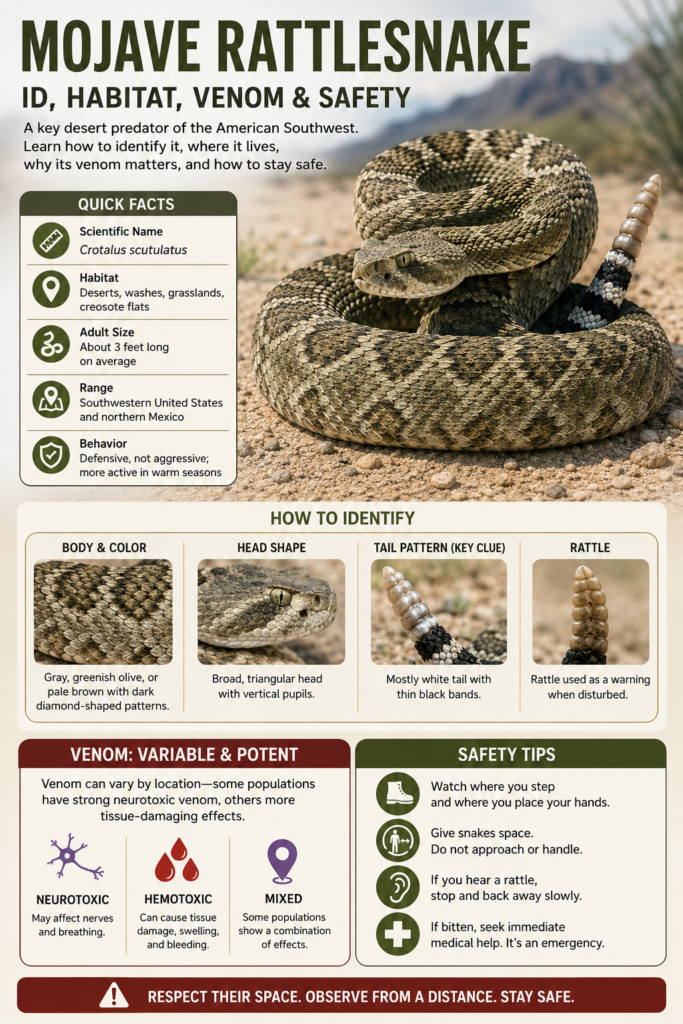
Quick Facts
| Feature | Details |
| Common names | Mojave rattlesnake, Mohave rattlesnake, Mojave green |
| Scientific name | Crotalus scutulatus |
| Family | Pit viper/rattlesnake group |
| Adult size | About 3 feet long on average |
| Range | Southwestern United States and northern Mexico |
| Habitat | Low deserts, creosote flats, desert washes, grasslands, open dry terrain |
| Venom | Variable; may be strongly neurotoxic or more tissue-damaging depending on the population |
| Behavior | Generally defensive, not truly aggressive; more active in warm seasons |
| Safety note | A bite is a medical emergency and requires fast professional care |
Overview and Introduction
The Mojave Desert rattlesnake is often described as a symbol of the harsh desert environment because it embodies so many of the traits needed to survive there. It uses camouflage to disappear into the ground cover, a rattle to warn off threats, and an ambush hunting style that conserves energy in a landscape where food and water can be scarce. The snake is adapted to heat, dryness, and wide-open terrain. It does not need lush forests or constant moisture. Instead, it thrives in places where many animals would struggle.
At the same time, it is important to understand that “dangerous” does not mean “malicious.” This snake does not stalk humans, chase people, or behave with aggression in the way many people imagine. Most bites happen when a snake is surprised, stepped on, cornered, or handled. The risk comes from proximity and mistake, not from intent. That distinction matters because fear often leads to poor judgment. Calm awareness, not panic, is the right response.
The Mojave rattlesnake also plays a valuable ecological role. It helps regulate populations of rodents and other small prey, which contributes to the balance of desert ecosystems. In many ways, it is a predator that helps keep the system stable. Without snakes like this one, rodent populations can increase and disturb the natural web of life. So while the species deserves respect and caution, it also deserves appreciation as a functioning part of the desert environment.
Location and Geography
The Mojave Desert rattlesnake is closely Associated with arid and semi-arid regions. It is not confined to a single state or one isolated habitat patch. Instead, it appears across desert landscapes in the southwestern United States and extends into northern Mexico. Its range overlaps with many hot, open places where sparse cover and broad sunlight define the terrain. This wide distribution also helps explain why the species can vary from one region to another in appearance, behavior, and venom profile.
Because the snake occupies a broad geographical range, different populations may adapt to different local conditions. A snake in one desert basin may appear slightly different from one in another. Color tones, pattern clarity, body shading, and even venom characteristics may shift across locations. That is one reason field identification should never rely on a single feature. Geography is useful, but it should be read alongside body shape, tail markings, habitat, and overall context.
Range in the United States and Mexico
The Mojave rattlesnake occurs across the desert Southwest and into northern Mexico, including areas where hot summers, sparse vegetation, and open ground dominate the landscape. It is not a mountain snake, nor is it typically a dense-forest species. It favors warm, low-elevation environments and dry plains where it can move efficiently, hide effectively, and wait for prey with minimal energy expenditure.
This wide range is also part of what makes the species so well known. People encounter it in different settings, from open desert preserves to ranch land, trail corridors, and wilderness edge habitats. Its distribution is broad enough that it is relevant to hikers, campers, field workers, park visitors, and residents of desert communities.
Habitat Preferences
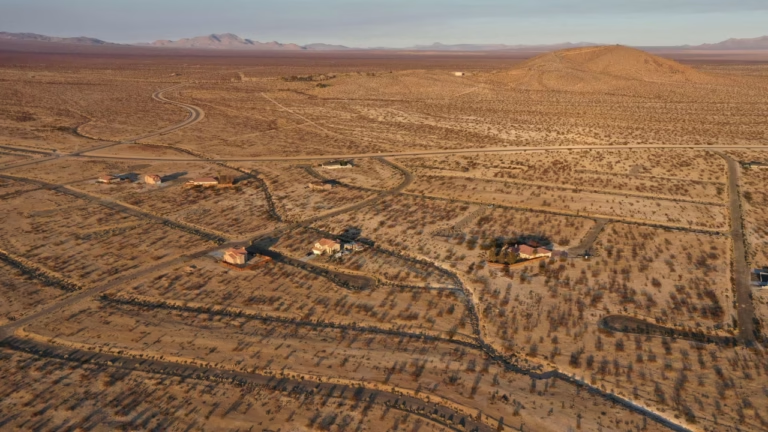
The Mojave rattlesnake prefers open ground rather than thick vegetation. Desert washes, creosote flats, grasslands, and sparse scrubland are classic habitats. These are places where the snake can blend into the terrain and remain difficult to spot until it moves or rattles. The species does not need dense cover to survive. In fact, open desert often suits it better because it supports the ambush strategy that defines its hunting style.
The snake also benefits from places that provide a mix of concealment and access. It needs spots where it can retreat from heat, hide from predators, and lie in wait for prey. Burrows, brush edges, ground depressions, and scattered rock cover can all support that lifestyle. Its preferred habitat is therefore not random desert emptiness, but a structured dry environment with enough irregularity to provide safety and hunting opportunities.
Climate and Weather Patterns
The Mojave Desert is shaped by heat, dryness, and dramatic temperature swings. Daytime temperatures can rise sharply, while evenings and winters can become surprisingly cool. The Mojave rattlesnake has evolved to function in those conditions. It is especially active in warm weather and less active during the hottest periods of the day. In extreme heat, it may shift behavior to reduce exposure and conserve energy.
Season also matters. During cooler months, the snake reduces surface activity and may shelter in rodent burrows or other protected spaces. That seasonal rhythm helps it avoid thermal stress. For people who hike, camp, or work outdoors, this means that snake activity changes across the year. Encounters may be more likely during the warmer months or at times of day when the temperature allows the snake to move comfortably.
Landscape Features
An open desert does not mean a featureless desert. The Mojave rattlesnake often uses distinct landscape elements such as washes, dry stream beds, grasses, and transitional habitat between open ground and low scrub. These structures support its movement, hunting, and concealment. A wash, for instance, may offer loose substrate, prey activity, and small pockets of shade or shelter.
Rodent burrows are especially important. They offer refuge from heat, cold, and disturbance. During winter or during extreme environmental conditions, these burrows function as safe retreats. In a harsh desert climate, access to shelter can mean the difference between survival and exposure.
Flora: Plants That Shape Their Habitat
The vegetation associated with the Mojave rattlesnake is usually sparse, drought-resistant, and widely spaced. Creosote bush communities are especially important, along with open scrub and dry grassland vegetation. These plants do not feed the snake directly, but they shape the structure of its environment. They create patchiness, shadow, hiding opportunities, and movement corridors.
Creosote flats and similar plant communities are classic examples of habitats where the snake can remain concealed. The colors of the plant cover, the soil, the rocks, and the dry ground often blend into the snake’s body coloration. That camouflage advantage is central to its survival. The vegetation does not have to be dense to matter. Even scattered low shrubs can provide enough cover to help the snake remain unseen.
A useful way to think about its habitat is this: the Mojave rattlesnake is built for spaces where visibility is deceptive. A person may assume the area is “empty,” but the snake is often using tiny details in the landscape to stay hidden. Dry branches, pale stones, grass clumps, and low brush all become part of the background that makes the snake difficult to detect.
Fauna: Animals It Lives With and Eats
The Mojave rattlesnake is an ambush predator. That means it does not chase prey over long distances. Instead, it waits patiently until an animal comes within striking range. When the timing is right, it delivers a rapid strike and then waits for the prey to weaken. This style of hunting is energy-efficient and fits desert conditions extremely well.
Its diet includes small mammals, lizards, other snakes, and sometimes prey as large as a rabbit. Rodents are especially important food sources. Because rodents are abundant in many desert ecosystems, the Mojave rattlesnake occupies a valuable predatory niche. It helps regulate prey populations and contributes to broader ecological balance.
The animals it lives alongside also shape its behavior. Larger predators, prey species, and seasonal resource patterns all affect how and where it moves. The snake’s presence is part of a larger desert food web that includes insects, lizards, birds of prey, mammals, and other snakes. This is another reason the species matters beyond human safety concerns. It is not an isolated hazard. It is one participant in a much larger ecological system.
How to Identify a Mojave Desert Rattlesnake
Identification is one of the most searched and most misunderstood topics about this snake. The reason is simple: the Mojave rattlesnake can look a lot like the western diamondback rattlesnake, especially at a distance or in poor light. Both are patterned, heavy-bodied, desert-dwelling rattlesnakes with a rattle on the tail. Both can appear gray, brown, or earthy in tone. Both can be dangerous. That similarity creates confusion, and confusion can lead to mistakes.
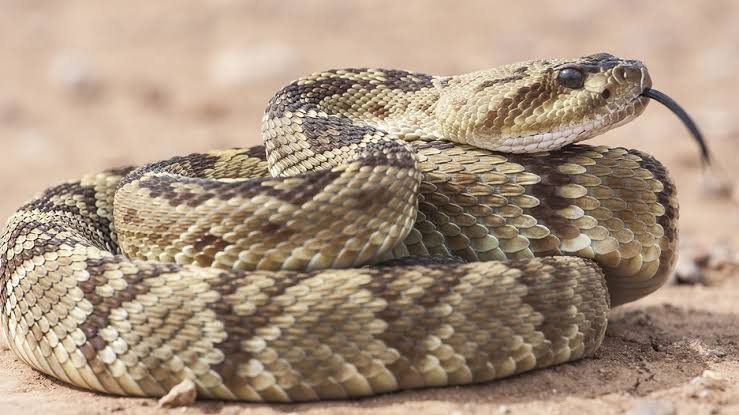
The basic body structure of the Mojave rattlesnake includes a thick torso, triangular head, and a tail ending in a rattle. It typically has diamonds or blotches along the back, though the exact pattern can vary by region. Adults are often around 3 feet long, though individuals may be somewhat larger or smaller. Color may range from gray to greenish olive to pale brown. The “green” in Mojave green does not mean bright green like a leaf. It usually refers to a subtle olive or greenish cast that appears under certain lighting conditions.
Size, Color, and Markings
The overall look of the Mojave rattlesnake is built for blending in. Its colors are usually muted and earthy rather than vivid. The body often appears grayish, dusty, or olive-toned, with darker markings that create a patterned back. The head is triangular, which is common among pit vipers, and the body is sturdy rather than slender. These features help it appear solid and compact, especially when coiled.
The tail markings are one of the most useful clues. The tail often has a pale appearance with dark bands, but the exact arrangement matters. Because the snake may be observed from several feet away, these details are best used cautiously. Color can shift in sunlight, shadow, and dust. A snake that looks greenish at noon may seem brown at dusk. That is why reliable identification should combine multiple signals rather than depending on a single visual impression.
The Tail Pattern Matters Most
The tail pattern is one of the strongest field clues for distinguishing the Mojave rattlesnake from the western diamondback. In general, the Mojave rattlesnake tends to have a tail that is mostly white with thinner black bands, while the western diamondback usually shows black and white bands that are more similar in width. This difference can be very helpful when seen clearly.
The problem is that the tail is not always easy to inspect safely. A rattlesnake should never be approached just to confirm an identification. The best practice is to observe from a safe distance and leave the area. If you do see the tail pattern clearly, it can support your identification, but it should not be the only criterion. Habitat, location, body shape, and overall pattern all matter.
Common Identification Mistakes
One common mistake is assuming that all diamond-patterned desert rattlesnakes are western diamondbacks. Another is assuming that any greenish rattlesnake is automatically a Mojave rattlesnake. Both assumptions can be wrong. Desert snakes vary, and color alone can mislead even experienced observers. Lighting, dust, regional variation, and distance all affect perception.
Another mistake is trying to identify the snake by getting closer. That is never a smart tradeoff. A more useful approach is to remember that if a rattlesnake is close enough to be concerning, it is close enough to leave alone. The safest identification method is distance-first observation, not hands-on verification.
Behavior and Hunting Style
The Mojave rattlesnake is a sit-and-wait predator. It does not waste energy chasing prey across open ground. Instead, it uses camouflage and patience to position itself where prey may travel. Once an animal crosses into range, it strikes quickly and precisely. That strategy is ideal for desert environments, where energy conservation is critical.
Its behavior toward humans is usually defensive rather than aggressive. If it has room, it will often try to move away rather than confront a threat. The rattle is part of that defense system. It gives a warning before a strike, functioning as a loud, unmistakable signal that the snake wants space. Hearing that rattle should prompt immediate caution, not curiosity.
The most important thing to understand is that rattlesnakes do not want to spend venom unnecessarily. Venom is biologically expensive, and the snake uses it to capture prey and defend itself when needed. That means many conflicts happen because the snake was surprised or cornered, not because it was actively seeking a battle. Respecting distance is the simplest and most effective prevention strategy.
Is the Mojave Desert Rattlesnake Dangerous?
Yes, it is dangerous, and that reality should not be minimized. The species has medically significant venom and can cause serious injury if a bite occurs. Its reputation is tied not only to its presence in the desert but to the seriousness of its envenomation potential. Some bites can affect the nervous system; others may cause more local tissue damage. Either way, it is a situation that requires urgent professional attention.
But danger does not mean the snake is “evil,” and it does not mean every encounter will end badly. In fact, many encounters are avoidable if people give the snake enough room. The important distinction is between risk and behavior. The snake poses a risk because of what it can do if threatened, but it is not a creature that seeks out human conflict. A calm, informed response is always better than panic.
Mojave Rattlesnake Venom: Neurotoxic vs. Hemotoxic
The venom of the Mojave rattlesnake is one of the most interesting and medically important features of the species. It is not uniform across the entire range. Some populations produce strongly neurotoxic venom, while others have venom that is more hemorrhagic or tissue-damaging. Some snakes show mixed characteristics. This diversity has made the species a major subject of toxicology and herpetology research.
The neurotoxic form is often associated with Mojave Toxin, a potent component that affects nerve function. In contrast, the more tissue-damaging form may involve higher activity from other venom components, including metalloproteinases that contribute to swelling, bleeding, and local damage. These differences can influence how symptoms develop after a bite.
This is not just a laboratory curiosity. It matters in the real world because the effects of a bite may vary depending on where the snake came from. Geographic variation can shape the medical presentation. Two bites from the same species may not look exactly alike, and that makes the Mojave rattlesnake especially significant in emergency medicine.
Venom Types at a Glance
| Venom Type | Main Feature | Practical Meaning |
| Type A | Rich in Mojave Toxin, strongly neurotoxic | Can affect nerves and breathing more seriously |
| Type B | Lacks Mojave Toxin and has more tissue-damaging activity | Often more hemorrhagic and locally damaging |
| Mixed | A combination of traits in some populations | May show a blend of symptoms |
The key takeaway is not the label itself, but the variability. This snake is medically important precisely because it does not behave like a one-size-fits-all species. Its venom profile varies across geography, and that variation can influence the urgency and style of treatment.
What to Do If You Are Bitten
A rattlesnake bite is a medical emergency. The priority is not improvisation, folklore, or guesswork. It is rapid access to emergency care. The best response is to remain as calm as possible, move away from the snake, and seek professional treatment immediately. Panic increases heart rate and movement, which can make the situation worse.
If possible, remove rings, watches, and tight clothing before swelling begins. Wash the bite gently with soap and water, then cover it with a clean, dry dressing. Call emergency services or get to a hospital as quickly as possible. If there is no risk in doing so, a photo from a safe distance can help with identification, but no one should ever approach the snake to take that photo.
The goal of first aid is to slow harm, not to “neutralize” venom on your own. Professional medical treatment is the only reliable solution. Time matters. Calm matters. Correct action matters.
Do Not Do These Things
Do not cut the wound. Do not try to suck out venom. Do not apply ice. Do not use a tourniquet. Do not shock the bite. Do not rely on herbs, chemicals, or home remedies. These actions do not solve the problem and can make it worse.
The internet is full of dramatic ideas about snakebite first aid, but most of them are outdated or dangerous. The safest plan is the simplest one: get medical help fast and avoid interfering with the bite site in harmful ways.
Simple Emergency Steps
- Move away from the snake.
- Stay calm and keep movement to a minimum.
- Remove jewelry and tight accessories.
- Wash the bite gently with soap and water.
- Cover the area with a clean dressing.
- Call emergency services or go to a hospital immediately.
How to Avoid a Bite
Prevention is far easier than treatment. Most snakebites happen when people do not notice a snake nearby or place their hands and feet in the wrong place. That means the smartest behavior is not dramatic; it is careful. Watch where you step. Watch where you reach. Stay alert around rocks, brush, logs, burrows, and hidden spaces.
Wear boots and long pants when hiking or working in areas where snakes may live. Avoid putting hands into crevices, thick brush, or piles of debris. Do not step over logs or rocks without looking to the other side first. Keep children close and pets under control. If you hear a rattle, stop and slowly move away. There is no advantage to trying to get a better look.
Around homes, ranches, or work sites, reducing rodent activity can help reduce snake activity, because rodents are a major food source. Secure food waste, reduce clutter, close access gaps, and make the area less inviting to prey animals. A less rodent-friendly environment is often a less snake-friendly one as well.
Mojave Rattlesnake vs. Western Diamondback
These two snakes are frequently confused because they share a lot of broad traits: desert habitat, patterned backs, rattles, and similar body forms. Yet there are important differences, especially in the tail pattern. The Mojave rattlesnake often has mostly white tail bands with thin black bands, while the western diamondback usually has black and white bands that are closer in width.
| Feature | Mojave Desert Rattlesnake | Western Diamondback Rattlesnake |
| Scientific name | Crotalus scutulatus | Crotalus atrox |
| Habitat | Low hot deserts, creosote flats, grasslands, desert washes | Desert washes, rocky slopes, and grasslands in the Southwest |
| Tail pattern | Mostly white with thin black bands | Alternating black and white bands of more similar width |
| Color | Gray, greenish olive, pale brown | Often dusty gray-brown with a diamond pattern |
| Venom | Variable; can be strongly neurotoxic or more tissue-damaging | Venomous pit viper with a different profile |
| Common confusion | Often mistaken in the field | Also easy to misread at a glance |
The main lesson is that safe identification is about probability, not certainty. If you are not a trained professional, the best policy is not to classify the snake with confidence at close range. The correct response is still the same: keep away.
Pros and Cons
Pros
The Mojave Desert rattlesnake is an important predator in desert ecosystems. It helps control rodent populations and contributes to ecological balance. Its warning rattle gives people a chance to back away before contact. It is also a remarkable example of adaptation, with survival strategies that fit a dry and demanding environment.
Cons
The species is medically significant because its venom can be dangerous and variable. It can be difficult to identify accurately, especially when confused with similar species. Like any venomous snake, it may defend itself quickly if it feels trapped or startled.
Human Encounters, Field Culture, and Common Misconceptions
The Mojave rattlesnake has a strong place in outdoor culture because it inhabits the same landscapes that hikers, campers, ranchers, and field workers frequent. That visibility makes it familiar, but familiarity can also breed false confidence. People may think they know the snake when they actually know only a few broad stereotypes about it.
One common misconception is that the nickname Mojave green is enough to identify the species. It is not. The snake may appear greenish, gray, brown, or olive depending on the habitat and light. A name used by local communities is not a reliable diagnostic tool. Another misconception is that all rattlesnakes in the desert behave the same way. They do not. Species differ in appearance, habitat, and venom pattern.
Another dangerous habit is trying to move closer for a photo, a better look, or a dramatic video. That can convert a safe sighting into a serious emergency in seconds. The better instinct is simple: back up, stay calm, and let the animal continue on its own.
Interesting Facts
One of the most remarkable things about the Mojave Desert rattlesnake is its venom diversity. Scientists have studied this species for years because its venom composition changes across geography, and those differences can influence medical symptoms. That makes it one of the more important rattlesnakes in both research and emergency medicine.
Another interesting fact is how efficiently it is adapted to desert life. The snake is not flashy or wasteful. It uses camouflage, burrows, seasonal timing, and low-energy ambush hunting to survive in a landscape where many animals would struggle to persist. It is a model of biological efficiency in a harsh environment.
The species is also a reminder that “dangerous” animals often have highly specialized roles. The Mojave rattlesnake is not just a hazard. It is a survivor, a predator, and a piece of the ecological puzzle.
Environmental Issues and Conservation
The biggest threat often mentioned for desert wildlife, like the Mojave rattlesnake,e is habitat loss. Whether the open desert is developed, fragmented, or disturbed, the snake loses the room it needs for hunting, shelter, and movement. Because it depends on open and semi-open habitats, it is vulnerable to changes that reduce continuity across the landscape.
Conservation of this snake is really conservation of the desert habitat. Protecting open ground, maintaining natural prey populations, and preserving habitat corridors support more than one species. It helps birds, mammals, reptiles, and the broader web of life that depends on intact desert systems. The Mojave Desert is fragile in many places, and the species that live there reflect that fragility.
FAQs
It can be, because some populations produce venom with strong neurotoxic effects. Its venom variability makes it especially notable among North American rattlesnakes. That said, “more dangerous” depends on context, geography, and how a bite is treated. All rattlesnake bites deserve immediate medical attention.
Look at the tail first. The Mojave rattlesnake usually has mostly white tail bands with thin black bands, while the western diamondback has black and white bands that are closer in width. Habitat, location, and overall pattern can help too, but the tail is one of the best clues.
Stop moving, back away slowly, and give the snake room. Do not approach it, film it closely, or try to move it. The rattle is a warning signal, and the correct response is to leave the area calmly.
Call emergency services right away, stay as calm as possible, and get to a hospital quickly. Remove rings and tight items, wash the bite gently with soap and water, and avoid dangerous first-aid myths like cutting, sucking, icing, or using a tourniquet.
It is most often found in hot, open desert habitats such as desert washes, grasslands, and creosote bush flats in the southwestern United States and northern Mexico. It prefers dry, open areas where it can blend in and ambush prey.
Conclusion
The Mojave Rattlesnake is a remarkable desert predator and a species that deserves both respect and caution. It plays an important role in the ecosystem, but its venom makes it medically significant as well. The safest approach is to recognize it from a distance, give it space, and take every bite seriously as a medical emergency.