
Introduction
When people search for The Hottest Desert in the world, the clearest answer is Iran’s Lut Desert. NASA’s satellite research shows that Lut has reached some of the highest land surface temperatures ever recorded on Earth. While the Sahara is the largest hot desert, Lut is the stronger answer for “hottest” because it holds the surface heat record. That makes it one of the most extreme and fascinating desert landscapes on the planet.
- What Is the Hottest Desert in the World?
- Why the Lut Desert Gets So Hot
- Lut Desert vs Sahara Desert: The Real Difference
- Location and Geography of the Lut Desert
- Climate and Weather Patterns
- Why the Lut Desert Is So Important in Science
- Landscape Features: Dunes, Yardangs, Rocks, Salt Flats, and More
- Quick look at major landforms
- Flora: What Plants Can Survive in the Lut Desert?
- Fauna: What Animals Live in the Lut Desert?
- Human History and Culture Around the Lut Desert
- Travel Appeal: Why People Want to Visit the Lut Desert
- Travel Tips and Survival Challenges
- Environmental Issues and Conservation
- Interesting Facts About the Lut Desert
- Pros and Cons
- Pros
- Cons
- FAQs
- Conclusion
What Is the Hottest Desert in the World?
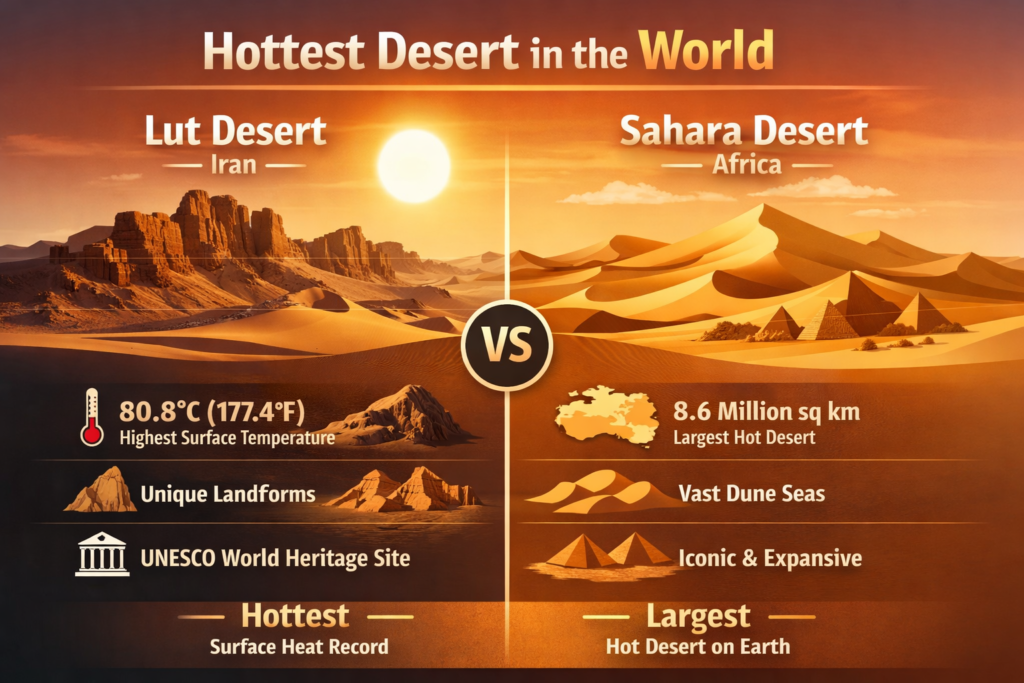
The most accurate answer is this: Iran’s Lut Desert is widely considered the hottest desert in the world by land surface temperature. NASA’s MODIS-based research found that Lut recorded the highest land surface temperature in the study period, reaching 80.8°C (177.4°F) and tying with Mexico’s Sonoran Desert. NASA also reported earlier that Lut held the hottest place on Earth in several years, including 2004 and 2005.
This is the key idea your article should make unmistakably clear. The Lut Desert is the best answer when someone asks about the hottest desert, while the Sahara is the best answer when someone asks about the largest hot desert. Britannica identifies the Sahara as the world’s largest hot desert, covering about 8.6 million square kilometers across northern Africa. So the strongest explanation is not that Lut is “better than the Sahara in every sense.” The stronger and more precise explanation is that they answer different questions.
That distinction is the backbone of a high-quality SEO article. It reflects search intent, improves clarity, and makes the content more useful. Search engines reward pages that resolve ambiguity instead of creating it. Readers do the same. If your content can explain the heat-vs-size difference clearly, it becomes far more trustworthy and more helpful than pages that simply repeat a slogan.
Why the Lut Desert Gets So Hot
NASA gives several reasons why the Lut Desert becomes so extreme. First, the surface is darkened by volcanic lava, which helps it absorb more sunlight. Dark surfaces collect and retain heat more efficiently than lighter ones, so the ground warms up aggressively under direct sunlight. Second, the desert is surrounded by mountains, which limit air circulation and reduce cooling. Third, the temperature record is based on the ground surface, not the air above it. Those three factors combine to create a place where surface temperatures can climb to extraordinary levels.
UNESCO adds another important layer. Between June and October, strong winds sweep across the region and move sediment on a massive scale. These winds help shape the terrain, expose different surfaces, and continually remodel the landscape. The result is a desert that behaves like a natural heat amplifier. It traps sunlight, has little moisture, and receives little relief from airflow.
A simple way to describe it is this: the Lut Desert is hot because its terrain is built to store heat, not release it. The ground absorbs solar energy, the climate offers very little water for cooling, and the surrounding topography restricts ventilation. Even the surface itself contributes to the heat profile. That is why Lut keeps showing up in NASA’s hottest-surface research and why it remains one of the most famous extreme-environment locations on Earth.
Lut Desert vs Sahara Desert: The Real Difference
This is the comparison many pages get wrong, and it is the comparison your article should explain better than anyone else.
| Feature | Lut Desert (Dasht-e Lut) | Sahara Desert | Why it matters |
| Main claim to fame | Hottest surface record | Largest hot desert | They answer different search intents |
| Location | Southeastern Iran | Northern Africa | Different geographic scale and setting |
| Size | Much smaller than the Sahara | About 8.6 million sq km | Sahara dominates in size |
| Heat record | 80.8°C land surface temperature | Not the hottest surface record holder | Lut fits “hottest desert” better |
| Landforms | Yardangs, giant dunes, salt pans, stony plains | Dunes, plateaus, basins, sand seas | Both are rich, but Lut is unusually dramatic |
| UNESCO status | World Heritage Site | Not the same natural-desert World Heritage context | Lut gains extra authority |
| Travel appeal | Remote, scientific, geotourism-focused | Vast, iconic, widely known | Different visitor expectations |
The Sahara is still an exceptional desert. Britannica describes it as the largest hot desert in the world, stretching across much of northern Africa and containing gravel plains, mountains, basins, dunes, and sand seas. But the Sahara’s fame comes from its scale, while Lut’s fame comes from its surface heat and its extraordinary landforms.
Location and Geography of the Lut Desert
The Lut Desert is located in southeastern Iran. UNESCO describes it as an arid subtropical region in that part of the country, enclosed by mountains and shaped by intense dryness and wind-driven processes. NASA also places Dasht-e Lut in Southeastern Iran and describes it as a broad salt desert with diverse terrain.
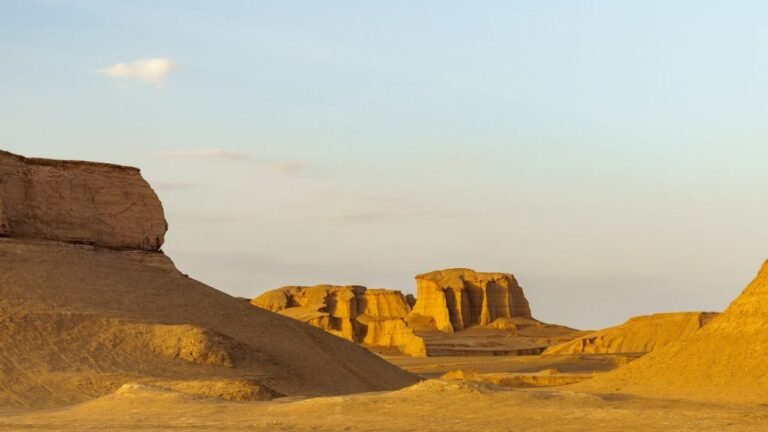
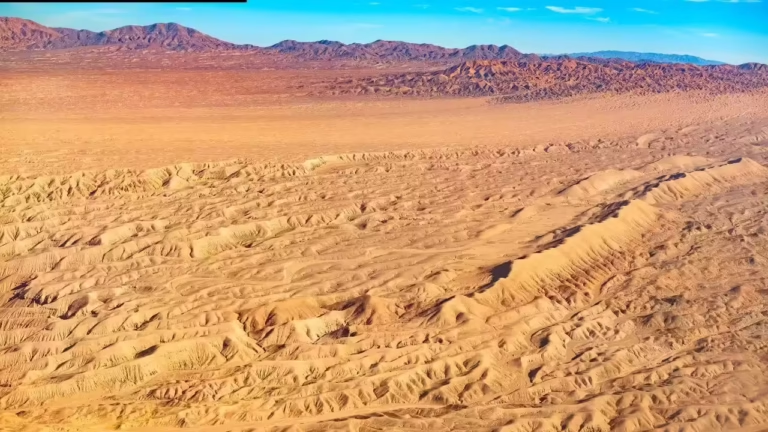
Geographically, Lut is not just a single flat expanse of sand. It is a complex desert system with different zones and distinct landform types. UNESCO says the property includes yardangs, stony deserts, dune fields, salt pans, and desert pavements. NASA also notes rust-colored sand seas in the eastern and southern parts of the desert. This diversity is one of the main reasons Lut stands out to scientists, travelers, and content creators alike.
That diversity also changes the way people imagine deserts. Many readers picture an endless field of dunes, but the Lut Desert proves that a desert can contain many textures and many surfaces at once. There are rock-heavy zones, salt-crusted areas, dune systems, and wind-carved ridges all within the same broad desert environment. This is not a one-note landscape. It is a layered, dynamic, visually powerful environment with enormous scientific value.
Climate and Weather Patterns
The climate of the Lut Desert is brutally dry. UNESCO describes the region as arid and subtropical, with strong winds between June and October. It also explains that the desert sits in an interior basin surrounded by mountains, which creates a rain-shadow effect and contributes to the area’s hyper-arid conditions.
The rain-shadow effect matters because it limits moisture. When moist air is pushed up over mountain ranges, it cools and drops much of its precipitation on the windward side. The leeward side receives far less rainfall. In the Lut Desert, that means the land stays dry for long periods, and dry land heats up much more easily under intense sunlight. Less moisture means less evaporative cooling, and less cooling means higher surface temperatures.
This is also where the difference between air temperature and land surface temperature becomes essential. Air temperature tells us how hot the air is at a standard height above the ground. Land surface temperature tells us how hot the soil, sand, or rock itself becomes. In the Lut Desert, the record is about the surface, which is why satellite measurements are so important. They reveal heat conditions that ordinary ground-level thermometers may not capture in the same way.
Why the Lut Desert Is So Important in Science
The Lut Desert is not famous only because of the heat. It is also a scientific treasure because it helps researchers understand how extreme deserts work. NASA explains that the region demonstrates how heat, wind, dark surface material, and mountain barriers can combine to produce record temperatures. UNESCO calls it an exceptional example of ongoing geological processes. Together, those descriptions show why Lut matters far beyond a headline temperature figure.
This is one of the strongest angles in the article. The desert is not merely a spectacle; it is a natural laboratory. Scientists can study how surfaces heat up, how dunes migrate, how wind sculpts rock, how salt surfaces form, and how aridity shapes ecosystems. In other words, Lut is a real-world case study in extreme environmental physics and desert geomorphology.
For readers, this makes the topic more compelling. this search engines, it adds topical depth. For your article strategy, it means you are not just answering “what is the hottest desert?” You are also explaining why it matters, how it works, and what makes it scientifically remarkable. That kind of context improves authority and engagement.
Landscape Features: Dunes, Yardangs, Rocks, Salt Flats, and More
One of the most fascinating things about the Lut Desert is the variety of its landforms. UNESCO says the site includes some of the world’s best examples of aeolian yardangs, which are long ridges carved by wind and sand. These formations are so massive that they can be seen from space, which gives the desert an almost otherworldly visual identity. That alone makes Lut unforgettable.
NASA says the eastern and southern parts of the desert contain enormous rust-colored sand seas with dunes shaped in several different forms, including linear ridges, crescents, stars, and funnels. UNESCO adds that some dunes rise to 475 meters and are among the tallest known on Earth. That makes the desert not just hot, but also spectacularly sculpted.
The desert also contains stony plains, basaltic stretches, salt crusts, salt pans, and evaporite features. UNESCO mentions salt polygons, salt blisters, salt karren, gypsum domes, and ventifacts. These features reveal how wind, evaporation, mineral deposition, and time interact in a hyper-arid setting. The terrain is a living archive of geologic processes.
Quick look at major landforms
| Landform | What it is | Why it matters |
| Yardangs | Wind-carved rock ridges | Show the force of aeolian erosion |
| Sand seas | Large dune fields | Create the classic desert scenery people expect |
| Stony desert | Rock and gravel surfaces | Help explain heat absorption and exposure |
| Salt pans | Flat evaporated mineral surfaces | Show what is left behind when water disappears |
| Nebkhas | Dunes formed around plants | Show how even limited vegetation shapes terrain |
The most important takeaway is that the Lut Desert is not a single-surface landscape. It is a mosaic of extreme features. That gives your article more substance, more visual interest, and more topical depth than a generic “hot desert facts” page.
Flora: What Plants Can Survive in the Lut Desert?
Plant life in the Lut Desert is very limited, and UNESCO notes that biological knowledge for the area is still incomplete. Even so, the property does support flora that are adapted to harsh conditions. UNESCO also points out that nebkha dunes form around plants at the slightly wetter edges of the basin, which is direct evidence that vegetation survives in particular microhabitats.
That is an important detail because it keeps the article accurate. A lot of desert writing makes these environments sound empty, but that is not true. The Lut Desert is not lush, and it is certainly not green, but it does contain living organisms in carefully adapted forms and in specific locations where conditions are just a little less severe.
A clear way to explain the ecology is this: most of the desert is too hot, too dry, and too exposed for dense plant growth, but a few hardy species survive in protected areas, on margins, and in places where moisture lingers slightly longer. In a hyper-arid system, even small pockets of survival are ecologically meaningful. They help stabilize soil, influence dune formation, and support parts of the broader desert ecosystem.
Fauna: What Animals Live in the Lut Desert?
UNESCO states that the Lut Desert has fauna adapted to extreme conditions, including a distinctive insect fauna. It also explains that the area was once described as a place of “no life,” but that description oversimplifies the truth. Life does exist there. It is just sparse, specialized, and highly adapted.
Because the environment is so severe, biodiversity is naturally lower than in wetter or milder ecosystems. That does not mean the desert is lifeless; it means it is highly selective. Only the toughest species can persist, especially in places that offer a little shade, a little moisture, or seasonal access to resources. In this way, the Lut Desert acts like an ecological filter.
For a pillar article, it is better to stay careful and precise here. Rather than exaggerating species counts or naming animals without strong support, it is safer and smarter to say that the Lut Desert supports desert-adapted insects and other hardy organisms, while the biological record is still limited and the environment remains extremely harsh. That honesty makes the article more credible.
Human History and Culture Around the Lut Desert
Although the Lut Desert feels remote and empty, it has a long human story around its edges. UNESCO says there is evidence of habitation going back 7,000 years, though the core of the desert has always been too severe for sustained settlement. People lived mostly on the margins, where water access and survival were more realistic.
That is a powerful cultural insight because it shows the desert was never truly “nothing.” It was always part of a wider human geography. Communities adapted to scarcity, trade routes, seasonal movement, and difficult terrain. The desert shaped human behavior just as much as human presence shaped nearby settlements. Even today, UNESCO notes that there are villages and town areas in or near the wider property, while the most extreme core remains largely inaccessible.
This history helps readers understand the desert on a deeper level. It is not just a record-setting environment or a satellite image. It is a place that has stood beside human life for millennia, influencing movement, settlement, adaptation, and survival. That gives the article more emotional and historical depth.
Travel Appeal: Why People Want to Visit the Lut Desert
The Lut Desert has strong travel appeal because it looks almost surreal. UNESCO highlights its enormous landforms, colorful desert surfaces, and vast dune systems, while NASA imagery reveals striking contrasts between dark ground, carved ridges, and sweeping sand seas. That visual power makes Lut attractive to photographers, geotourism enthusiasts, researchers, and adventure travelers.
A 2021 tourism study focused on Lut found that media advertising, safety, and cost-effective travel were important influences on tourism development. The research also identified adventure travel, astronomy, zoology, and archaeology as useful themes for attracting visitors. That means the desert is not only beautiful; it also has strong thematic potential for responsible tourism and education.
For readers, this creates a compelling travel angle. The Lut Desert is not for casual sightseeing or ordinary vacation behavior. It is for people who want awe, extremity, and meaning. It offers dramatic scenery, scientific relevance, cultural history, and a sense of standing in one of the most intense landscapes on the planet.
Travel Tips and Survival Challenges
The Lut Desert is not an easy place to explore. UNESCO states that much of the property is inaccessible because of extreme heat and a severe lack of water, and that remoteness is part of what has helped preserve the landscape. Those same conditions also create the biggest travel risks.
Here is the practical reality in simple language: the desert is beautiful, but it is serious. Anyone writing about it should make that clear.
Travel in cooler months rather than during the harshest heat period. The desert experiences strong winds and severe aridity, and summer conditions can become punishing.
Carry far more water than you think you need. Water scarcity is one of the defining features of the region.
Avoid casual wandering or poor planning. The terrain is vast, remote, and difficult to navigate.
Use local guidance and do not rely on spur-of-the-moment movement, especially in the middle of the day.
Respect the landforms. Fragile desert features can be damaged by careless vehicles and off-route movement, and UNESCO emphasizes the site’s exceptional geological value.
That balance is important. You do not want to sensationalize danger, but you also should not minimize it. The Lut Desert is a place of wonder, but also a place that demands caution, preparation, and respect.
Environmental Issues and Conservation
The Lut Desert is naturally protected by its harsh climate, but that does not mean it is beyond concern. UNESCO explains that the property is managed with support from Iranian conservation, environment, and tourism authorities, and that watershed management, rangeland management, and desertification control are part of the broader stewardship framework.
This matters because deserts can still be affected by human pressure. Roads, vehicles, resource extraction, irresponsible tourism, and poor land management can all affect fragile surfaces and ecological balance. UNESCO also notes that the biological resources of the area are not yet fully understood, which means scientific study and conservation still have plenty of room to grow.
Including this section strengthens your article because it adds responsibility and credibility. It shows that the Lut Desert is not just a spectacular natural destination; it is also a protected heritage landscape that deserves care, research, and long-term stewardship.
Interesting Facts About the Lut Desert
The Lut Desert contains several facts that make it especially memorable. One of the most striking is that its yardangs are so large that UNESCO says they can be seen easily from space. That is an unusually strong visual claim and one of the reasons the site stands out so sharply in satellite imagery.
Another memorable fact is that the dunes are not only tall but also diverse. NASA and UNESCO mention multiple dune shapes, including linear, crescentic, star, and funnel forms. This visual diversity helps explain why the desert looks so extraordinary in photographs and from above.
A third interesting fact is the confusion surrounding its fame. Many people instinctively call the Sahara the hottest desert because it is the most famous desert in popular culture. But the truth is more exact: the Sahara is the largest hot desert, while the Lut Desert is one of the best answers to the hottest-desert question. That distinction is the core message of the entire article.
Pros and Cons
Pros
The Lut Desert is one of the clearest answers to the search phrase hottest desert in the world because NASA’s satellite data shows record-breaking land surface temperatures. It also offers world-class landforms, including enormous dunes, yardangs, salt flats, and desert pavements. UNESCO World Heritage status adds authority and credibility, and the site has strong value for science, photography, and geotourism.
Cons
The desert is extremely harsh, with limited water, extreme heat, and difficult access. Biological information is still limited in some areas, and travel is not straightforward. In addition, because the Sahara is more widely known, many readers still need a careful explanation of the difference between heat and size.
FAQs
No. The Sahara is the largest hot desert in the world, but NASA’s satellite research points to the Lut Desert as one of the hottest places on Earth by land surface temperature.
For surface heat, yes, Lut is the stronger answer. For size, the Sahara is much larger. They are different answers to different questions.
NASA says the sand has been darkened by volcanic lava, which helps it absorb heat, and the surrounding mountains limit air movement. UNESCO also highlights strong winds and extreme aridity as major factors.
Yes. UNESCO lists the Lut Desert as a World Heritage Site because of its exceptional landforms and ongoing geological processes.
Yes, but it is a remote and difficult destination. UNESCO says much of the area is inaccessible because of extreme heat and lack of water, so any visit requires careful planning.
Air temperature is measured above the ground, while land surface temperature measures the heat of the ground itself. NASA explains that this difference is why one place can hold the hottest surface record without holding the hottest air record.
Conclusion
The Lut Desert is the best answer to the question of the hottest desert in the world. The Sahara may be larger, but Lut stands out for its record-breaking surface heat, dramatic landforms, and scientific importance. For anyone looking for the true hottest desert, Iran’s Lut Desert is the name that matters most.