
Introduction
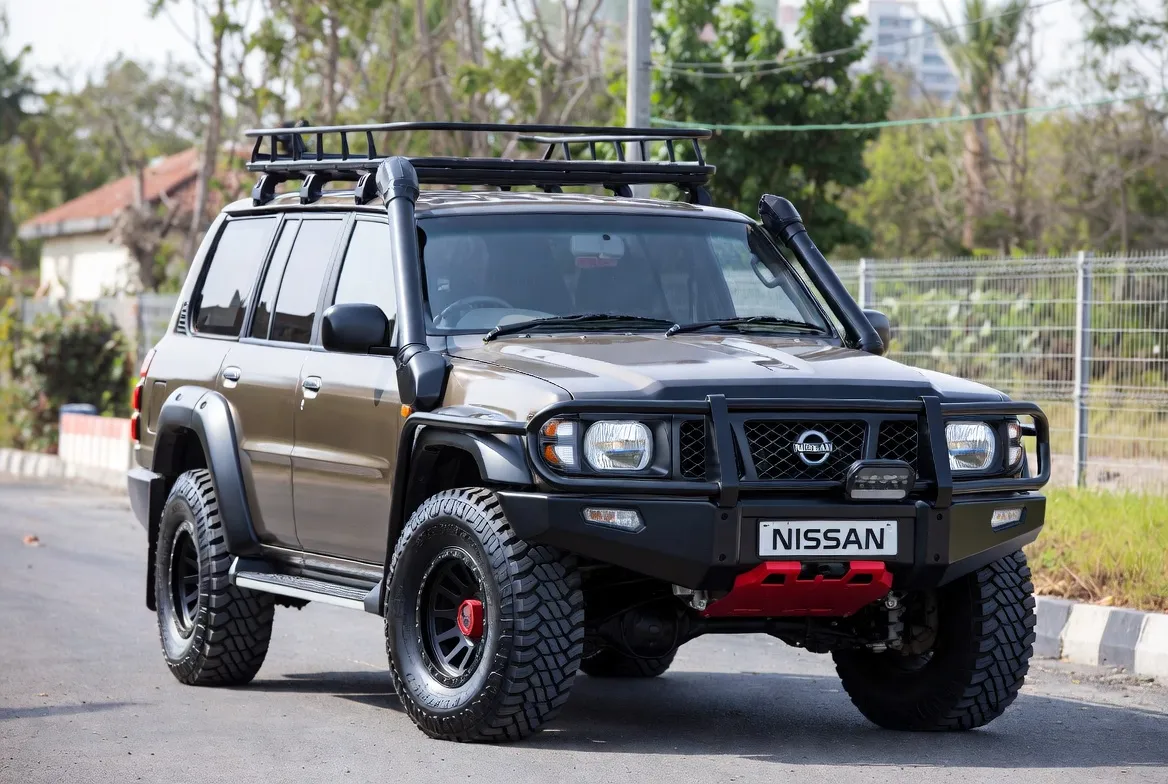
If you live where sand, heat and long distances rule — the Middle East, the Arabian Peninsula, or Pakistan’s deserts — you already know the name Nissan Patrol Super Safari. It’s a rugged, no-nonsense workhorse from the Y61 / “GU” Patrol family built for durability and desert use, not luxury frills. This guide assembles official specs, hands-on driving notes, buying advice (new vs used and import tips), typical maintenance and weak spots, the best modifications for dune and desert work, and localised price ranges for the UAE, KSA and Pakistan.
- Quick facts snapshot
- What is the Super Safari? — short history & why it matters
- Why it matters
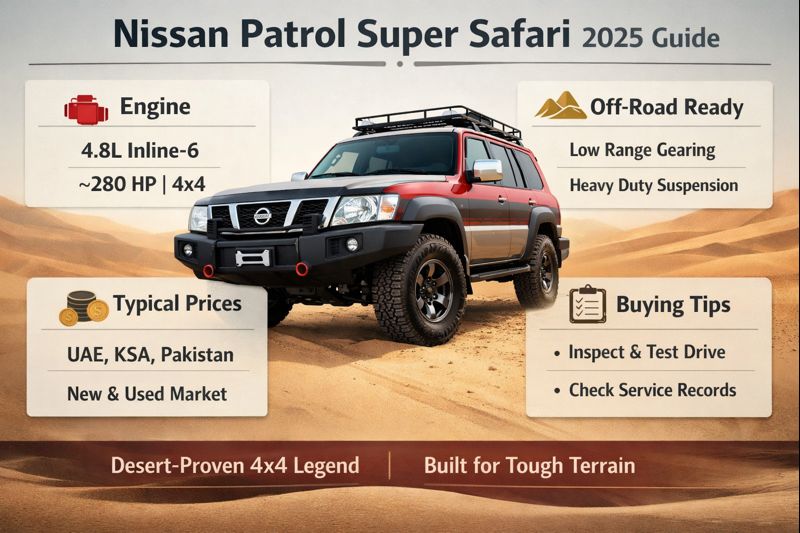
- Full specifications and what they mean
- Engine & drivetrain
- Transmission & transfer case
- Chassis, suspension & geometry
- Fuel economy & range
- Real-world driving & first-drive highlights
- Buying guide — new vs used, market pricing, import tips
- New vs Used
- Sample price table
- Import & registration tips
- Buying checklist — what to inspect
- Maintenance & common issues
- Routine service
- After heavy sand trips
- Common weak points & owner notes
- Best modifications & upgrades for desert use
- Priority list
- Cost/benefit notes
- Recommended installer approach
- Super Safari vs alternatives — head-to-head
- Touring & dune driving tips for Super Safari owners
- Tyre pressures & sand technique
- Convoy & recovery etiquette
- Vehicle prep checklist
- Emergency & survival considerations
- Maintenance schedule — simple owner plan
- Market watch: current editions & price snapshot
- Pros & Cons
- Pros
- Cons
- Desert context — how the environment changes the choice
- Useful on-road & off-road gear list
- Who should buy a Nissan Patrol Super Safari?
- Step-by-step buying plan
- Example build plans
- Basic touring build
- Serious off-road build
- FAQs
- Final verdict
Quick facts snapshot
| Item | Detail |
| Engine | TB48DE — 4.8 L inline-6, DOHC, VTC (naturally aspirated) |
| Power | ~280 hp (284 PS) at ~4800 rpm |
| Torque | ~451 Nm |
| Transmission | 5-speed manual or 5-speed automatic (market dependent) |
| Drive | 4×4, part/full-time systems; many have low-range |
| Ground geometry | Strong approach/departure; well-suited to sand |
| Typical new price (sample) | UAE: AED 162,000–200,000 (region & options vary) |
| Typical used price (sample) | UAE: AED 100,000–170,000 (year, mileage, condition) |
What is the Super Safari? — short history & why it matters
The Nissan Patrol Super Safari is the off-road-oriented variant of the Y61 Patrol brood. Think of it as the Patrol that prioritises durability, mechanical simplicity, and the power to be repaired in faraway locations. It evolved from Nissan’s long lineage of body-on-frame SUVs designed to carry loads over rough terrain and to operate for long periods in harsh climates.
Why it matters
- Field repairability: Simple mechanics and widely accessible parts mean local mechanics can fix most faults without dealer tools.
- Torque & hauling: The TB48DE straight-six brings broad low-end torque for sand crawling and towing.
- Ladder frame: Strong for heavy loads and towing; chassis geometry is forgiving on tracks and dunes.
- Aftermarket & community: A robust owner circle and many regional aftermarket vendors make upgrades and spares available.
For desert tour operators, search-and-rescue teams, and owners who prefer a platform that continues to work after harsh use, the Super Safari is a logical, proven choice.
Full specifications and what they mean
Below are the key mechanical elements and what they imply for ownership and performance.
Engine & drivetrain
Engine: TB48DE — a 4.8-litre inline-6, DOHC with intake VTC.
Why it helps: The TB48DE delivers steady low-down torque that’s useful for climbing dunes, pulling out bogged vehicles, and towing. The straight-six layout is inherently balanced and tends to run smoothly under long loads.
Downside: It’s a large petrol engine, so fuel consumption will be higher than modern diesel alternatives; expect heavier fuel bills on long trips.
Transmission & transfer case
Options: 5-speed manual or 5-speed automatic (market dependent).
Low-range: Many Super Safaris include low-range gearing, which is essential for technical climbs and controlled dune work.
Why it matters: Simpler gearboxes and transfer cases are easier and cheaper to maintain, and are less likely to fail under repetitive heavy use than highly complex modern systems.
Chassis, suspension & geometry
Chassis: Body-on-frame construction with coil springs; sturdy and designed for loads.
Ground geometry: Generous approach, breakover and departure angles — good for sand ridges and desert obstacles.
Why owners like it: Predictable behaviour on rough tracks and under heavy load. The suspension is tuned for resilience and carrying capacity rather than supple road comfort.
Fuel economy & range
Expect modest fuel economy under normal conditions and especially under desert use. Fuel tanks tend to be large to increase range, but you should still plan fuel stops carefully on long crossings. Consider long-range fuel options for remote trips.
Real-world driving & first-drive highlights
The Super Safari feels like a traditional heavy SUV — solid, predictable, and built to endure.
- On the sand: The TB48DE’s torque and the vehicle’s geometry make dune running composed and forgiving when driven with correct technique. It resists bogging and maintains momentum well.
- On the road: The vehicle is heavy, and body roll is noticeable; steering is more mechanical than nimble. High-speed highway cruising is stable but not sporty.
- Comfort: Seats and interior are practical; the ride is functional rather than refined. Noise levels are higher than in modern luxury SUVs.
- Electronics: The relative lack of complex electronics reduces the chance of debilitating electrical faults in remote areas.
- Owner tip: If you plan hard off-road use, many experienced owners prefer a manual gearbox for clutch control and engine braking. For long tours and urban driving, an automatic is easier and less fatiguing.
Buying guide — new vs used, market pricing, import tips
New vs Used
New
- Pros: Manufacturer warranty, fresh components, dealer support, and the possibility to order regional special editions (for example, Al Ostoura-style trims).
- Cons: Higher initial cost.
Used
- Pros: Better value per dirham/riyal/pk-rupee. The Y61 platform is common in desert markets.
- Cons: Many used examples have been through heavy desert duty; wear and tear vary dramatically.
Sample price table
| Market | New (sample) | Used (sample range) |
| UAE | AED 162,500–199,900 | AED 100,000–170,000 |
| KSA | SAR ~162,500–190,000 (varies) | Local classifieds vary widely |
| Pakistan | Variable; account for import duties & customs | Depends on import, condition, and year |
Import & registration tips
- GCC compliance: Check homologation and emissions regulations.
- Pakistan imports: Confirm customs duties, and check whether the registration authorities accept the model year and origin.
- Service history: Always ask for full service records — desert use produces characteristic wear.
- Pre-purchase check: Insist on a thorough inspection of frame, engine, transfer case, differentials, cooling system and body integrity.
Buying checklist — what to inspect
Use this short, practical checklist during inspections.
| Item | What to check |
| Engine | Cold/hot start behaviour, smoke on startup, oil leaks, valve noise, service history |
| Cooling | Radiator condition, hose integrity, thermostat and overheating history |
| Drivetrain | Transfer case engagement smoothness, diff noises, driveshaft play |
| Suspension | Sagging springs, leaking dampers, uneven ride height |
| Body & Frame | Frame straightness, patch welding, signs of rollovers or heavy repair |
| Electrical | Dashboard warning lights, functioning lights, AC performance, and instrument cluster |
| Tyres & Spare | Correct sizes, sidewall damage, spare tyre condition and compressor |
| Underbody | Skid plate damage, rust, corrosion — especially if used near the sea |
Pro tip: If you’re not a mechanic, hire an independent specialist familiar with Y61 Patrols — it’s worth the inspection fee.
Maintenance & common issues
Routine service
- Frequent oil changes and filter checks matter more if you operate in dusty, sandy environments.
- Valve clearances on the TB48DE should be checked periodically; this engine benefits from scheduled valve service.
- Replace air filters more often under heavy dust.
After heavy sand trips
- Wash the underside — remove packed sand from around underbody components (avoid aiming high-pressure water at electrical connectors).
- Change oil if sand or water entered the engine bay.
- Check breathers for transfer case and diffs — desert grit can clog and create pressure differentials.
- Inspect radiator & hoses for grit-induced clogging.
Common weak points & owner notes
- Traction control/ABS: Some owners find factory traction aids intrusive in certain side-slope or soft-sand scenarios and modify settings or hardware for better control.
- AC performance: In extreme heat, older AC systems can struggle — check compressor and condenser health.
- Electrical gremlins: High-mileage units may show sensor faults or cluster issues; these are often repairable with local parts.
- Sand contamination: Address sand ingress quickly to avoid gearbox/transfer case damage.
Best modifications & upgrades for desert use
The Super Safari improves dramatically with focused upgrades. Prioritise high-impact items first.
Priority list
- Tyres — Sand-specialist or high-flotation tyres for dunes; quality All-Terrains (e.g. BFG) for mixed use.
- Recovery gear & bumpers — Solid, rated tow points and a winch. Front and rear steel bumpers for protection and recovery mounting.
- Suspension — Heavy springs and upgraded shocks to manage loads and repeated impacts.
- Air filtration & snorkel — Keeps the intake clear of deep sand and dust clouds.
- Lockers & diffs — ARB or similar lockers for guaranteed traction in technical terrain.
- Cooling upgrades — Larger radiators, high-capacity electric fans, and oil coolers for heavy towing.
- Re-gearing — Necessary if fitting oversized tyres to restore drivability.
Cost/benefit notes
- Tyres & recovery gear: High impact for relatively low cost — essential for safety and capability.
- Lockers & re-gearing: More expensive but transformative for extreme off-road use.
- Cooling & filtration: Essential for reliability in high-heat operational zones.
Recommended installer approach
Use reputable 4×4 specialists in Dubai, Abu Dhabi, Riyadh, Jeddah, or Islamabad. Request references, warranty on fabrication, and photos of previous builds. Join local Patrol owner groups to find trusted fitters and to compare part sources.
Super Safari vs alternatives — head-to-head
If your goal is a desert workhorse, compare these common options:
| Model | Strengths | Weaknesses | Best for |
| Nissan Patrol Super Safari (Y61) | Rugged, simple, easy to repair, strong sand geometry | Older tech, thirsty petrol engine | Off-roaders, remote travel, heavy mods |
| Toyota Land Cruiser 70/76/78 | Legendary durability, enormous aftermarket, diesel options | Spartan comfort | Commercial, heavy remote use |
| Patrol Y62 (modern Patrol) | Modern comfort and safety tech | More complex electronics, higher repair cost | Buyers who want comfort + capability |
| Lexus LX/luxury SUVs | Comfort, luxury features | Heavy electronics are costly to modify | Buyers prioritising comfort and city driving |
Takeaway: For simple, field-repairable desert reliability, the Super Safari remains a top choice. If you want better fuel economy and modern safety/comfort, look at newer diesel platforms or the Y62 Patrol.
Touring & dune driving tips for Super Safari owners
Tyre pressures & sand technique
- Lower tyre pressures for deep sand — typical 10–15 psi range depending on tyre size and load.
- Keep momentum: gentle, steady throttle; avoid braking on a dune crest.
- Low-range for technical sections: use low-range for steep climbs and tricky, soft sand climbs.
Convoy & recovery etiquette
- Agree on radio channels before departure.
- Use rated snatch straps, bow shackles, and a winch in the convoy.
- Always use a dampener on any tensioned strap to reduce the risk of recoil.
- Keep bystanders clear of recovery lines and recovery operations.
Vehicle prep checklist
- Fluids: oil, coolant, brake fluid.
- Belts & hoses: inspect for cracking or abrasions.
- Tyres & spare: ensure condition and proper fitment.
- Recovery gear: winch, straps, shackles, hi-lift or bottle jack.
- Battery and electrical security.
Emergency & survival considerations
- Carry adequate water (litres per person per day).
- Bring shade, a first aid kit, signalling gear, and preferably a satellite messenger or satphone for remote trips.
- Never rely only on vehicle range — bring extra fuel or arrange fuel caches for very long crossings.
Maintenance schedule — simple owner plan
A conservative, desert-oriented maintenance plan:
- Every 5,000–7,500 km: Oil and filter change (shorten interval for extreme sand use).
- Every 10,000–15,000 km: Air filter inspection, cleaning and replacement when dusty.
- Every 20,000–30,000 km: Valve clearance inspection and adjustment — the TB48DE benefits notably from this.
- Every 30,000–60,000 km: Coolant flush, Transmission & transfer case fluid change.
- After a heavy sand trip: Inspect, wash, and consider immediate oil/filter change if contamination is suspected.
Adjust intervals shorter for severe desert conditions — more frequent inspection is better than waiting for failure.
Market watch: current editions & price snapshot
Nissan occasionally publishes regional special editions of the Patrol line; these are often cosmetic packages that add trim, upholstery, or small accessories but keep mechanicals unchanged.
Pricing notes: New Super Safari trims in GCC (2024–2025) often list in the mid-100k AED to 200k AED band, depending on options. Used units vary widely, with service history and desert exposure being major price drivers.
Practical step: Always verify current local listings and classifieds — prices shift with supply, currency changes, and import rules.
Pros & Cons
Pros
- Purpose-built for desert work — a torquey TB48DE and robust drivetrain.
- Simple, repairable mechanics — easy to fix in the field.
- Excellent approach and departure geometry for dunes and tracks.
- Large owner community and aftermarket parts availability.
Cons
- Fuel economy is poor compared with modern diesels.
- On-road refinement is lower than that of newer SUVs.
- Older electronics on high-mileage units can present faults.
- Some replacement parts can be costly compared with simpler pickups.
Desert context — how the environment changes the choice
When your primary operating environment is hot, sandy and remote, several vehicle aspects become critical:
- Cooling capacity: A robust radiator and effective airflow trump premium audio or leather.
- Filtration: Frequent air-filter changes and a quality snorkel help protect the engine from damaging sand ingestion.
- Corrosion: Coastal deserts accelerate rust; inspect chassis and underbody struts for corrosion.
- Local knowledge: Use experienced local guides and community forums for track safety and seasonal hazards.
Useful on-road & off-road gear list
Essential gear:
- Rated recovery straps and bow shackles
- Winch with remote and adequate capacity
- Hi-lift jack or bottle jack with base plate
- Air compressor and tyre gauge
- Mounted jerry cans for extra fuel
- Water containers and a shade tarp
- Basic toolkit, spare belts, hoses, and extra oil
Optional but recommended:
- ARB-style lockers or aftermarket differential lockers
- Heavy-duty skid plates and bash protection
- Long-range fuel tank or auxiliary fuel cells
- Satellite messenger or emergency beacon
Who should buy a Nissan Patrol Super Safari?
Buy it if:
- You need a vehicle for remote desert travel or heavy towing.
- You value repairability and simple mechanics.
- You want a platform that accepts serious modifications.
- You live where local mechanics know the Patrol platform.
Don’t buy it if:
- You want modern fuel economy and advanced driver aids.
- You prefer a luxurious, quiet city cruiser.
- You cannot or will not maintain the vehicle properly.
Step-by-step buying plan
- Set budget — include purchase, immediate upgrades (tyres, recovery kit), and maintenance buffer.
- Search listings — dealers, reputable classifieds, and owner forums.
- Check history — service records, accident history, and export/import paperwork.
- Inspect — use the checklist above or hire a mechanic experienced with Y61S.
- Test drive — check clutch, gearbox, low-range, cooling behaviour, and any differential noise.
- Negotiate — use inspection findings to set an offer and reserve funds for predictable maintenance.
- Paperwork & import checks — confirm homologation, taxes, and registration before transfer.
- Plan immediate upgrades — get tyres, filtration, and recovery gear fitted first.
Example build plans
Basic touring build
- High-flotation sand tyres
- Heavy front bumper with rated recovery points
- Roof rack for gear and extra water cans
- Dual battery and isolator
- Air compressor and basic spare parts kit
Purpose: Safe, comfortable desert touring with family and basic self-recovery capability.
Serious off-road build
- ARB or aftermarket lockers
- Re-gearing for larger tyres
- Heavy springs and remote reservoir shocks
- Winch, full skid plate set and long-range fuel system
Purpose: Technical dunes and remote expeditions where self-recovery and absolute reliability matter.
FAQs
A: Yes. The Super Safari is built for sand: strong low-end torque, durable driveline, and good approach/departure angles. Use good sand driving technique and the correct tyre pressures.
A: The TB48DE is generally robust. It is a durable petrol six, popular in the region. But, like any big petrol engine, it needs regular maintenance — especially valve checks and cooling checks in hot and dusty conditions.
A: Look for full service history, signs of overheating, transfer case and diff play, evidence of rollovers or big repairs, and whether the vehicle was properly maintained after desert use.
A: High-flotation sand tyres are best for deep dunes. For mixed use, All-Terrains like BFGs are common. Always carry a compressor and know how to re-inflate tyres for road use.
A: For heavy off-road work, many owners prefer a manual for control. Automatics are fine for touring and city use. Choose based on your driving style and how much work you want to do yourself.
Final verdict
The Nissan Patrol Super Safari is a tool — not a luxury statement. If your life is long desert runs, heavy loads, or remote travel where Repairability and simple mechanical logic matter more than digital conveniences, the Super Safari is extremely hard to beat. If you want modern fuel economy, advanced safety assists, and a quieter, more refined highway cruiser, look at newer diesel-based platforms or the modern Patrol/Y62.