

Introduction
This guide gives you everything you need to plan a perfect visit to Dubai Safari Park — clear ticket advice, three hour-by-hour itineraries (half-day, full-day, photographer), a photographer’s mini-map, family & Accessibility tips, conservation notes, and an easy ticket comparison so you know what to buy. Read the short TL;DR or jump to the section you need.
- Quick facts
- Why visit Dubai Safari Park
- Who this guide is for
- Tickets & packages
- Quick buying rules
- Ticket comparison (simple table)
- Where to start (first 20 minutes)
- Hour-by-hour itineraries
- Itinerary A — Half-day
- Itinerary B — Full-day
- Itinerary C — Photographer’s day
- Family & accessibility
- Photography guide
- Main keywords for photographers: photography guide, best viewpoints, lens recommendations, golden hour, close encounters
- Best lenses (practical)
- Camera settings & approach
- Golden hour
- Vantage map highlights
- Conservation & education
- Safety & conduct
- Printable one-page itinerary
- Micro UX ideas you can steal
- FAQ
- Photographer mini-map
- Conclusion
Quick facts
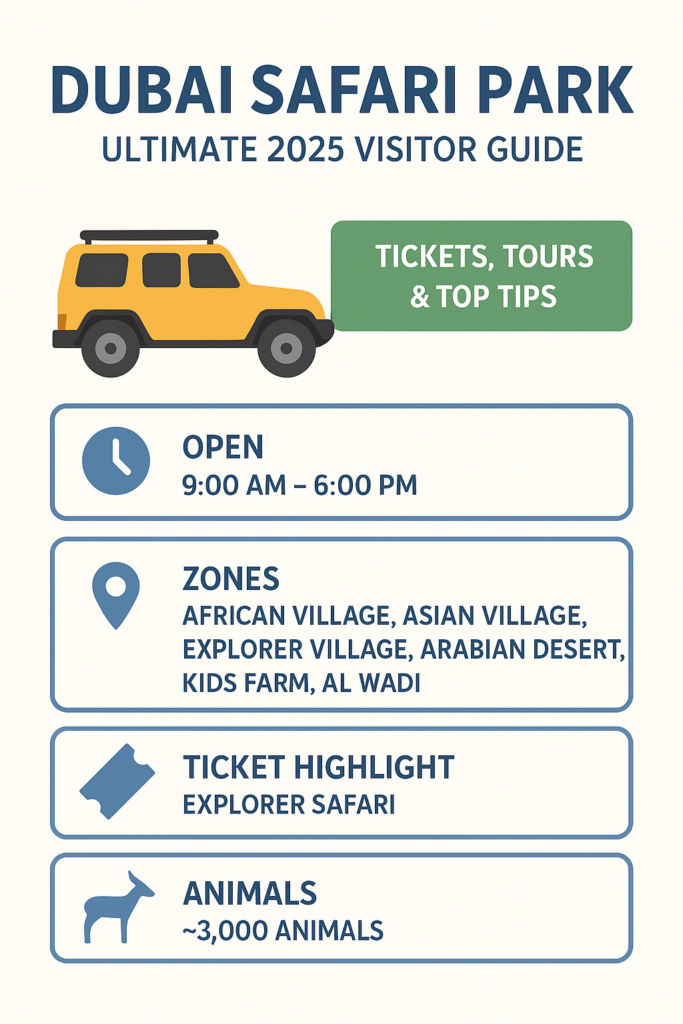
- Open: generally 9:00 AM – 6:00 PM (always confirm the official site before you go).
- Zones: Six main zones — African Village, Asian Village, Explorer Village, Arabian Desert, Kids Farm, and Al Wadi.
- Ticket highlights: Explorer Safari = a one-time ~35-minute guided close encounter (timed). Arabian Desert Safari = ~15-minute drive-through experience inside park grounds (inclusion depends on ticket).
- Animal scale: Park hosts roughly ~3,000 animals across many species — good for conservation credibility.
- Best time to visit: Early morning (at opening) or late afternoon/early evening for cooler temperatures and more active animals. Weekdays are quieter.
Why visit Dubai Safari Park
Dubai Safari Park is far more than a typical zoo — it’s a themed wildlife destination built around immersive villages representing different ecological regions. Instead of a linear chain of cages, it’s organized into interconnected zones that let you walk, hop a shuttle, or join guided safaris to get closer to animals in naturalistic settings. It’s ideal for families, keen photographers, and visitors who want a full-day wildlife experience without leaving Greater Dubai. This guide is designed so you can squeeze the most value and joy out of a single visit.
Who this guide is for
- Families who want clear itineraries, child-friendly tips and play-friendly logistics.
- Photographers seeking gear lists, golden-hour windows, and vantage guidance.
- Conservation-minded visitors who want to learn what the park does and how to support it.
- Ticket shoppers & time-sensitive visitors who want to pick the right package and avoid wasted time or money.
Tickets & packages
The key to a smooth visit is purchasing the right ticket. Below is a plain comparison and simple buying advice so you don’t overpay or miss the Explorer Safari slot you want.
Quick buying rules
- Explorer Safari priority: If a close encounter matters, buy a ticket that explicitly includes the Explorer Safari (35 minutes). This is timed and can sell out. Book the Explorer slot early.
- All-day park pass: If you’re after a relaxed walk and access to all zones without guided encounters, the All-Day or Park Pass is a better value.
- Families: Look for family bundles that include shuttle access, feeding or encounter inclusions, and free/discounted child tickets.
- VIP/Fast-track: If you want to skip lines and reserve seating/feeding, buy VIP packages.
Ticket comparison (simple table)
| Ticket type | What’s included | Best for |
| All-day Park Pass | Entry to all 6 zones, internal shuttle, access to scheduled shows | Walkers, families, budget visitors |
| Explorer Safari (timed) | 35-minute guided safari vehicle experience — single time slot | Photographers, animal-lovers wanting close encounters |
| Arabian Desert Safari | 15-minute drive-through within the park; sometimes unlimited, depending on ticket | Short visits, families with little kids |
| VIP / Fast-Track | VIP Explorer Safari, fast lanes, possible extras (feeding/reserved seating) | Visitors wanting premium, fewer queues |
| Night/Evening Pass | Limited seasonal evening access | Locals or short-visit guests (check availability) |
Buying tip: Always verify inclusions on the vendor page before checkout — “Explorer Safari included” is the single phrase that matters if you want the guided ride.
Where to start (first 20 minutes)
- Enter through the main gate, pick up a printed map or use the downloadable map.
- Check the day’s show and feeding timetable at the information desk or display boards.
- Confirm your Explorer Safari slot (if booked) and locate the meeting point early.
Hour-by-hour itineraries
Below are three sequential, time-stamped itineraries you can copy, paste, and print: half-day, full-day and a photographer-focused schedule. Each is optimized for flow, animal activity, and comfort.
Itinerary A — Half-day
Goal: See highlights, prioritize kid-friendly spots, and avoid midday heat.
- 09:00 – 09:15 — Arrive, pick up map, restroom stop, apply sunscreen, stroller check.
- 09:15 – 10:00 — African Village: giraffes, elephants, and other large mammals — easy walking, ideal for children.
- 10:00 – 10:30 — Kids Farm: petting, safe encounters and pony-rides if available — perfect for small kids.
- 10:30 – 11:00 — Snack break + souvenir stop.
- 11:00 – 11:35 — Explorer Safari (if booked) — do early to beat the heat.
- 11:35 – 12:00 — Asian Village: short walk to birds & reptiles.
- 12:00 — Exit or lunch at park dining if staying.
Why this works: Fast, kid-centric, maximizes close encounters while avoiding peak midday sun.
Itinerary B — Full-day
Goal: See all six zones at a relaxed pace, attend a show, and capture good photos.
- 09:00 – 09:20 — Arrive early; grab map and show schedule.
- 09:20 – 10:10 — African Village: take your time with larger mammals.
- 10:10 – 10:40 — Asian Village: attend a bird/reptile talk if scheduled.
- 10:40 – 11:20 — Explorer Village: walk and use the shuttle if you like.
- 11:30 – 12:05 — Explorer Safari — book for late morning if you prefer softer light.
- 12:30 – 13:30 — Lunch + rest at Al Wadi (pond area).
- 13:30 – 14:00 — Kids Farm revisit for afternoon activities.
- 14:00 – 15:00 — Arabian Desert Safari drive-through (repeat if ticket allows).
- 15:30 – 16:00 — Afternoon show (birds of prey / theatre).
- 16:00 – 17:00 — Revisit missed zones, shopping, and prep for golden hour.
- 17:00 – 18:00 — Golden-hour photography or gentle stroll; final exit before close.
Why this works: Balanced schedule with rest, shows, and prime photo opportunities.
Itinerary C — Photographer’s day
Goal: Maximize photographic opportunities — wide habitat frames, intimate portraits and moving safari frames.
- 09:00 – 09:30 — Early scout: African Village for wide-angle habitat shots; 24–70mm and 70–200mm recommended.
- 10:30 – 11:05 — Explorer Safari (35 min) — morning slot to capture softer light and active animal behaviour from the vehicle. Use 70–200mm and a 1.4x/2x if needed.
- 12:00 – 13:00 — Lunch and relocate to Asian Village for controlled light and close bird/reptile portraits (macro or 100–400mm).
- 14:00 – 16:00 — Scout Al Wadi reflections and the desert drive for wide open compositions.
- 16:30 – 18:00 — Golden hour back at African Village or Explorer Village for warm, directional light and silhouettes. Aim for rim lighting or side light for drama.
Gear notes: monopod for long lenses, a fast prime (50mm/85mm) for portraits, a weather-resistant bag, spare batteries and memory cards.
Family & accessibility
Stroller & wheelchair access: Paths are mostly accessible; some gravel sections exist. Lightweight strollers are easier for mixed surfaces. Wheelchair users will find main routes navigable — check access ramps at entrances and around exhibits.
Shade & heat: Bring hats, sunscreen, and refillable water bottles. Morning visits are far more Comfortable during warm months.
Toilets & baby change: Facilities are distributed — pick a route that passes restrooms every 30–45 minutes for families.
Food & Allergies: On-site outlets are available; however, options may be limited. Bring snacks for picky eaters or special diet needs.
Quiet spaces: Al Wadi’s ponds and seating areas are calm, shaded, and ideal for short rests or sensory breaks.
Family tip: Book packages with reserved seating or feeding encounters if you want priority at shows and hands-on activities.
Photography guide
Main keywords for photographers: photography guide, best viewpoints, lens recommendations, golden hour, close encounters
Best lenses (practical)
- Wide-angle (24–70mm): habitat and environment compositions.
- Telephoto (70–200mm, 100–400mm): tight animal portraits and behaviour frames from a safe distance.
- Prime (50mm/85mm): handler portraits and intimate animal expressions.
- Macro/close-focus: small birds, reptiles, insects.
Camera settings & approach
- Shutter speed: aim for 1/500s or faster for moving subjects.
- Aperture: f/4–f/8 for subject separation with enough depth.
- ISO: keep low in the morning; boost as needed in shaded enclosures.
- White balance: auto is fine in mixed light; switch to daylight in golden hour for warmer tones.
- Silent shooting & respect: silent or quiet modes are kinder; never attract attention with food or loud noises.
Golden hour
Late afternoon (approx 16:30–18:00) usually yields warm, soft light. Face the sun behind you for balanced, evenly lit subjects or put the sun behind the animal for rim light.
Vantage map highlights
- African Village: expansive frames; excellent for wide and telephoto shots.
- Explorer Safari vehicle: movable vantage for candid motion frames (shoot from the vehicle during the guided ride).
- Asian Village: calmer light for birds and reptiles; better for portraiture.
- Al Wadi ponds: reflective surfaces for creative compositions.
Conservation & education
Modern parks balance visitor experience with animal welfare, education and breeding programs. Dubai Safari Park runs conservation and educational initiatives, hosts breeding programs and collaborates in regional conservation efforts. As a visitor, you can support these aims by:
- Reading and respecting exhibit signage (it’s curated to inform).
- Attending short education talks (often included with entry).
Avoid feeding animals unless explicitly authorized and supervised. - Considering a donation or enrolment in membership programs if available.
Conservation is part of the visitor experience — appreciating and learning about species supports long-term habitat and welfare work.
Safety & conduct
- Follow staff instructions at all times.
- Observe barriers — they are for your safety and animal welfare.
- No smoking near exhibits.
- Supervise children on viewing platforms and near water.
- Keep a respectful distance; never attempt to touch animals unless in designated, supervised encounters.
Printable one-page itinerary
Title: Dubai Safari Park — One-Page Visit Plan
Time window: 09:00–15:00 (Half-day)
- 09:00 — Arrive, collect map, check show times.
- 09:15–10:00 — African Village (giraffes, elephants).
- 10:00–10:30 — Kids Farm (petting & activities).
- 10:30–11:05 — Explorer Safari (booked slot).
- 11:10–12:00 — Asian Village & reptile house.
- 12:00 — Lunch; quick shop; exit.
Micro UX ideas you can steal
- Sticky quick-facts bar (hours, price bracket, “Buy tickets” CTA).
- Prominent Explorer Safari column in the ticket comparison table.
- Printable PDF download behind an email capture (top itinerary).
- Photographer mini-map (downloadable) of best vantage points & light windows.
- FAQ with JSON-LD for People Also Ask.
FAQ
A: The park typically opens at 9:00 AM and closes around 6:00 PM, but hours can change seasonally — always confirm on the official site before visiting.
A: The Explorer Safari is a guided 35-minute safari ride included with some tickets. Tours run between set times (usually 10:00–17:00) and are a one-time access per relevant ticket. Book early for the best slots.
A: Many ticket types include the Arabian Desert Safari — a 15-minute drive-through experience. Some tickets offer unlimited short rides; check the ticket inclusions before you buy.
A: There are 6 main zones: African Village, Asian Village, Explorer Village, Arabian Desert, Kids Farm, and Al Wadi. These are included with general admission or specific packages.
A: Yes — there’s a dedicated Kids Farm, live shows, and safe, educational viewing areas. Family packages often include feeding sessions and reserved seating for shows.
Photographer mini-map
If you host the article on a site, include an interactive mini-map overlaying the park map: mark African Village, Explorer Safari pickup, Asian Village theatre, Al Wadi ponds, and Kids Farm. Add timed light-windows (morning/afternoon) and recommended lenses for each marker.
Conclusion
Dubai Safari Park offers one of the most rewarding full-day wildlife experiences in the UAE — and with the right preparation, you can enjoy it smoothly, comfortably, and without missing any of the Highlights. Whether you’re visiting with family, planning a photography-focused day, or simply looking for an immersive way to learn about animals and conservation, the park’s six themed zones, guided safaris, and educational shows provide something for every age and interest.