
Introduction
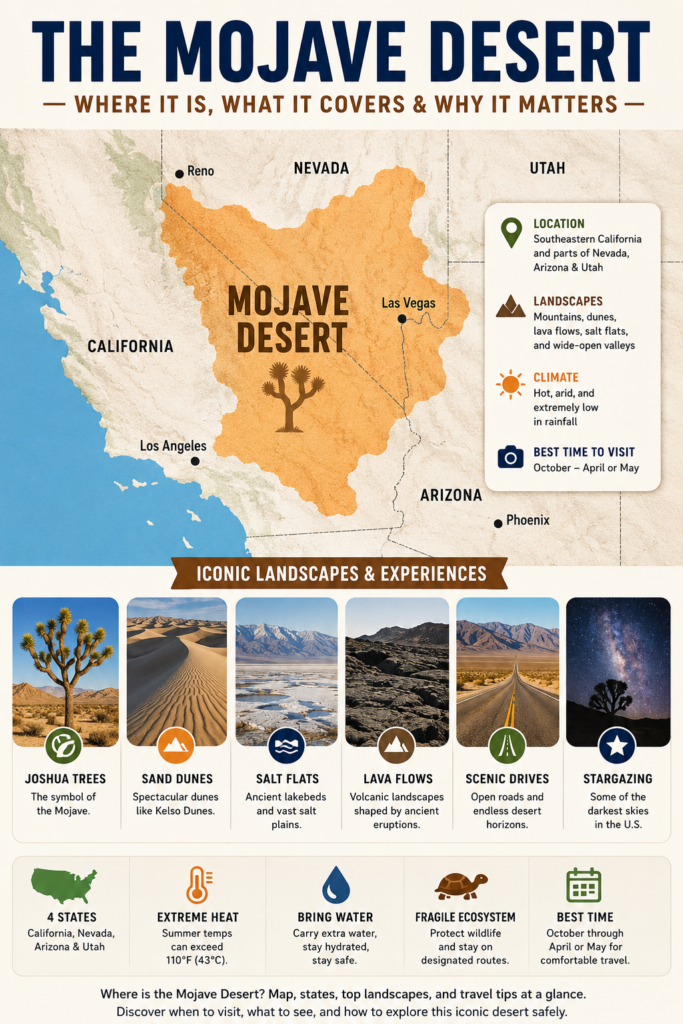
The Mojave Desert is one of the most famous desert regions in the southwestern United States. It lies mostly in southeastern California and extends into Nevada, Arizona, and Utah. Known for its dry climate, Joshua trees, dunes, lava fields, and wide open landscapes, the Mojave is more than just a desert on a map. It is a unique natural region with striking scenery, rich ecology, and deep history. This guide explains where the Mojave Desert is, which states it covers, which states border it, and why it is such an important and fascinating landscape.
- Mojave Desert at a Glance
- What Is the Mojave Desert?
- Where Is the Mojave Desert on the Map?
- Simple map idea
- What States Does the Mojave Desert Cover?
- California
- Nevada
- Arizona
- Utah
- What Borders the Mojave Desert?
- Why the borders vary
- An easy way to understand the border
- Why the Mojave Desert Is Famous
- 1. Death Valley
- 2. Joshua trees
- 3. Lava flows and volcanic landforms
- 4. dunes
- 5. Open roads and wide horizons
- 6. Wildlife and plant life
- 7. History
- Climate and Weather in the Mojave Desert
- Hot summers
- Mild to cool winters
- Very low rainfall
- Elevation changes matter
- Example
- Landscape Features of the Mojave Desert
- Mountain-and-basin topography
- Salt flats and dry lakebeds
- Lava flows and volcanic cones.
- Dunes
- Rocky hills and desert plains
- Dry riverbeds and washes
- Lava Flows and Volcanic Terrain
- What makes volcanic terrain special?
- Why travelers love it
- Good example
- Sand Dunes in the Mojave Desert
- Kelso Dunes
- Why dunes form
- What makes the Mojave Dunes special?
- Travel tip
- Flora: Plants That Define the Mojave Desert
- Joshua trees
- Creosote bush
- Mojave yucca
- Blackbrush
- Other desert plants
- Why plants matter here
- Endemic plant life
- Fauna: Animals of the Mojave Desert
- Mammals
- Reptiles
- Birds
- Why wildlife survives here
- The desert tortoise
- Human History and Culture in the Mojave Desert
- Indigenous history
- Trade and travel routes
- The Mojave Road
- Exploration and settlement
- Why this matters
- Mojave Desert Travel Guide
- Best places to visit
- Things to Do in the Mojave Desert
- Scenic driving
- Short hikes
- Photography
- Geology viewing
- Wildlife watching
- Stargazing
- Best Time to Visit the Mojave Desert
- Why cooler months are better
- Why summer is harder
- Simple travel rule
- Safety Tips for Visiting the Mojave Desert
- Bring extra water
- Check road conditions
- Use a real map
- Keep your vehicle ready.
- Stay on marked routes
- Avoid the hottest hours.
- Tell someone your plan.
- Conservation and Environmental Issues
- Main threats
- Why fire is a major issue
- Why restoration is difficult
- Why conservation matters
- The larger lesson
- Interesting Facts About the Mojave Desert
- Pros and Cons
- Pros
- Cons
- Why the Mojave Desert Is Different from Other Deserts
- Compared with the Sonoran Desert
- Compared with the Great Basin Desert
- What makes the Mojave unique
- A Simple Example of a Mojave Trip
- Day 1
- Day 2
- Day 3
- Why the Mojave Desert Matters
- FAQs
- Conclusion
Mojave Desert at a Glance
| Quick Fact | Details |
| Location | Mostly southeastern California, with parts extending into Nevada, Arizona, and Utah |
| Size | Boundary definitions vary, so published area figures differ |
| Climate | Hot, arid, and extremely low in rainfall |
| Famous for | Death Valley, Joshua trees, dunes, lava flows, salt flats, and dramatic mountains |
| Best time to visit | Usually, October through April or May |
| Main travel style | Scenic drives, short hikes, photography, geology stops, and stargazing |
This summary gives the short answer. The full story is much deeper.
What Is the Mojave Desert?
The Mojave Desert is a large arid region in the southwestern United States. This belongs to the broader North American desert system and sits between other major desert zones. It is known for dry air, intense sunlight, large temperature swings, and scenery that can shift dramatically from one place to the next.
It is not a desert made of only sand. That is a common misconception. The Mojave includes:
- mountain ranges
- dry basins
- salt flats
- lava fields
- volcanic cones
- rocky valleys
- dune systems
- desert scrub
- Joshua tree woodlands
That diversity is one of the reasons the Mojave is so compelling. You can drive through an area that feels like a barren stone plain, then reach a basin with a white salt crust, and later arrive at a mountain slope covered in desert plants, offering broad panoramic views.
The Mojave Desert is also significant because it lies at a natural meeting point between other desert systems. That gives it the role of an ecological transition zone, not just a simple stretch of dry land.
Where Is the Mojave Desert on the Map?
If you want to find the Mojave Desert on a map, begin in the southwestern United States. Most of the desert is located in southeastern California, while smaller portions extend into Nevada, Arizona, and Utah.
The easiest way to visualize it is like this:
- It sits east of Southern California’s coastal mountain systems
- It lies south of the Great Basin Desert
- It is north of the Sonoran Desert
- It extends toward the Colorado Plateau and the Colorado River region
That position means the Mojave lies in a region where desert landscapes merge, overlap, and shift. Because of that, its border is not a rigid line on every map. Different researchers, agencies, and reference sources may draw it slightly differently depending on whether they are using climate, vegetation, landform, or geography as the primary basis.
Simple map idea
Think of the Mojave as a desert region spread across parts of four states, with the largest share in California. On a map of the western United States, it appears inland from the Pacific coast, east of Los Angeles, and west of Las Vegas in many places.
What States Does the Mojave Desert Cover?
The Mojave Desert covers parts of:
- California
- Nevada
- Arizona
- Utah
California
California holds the largest portion of the Mojave. Many of its most famous destinations are here, including:
- Death Valley National Park
- Joshua Tree National Park
- Mojave National Preserve
- major desert highways and open basins
Nevada
The Mojave extends into southern Nevada, especially in desert lands near the California border.
Arizona
Small sections reach into Arizona, usually in western transition zones where desert types blend together.
Utah
The desert also touches parts of southwestern Utah, showing how broad and interconnected this arid system really is.
This four-state spread is one reason the Mojave is such an important desert to study and explore. It is not limited to one park, one county, or one travel corridor. It is a true regional landscape.
What Borders the Mojave Desert?
The Mojave Desert does not have a single hard boundary like a fence or wall. Instead, it has natural edges that shift depending on how the desert is defined.
Some of the major borders and nearby regions include:
- the Sierra Nevada to the west
- The Coast Ranges farther west in California
- the Great Basin Desert to the north
- the Sonoran Desert to the south
- the Colorado Plateau and Colorado River region to the east
Why the borders vary
The Mojave is often defined by more than just its physical location. Scientists and geographers may use:
- climate patterns
- plant communities
- elevation
- soil type
- landform patterns
- drainage systems
That is why one source may show a slightly different Mojave outline than another. The desert is real, but its exact shape is not always identical in every reference.
An easy way to understand the border
A simple way to think about it is this: the Mojave is the desert between the Mountains of California, the higher deserts to the north, and the hotter desert systems to the south and east. It is a transition zone with a strong identity of its own.
Why the Mojave Desert Is Famous
The Mojave Desert is famous for several reasons, and each one adds to its appeal.
1. Death Valley
Death Valley is one of the most well-known desert places on Earth. It is famous for extreme heat, very low elevation, salt flats, and dramatic scenery.
2. Joshua trees
The Joshua tree is one of the most recognizable plants in the American desert. Its shape is unusual, striking, and unforgettable.
3. Lava flows and volcanic landforms
The Mojave has old lava fields, cinder cones, and volcanic terrain that create a very different type of desert scenery.
4. dunes
The Mojave contains major dune systems such as the Kelso Dunes, which are among the most impressive in the United States.
5. Open roads and wide horizons
Travelers love the Mojave because it feels expansive and quiet. The broad roads and open emptiness create a powerful sense of space.
6. Wildlife and plant life
Even though it is dry, the Mojave supports a wide range of desert species, many specially adapted to severe conditions.
7. History
The desert has a deep human story, including Native travel routes, trade corridors, mining history, military roads, and conservation efforts.
Climate and Weather in the Mojave Desert
The Mojave Desert is known for heat, dryness, and strong seasonal variation. But the climate is more nuanced than simply “hot all the time.”
Hot summers
Summer temperatures can become extremely high, especially in low-lying areas. That is one reason the Mojave is often described as one of the hottest desert regions in the country.
Mild to cool winters
Winters are often more comfortable, particularly during the day. Still, nights can be cold, and higher elevations may even receive snow.
Very low rainfall
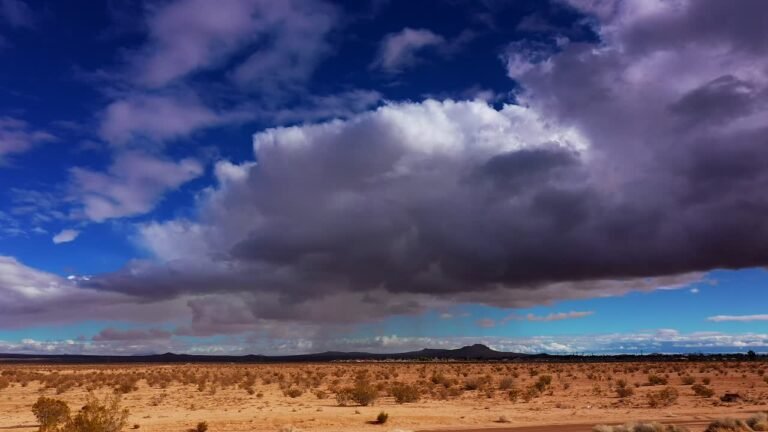
The Mojave receives very little precipitation. That helps create its dry landscape, open spaces, and sparse vegetation in many places.
Elevation changes matter
The desert includes both high mountains and low basins. That means one area may be much cooler than another, only a short drive away.
Example
A traveler might begin in a hot valley, then drive into cooler mountain air, and later see frost or snow in winter at a higher elevation. That dramatic shift is one of the Mojave’s most distinctive traits.
Landscape Features of the Mojave Desert
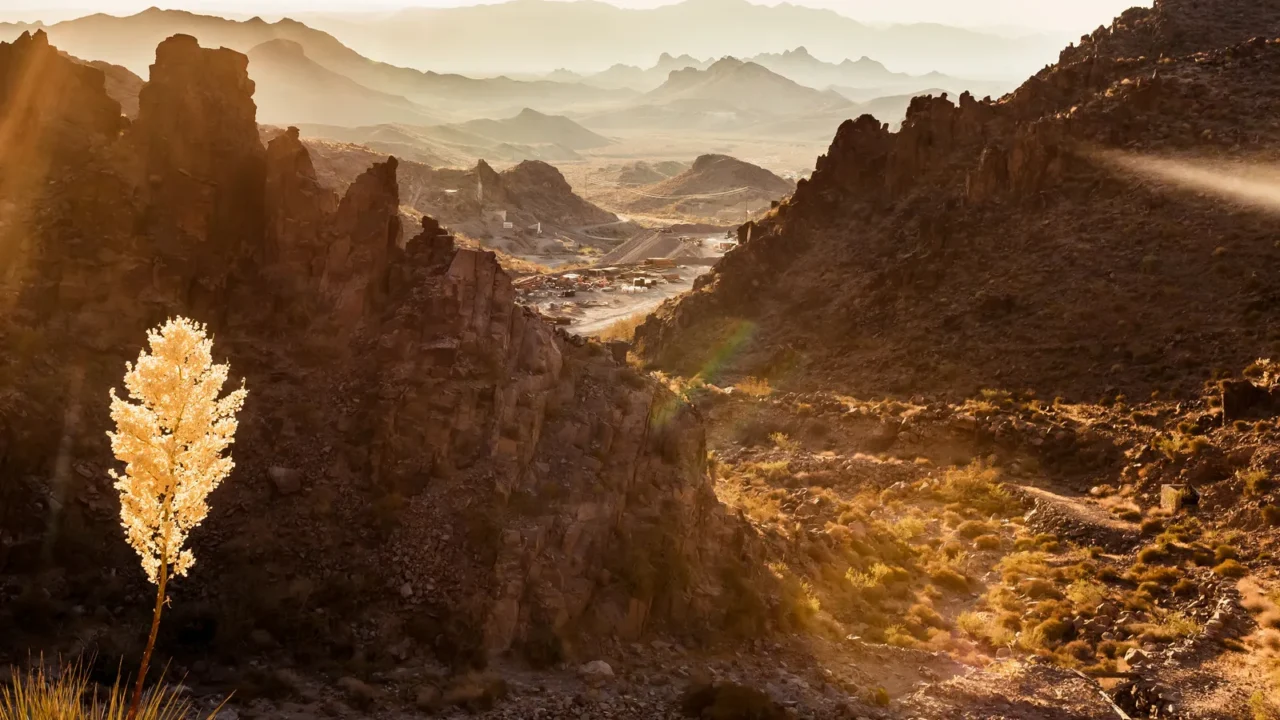
The Mojave Desert is famous for its landscape diversity. It is not one flat, uniform scene. It is a blend of landforms that tells a geological story.
Mountain-and-basin topography
Much of the Mojave follows a basin-and-range pattern. This means long mountain blocks rise beside low basins.
Salt flats and dry lakebeds
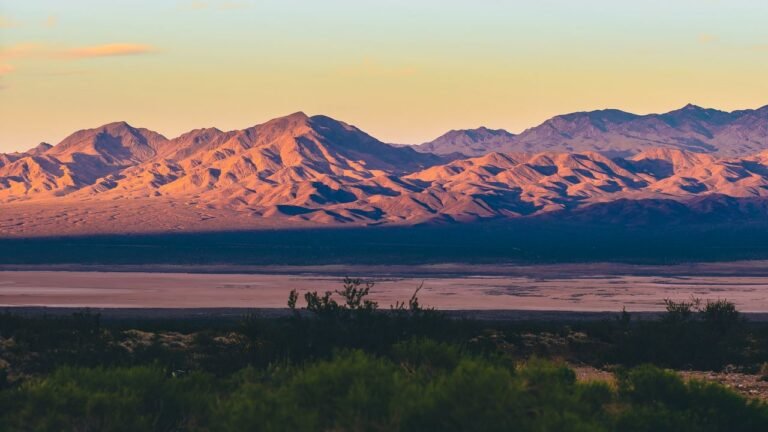
Some low areas gather minerals and create dry lakes or salt flats. These places can appear white, bright, and almost alien.
Lava flows and volcanic cones.
Volcanic history has shaped large parts of the Mojave. You can still see lava rock, black fields, and old volcanic cones in some locations.
Dunes
The Mojave includes major dune fields formed over time by wind, dry basins, and shifting sediment sources.
Rocky hills and desert plains
The desert also includes rocky slopes, broad gravel flats, and open plains covered with desert shrubs.
Dry riverbeds and washes
Many waterways in the Mojave are seasonal. They may remain dry for long stretches and then briefly carry water after rain.
Lava Flows and Volcanic Terrain
One of the most striking aspects of the Mojave Desert is its volcanic landscape. Many visitors expect only sand and heat, but the Mojave also contains old lava fields and cinder cones.
What makes volcanic terrain special?
Volcanic areas create:
- dark rock surfaces
- rugged hiking terrain
- unusual geology
- strong visual contrast against pale desert soil
Why travelers love it
Volcanic landforms make the Mojave feel dramatic and distinctive. The black lava, rough stone, and broad sky combine to produce scenery that looks very different from a standard desert postcard.
Good example
The area around Mojave National Preserve includes volcanic features that give visitors a clear look at how powerful desert geology can be.
Sand Dunes in the Mojave Desert
When many people picture deserts, they imagine dunes. The Mojave Desert does have dunes, and some of them are highly impressive.
Kelso Dunes
Kelso Dunes are one of the best-known dune systems in the Mojave. They are large, scenic, and popular with hikers and photographers.
Why dunes form
Dunes form when wind moves sand into large accumulations over time. In the Mojave, that process has continued for thousands of years.
What makes the Mojave Dunes special?
They are not only beautiful. They also show how wind, dry basins, and ancient water systems helped shape the desert.
Travel tip
Dunes may look easy to walk on, but they can be exhausting. Hot sand, open sun, and loose footing make them much harder than they appear.
Flora: Plants That Define the Mojave Desert
The plant life of the Mojave Desert is one of its defining traits. These plants are not random background details. They are part of what gives the region its identity.
Joshua trees
The Joshua tree is the signature plant of the Mojave. It has become a symbol of the desert because it is so unusual and so closely tied to this region.
Creosote bush
The creosote bush is another classic Mojave plant. It is resilient, drought-tolerant, and widespread across desert flats.
Mojave yucca
The Mojave yucca is another native plant that helps define the region.
Blackbrush
Blackbrush is common in many desert plant communities and contributes to the larger ecological structure.
Other desert plants
The Mojave also includes:
- shadscale
- bursage
- bladder-sage
- big sagebrush
- desert wildflowers during wetter seasons
Why plants matter here
Plants are not just decoration in the desert. They:
- stabilize soil
- provide food for wildlife
- create shade
- support insects and birds
- help mark the boundaries between desert zones
Endemic plant life
The Mojave is also known for plant species found only in this desert region or in very limited areas. That makes it ecologically valuable and worth protecting.
Fauna: Animals of the Mojave Desert
Even though the Mojave is dry, it supports a surprising variety of animals. These species are adapted to heat, scarcity of water, and harsh survival conditions.
Mammals
Some Mojave mammals include:
- coyotes
- foxes
- bighorn sheep
- kangaroo rats
- bats
- rodents
Reptiles
Reptiles are a major part of desert life. You may encounter:
- lizards
- snakes
- sidewinder rattlesnakes
- desert tortoises
- chukwallas
Birds
The Mojave also supports many birds, including:
- hawks
- eagles
- quail
- birds of prey
- other desert and migratory species
Why wildlife survives here
Desert animals survive by:
- staying active at night or early morning
- hiding in shade
- burrowing underground
- conserving water efficiently
- avoiding the hottest part of the day
The desert tortoise
The desert tortoise is one of the most famous Mojave animals. It is also a symbol of how fragile desert life can be. Protecting this species means protecting the larger habitat as well.
Human History and Culture in the Mojave Desert
The Mojave Desert has a long human history. It is not empty land. It has been inhabited, crossed, traded through, and protected for thousands of years.
Indigenous history
Native peoples have lived in and traveled through the Mojave lands for generations. They knew where to find water, how to move across difficult terrain, and how to survive in a demanding environment.
Trade and travel routes
The desert also became a corridor for movement. Trails linked water, food, exchange, and later exploration routes.
The Mojave Road
The Mojave Road is one of the most important historic travel routes in the region. It reveals how people crossed the desert before modern highways existed.
Exploration and settlement
Later, explorers, settlers, miners, military groups, and mail routes all used desert corridors. The desert became part of the larger western expansion narrative in the United States.
Why this matters
The Mojave is not only a natural landscape. It is also a cultural landscape. The road, the camps, the trade routes, and the conservation zones all tell a story about how humans adapted to a difficult environment.
Mojave Desert Travel Guide
If you are planning to visit the Mojave Desert, the experience can be unforgettable. But it should be planned carefully.
Best places to visit
1. Death Valley National Park
Death Valley is one of the most iconic desert destinations in the world. It offers vast views, salt flats, low valleys, and dramatic conditions.
2. Joshua Tree National Park
Joshua Tree is where the Mojave meets other desert zones. It is famous for boulder fields, Joshua trees, hiking, climbing, and sunsets.
3. Mojave National Preserve
This is one of the best places to experience a broad range of Mojave landscapes, including dunes, lava flows, volcanic cones, and remote desert roads.
4. Kelso Dunes
These dunes are a strong choice for hikers, photographers, and travelers who want to feel the scale of the desert.
5. Historic desert routes
Old roads and byways help travelers connect with the human history of the region.
Things to Do in the Mojave Desert
A great Mojave trip usually blends scenery, history, and outdoor exploration.
Scenic driving
Driving is one of the easiest ways to see the desert. The long roads and open horizons are part of the experience.
Short hikes
The Mojave is ideal for shorter hikes, especially for travelers who want to explore without spending all day on the trail.
Photography
The desert offers strong light, bold shapes, and expansive views. Sunrise and sunset are especially rewarding for photography.
Geology viewing
If you enjoy rocks, landforms, and Earth science, the Mojave has many interesting stops.
Wildlife watching
Early morning and evening are the best times to observe birds, lizards, and other animals.
Stargazing
The night sky is one of the Mojave’s greatest natural treasures. In remote areas, stars appear bright, sharp, and abundant.
Best Time to Visit the Mojave Desert
The best time to visit the Mojave Desert is usually October through April or May.
Why cooler months are better
- Temperatures are easier to handle
- Hiking is safer
- Driving is less stressful
- Photography is more comfortable
- Wildlife viewing is often better
Why summer is harder
Summer can bring severe heat, especially in lower elevations. Long exposure outdoors can become unsafe very quickly.
Simple travel rule
For most visitors, the desert is best enjoyed when the weather is cool enough to let you explore without rushing.
Safety Tips for Visiting the Mojave Desert
The Mojave is beautiful, but it can also be dangerous if you are not prepared.
Bring extra water
This is the most important rule. Carry more water than you think you will need.
Check road conditions
Some roads are rough, isolated, or affected by weather.
Use a real map
Cell service may be unreliable in many areas.
Keep your vehicle ready.
A full gas tank, spare tire, and basic emergency supplies are smart choices.
Stay on marked routes
This protects both you and the fragile desert environment.
Avoid the hottest hours.
Midd. The heat can be intense. Morning and evening are usually better for outdoor activity.
Tell someone your plan.
Let a friend or family member know where you are going and when you expect to return.
Conservation and Environmental Issues
The Mojave Desert is fragile. It looks tough because it is vast and open, but its ecosystems can be damaged easily.
Main threats
The desert faces pressure from:
- invasive grasses
- fire
- recreational impacts
- urban growth
- energy development
- habitat fragmentation
Why fire is a major issue
Invasive grasses can alter how fire spreads. In a desert that is not adapted to frequent fire, this can cause serious problems for native plants and wildlife.
Why restoration is difficult
The desert receives little rain. That makes recovery slow and challenging after a disturbance.
Why conservation matters
Protecting the Mojave helps preserve:
- native plants
- wildlife habitat
- scenic beauty
- cultural history
- future travel opportunities
The larger lesson
Deserts are not empty. They are living systems. Once damaged, they may take a very long time to heal.
Interesting Facts About the Mojave Desert
Here are some easy-to-remember facts about the Mojave Desert:
- It is one of the most famous deserts in the United States.
- It spans parts of four states.
- It is known for Joshua trees and Death Valley.
- It includes both very low basins and very high mountains.
- It has lava fields, dunes, and salt flats.
- It supports plant and animal life adapted to dry conditions.
- Its precise boundaries can vary depending on how the desert is defined.
- It has a deep history of Indigenous travel and later Western migration.
These facts show why the Mojave is far more than a simple desert label.
Pros and Cons
Pros
- The scenery is highly varied and dramatic
- It offers world-famous landmarks
- The night sky is often excellent
- It is ideal for scenic driving and short outdoor stops
- It has a rich blend of geology, biology, and history
Cons
- Heat can be dangerous
- Services may be far apart
- Some roads are rough or remote
- Visitors must plan carefully
- The environment is fragile and deserves respect
Why the Mojave Desert Is Different from Other Deserts
People often compare the Mojave Desert with the Sonoran Desert or the Great Basin Desert. The Mojave stands apart because of its special mix of elevation, landforms, and plant life.
Compared with the Sonoran Desert
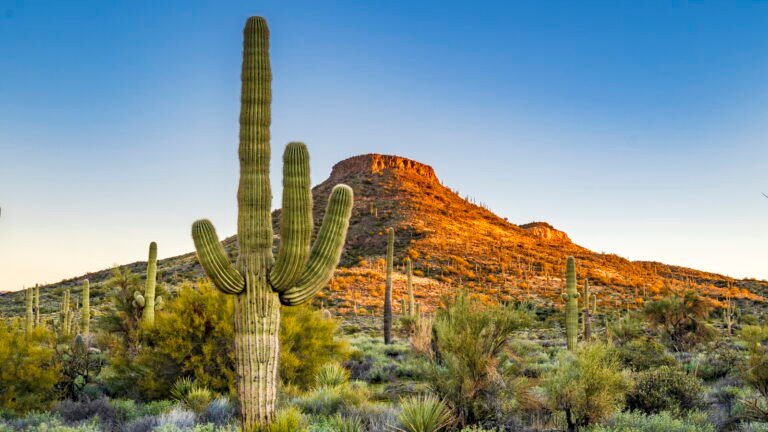
The Sonoran Desert is known for different plant communities, including saguaro cactus zones. The Mojave is more closely associated with the Joshua tree and dry basin landscape.
Compared with the Great Basin Desert
The Great Basin is generally cooler and higher. The Mojave is hotter and has a distinct ecological identity.
What makes the Mojave unique
- Joshua tree forests
- strong heat
- basin-and-range geography
- volcanic landforms
- major salt flats and dry basins
- famous travel destinations
The Mojave has its own unmistakable voice in the desert world.
A Simple Example of a Mojave Trip
Here is a simple example of how a traveler might explore the Mojave Desert over a short trip:
Day 1
Drive into the desert in the morning, stop at a scenic viewpoint, walk a short trail, and watch the sunset from a safe overlook.
Day 2
Visit a national park or preserve, explore a geology site, take photos of Joshua trees or dunes, and end the day with stargazing.
Day 3
Use the final day for a historic road, a museum stop, or a quieter desert trail before heading home.
This type of trip works well because it gives you a meaningful taste of the desert without overloading the itinerary or pushing too hard in the heat.
Why the Mojave Desert Matters
The Mojave Desert matters for more than travel. It matters because it helps people understand how life functions in dry environments.
It teaches us that:
- deserts are alive
- Climate shapes land
- plants and animals adapt in remarkable ways
- Water is precious
- Land use has long-term consequences
- Conservation is essential
The Mojave is a strong example of a landscape that is beautiful, harsh, historic, and ecologically important all at once.
FAQs
It is in both, but most of it is in California. It also extends into Arizona and Utah.
Yes. Death Valley is one of the most famous parts of the Mojave Desert.
The exact size depends on how the boundary is defined. Different sources may give different figures because the desert is a transition zone.
It is famous for Joshua trees, Death Valley, dunes, lava flows, salt flats, and dramatic desert scenery.
The best time is usually October through April or May, when temperatures are more comfortable.
Conclusion
So, where is the Mojave Desert? It is a vast desert region in the southwestern United States, centered in southeastern California and stretching into Nevada, Arizona, and Utah. Its exact boundaries may vary, but its identity is clear: the Mojave is a dramatic desert landscape known for extreme conditions, iconic Landmarks, and unique natural beauty. Whether you are planning a trip or simply learning about the region, the Mojave Desert stands out as one of America’s most remarkable desert environments.