
Introduction
Desert Land is much more than sand and heat. It is a very dry environment with little rainfall, sparse vegetation, and unique plants, animals, and landforms adapted to harsh conditions. Deserts can be hot, cold, coastal, rocky, or even icy, and they exist on every continent. In this guide, you will learn the meaning of desert land, its climate, major types, landforms, wildlife, and how people live in and use these regions.
- What Is Desert Land?
- Desert Land Meaning in Simple Words
- Why Desert Land Matters
- Climate of Desert Land
- How Desert Climates Form
- Temperature in Desert Land
- Types of Desert Land
- Desert Landforms
- Common Desert Landforms
- Why Desert Landforms Matter
- Plants in Desert Land
- Common Desert Plant Adaptations
- Examples of Desert Plants
- Why Desert Flora Is Important
- Animals in Desert Land
- Common Desert Animal Adaptations
- Examples of Desert Animals
- Birds, Reptiles, and Insects
- Human History and Use of Desert Land
- Human Use of Desert Land
- Desert Cities and Culture
- Tourism in the Desert Land
- Safe Desert Travel Tips
- Threats Facing Desert Land
- Why Desertification Matters
- Conservation in Desert Land
- Interesting Facts About Desert Land
- Pros and Cons
- Pros
- Cons
- FAQs
- Conclusion
What Is Desert Land?
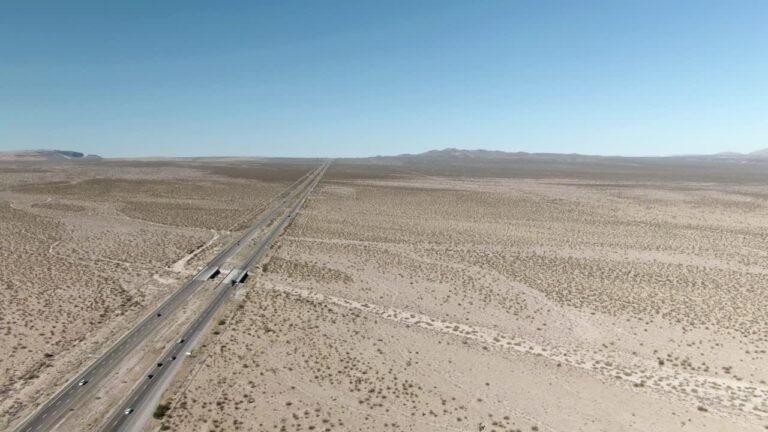
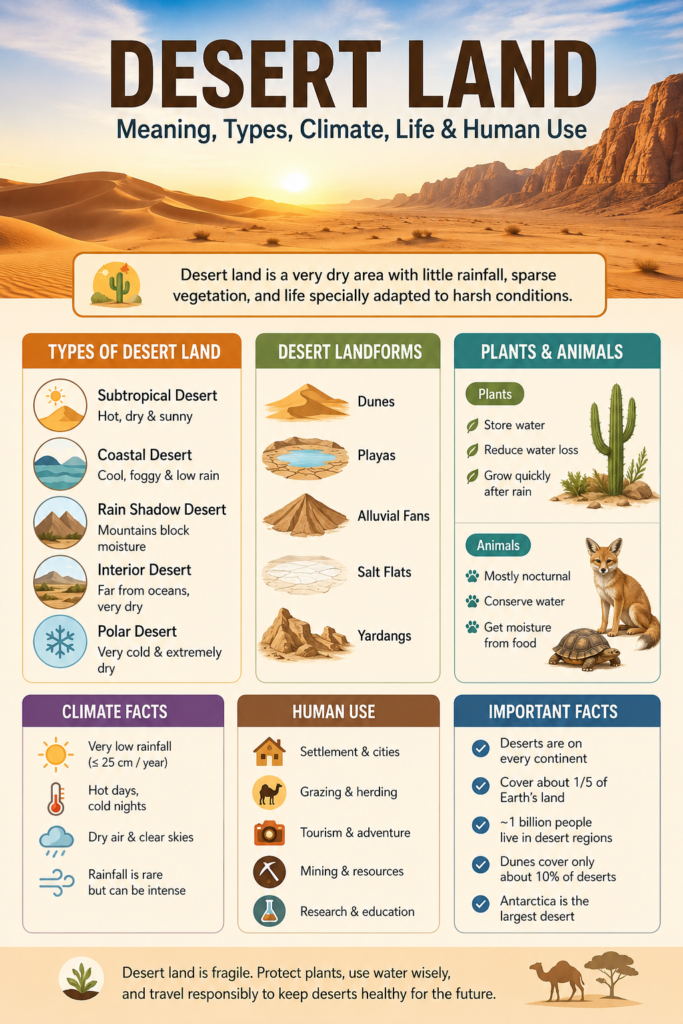
Desert land is an extremely dry landscape with sparse vegetation and very low precipitation. Most scientific descriptions use a general benchmark of 25 centimeters (10 inches) or less of rainfall per year, although the real definition depends more on water balance than on a single number. In a desert, the environment loses more water than it receives, which creates chronic moisture stress for plants, animals, and people.
A desert is not just a place with dunes. In fact, dunes make up only a small fraction of the world’s deserts. Many desert regions are covered with gravel, exposed rock, salt flats, rugged mountains, or frozen ground. Antarctica is the largest desert on Earth, which surprises many people because it is cold rather than hot. This alone shows why desert land must be understood by dryness, not by temperature alone.
Britannica describes deserts as one of Earth’s major ecosystem types, with distinctive organisms that are specially adapted to harsh conditions. So, desert land is not dead land. It is difficult land, yes, but it is also biologically active, ecologically important, and full of survival strategies.
Desert Land Meaning in Simple Words
In simple English, desert land means land that gets very little rain and has very little free water for plants and animals. Because water is limited, life in desert areas must adapt in intelligent ways. Any plants conserve moisture. Some animals stay hidden during the daytime and become active at night. Some people build settlements, homes, and lifestyles that fit the dry climate.
So the meaning of desert land is not “a place where nothing grows.” A better meaning is: a dry region where life survives through special adaptation. That idea matters for students, researchers, travelers, educators, and anyone writing about geography, climate, or nature.
Why Desert Land Matters
Desert regions matter for many reasons. They contain major ecosystems, human communities, trade corridors, mineral resources, fossils, and unique wildlife. The U.S. Geological Survey notes that deserts are natural laboratories for studying wind, water, and arid surface processes. They also preserve artifacts and fossils exceptionally well because dry conditions slow decomposition.
Desert land also matters because it is fragile. Vegetation is often sparse, soils recover slowly, and damage from off-road traffic, overgrazing, or development can remain visible for a very long time. That is why desert conservation is a serious environmental issue, not a minor one.
Climate of Desert Land
The climate of desert land is shaped primarily by low rainfall, but desert temperatures can vary widely. A portion of the desert is scorching during the day and cold at night. Some remain cool for most of the year. Some receive fog instead of rain. The key idea is that a desert climate is dry first, and temperature comes second.
Dry air and minimal cloud cover create dramatic swings between daytime and nighttime conditions. During the day, the sun warms the surface rapidly. At night, heat escapes quickly because the air contains too little moisture to retain warmth. That is why desert land often feels intense, sharp, and extreme rather than stable or gentle.
How Desert Climates Form
Deserts form for several different reasons. Any is created by subtropical sinking air, where air descends near the tropics and suppresses cloud formation. Some are coastal deserts, shaped by cold ocean currents that reduce rainfall and may create fog. Some are rain shadow deserts, where mountains force moist air upward, causing rain to fall on one side while the other side remains dry. Others are interior deserts, located far from ocean moisture. Polar deserts are dry because very little precipitation falls there, and much of the available water is frozen.
This variety helps explain why not all deserts look alike. Desert land is not a single template. It is a family of environments connected by dryness.
Temperature in Desert Land
A very common mistake is assuming that all deserts are hot. That is not true. Some deserts are warm or extremely hot, but others are cold. The world’s deserts include the blazing Sahara, the foggy Atacama, the interior Gobi, rain-shadow regions such as Death Valley, and polar deserts such as Antarctica.
So the phrase desert land should never be treated as a simple synonym for “hot land.” A desert is best understood as a dry place with a water deficit, while temperature is only one piece of the larger Environmental puzzle.
Types of Desert Land
There are several ways to classify deserts, but one highly useful method is to group them by the cause of dryness. National Geographic Education identifies five major types: subtropical, coastal, rain shadow, interior, and polar. This framework is useful because it shows why deserts form in different ways and why they look so different from one another.
| Desert Type | Main Cause of Dryness | Common Weather Pattern | Example |
| Subtropical desert | Sinking air near the tropics | Hot, bright, very dry | Sahara |
| Coastal desert | Cold ocean currents and fog | Cool to mild, misty, low rainfall | Atacama |
| Rain shadow desert | Mountains block moist air | Dry leeward side, often warm | Death Valley |
| Interior desert | Moisture weakens before reaching inland areas | Dry, often with seasonal extremes | Gobi |
| Polar desert | Very low precipitation, water locked as ice | Cold, dry, windy | Antarctica |
This table highlights an important truth: desert land is a category, not a single appearance. One desert may be dominated by dunes, another by stone, another by salt flats, and another by ice.
Desert Landforms
Desert landforms are shaped by both wind and water. Wind is often the most visible force because it moves sand and dust, sculpts surfaces, and shapes exposed terrain. But water still plays a powerful role. When rain does fall, it often arrives in short, intense bursts that can trigger flash floods and move huge amounts of sediment in a short time.
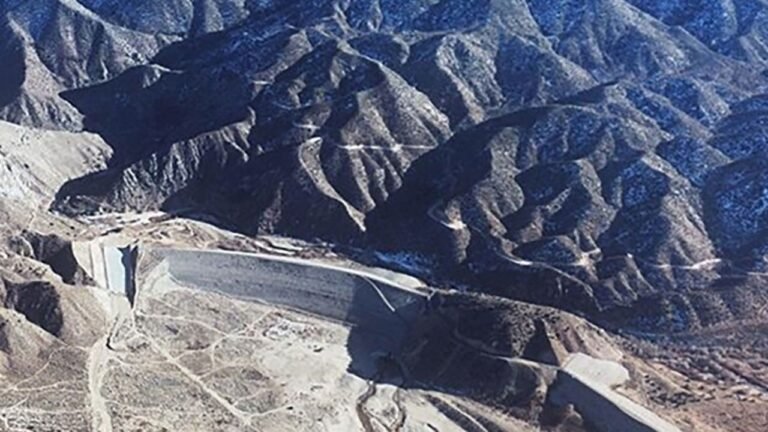
The U.S. Geological Survey explains that desert landscapes frequently include stream channels, alluvial fans, playas, dunes, and mountain systems. These features are created and reshaped by tectonic forces, erosion, weathering, and long-term climate change. So a desert is not a flat, lifeless plain. It is a dynamic landscape filled with motion, memory, and geological history.
Common Desert Landforms
Some of the most familiar desert landforms include the following:
Dunes: Hills or ridges created by wind transport of sand.
Playas: Dry lakebeds that may briefly flood after rainfall.
Alluvial fans: Fan-shaped deposits formed by water and sediment at the base of mountains.
Salt flats: Smooth, bright surfaces left when water evaporates,s and minerals remain behind.
Yardangs: Long, streamlined ridges carved by strong wind.
Ventifacts: Rocks shaped, smoothed, or polished by windblown sand.
A useful point to remember is that dunes cover only about 10% of the world’s deserts. So when people imagine desert land as nothing but sand hills, they are seeing only a small portion of the full reality.
Why Desert Landforms Matter
These landforms help geologists interpret the story of a region. Playas can reveal how a basin drains. Alluvial fans can show where flash floods once carried sediment. Wind-carved stones can indicate the strength and duration of abrasion. In desert land, the surface itself becomes a record of climate, erosion, and time.
Plants in Desert Land
Desert plants are masters of survival. Britannica explains that desert flora has many adaptations that help it endure long dry periods and quickly exploit short wet windows. That is the essential principle behind plant life in arid places: store water, save water, or grow rapidly when rain appears.
Many desert plants are built for hostile conditions. A few have thick stems that store moisture. Some have very small leaves or sharp spines that reduce water loss. Some spread roots widely to capture scarce rainfall. Others go dormant during drought and revive when conditions improve.
Common Desert Plant Adaptations
- storing water in stems or roots
- Closing pores during the hottest part of the day
- growing quickly after rainfall
- having waxy, tiny, or spiny leaves
- using deep or wide root systems
- surviving dry seasons in a dormant state
Examples of Desert Plants
Cacti are the best-known desert plants, but they are only one group. Many deserts also support succulents, shrubs, grasses, mosses, lichens, and so-called resurrection plants that can revive after drying out. National Geographic and Britannica both emphasize that desert ecosystems are biologically rich, even when they appear sparse at first glance.
Why Desert Flora Is Important
Desert plants stabilize soil, provide shade, support animal life, and protect fragile ground surfaces. In drylands, even a thin layer of plant cover can make a major difference. When desert vegetation is lost, erosion increases, dust becomes more widespread, and the entire ecosystem becomes less stable.
Animals in Desert Land
Desert animals are just as remarkable as desert plants. Britannica explains that desert life is full of adaptations that help organisms survive limited water and make the most of short wet seasons. National Geographic also notes that desert animals often stay underground, hide in shade, or become active at night when temperatures are lower.
Desert wildlife includes reptiles, birds, insects, mammals, and many other groups. Certain
species obtain most of their water from food. Some reduce water loss through specialized body functions. Some are nocturnal. Others use burrows, camouflage, or behavioral caution to avoid heat and predators.
Common Desert Animal Adaptations
- being nocturnal
- burrowing underground
- using less water in the body
- getting moisture from food
- blending into the environment
- slowing activity during extreme heat or drought
Examples of Desert Animals
National Geographic gives examples such as kangaroo rats, desert foxes, bats, desert tortoises, Gila monsters, and pronghorns. Each of these species uses a different strategy to survive in dry terrain. Some get water from seeds or prey rather than from open drinking sources. Others conserve moisture in highly efficient ways.
Birds, Reptiles, and Insects
Birds may travel farther, nest carefully, or breed after rainfall. Reptiles often bask in the sun briefly, then retreat to shade or shelter when temperatures rise. Insects may appear after rare showers and take advantage of brief bursts of vegetation or food. All of this proves that desert land is far from lifeless. It is simply governed by the timing of water.
Human History and Use of Desert Land
Humans have lived in desert land for a very long time. National Geographic states that deserts are home to around 1 billion people. That means deserts are not only natural systems; they are human landscapes where people farm, travel, trade, build cities, and create cultures shaped by scarce water.
People in desert regions have long relied on inventive survival methods. Several groups moved with livestock. Some built communities near rivers, oases, or underground aquifers. Some developed long-distance trade routes across dry land. Others created architecture that reduces heat, controls light, and limits dust exposure.
Human Use of Desert Land
Desert land is used in several important ways:
- settlement and city building
- grazing and herding
- tourism and adventure travel
- mining and resource extraction
- archaeology and fossil study
- scientific research on climate, erosion, and ecosystems
The U.S. Geological Survey notes that desert conditions preserve minerals, fossils, and artifacts especially well because decay is slowed by dryness. This makes desert land valuable not only for local communities but also for scientists, historians, and researchers.
Desert Cities and Culture
Some major cities exist in or near deserts because people have learned how to manage water and create resilient systems. Desert cultures often develop around community knowledge, careful water use, trade, and adaptation to climate stress. That is why desert land should be viewed not just as a survival zone, but as a place of intelligence, tradition, and persistence.
Tourism in the Desert Land
Desert land is a powerful travel destination because it offers wide horizons, dramatic color, deep quiet, and extraordinary skies. Visitors travel to deserts for hiking, photography, stargazing, geology, wildlife watching, and cultural exploration. Some deserts are famous for enormous dunes, while others are known for salt flats, stone plains, or cold, dry air.
Tourism can be rewarding, but desert travel must be approached carefully. National Geographic recommends carrying water, sunscreen, and protective clothing. National Park Service guidance similarly emphasizes sun protection, proper clothing, and extra water because desert conditions can become dangerous very quickly.
Safe Desert Travel Tips
- carry more water than you think you need
- wear a hat, sunscreen, and light protective clothing
- avoid the hottest part of the day
- Stay on marked routes
- Protect your eyes and skin from the sun and dust
- Check the local weather before entering remote areas
The beauty of desert tourism often lies in contrast: bright light and dark shadow, heat and coolness, silence and space, sand and rock. Responsible travel helps preserve these delicate places while still allowing people to experience their grandeur.
Threats Facing Desert Land
Desert land is fragile. The U.S. Geological Survey explains that dry environments recover slowly because plant cover is limited and soils develop slowly. That means even a small disturbance can leave lasting marks. Off-road driving, heavy grazing, poor land use, and construction can all damage the ground and vegetation.
Climate change adds additional pressure. National Geographic describes aridification as the process by which once-moist regions become drier, while desertification is the degradation of drylands into desert-like conditions. These are related, but not identical,l processes, and both have major implications for the future of desert land.
Why Desertification Matters
When drylands deteriorate, they can lose vegetation, soil structure, and biodiversity. That makes the land more vulnerable to erosion, dust storms, and reduced productivity. It can also harm people who depend on grazing, farming, or local water systems for their livelihoods.
Conservation in Desert Land
Strong conservation in desert land includes:
- protecting native plants
- limiting surface damage
- managing grazing carefully
- controlling off-road traffic
- using water wisely
- supporting low-impact tourism
- protecting biological soil crusts and fragile soils
The U.S. Geological Survey notes that biological soil crusts are important in drylands and are highly vulnerable to disturbance. These living communities help bind soil, reduce erosion, and strengthen ecosystem stability, so protecting them is far more important than many people realize.
Interesting Facts About Desert Land
Here are some memorable facts about desert land:
- Deserts are found on every continent.
- They cover about one-fifth of Earth’s land area.
- Around 1 billion people live in desert regions.
- Dunes cover only about 10% of deserts.
- Antarctica is the largest desert on Earth.
- Desert land can preserve fossils, minerals, and artifacts extremely well.
Another important fact is that desert land is not permanent in every location. Climate can shift, drylands can expand, and some areas can become even drier over time through aridification. So, desert land is part of a changing planet, not a frozen scene.
Pros and Cons
Pros
Desert land supports unique plants and animals with specialized adaptations. It is valuable for geology, fossil study, and mineral research. It can also support tourism, cultural heritage, and large human settlements where water is carefully managed.
Cons
Desert land is difficult for farming and settlement without planning. Heat, dryness, dust, and long travel distances can create serious safety risks. Soils and ecosystems recover slowly after disturbance, and climate stress can weaken fragile drylands even further.
FAQs
Desert land is a very dry area with sparse vegetation and low rainfall, usually around 25 centimeters (10 inches) or less per year.
No. Dunes cover only about 10% of the world’s deserts. Many deserts are rocky, salty, mountainous, or icy.
Deserts form when an area loses more water than it gains. This can happen because of sinking air, cold ocean currents, mountain rain shadows, inland distance from moisture, or polar conditions.
Yes. Around 1 billion people live in desert regions, and many communities have adapted through herding, water management, city building, and trade.
Common desert plants include cacti, succulents, shrubs, grasses, mosses, and lichens. Many survive by storing water, reducing water loss, or growing fast after rain.
Conclusion
Desert land is a remarkable part of Earth’s geography, shaped by dryness, climate, and adaptation. It supports specialized ecosystems, human communities, and distinctive landforms that make it both fragile and valuable. Understanding desert land helps us appreciate its beauty, its importance, and the need to protect it for the future.