
Introduction
The Vegas Desert is one of the most rewarding parts of a Las Vegas trip. Beyond the neon lights and busy Strip, you will find dramatic rock formations, scenic drives, desert wildlife, and unforgettable outdoor views just a short distance from the city. From Red Rock Canyon and Valley of Fire to Hoover Dam and Seven Magic Mountains, the area offers a mix of nature, history, and photo-worthy stops that suit many types of travelers.
What makes the Vegas Desert especially appealing is its variety. You can plan a quick half-day outing, a full desert road trip, or a relaxed sightseeing stop without leaving the Las Vegas region. At the same time, the desert climate demands smart planning, especially in hotter months. With the right timing, packing, and safety awareness, this landscape becomes one of the most memorable experiences near Las Vegas.
- Overview and Introduction
- What the Vegas Desert Really Means
- Location and Geography
- Climate and Weather Patterns
- Landscape Features: Rocks, Valleys, Dry Basins, and Scenic Views
- Flora: Plants That Define the Vegas Desert
- Fauna: Animals, Reptiles, Insects, and Birds
- Human History and Culture
- Best Things to Do in the Vegas Desert
- 1. Drive the Red Rock Canyon Scenic Loop
- 2. Explore Valley of Fire for Color and History
- 3. Visit Hoover Dam for an Easy Landmark Day Trip
- 4. Stop at Seven Magic Mountains for a Fast Photo Break
- Day Trips from Las Vegas: Best Options at a Glance
- Travel Tips for the Vegas Desert
- What to Pack for a Desert Trip from Las Vegas
- Safety Tips and Common Mistakes
- When Is the Best Time to Visit the Vegas Desert?
- Pros and Cons
- Pros
- Cons
- Interesting Facts About the Vegas Desert
- Environmental Issues and Conservation
- Sample Itineraries
- Half-Day Desert Plan
- Full-Day Desert Plan
- Easy Landmark Plan
- FAQ
- Conclusion
Overview and Introduction
When travelers say “Vegas Desert,” they usually mean the Mojave Desert environment around Las Vegas rather than the city’s Strip itself. That landscape is close enough for an easy day trip, yet wild enough to feel completely different from the urban center. In a short drive, visitors can move from tall hotel towers and traffic-heavy roads to open desert highways, layered rock formations, and quiet trailheads where the city seems far away.
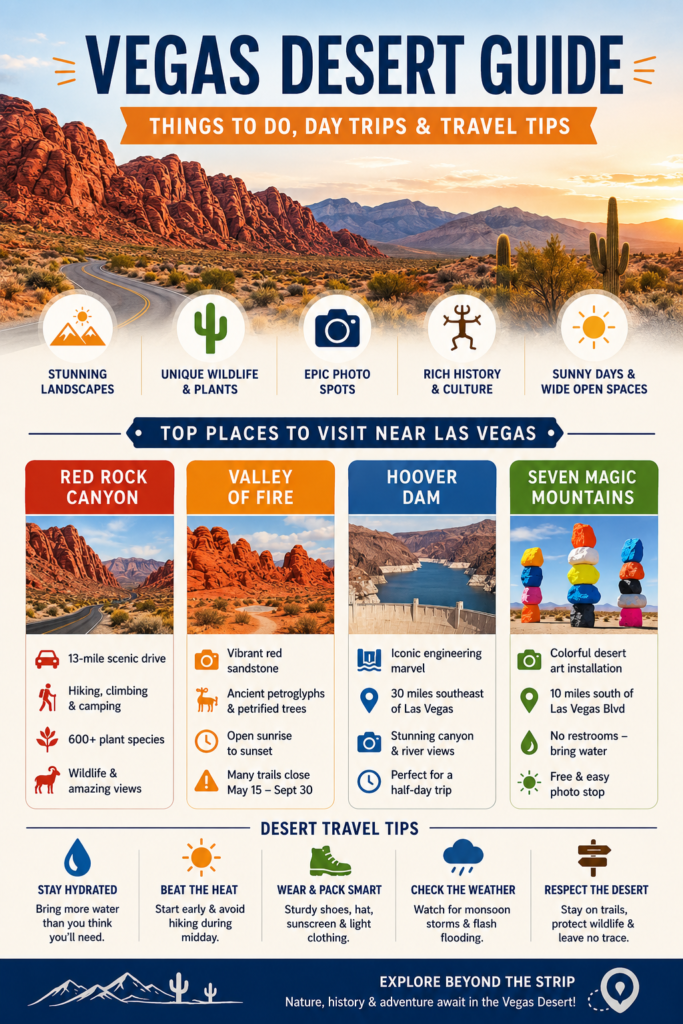
One of the biggest reasons this topic has value is that the desert is not hidden or remote in the usual sense. It is accessible. Red Rock Canyon is roughly 17 miles west of the Las Vegas Strip and is known for a 13-mile scenic loop drive, hiking, climbing, and camping opportunities. That means even travelers with only a half day can still experience a real desert setting without committing to a major expedition.
The desert also changes the mood of a trip in a powerful way. Las Vegas can feel fast, crowded, loud, and artificial, while the desert feels spacious, open, grounded, and quiet. That contrast is part of the appeal. A good travel guide helps readers understand what the desert feels like, not just what is located there. It explains how to move through it safely, what to expect from the weather, and how to choose between sightseeing, hiking, photography, or a simple drive.
Another reason the Vegas Desert matters is flexibility. You do not have to be an advanced hiker or a serious off-road traveler to enjoy it. A sunrise stop, a scenic pull-off, a short boardwalk-style walk, or a simple loop drive can all create a memorable experience. That makes the region suitable for couples, families, solo travelers, road-trippers, photographers, and first-time visitors who want something beyond the Strip.
What the Vegas Desert Really Means
“Vegas Desert” is not the official name of one park or one protected area. It is a travel phrase that describes the desert landscape surrounding Las Vegas. In practical terms, it refers to the Mojave-style environment near the city: dry air, sharp sunlight, rocky hills, open space, sparse plant growth, heat, and that unmistakable feeling of being in a landscape shaped by water scarcity and long-term erosion.
This matters because many visitors think of Las Vegas as an indoor destination only. They picture casinos, shows, restaurants, and resorts, but the desert is a major part of the story. The region is defined not only by entertainment and tourism infrastructure, but also by mountains, canyons, wide basins, red cliffs, and a climate that influences everything from plant life to route planning.
Understanding the desert as a real landscape helps travelers make better choices. It explains why hiking should start early, why water matters so much, why the weather can change quickly, and why some locations are better in spring or fall than in the hottest months. It also helps readers appreciate why the region is beautiful in such a distinct way. The desert does not compete with lush forests or alpine lakes. It offers a different kind of beauty: spare, dramatic, sunlit, and ancient-feeling.
Location and Geography
Las Vegas sits in a desert valley in southern Nevada, and the surrounding land gives the city much of its visual identity. Mountains ring the horizon, valleys open in broad stretches, and dry roads lead toward canyons, ridges, washes, and colorful rock country. The area feels expansive because the built environment ends quickly and the open desert begins almost immediately.
Red Rock Canyon is one of the clearest examples of this geography. Located about 17 miles west of the Strip, it is close enough for a simple outing but expansive enough to feel like a true desert escape. The area is known for dramatic sandstone cliffs, a scenic loop drive, desert wildlife, and multiple trail options. Because it is so near the city, it is often the first place travelers visit when they want a quick transition from urban energy to natural quiet.
Hoover Dam gives the desert a different kind of geographic identity. It sits around 30 miles southeast of Las Vegas on the Nevada-Arizona border, in Black Canyon on the Colorado River. That location makes it a powerful landmark because it ties together desert terrain, water control, engineering, and human settlement. It is not a natural feature, but it belongs in any serious desert travel guide because it explains how people adapted to the region.
Seven Magic Mountains adds another geographic layer. It stands approximately 10 miles south of the intersection of Las Vegas Boulevard and St. Rose Parkway, near Jean Dry Lake and Interstate 15. The site is easy to reach and visually unmistakable, which is part of why it has become one of the most photographed desert stops near the city.
Valley of Fire is farther out than Red Rock, but still highly accessible for a day trip. It is prized for its huge red rock formations, its wide desert views, and the way its geology seems to glow in changing light. Together, these destinations show that the Vegas Desert is not one uniform place. It is a collection of distinct desert settings connected by the same broader climate and landscape system.
Climate and Weather Patterns
The Vegas Desert is known for sun, dryness, and heat, but the weather is more complex than many visitors expect. Summer monsoon moisture can enter the region and trigger storms, gusty winds, and flash flooding. That is important because the desert’s dry surfaces often look harmless while still being vulnerable to sudden runoff. Dry washes can fill fast, and low-lying areas can become dangerous in a short amount of time.
This is why weather awareness is essential, not optional. Desert travel is not just about sunscreen and hats. It is also about Understanding timing, storm risk, and terrain. A sunny morning can turn into an unstable afternoon if monsoon activity builds, and a safe-looking route may become hazardous if water begins to move through canyons or channels.
Seasonality matters too. Spring is often one of the most comfortable times to explore the region, with milder temperatures and more pleasant walking conditions. Fall is also appealing because the heat begins to soften and the outdoors becomes easier to enjoy. Summer can still work, but it requires more caution, more water, shorter hikes, and a willingness to change plans if temperatures spike.
Seven Magic Mountains is especially direct about this reality. Its visitor guidance notes that summer daytime temperatures can average 104°F / 40°C and higher, and it specifically encourages visitors to bring water, use sun protection, and prepare for hot, dry conditions. It also warns that flash flooding can occur during seasonal monsoons. These are not small details. They summarize what desert travel in the Las Vegas area is really about: beauty paired with exposure, and access paired with responsibility.
Valley of Fire also shows how seasonal conditions shape outdoor access. The park is open from sunrise to sunset, but many popular trails close from May 15 to September 30 because of extreme heat and safety concerns. That makes the best desert plans those that respect the season rather than fighting it.
Landscape Features: Rocks, Valleys, Dry Basins, and Scenic Views
The Vegas Desert is much more varied than a flat field of sand. It includes red cliffs, cream-colored stone, dry canyons, mountain edges, broad basins, and open roads with huge views in every direction. This layered scenery is one of the reasons the region is so attractive to photographers and road-trippers. Every stop offers a slightly different palette and texture.
Red Rock Canyon is one of the most accessible examples of this diversity. The 13-mile scenic drive gives visitors a concentrated look at the desert landscape: cliffs, ridges, desert shrubs, layered stone, and wide vistas that change with the light. It is a place where you can get a lot of visual variety without needing to hike for hours.
Valley of Fire takes the visual drama even further. The park is widely recognized for bright red Aztec sandstone outcrops mixed with gray and tan limestone, along with petrified trees and ancient petroglyphs. It’s 40,000 acres of rock formations that create a landscape that feels almost theatrical. In morning or late-afternoon light, the colors intensify, and the terrain seems to glow.
Hoover Dam adds a monumental human-made structure to the region. It stands as a major landmark because it transforms the story of the desert from one of scenery alone into one of water, power, infrastructure, and regional development. The dam also changes the visual experience by contrasting industrial strength with raw canyon walls and river flow.
Seven Magic Mountains is visually distinct in a different way. The installation consists of stacked boulders painted in bright colors and standing more than thirty feet high. It creates a striking collision between modern art and the open desert. The result is memorable, highly shareable, and easy to fit into a short trip.
Taken together, these places show that the Vegas Desert is not one-dimensional. It can feel natural, engineered, artistic, historical, or deeply ancient depending on where you stand.
Flora: Plants That Define the Vegas Desert
Plants are one of the most revealing parts of the desert story. They are not just scenery; they are evidence of adaptation. In the Mojave Desert region near Las Vegas, plant life includes creosote bush, Mojave yucca, bursage, and Joshua tree at higher elevations. These species have evolved ways to survive with minimal water and strong sun, which is one reason the desert looks open rather than dense.
Red Rock Canyon is especially notable for plant diversity. It contains more than 600 species of plants, and 15 of them are found nowhere else in the world. That is an astonishing fact for travelers because it reframes the desert as a biologically rich place rather than a barren one. The land may appear dry, but it supports a highly specialized ecosystem full of unique life forms.
Spring is the season when many visitors notice this most clearly. Red Rock Canyon highlights spring wildflowers and new growth as part of the visitor experience, and the desert takes on a softer, more colorful appearance during that period. For many travelers, this is the best season to appreciate the plant life because the environment feels alive without being overwhelming.
Plant communities also help explain why the desert looks the way it does. The spacing between shrubs, the shape of the landscape, and the pale tones of the ground all reflect the way plants and climate interact over time. A strong travel article should make this visible to readers. The desert is not empty. It is carefully populated by organisms that know how to survive under intense conditions.
Fauna: Animals, Reptiles, Insects, and Birds
The Vegas Desert also supports a surprising amount of wildlife. Many visitors arrive expecting to see only a few birds or the occasional lizard, but the region actually hosts a wide mix of species. Red Rock Canyon includes desert bighorn sheep and other native animals, and Valley of Fire lists coyote, house finch, black-tailed jackrabbit, desert bighorn sheep, greater roadrunner, and desert tortoise among the species associated with the park.
That variety matters because it shows the desert as a functioning ecosystem. Birds, mammals, reptiles, and insects all play different roles in keeping the landscape alive. The heat may keep animals hidden during the middle of the day, but that does not mean the environment is inactive. It often means the animals are conserving energy and waiting for cooler times.
Red Rock Canyon’s educational materials also mention mule deer, bobcat, fox, coyote, desert tortoise, jackrabbit, and several reptile species. This gives readers a better sense of the wildlife they might encounter, especially if they travel early in the morning or near dusk. Those are the best windows for movement and observation.
The most important thing to know is that desert wildlife should be observed carefully and at a distance. Animals in the region are adapted to limited water, extreme temperatures, and sparse cover. They are not accustomed to human interference. Visitors should avoid feeding, approaching, or chasing them. A good desert trip is one where the human guests move respectfully through the animals’ habitat.
Human History and Culture
The Vegas Desert has a long and meaningful human history. This is not empty land waiting to be discovered. It is a place with ancient ties, cultural memory, and continuous meaning for Native peoples and later settlers. Red Rock Canyon lies on the ancestral homelands of the Southern Paiute, Chemehuevi, and Western Shoshone peoples. That is a critical fact because it reminds visitors that the desert is not only scenic—it is also a cultural landscape.
Valley of Fire deepens that history even further. The park contains petroglyphs and traces of human presence that go back more than 2,000 years. It also includes ancient petrified trees and interpretive resources that help visitors understand geology, ecology, prehistory, and regional history. In other words, it is not merely a beautiful drive. It is a place where land and human story meet.
Hoover Dam represents a later but equally important chapter. It shows how the desert became part of a larger system of water management, electricity, and regional development. The dam helped shape settlement and growth in the Southwest by making water and power more usable in a difficult climate. In a Vegas Desert article, the dam should be treated as a major historical landmark, not just a scenic side trip.
Seven Magic Mountains adds a modern cultural dimension. The installation is a public artwork by Swiss artist Ugo Rondinone and is part of a broader land-art conversation. It shows that the desert continues to inspire creative interpretation today. People still go to the desert not only to survive or pass through it, but also to make statements, create beauty, and interact with the land in new ways.
Best Things to Do in the Vegas Desert
1. Drive the Red Rock Canyon Scenic Loop
For many travelers, Red Rock Canyon is the best first desert experience near Las Vegas. The scenic drive is the center of the visit: a 13-mile loop that delivers huge views, dramatic cliffs, and an easy way to enjoy the landscape without a strenuous hike. It is one of the most efficient ways to see real desert scenery close to the city.
The area also works well for different travel styles. Families can enjoy the drive and short walks. Photographers can stop at pull-offs for wide shots and close detail. Hikers can choose from a range of trails. Climbers and geology lovers can appreciate the terrain in more depth. Because it is so accessible, Red Rock Canyon belongs near the top of almost any desert itinerary.
2. Explore Valley of Fire for Color and History
If Red Rock is the most convenient classic desert stop, Valley of Fire is the most visually intense. The park’s red sandstone, ancient markings, and dramatic rock formations make it one of the most memorable landscapes in Nevada. It is a place where history and natural beauty coexist in a way that feels immediate and immersive.
Valley of Fire is especially strong for photography. The color contrast between red rock, pale stone, and bright sky can be extraordinary in the right light. Early morning and late afternoon are especially rewarding times to visit because the angles soften and the formations become more sculptural. For many travelers, this is the place that best captures the emotional power of the desert.
3. Visit Hoover Dam for an Easy Landmark Day Trip
Hoover Dam is one of the simplest major desert day trips from Las Vegas. It is close enough for a half-day outing, yet significant enough to feel like a major destination. The combination of engineering, water history, canyon scenery, and regional importance gives it lasting appeal.
This stop is ideal for travelers who want something iconic without committing to a long hike or an all-day outdoor effort. It offers a clear narrative and a powerful visual presence. It also helps visitors understand how the desert was transformed by infrastructure and how the broader region developed around water and energy.
4. Stop at Seven Magic Mountains for a Fast Photo Break
Seven Magic Mountains is perfect for travelers who want a short, creative desert stop. It is easy to access, free to visit, and highly distinctive. The stacked, brightly painted towers rise sharply from the open landscape, making the site one of the most recognizable art installations near Las Vegas.
Even though it is a simple stop, it still deserves preparation. The site has no restroom facilities, and the desert climate can be harsh. Visitors should bring water, use sun protection, and plan for hot, dry conditions. That combination of ease and exposure is part of what makes the stop so memorable.
Day Trips from Las Vegas: Best Options at a Glance
Here is a simple comparison that helps readers choose the right desert outing more quickly:
| Place | Best for | Main highlights | Planning notes |
| Red Rock Canyon | Hiking, scenic driving, and geology | 13-mile scenic drive, trails, climbing, wildlife, plants | Timed reservations are required for Scenic Drive entry during certain periods |
| Valley of Fire | Photography, rock color, and history | 40,000 acres of red sandstone, petroglyphs, and petrified trees | Open sunrise to sunset; many trails close May 15 to September 30 |
| Hoover Dam | History, engineering, short outing | Dam, canyon views, river, and power story | About 30 miles southeast of Las Vegas on the Nevada-Arizona border |
| Seven Magic Mountains | Quick stop, photos, art lovers | Colorful public art in the open desert | Free, open, no reservations; no restrooms on site |
This kind of quick comparison is useful because many readers do not want to wade through long descriptions before deciding. They want to know what each place is best for, how much effort it takes, and what practical issues to expect.
Travel Tips for the Vegas Desert
The first rule of desert travel is timing. Early morning is usually the best time for longer scenic stops and hikes because temperatures are lower and the light is more forgiving. The landscape also tends to look sharper and more vibrant in the morning. Late afternoon can also be beautiful, but it should be approached carefully if you have a long drive ahead or if temperatures are still high.
The second rule is hydration. Bring more water than you think you will need. Desert dryness can fool people because sweat evaporates quickly, and the body may lose water faster than expected. Even brief outings can become uncomfortable if a traveler underestimates heat exposure. Water is not a backup item in the Vegas Desert. It is an essential piece of gear.
The third rule is route planning. Red Rock Canyon, Valley of Fire, Hoover Dam, and Seven Magic Mountains are all manageable day trips, but they should not be packed too tightly into one rushed schedule. It is much better to enjoy two stops properly than to speed through four stops in exhaustion. Desert travel rewards patience, not overbooking.
A fourth rule is flexibility. Weather, crowds, parking, and trail access can all affect the day. A smart traveler knows when to shorten a hike, change the route, or switch from an outdoor activity to a scenic drive. That flexibility is what turns a difficult day into a successful one.
What to Pack for a Desert Trip from Las Vegas
Packing well makes a huge difference in how comfortable the desert feels. At a minimum, bring water, sun protection, sturdy shoes, a hat, and light clothing that can handle heat. These are basic items, but they are more important here than in many other destinations because the environment is so exposed.
For longer outings, it is wise to bring snacks, a charger, offline navigation, and a small first-aid kit. Desert areas can have weak signals, limited services, and long stretches without conveniences. Being prepared means you can focus on the scenery instead of worrying about avoidable problems.
Seasonal packing matters too. In summer, extra caution becomes even more important. Heat can intensify quickly, and monsoon storms can create sudden safety issues. A traveler who is ready for both sun and storm is in a much better position than someone who only packed for a simple sightseeing stop.
Safety Tips and Common Mistakes
The biggest mistake many visitors make is treating the desert like a city park. It is not. The Vegas Desert is hot, open, and capable of changing conditions quickly. The same place that feels calm in the morning can become risky in the afternoon if the heat increases or storms move in.
One common error is ignoring seasonal closures and access rules. Some trails at Valley of Fire close during the hottest months, and Red Rock Canyon uses timed reservation systems for certain entry periods. These details matter because they can shape the entire trip. A good plan starts with current access rules, not assumptions.
Another mistake is arriving underprepared at what looks like a very simple stop. Seven Magic Mountains is easy to reach, but that does not mean the environment is mild. It is still desert. Visitors need water, sun protection, and awareness of the site conditions. Even a fast photo stop can become uncomfortable if it is treated casually.
A final mistake is underestimating flash flood risk. Dry washes and low-lying terrain can be dangerous during monsoon season, even when the sky looks only partly unsettled. Travelers should pay attention to weather alerts, avoid low flood-prone areas during storms, and never assume that dry ground means guaranteed safety.
When Is the Best Time to Visit the Vegas Desert?
For most travelers, spring and fall are the best seasons. Temperatures are usually more manageable, outdoor walks are more pleasant, and longer visits feel easier. Spring is particularly attractive because some areas show wildflowers and fresh desert growth, especially in places like Red Rock Canyon.
Summer can still be done, but it requires a different mindset. The trip should start early, activities should be shorter, and there should be plenty of room to adjust plans around the heat. Visitors who try to force a long midday itinerary in the hottest months often end up uncomfortable or fatigued.
Winter can also be a good option for travelers who prefer cooler weather and quieter conditions. While some desert beauty is at its most dramatic in warmer sunlight, cooler months can make hiking and exploring much easier. The “best” time depends on whether a traveler values comfort, color, solitude, or photography conditions most.
Pros and Cons
Pros
The biggest advantage is access. The desert scenery near Las Vegas is very close to the city, which means travelers can see major natural and cultural landmarks without long transfers. The variety is another major strength. Within a relatively small radius, visitors can experience scenic drives, hiking, history, art, geology, and photography.
Another advantage is affordability. Some of the best stops are free or low-cost, and even the more developed sites are usually manageable for day-trip budgets. For travelers who want high-impact scenery without a major expense, the region is strong.
Cons
The main drawback is the environment itself. Heat can be intense, services can be limited, and some areas require serious seasonal caution. Travel in the desert is not difficult, but it is not casual either. Visitors need to take the weather and terrain seriously.
Another limitation is that not every activity is available all year round in the same way. Trail closures, timed entry systems, and weather-related restrictions can alter plans. That is not a flaw in the region as much as a sign that the desert needs to be handled responsibly.
Interesting Facts About the Vegas Desert
Red Rock Canyon is more than a scenic stop. It contains more than 600 plant species, world-class climbing, a visitor center, and a 13-mile scenic drive. That makes it one of the most complete desert attractions near Las Vegas.
Valley of Fire is famous for its color and historical value. It’s 40,000 acres of bright red sandstone and ancient petroglyphs make it one of the most iconic desert landscapes in the state. The fact that many trails close during the hottest season also shows how seriously the climate shapes access.
Hoover Dam is closer than many travelers realize. At roughly 30 miles southeast of Las Vegas, it is easy to pair with another stop or visit on its own as a short landmark outing.
Seven Magic Mountains is unusual because it is both a public art piece and a desert experience. It is free, dramatic, and simple to access, but still requires practical preparation because of the heat and limited facilities. That mix of convenience and exposure is very typical of desert tourism around Las Vegas.
Environmental Issues and Conservation
The Vegas Desert faces real environmental pressure. Heat, limited water, heavy visitation, and fragile terrain all create challenges for land managers and travelers alike. Monsoon storms can create flash flooding, and constant exposure can wear down trails and sensitive areas over time.
That is why conservation matters. Timed entry systems, trail closures, and visitor education are not annoyances. They are part of protecting a landscape that can be damaged easily. When travelers follow the rules, they help keep the desert usable for future visitors.
Respect for culture is also part of conservation. Red Rock Canyon exists on ancestral homelands, and Valley of Fire preserves cultural and historical traces that deserve care. These are not just scenic backdrops. They are places with deep human meaning, and responsible travel should reflect that.
Sample Itineraries
Half-Day Desert Plan
Begin with Red Rock Canyon for a scenic drive or a short trail experience, then finish with Seven Magic Mountains for a quick creative stop and photo session. This works especially well for visitors with limited time because both locations are relatively close to Las Vegas and easy to combine.
Full-Day Desert Plan
Start early at Valley of Fire and spend the morning exploring the rock formations, views, and historical features. If time and routing allow, add Hoover Dam on the way back. This creates a full day that blends geology, history, and engineering in one trip.
Easy Landmark Plan
For travelers who want a lower-effort desert outing, Hoover Dam and Seven Magic Mountains make a strong pair. Both are iconic, both are accessible, and neither requires a long hike. That makes them especially appealing for families, older travelers, or anyone who wants memorable scenery without a strenuous day.
FAQ
Yes. Las Vegas sits in a desert valley in southern Nevada, and the surrounding region has Mojave Desert conditions, dry air, hot summers, and mountain-framed scenery. The desert is not separate from the city experience; it is one of the main reasons the region feels so distinctive.
Red Rock Canyon and Valley of Fire are usually the strongest all-around choices. Red Rock is especially good for scenic driving and shorter hikes, while Valley of Fire is better for dramatic rock color, petroglyphs, and a more visually intense landscape.
Yes. Many of the main desert attractions near Las Vegas work well as day trips. Red Rock Canyon, Valley of Fire, Hoover Dam, and Seven Magic Mountains can all be reached in a day, depending on how much time you want to spend and how much walking you prefer.
Bring plenty of water, sun protection, sturdy shoes, and flexible timing. In warmer months, it is wise to prepare for heat and the possibility of flash flooding during monsoon season. A hat, snacks, and offline navigation are also smart additions.
Spring and fall are usually the most comfortable seasons. Spring is especially good for Red Rock Canyon because of mild weather and wildflowers, while summer can be much harder because of heat and storm risk. Winter can also be pleasant for travelers who like cooler outdoor conditions.
Conclusion
The Vegas Desert is much more than a scenic backdrop to Las Vegas. It is a striking travel destination filled with natural beauty, cultural history, and practical adventure. Whether you want a short drive, a photography stop, or a full day of exploration, the desert around Las Vegas delivers a rich and varied experience.
Red Rock Canyon, Valley of Fire, Hoover Dam, and Seven Magic Mountains each show a different side of the region, from red rock landscapes to engineering Landmarks and modern art. With careful planning and respect for the climate, the Vegas Desert can be one of the best parts of any Las Vegas trip.