
Introduction
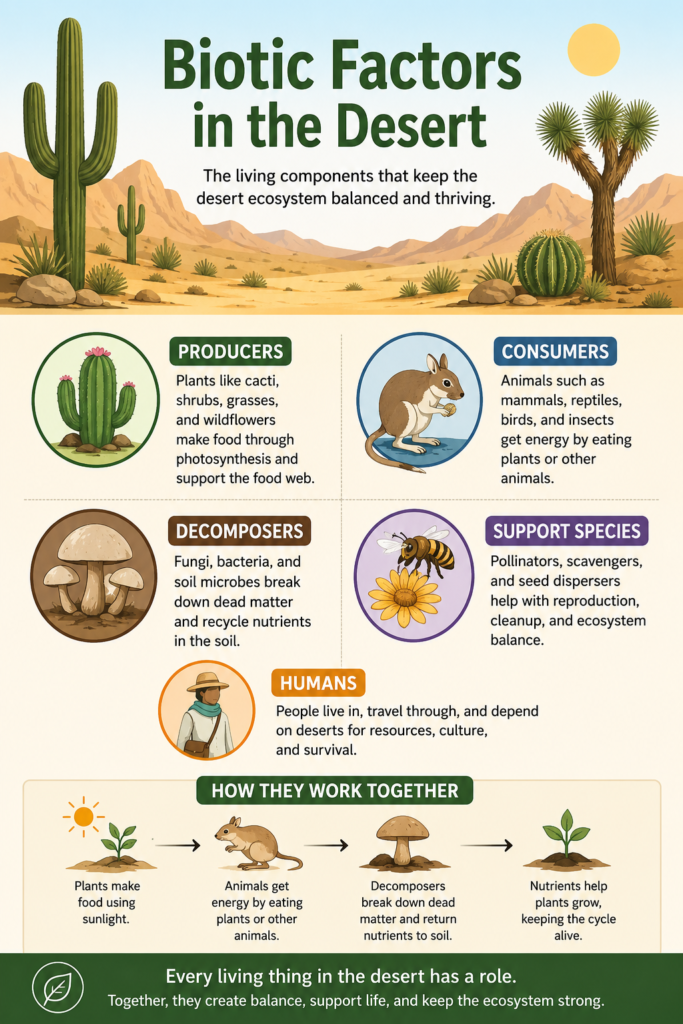
Biotic Factors In The Desert are the living things that survive in dry, harsh conditions. These include plants, animals, insects, birds, fungi, bacteria, and humans. Each one plays an important role in the desert ecosystem by helping with food, shelter, reproduction, and nutrient cycling.
- What Are Biotic Factors for the Desert?
- Why Desert Biotic Factors Matter
- Desert Biotic Factors at a Glance
- Desert Location and Geography
- Why do deserts form in different places
- Climate and Weather in the Desert
- Main climate features of deserts
- Landscape Features That Shape Desert Life
- Common desert landscapes
- Flora: Desert Plants as Producers
- Common desert plants
- How desert plants survive
- Major plant adaptations
- Fauna: Desert Animals, Reptiles, Insects, and Birds
- Common desert animals
- How desert animals survive
- Common animal adaptations
- Desert Insects and Small Creatures
- Examples of desert insects and arthropods
- Desert Decomposers and Microorganisms
- What decomposers do
- Why microbes matter in deserts
- How Biotic and Abiotic Factors Work Together
- Important abiotic factors in deserts
- Desert Food Chains and Food Webs
- Simple desert food chain examples
- Why food webs matter more than food chains
- How rainfall affects the food web
- Common Desert Adaptations
- Plant adaptations
- Animal adaptations
- Microbial and soil adaptations
- Table of Desert Biotic Factors, Roles, and Adaptations
- Why Desert Plants and Animals Are So Special
- Why There Are Fewer Organisms in Deserts
- Main reasons include
- Human Life and Desert Biotic Factors
- How humans adapt in deserts
- Human uses of desert biotic factors
- Human History and Desert Cultures
- Important desert cultural patterns
- Survival Tips for People in Deserts
- Simple desert travel safety tips
- Tourism: Why Deserts Attract Visitors
- Common desert tourism activities
- Pros and Cons
- Pros
- Cons and challenges
- Environmental Issues and Conservation
- Main threats
- What is desertification?
- Conservation actions that help
- Interesting Facts About Desert Biotic Factors
- Why This Topic Is Important for Students and Writers
- FAQs
- Conclusion
What Are Biotic Factors for the Desert?
Biotic factors are all the living things in an ecosystem. In a desert environment, these living organisms must persist under low water availability, high thermal stress, nutrient-poor soil, and strong environmental pressure. They interact constantly with the non-living features of the habitat, which are called abiotic factors.
In desert ecosystems, biotic factors include:
- Producers such as cacti, shrubs, grasses, succulents, and wildflowers
- Consumers such as kangaroo rats, foxes, lizards, snakes, camels, owls, and birds
- Decomposers such as fungi, bacteria, and soil microbes
- Support organisms such as pollinators, scavengers, and seed dispersers
- Humans who live in, travel through, study, or depend on desert landscapes
The desert ecosystem is a powerful example of biological resilience. Even when rainfall is minimal, life continues. Plants conserve moisture. Animals avoid heat. Microorganisms recycle nutrients. Together, these living systems help maintain ecological balance in one of the harshest biomes on Earth.
In ecological language, biotic factors are not isolated. They are part of an interdependent network. Each organism affects the others. Each species contributes to ecosystem stability. In deserts, this interdependence becomes even more visible because every role matters.
Why Desert Biotic Factors Matter
Desert ecosystems may look simple from a distance, but they are highly structured and biologically meaningful. Every living organism in a desert has a function, and every function supports the survival of the whole system.
Desert biotic factors matter because they:
- forms the foundation of the food web
- provide food, shelter, and nesting space. Reduce erosion by stabilizing soil
- help with pollination and seed dispersal
- recycle nutrients through decomposition
- support human life, farming, travel, and trade
- preserve ecological balance in harsh conditions
Without desert biotic factors, the ecosystem would weaken quickly. Native plants would decline. Animal populations would collapse. Soil would erode faster. Nutrient cycling would slow. Food chains would break apart. The desert would lose structure and biodiversity.
In other words, desert life is not decorative. It is functional. It is the operating system of the ecosystem.
Desert Biotic Factors at a Glance
| Biotic Group | Common Examples | Main Role in the Desert Ecosystem | Main Survival Strategy |
| Producers | Cacti, Joshua trees, saltbush, desert marigold, grasses, lichens | Make food through photosynthesis and support the food web | Store water, reduce leaf size, grow deep roots, bloom after rain |
| Consumers | Kangaroo rats, tortoises, foxes, camels, lizards, snakes, owls, scorpions | Transfer energy through food chains and food webs | Nocturnal behavior, burrowing, water from food, heat avoidance |
| Decomposers | Bacteria, fungi, soil microbes, and some insects | Break down dead matter and recycle nutrients | Work in low-organic soil and around roots |
| Support Species | Pollinators, scavengers, seed dispersers, birds | Help with reproduction, cleanup, and ecosystem balance | Seasonal movement, opportunistic feeding, and mobility |
| Humans | Desert communities, farmers, traders, travelers, herders | Use desert land carefully for survival and culture | Water management, mobility, trade, and shelter planning |
This overview shows one important truth: desert life is organized, not random. Each organism contributes to a larger ecological network. The ecosystem is a living system of roles, exchanges, and adaptations.
Desert Location and Geography
Deserts exist on every continent. Some of the most familiar include the Sahara, Mojave, Gobi, Atacama, Namib, and Antarctic Desert. These deserts differ widely in temperature, topography, and water availability, but they all share the same fundamental condition: low moisture.
Why do deserts form in different places
Deserts can develop for several reasons:
- subtropical high-pressure zones that block rainfall
- rain shadows behind mountain ranges
- cold ocean currents that reduce evaporation and precipitation
- A great distance from large bodies of water
- polar conditions where precipitation is extremely low
This matters because geography shapes biology. A coastal desert may receive fog or dew. An interior desert may rely on rare storms or Underground water. A cold desert may host organisms adapted to freezing conditions rather than extreme heat. So, desert biotic factors are not identical everywhere. They are shaped by local climate, altitude, soil, and water patterns.
That is why a plant in the Mojave may not look like a plant in the Sahara, yet both may share the same ecological logic: conserve water, tolerate stress, and reproduce efficiently.
Climate and Weather in the Desert
The desert climate is defined by water scarcity. Rainfall is low, irregular, and often brief. Some desert regions may go months or even years with very little precipitation. This creates a challenging environment where organisms must survive both scarcity and unpredictability.
Main climate features of deserts
- low annual rainfall
- high evaporation
- intense sunlight
- dry air
- major temperature swings
- sudden storms in some regions
- cold nights in hot deserts
- freezing conditions in cold deserts
In hot deserts, daytime temperatures can be extremely high, but nights may become surprisingly cool. Dry air does not retain heat well, so the temperature often drops quickly after sunset. That is one reason many desert animals are nocturnal. It is easier to conserve water and avoid overheating after dark.
Rainfall also creates dramatic ecological change. When a rare rain arrives, dormant seeds may germinate. Insects emerge. Birds gather. Plants bloom. Animals breed. The entire ecosystem may shift from quiet to active almost overnight. Then dry conditions return, and life slows again.
This boom-and-bust cycle is one of the defining ecological rhythms of desert life. It shows how flexible and opportunistic desert organisms must be.
Landscape Features That Shape Desert Life
A desert is not one uniform surface. It is a mosaic of microhabitats, each with different conditions for survival. Landforms influence which organisms can live where, how they move, and where they find shelter.
Common desert landscapes
- dunes
- rocky plateaus
- gravel plains
- desert pavements
- dry riverbeds or wadis
- salt flats
- canyons
- cliffs
- oases
Each landscape creates different ecological niches. Rocks can provide shade and thermal refuge. Wad is may collect water during storms? Dunes can support specialized plants and insects. Oases can sustain dense plant and animal communities. Cliffs may become nesting sites for birds.
Desert soils are often shallow, dry, saline, or low in nutrients. That makes plant growth difficult. Yet the plants that do survive become the structural base of the ecosystem. They anchor the soil, create shade, feed herbivores, and help other species persist.
Even small environmental changes can matter. Slightly more moisture, a patch of shade, or a sheltered rock face can create a pocket of life in a harsh landscape.
Flora: Desert Plants as Producers
Plants are among the most important biotic factors in the desert. They are called producers because they manufacture food using sunlight through photosynthesis. In the desert, plants do much more than produce energy. They also stabilize soil, reduce erosion, offer shade, and create habitat.
Common desert plants
- cacti
- Joshua trees
- desert marigold
- mesquite grass
- saltbush
- drought-tolerant shrubs
- wildflowers
- lichens
- succulents
How desert plants survive
Desert plants have evolved remarkable survival systems. Some store water in their stems, leaves, or roots. Some grow deep root systems to reach underground moisture. Others have tiny leaves, waxy coatings, or spines to reduce transpiration. Some remain dormant during drought and become active only when conditions improve.
Major plant adaptations
- water storage
- deep root systems
- small or waxy leaves
- spines instead of leaves
- slow growth
- dormancy during drought
- rapid flowering after rain
A cactus is one of the most recognizable desert plants. Its thick stem acts as a water reservoir, while its spines reduce water loss and discourage herbivores. Joshua trees are another iconic desert plant. They survive through drought-tolerant structures, efficient water use, and deep-root access to moisture.
Desert plants are not background scenery. They are an ecological infrastructure. They support insects, birds, mammals, and decomposers. Without them, the desert food web would collapse.
Fauna: Desert Animals, Reptiles, Insects, and Birds
Desert animals are just as essential as desert plants. They include herbivores, carnivores, scavengers, reptiles, birds, and insects. Each group contributes to energy transfer, population balance, and ecosystem function.
Common desert animals
- kangaroo rats
- desert tortoises
- camels
- foxes
- lizards
- snakes
- owls
- scorpions
- desert beetles
- ants
- ravens
- roadrunners
How desert animals survive
Animals in deserts must avoid excessive heat and minimize water loss. They do this through both physical traits and behavioral strategies.
Common animal adaptations
- nocturnal activity
- burrow living
- daytime shade seeking
- rapid movement between shelters
- getting water from food
- concentrated urine
- light-colored bodies
- fat storage
- long-distance travel for food and water
Kangaroo rats are a classic example. They can survive with little or no direct drinking water because they obtain moisture from seeds and metabolic processes. Camels are famous for their ability to endure long dry periods and travel across arid regions. Their body systems are highly suited to heat, dehydration, and distance.
Reptiles are especially successful in deserts. Lizards and snakes tolerate heat better than many other animals. Tortoises conserve energy by moving slowly and remaining inactive during the hottest periods. Birds often fly long distances to locate food and water, and some are nomadic, shifting from one area to another based on rainfall patterns.
Desert animals rely heavily on timing. Being active at dawn, dusk, or night can mean the difference between survival and heat stress.
Desert Insects and Small Creatures
Insects and other small arthropods are easy to miss, but they are vital to desert ecology. They pollinate plants, decompose organic matter, serve as prey, and keep energy moving through the ecosystem.
Examples of desert insects and arthropods
- ants
- beetles
- grasshoppers
- bees
- wasps
- moths
- scorpions
- spiders
These small organisms support the desert in several ways:
- They pollinate flowering plants
- They break down organic debris
- They feed birds, reptiles, and mammals
- They help sustain biodiversity
- They respond quickly to rainfall and seasonal change
Some desert insects have extraordinary moisture-harvesting abilities. Certain beetles can collect water from fog or dew. Ants may live underground where temperatures remain lower. Scorpions hide during the day and emerge at night to hunt.
Even though they are tiny, insects act like a hidden engine. They keep the ecological machinery of the desert running.
Desert Decomposers and Microorganisms
No ecosystem is complete without decomposers. In the desert, decomposers include bacteria, fungi, and microscopic soil organisms. They may be invisible to the eye, but they are essential for nutrient cycling.
What decomposers do
- break down dead plants and animals
- return nutrients to the soil
- support root health
- improve soil functioning
- Sustain recycling in nutrient-poor environments
Desert soils often contain very little organic matter. That makes decomposition especially important. When leaves fall, animals die, or plants decay, decomposers convert that material back into nutrients that can be used again by roots and soil communities.
Why microbes matter in deserts
Microbes often survive in tiny pockets of moisture near roots, beneath rocks, or in protected soil zones. These microscopic habitats are small but biologically significant. Roots and microbes often form mutually beneficial relationships that help plants survive drought and absorb nutrients more efficiently.
This underground life is easy to overlook, but it is one of the strongest forces in desert ecosystem maintenance.
How Biotic and Abiotic Factors Work Together
Desert ecosystems cannot be understood without abiotic factors. Living and non-living components constantly interact.
Important abiotic factors in deserts
- sunlight
- heat
- cold nights
- wind
- low rainfall
- dry soil
- poor nutrients
- salinity
- shifting sand
- water scarcity
These abiotic pressures shape the behavior and structure of life. Plants reduce water loss because the air is dry. Animals become nocturnal because daytime temperatures are dangerous. Microbes concentrate near roots where moisture is more likely to exist. Life adapts to the environment because the environment demands adaptation.
When rainfall improves, the ecosystem reacts quickly. Seeds germinate. Insects multiply. Birds arrive. Predators follow prey. When drought returns, the system contracts. This dynamic relationship between biotic and abiotic factors is what makes the desert such a fascinating biome.
Desert life is not separate from the climate. It is a response to the climate.
Desert Food Chains and Food Webs
A food chain shows the simple flow of energy from one organism to another. A food web shows multiple feeding relationships connected. In deserts, food webs are usually more accurate because many organisms eat more than one thing and are eaten by more than one predator.
Simple desert food chain examples
- Desert plant → kangaroo rat → snake → hawk
- Grass → insect → lizard → owl
- Shrub seeds → mouse → fox
- Desert flowers → bee → bird → predator
These examples show how energy moves through the ecosystem. Plants convert sunlight into stored energy. Herbivores consume plant matter. Carnivores eat herbivores. Scavengers and decomposers complete the cycle by breaking down remains and returning nutrients to the soil.
Why food webs matter more than food chains
Real desert ecosystems are not linear. They are networked. A bird may eat seeds one day and insects another day. A fox may hunt small mammals, birds, or reptiles. One shrub may support many species. So a food web gives a more realistic ecological picture.
How rainfall affects the food web
When rain falls:
- plants grow faster
- insects increase
- Birds and rodents become active
- Predators find more prey
When drought returns:
- plants dry up
- Animals reduce activity
- migration increases
- reproduction slows
- The food web shrinks
This seasonal expansion and contraction is one of the most important biological patterns in desert environments.
Common Desert Adaptations
Desert adaptations are survival tools. They allow organisms to manage heat, dehydration, scarcity, and unstable conditions. In the desert, adaptation is not optional. It is a requirement.
Plant adaptations
- water storage
- deep roots
- waxy surfaces
- small leaves
- spines
- slow metabolism
- dormant seeds
- quick growth after rain
Animal adaptations
- nocturnal behavior
- burrowing
- light body color
- water from food
- concentrated urine
- long-distance movement
- heat avoidance
- fat storage
- specialized breathing and cooling methods
Microbial and soil adaptations
- survival in tiny wet zones
- living near roots
- nutrient recycling in poor soil
- slow activity during dry periods
The main principle is simple: desert life survives by wasting as little water and energy as possible. Efficiency is the survival strategy.
Table of Desert Biotic Factors, Roles, and Adaptations
| Desert Biotic Factor | Example | Ecosystem Role | Special Adaptation |
| Plant | Cactus | Producer, shelter, soil support | Stores water in the stem |
| Plant | Joshua tree | Producer and habitat source | Deep roots and drought tolerance |
| Plant | Saltbush | Food source and soil stabilizer | Handles salty, dry soil |
| Mammal | Kangaroo rat | Seed eater, prey species | Gets water from food |
| Mammal | Camel | Transport and grazing animals | Survives long dry periods |
| Reptile | Desert tortoise | Herbivore, seed disperser | Burrowing and slow metabolism |
| Bird | Owl | Predator | Nocturnal hunting |
| Insect | Desert beetle | Decomposer, prey, moisture collector | Collects fog or dew |
| Microbe | Bacteria | Decomposer | Nutrient cycling in poor soil |
| Microbe | Fungi | Nutrient recycler | Works around roots and dead matter |
This table connects organism, function, and adaptation in one compact view. It shows how desert biotic factors operate as a coordinated ecological network.
Why Desert Plants and Animals Are So Special
Desert life is special because it does not depend on abundance. It depends on precision. It survives by using resources carefully, timing activity well, and responding quickly to environmental change.
Wasteland
plants are special because they:
- survive with very little water
- store moisture in specialized tissues
- provide shelter, shade, and nourishment
- endure poor soils and temperature extremes
Desert animals are special because they:
- avoid heat
- conserve water
- move at the right time of day
- Relies on behavior as much as anatomy
Desert microbes are special because they:
- keep nutrient cycling active
- survive in protected wet spaces
- support plant roots and soil life
That is why the desert is not lifeless. It is a highly adapted life under pressure.
Why There Are Fewer Organisms in Deserts
There are usually fewer organisms in deserts than in wetter ecosystems because the environment is more stressful. Life is possible, but it is limited by the availability of water and nutrients.
Main reasons include
- very little rainfall
- high evaporation
- extreme temperature swings
- poor soil nutrients
- limited plant growth
- reduced food availability
- strong water stress
Plants form the base of the food web. If plant growth is restricted, every level above it is also constrained. That is why deserts often have lower biomass than forests, grasslands, or wetlands.
But fewer organisms do not mean less importance. Desert life is ecologically valuable because it demonstrates survival under pressure, specialized adaptation, and environmental balance in a severe biome.
Human Life and Desert Biotic Factors
Humans are also part of the desert biotic factors. People have lived in desert environments for thousands of years and have developed cultural, agricultural, and logistical strategies to survive there.
How humans adapt in deserts
- using wells and irrigation
- living near oases
- herding camels, goats, or sheep
- building homes that reduce heat
- traveling at cooler times of day
- following trade routes
- farming with careful water use
Human uses of desert biotic factors
- food from livestock and crops
- medicine from native plants
- shade and shelter from trees and shrubs
- tourism and recreation
- cultural traditions and trade
Human communities often depend directly on the living desert landscape. Plants, grazing land, and water sources can support whole settlements. At the same time, human activity can damage the ecosystem if it is not managed carefully.
So humans are both users and stewards of desert ecology.
Human History and Desert Cultures
Deserts have shaped human history for thousands of years. Many cultures became nomadic because water and food were scarce and seasonal. The movement of people in deserts was often tied to climate, trade, and resource availability.
Important desert cultural patterns
- nomadic herding
- oasis farming
- camel caravans
- trade routes
- small settlements near water
- deep knowledge of land and weather
Oases were especially important. They supported date palms, fruit trees, grains, and vegetables. They also became centers of exchange, travel, and communication. In many desert regions, knowing where water, plants, and safe routes were located meant survival.
This is why biotic factors for the desert are not just a biology topic. They are also part of anthropology, history, geography, and human adaptation.
Survival Tips for People in Deserts
If you travel in a desert, both the climate and the ecosystem deserve respect. The terrain can be beautiful, but it can also be dangerous.
Simple desert travel safety tips
- Carry plenty of water
- wear sunscreen
- Use light protective clothing
- avoid midday heat
- know your route
- bring emergency supplies
- Never assume the land is easy to cross
- respect plants and wildlife
Desert heat can become dangerous very quickly. Dehydration can also happen fast. The landscape may appear calm, but it demands preparation.
Travelers should also protect the ecosystem. Desert plants often grow slowly. Soil damage can last a long time. Wildlife may be sensitive to noise, litter, and vehicles. Responsible travel is part of ecological respect.
Tourism: Why Deserts Attract Visitors
Deserts attract travelers because they feel vast, quiet, dramatic, and visually unique. Their open horizons, glowing sunsets, and unusual life forms create a strong appeal for tourism and photography.
Common desert tourism activities
- wildlife watching
- hiking
- photography
- stargazing
- camping
- dune visits
- cultural tours
- visits to oases and desert parks
Tourism can help people appreciate fragile ecosystems, but it must be managed carefully. Off-road driving, excessive waste, water misuse, and habitat disturbance can all harm desert biota. Sustainable tourism protects both the environment and the visitor experience.
Good desert tourism respects the land, the climate, and the living beings that depend on both.
Pros and Cons
Pros
- support the food web
- reduce soil erosion
- provide shade and shelter
- recycle nutrients
- support pollination and seed spread
- help people survive and travel
- create unique biodiversity
Cons and challenges
- Low water limits growth
- Extreme heat and cold make survival difficult
- Soil damage spreads quickly
- Overgrazing can destroy vegetation
- Invasive species can crowd out natives
- Recovery after damage can be slow
The desert is strong, but it is also fragile. That combination makes balance extremely important.
Environmental Issues and Conservation
Desert ecosystems face many threats. Even though they are dry and remote, they are not immune to environmental pressure.
Main threats
- overgrazing
- habitat loss
- water overuse
- soil compaction
- invasive species
- climate change
- desertification
- pollution
- off-road vehicle damage
What is desertification?
Desertification is the process by which fertile or semi-dry land becomes more desert-like due to climate stress and human activity. It can happen through:
- deforestation
- overgrazing
- poor irrigation
- soil degradation
- rising temperatures
- reduced rainfall
Conservation actions that help
- Protect native plants
- Manage grazing carefully
- Use water wisely
- control invasive species
- protect oases and riparian zones
- Limit soil disturbance
- educate visitors and local communities
Because desert life is adapted to narrow environmental limits, it can be damaged rapidly and recover slowly. That makes conservation especially important.
Interesting Facts About Desert Biotic Factors
- Deserts exist on all seven continents.
- Antarctica is the largest desert in the world because it receives very little precipitation.
- Only about 20% of deserts are covered by sand.
- Some deserts go years with very little rainfall.
- Some desert flowers bloom quickly after rain.
- Fog and dew can be important water sources in coastal deserts.
- Desert animals often use burrows to escape the heat.
- Many desert organisms are active at night rather than during the day.
These facts show that deserts are much more complex than people often assume.
Why This Topic Is Important for Students and Writers
The topic of biotic factors for the desert is useful in biology, ecology, geography, environmental science, and content writing. It helps explain:
- how life survives in harsh conditions,
- how ecosystems are structured,d
- how food chains and food webs work,rk
- how plants and animals adapt, and
- how humans interact with natural environments
For writers, this topic also has strong search value. Readers often want clear definitions, examples, comparison tables, and FAQs. A well-structured pillar article can satisfy those needs while building topical authority around desert ecology.
FAQs
The biotic factors for the desert are the living things in the ecosystem, such as plants, animals, fungi, bacteria, insects, birds, and humans.
Yes. Cacti and camels are both living things, so they are both biotic factors. Cacti are producers, and camels are consumers.
There are fewer organisms because water is limited, rainfall is irregular, and temperatures can be extreme. These conditions make it hard for many species to survive.
Yes. Bacteria and fungi are important desert biotic factors because they break down dead matter and recycle nutrients in the soil.
Many desert animals are nocturnal because nighttime is cooler. This helps them avoid overheating and reduces water loss.
Conclusion
Desert biotic factors show how life can survive in extreme Environments through adaptation and balance. Plants, animals, microbes, and humans all contribute to the desert ecosystem in different ways. Together, they keep one of Earth’s toughest biomes alive and functioning.