
If you are a young entrepreneur, starting a custom apparel business is a fantastic opportunity to make some money either on the side or even as your main business. From personalized T-shirts and hoodies to branded merchandise, uniforms, and promotional clothing, there is a large market for products that allow individuals and businesses to express their identity.
However, before investing in equipment, you need to decide how you will produce your designs. Two popular options are direct-to-film (DTF) printing and traditional screen printing. Both methods can produce attractive, durable apparel designs, but they work differently and have distinct advantages. The right choice depends on your budget, expected order volume, product range, and the type of customers you want to serve. If you are starting with limited capital and expect to handle a variety of customized orders, understanding these differences can help you avoid investing in equipment that does not match your business model. Let’s compare DTF and screen printing to see which makes more sense for a young entrepreneur.
- 1. Understanding How DTF and Screen Printing Work
- What Is DTF Printing?
- What Is Screen Printing?
- 2. Which Method Is More Affordable to Start?
- DTF Startup Costs
- Screen Printing Startup Costs
- 3. Which Method Is Better for Small and Large Orders?
- DTF for Small and Customized Orders
- Screen Printing for Larger Production Runs
- 4. What About Print Quality, Colors, and Fabric Compatibility?
- 5. Which Method Offers Better Long-Term Business Opportunities?
- Why Consider the OMTech Aurora D1 DTF Printer?
- Final Thoughts: DTF or Screen Printing?
1. Understanding How DTF and Screen Printing Work
Before comparing costs and production capabilities, it helps to understand how each printing method works.
What Is DTF Printing?
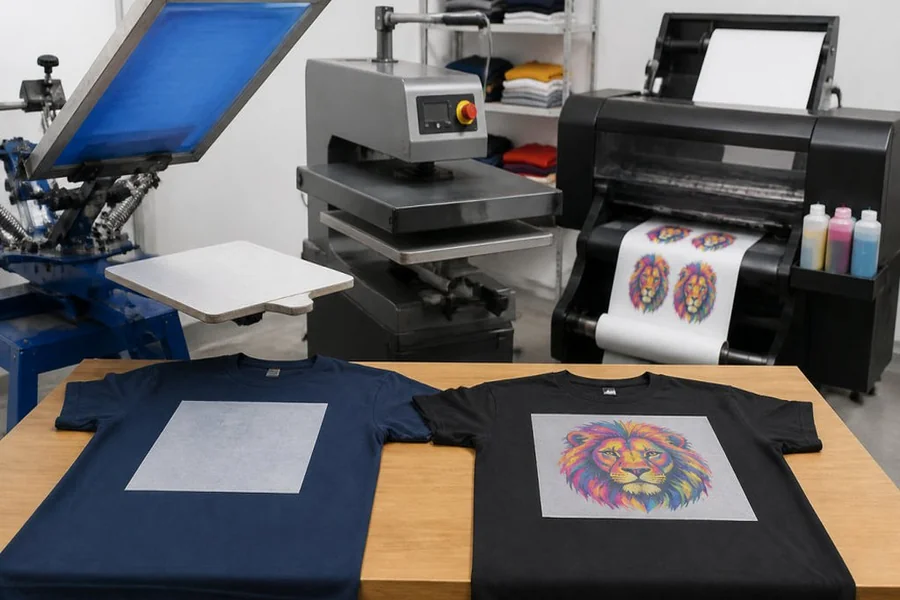
Direct-to-film printing involves printing a digital design onto a special PET transfer film using DTF ink. The printed design is then coated with hot-melt adhesive powder, cured, and transferred onto fabric using a heat press. The general process involves:
- Preparing your artwork using compatible graphic design or RIP software.
- Printing the design onto PET transfer film using CMYK and white ink.
- Applying hot-melt adhesive powder to the printed film.
- Curing the powder according to the manufacturer’s instructions.
- Using a heat press to transfer the design onto the garment.
One of the biggest advantages of DTF is that it does not require a separate screen for every color in the design. You can prepare different digital designs and print them using the same machine.
This makes DTF particularly attractive for personalized apparel, small orders, and businesses offering multiple design variations.
What Is Screen Printing?
Screen printing is a traditional method that uses a mesh screen to transfer ink onto fabric. A separate screen is generally prepared for each color in the design.
The process involves creating the artwork, preparing the screens, applying photosensitive emulsion, exposing the design, and transferring ink through the mesh onto the garment.
Each color requires careful preparation and registration to ensure that the finished design looks correct.
Screen printing is particularly effective for producing large batches of identical garments. Once the screens are prepared and the equipment is set up, you can print many items using the same design.
However, preparing screens takes time, and changing designs can require additional setup work.
2. Which Method Is More Affordable to Start?
For a young entrepreneur, startup costs are often one of the most important considerations.
You need to purchase equipment, materials, and supplies while keeping enough money available for marketing, packaging, shipping, and other operating expenses.
DTF and screen printing have different cost structures.
DTF Startup Costs
A DTF setup generally requires:
- A DTF printer
- PET transfer film
- CMYK and white DTF inks
- Hot-melt adhesive powder
- A heat press
- Powder application and curing equipment
- Compatible RIP software and a computer
You can begin with a relatively simple setup and expand as your order volume increases. Some printers also come with optional shaker and dryer systems that automate parts of the powder application and curing process.
The main advantage is that you do not need to prepare individual screens for different designs.
Screen Printing Startup Costs
Screen printing requires a different set of equipment and supplies, including:
- Screens and frames
- Photo emulsion and exposure equipment
- Screen printing inks
- Squeegees
- A printing press
- Cleaning and reclaiming supplies
- Drying or curing equipment
A basic manual setup can be relatively affordable, but a professional workflow requires additional equipment and space. You also need to account for the time and materials involved in preparing screens for different designs.
Which is better?
DTF is often more convenient for entrepreneurs who want to offer customized products without managing screen preparation. However, it is important to compare complete setup costs rather than just printer prices. A DTF printer still requires compatible consumables, a heat press, and a suitable curing solution.
3. Which Method Is Better for Small and Large Orders?
Your expected order volume should play a major role in choosing a printing method. If you are starting a business, you may initially receive orders for five, ten, or twenty shirts at a time. Some customers may even want a single personalized garment. This is where DTF printing has a clear practical advantage.
DTF for Small and Customized Orders
Because DTF uses digital artwork, you can change designs without preparing new screens. This makes it easier to handle orders involving different names, graphics, colors, and garment sizes. For example, you could receive an order for 15 T-shirts, each featuring a different name or design. You can prepare the artwork digitally and arrange multiple designs on a transfer film. This flexibility is useful for:
- Personalized birthday shirts
- Small business uniforms
- School and club merchandise
- Custom hoodies
- Event apparel
- Individual customer orders
Screen Printing for Larger Production Runs
Screen printing becomes more attractive when you produce large quantities of the same design. Although preparing screens requires time, that initial work can be spread across hundreds of garments. Once the setup is complete, repeated printing can be highly efficient.
For example, a company ordering 500 identical T-shirts for an event may be a better screen printing customer than someone ordering five personalized shirts. The practical difference: DTF is generally more flexible for short runs and frequent design changes, while screen printing can be more economical for large batches of identical designs.
4. What About Print Quality, Colors, and Fabric Compatibility?
Both printing methods can produce professional-looking apparel, but they offer different advantages. DTF printing is particularly useful for detailed, multicolored artwork. It can reproduce photographs, gradients, intricate illustrations, and designs with several colors without requiring separate screens.
The use of white ink also allows DTF transfers to work on dark fabrics. This is important if you want to offer customers more freedom when choosing garment colors. Screen printing is also capable of producing vibrant colors and excellent results. It is particularly effective for bold graphics, logos, and designs with relatively few colors.
However, complex multicolored designs may require more screen preparation and careful registration. Fabric compatibility is another consideration. DTF transfers can be applied to a variety of compatible fabrics, including cotton, polyester, and blends, provided the correct transfer materials and pressing settings are used.
Screen printing also works with many fabric types, although the ink formulation and curing requirements need to match the garment. Neither method is automatically better for every fabric or application. Testing is important, especially if you intend to sell premium apparel or garments that require frequent washing.
5. Which Method Offers Better Long-Term Business Opportunities?
Your printing method should support the type of business you want to build. If you want to focus on personalized clothing, online orders, and small businesses that need customized merchandise, DTF is an attractive option.
You can serve different customer groups without having to maintain a large inventory of preprinted garments. For example, you could offer:
- Custom T-shirts and hoodies
- Personalized sportswear
- Work uniforms
- School and club merchandise
- Event and promotional clothing
- Small clothing brand collections
Screen printing is particularly suitable if you plan to specialize in larger production orders. You could work with established clothing brands, schools, sports organizations, and businesses that need substantial quantities of identical apparel.
You should also think about the time you will spend on each order. DTF simplifies design changes, while screen printing requires additional preparation when introducing new designs.
For a young entrepreneur still testing the market, flexibility can be valuable. You may not know which products will sell consistently during your first few months. A production method that accommodates different designs and smaller orders can make it easier to experiment.
Why Consider the OMTech Aurora D1 DTF Printer?
If DTF seems like the better fit for your business model, the OMTech Aurora D1 15-inch DTF Printer is worth considering.
The Aurora D1 is designed for roll-fed DTF production and uses an Epson F1080 printhead. It supports CMYK and white ink, allowing you to produce detailed, colorful transfers for a variety of apparel applications.
Its printing width of up to 15 inches provides room for full-size garment graphics and multiple smaller designs arranged together on a transfer film. The single-head configuration offers a maximum printing speed of approximately 11 square feet per hour, making it a practical starting point for customized orders and smaller production batches.
Another useful feature is its white ink circulation and automatic stirring system. White ink can settle during periods of inactivity, so maintaining consistent circulation is important for reliable DTF printing. The Aurora D1 also includes scheduled printhead cleaning and moisturizing functions to help reduce routine maintenance requirements.
For entrepreneurs who are still developing their production workflow, these features can make managing the printer more convenient.
Explore the OMTech Aurora D1 15-inch DTF Printer
Final Thoughts: DTF or Screen Printing?
There is no universal winner between DTF and screen printing. Both technologies have a place in the custom apparel industry, and the better option depends on your customers and production requirements.
Screen printing is an excellent choice for entrepreneurs who expect to handle large orders featuring identical designs. Its setup process can be time-consuming, but the method becomes increasingly attractive when producing substantial quantities.
DTF, on the other hand, offers more flexibility for personalized products, smaller orders, and detailed multicolored artwork. It allows you to change designs without preparing new screens, which can be particularly useful when building a customer base.
If you are a young entrepreneur starting with a limited customer base and want to experiment with different apparel products, DTF is a practical technology to consider. A machine like the OMTech Aurora D1 can help you bring transfer production in-house and develop a more flexible custom apparel business.
Before investing, calculate your expected production costs, compare equipment requirements, and consider the type of orders you are most likely to receive. The best printing method is ultimately the one that supports your business model and gives you room to grow.