
Introduction
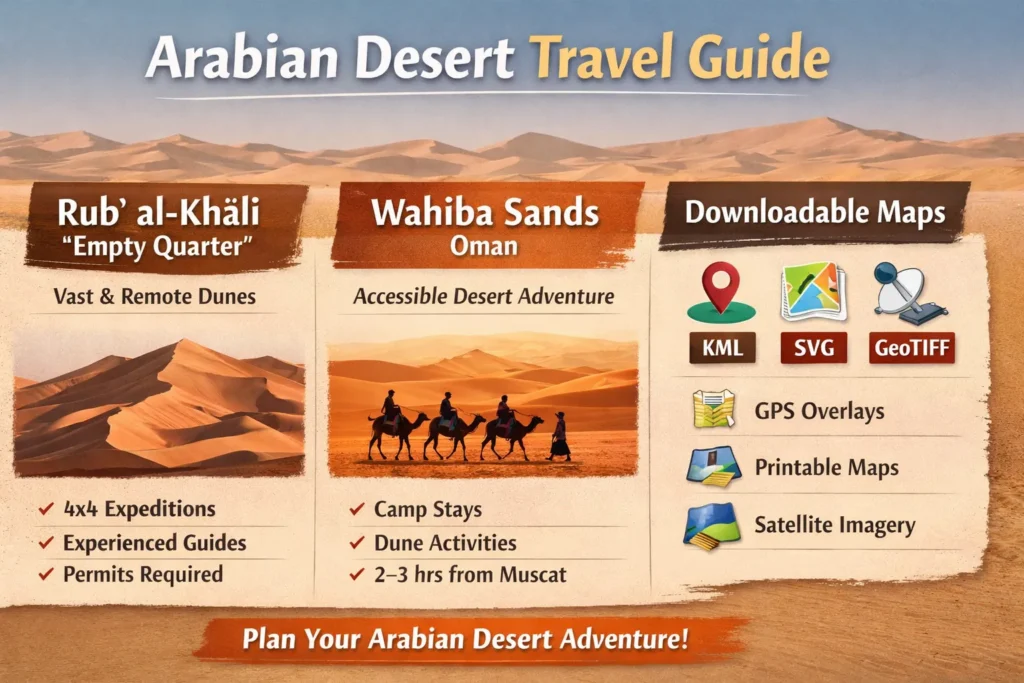
This concise guide—Arabian Desert — Rubʿ al-Khālī, Wahiba Sands & Complete Map + Travel Guide—gives you everything needed to plan safe, low-impact desert travel: clear maps and downloadable assets (KML, SVG, GeoTIFF), practical itineraries from 1–14 days, a compact packing and survival checklist, and region-specific tips for Wahiba, Liwa, An-Nafud, and the Rubʿ al-Khālī. Whether you’re after an easy overnight in Wahiba or a professionally supported Empty Quarter expedition, this guide focuses on logistics, safety, and conservation so your trip is memorable — and Responsible.
- What is the Arabian Desert?
- Rubʿ al-Khālī (the Empty Quarter) — the giant sand sea
- Wahiba Sands (Sharqiya Sands) — an accessible first desert
- How the desert formed — dunes, geology & climate
- Flora, fauna & conservation
- Plants you might see
- Fauna highlights
- Threats
- How visitors help
- Where to go: regional highlights & what to expect
- Travel planner: when to go, how to get there, permits & safety
- Gateway airports & staging towns
- Safety essentials
- Plug-and-play itineraries
- 1-day — Wahiba Sands
- 3-day — Photographic Wahiba + Coast
- 4–7 day — Rubʿ al-Khālī guided expedition
- Packing checklist & short survival tips
- Photography & satellite imagery tips
- Human history & culture
- Environment & conservation
- Pros & cons
- Pros
- Cons
- FAQs
- Simple step-by-step checklist to plan a desert trip
- Conclusion
What is the Arabian Desert?
The Arabian Desert is an expansive, predominantly arid ecoregion covering the bulk of the Arabian Peninsula. It is not a uniform “sand only” place; the landscape comprises discrete geomorphological classes: dune seas (ergs), rocky plateaus (hamadas), salt flats (sabkhas), gravelly expanses (reg), and ephemeral river channels (wadis). Each subregion has distinct logistics, access needs, and ecological character.
Prominent subregions
- Rubʿ al-Khālī (Empty Quarter): The planet’s largest continuous sand sea — vast, remote, sculpted dunes.
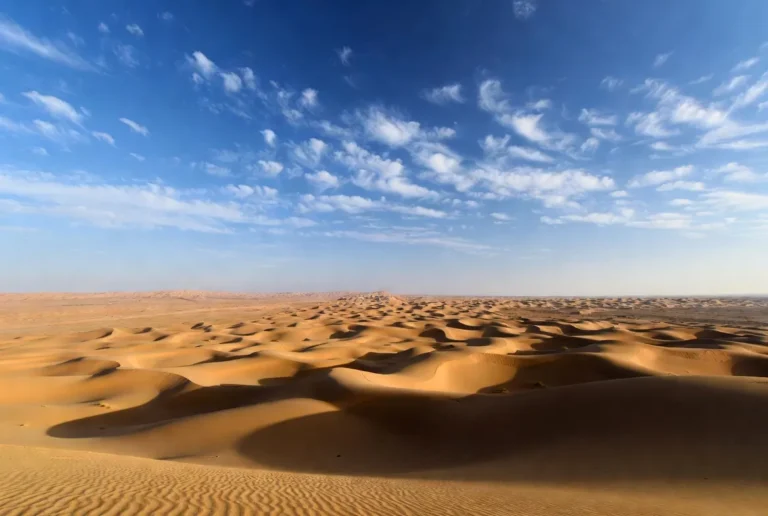
- Wahiba / Sharqiya Sands (Oman): Intense orange-red dunes, relatively accessible, with hospitality infrastructure.
- Liwa & Al Gharra (UAE): High dunes and luxury desert lodging; Liwa is sometimes a staging area for Empty Quarter approaches.
- An-Nafud (northern Saudi Arabia): Older, coarser dunes with a unique red hue and extensive cultural history.
- Coastal sabkhas & mangroves: Important birding and wetland habitats near coasts — ecologically rich and biologically distinct.
Think of the Arabian Desert as a mosaic — each tile (erg, hamada, wadi, sabkha) requires different preparation, gear, and seasonal considerations.
Rubʿ al-Khālī (the Empty Quarter) — the giant sand sea
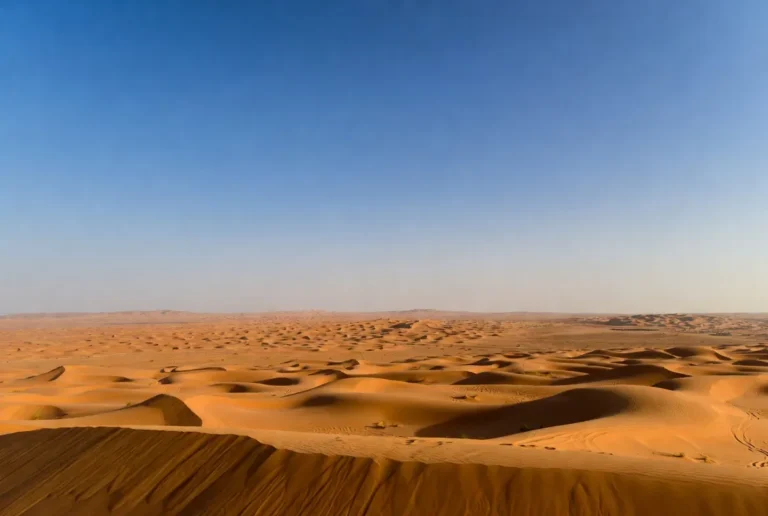
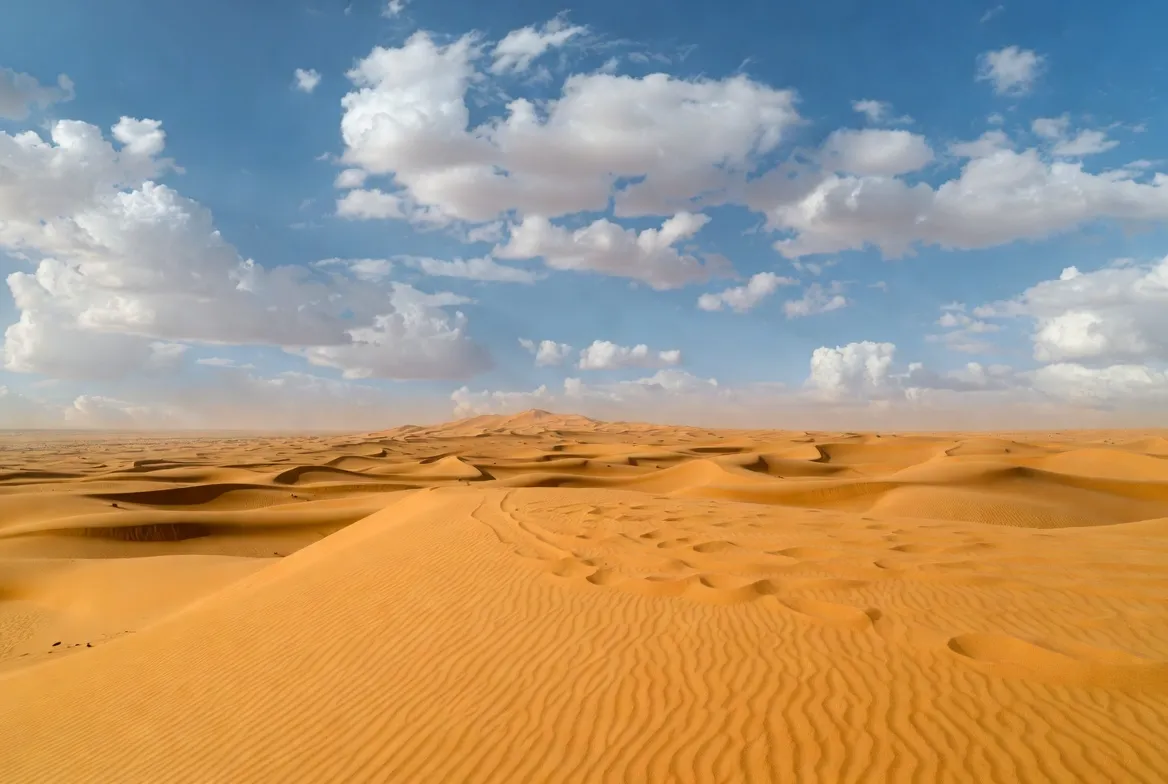
What it is: Rubʿ al-Khālī is the most extensive contiguous sand deposit on Earth. From satellite imagery to field reconnaissance, the Empty Quarter displays intricate dune systems (linear, star, and transverse dunes), interdunal plains, and occasional sabkhas and playas.
Size & shape: Area estimates vary by method — commonly cited near 583,000 km² in many NASA-related materials, while alternate calculations that include transitional margins push numbers higher (some figures approach ~650,000 km²). Differences arise from boundary decisions, remote-sensing thresholds, and inclusion of peripheral dune belts.
Dune morphologies: Expect a mixture of dune types:
- Linear dunes: long parallel ridges formed by bidirectional or reversing winds.
- Star dunes: radiating arms and multi-crest structures that grow tall where winds vary in direction.
- Transverse dunes: ridges perpendicular to prevailing wind direction in areas of abundant sand.
Some dunes reach tens to hundreds of meters in height in localized zones — dune height varies regionally.
Why it’s special: Remoteness. Scale. Photographic opportunity. Scientific interest (wind regimes, paleolakes, sediment budgets). For travelers, the Empty Quarter is rarely a casual day trip — it demands Experienced guides, logistical depth (fuel caches, spare parts, satellite comms), and, where appropriate, permits.
Wahiba Sands (Sharqiya Sands) — an accessible first desert
Why go: Wahiba Sands is the pragmatic first choice for desert experiences in the Arabian Peninsula: dramatic red-orange dunes, welcoming camp operators, Bedouin cultural encounters, and comparatively short transfers from Muscat.
Getting there: Typical transfer times are 2–3 hours from Muscat to staging towns adjacent to Wahiba. Many operators run shared transfers and packaged experiences.
What to expect: Rolling corridors of dunes, dune-driving and sandboarding options, guided walks to learn about desert flora and dunes, camp hospitality (dinner, music, stargazing). Wahiba supports day trips, overnights, and short 1–3 day itineraries suitable for families and first-time desert visitors.
How the desert formed — dunes, geology & climate
Short version: Aeolian processes (wind transport) acting over long durations produce dune fields. Sediment supply, wind direction variability, topography, and vegetation (or lack thereof) interact to yield dune type and pattern.
Dune classification & formation mechanics
- Linear dunes: Form where winds oscillate around a dominant axis; linear ridges can extend for tens to hundreds of kilometers.
- Star dunes: Grow where wind directions are multi-modal; they are complex, multi-armed, and typically among the tallest dune forms.
- Transverse dunes: A form where a prevailing wind and abundant sand produce regular perpendicular ridges.
Sand composition: Predominantly quartz, with traces of feldspar and heavy minerals. Iron oxides in the sand produce the characteristic warm red-orange hues in many places (especially Wahiba and An-Nafud).
Climate: Extremely arid overall. Many interior locations receive <50 mm/year precipitation. Summer heat is oppressive; humidity in coastal deserts varies. November–March is the most comfortable and safe season for most visitors.
Flora, fauna & conservation
Despite apparent barrenness, the Arabian Desert hosts specialized life. Plants are dispersed and adapted to conserve moisture; animals exploit microhabitats, oases, and nocturnal behaviors.
Plants you might see
- Shrubs and dwarf trees in interdune hollows and along wadis.
- Halophytes near sabkhas (salt-adapted species).
- Date palms in oases with human settlement.
Fauna highlights
- Arabian oryx (Oryx leucoryx): The emblematic conservation recovery. Once extinct in the wild, reintroduction programs since the 1980s have restored populations in protected zones across Oman, Saudi Arabia, and the UAE.
- Sand gazelles, desert foxes, lizards, geckos, snakes, and migratory birds at coastal wetlands.
Threats
- Off-road driving can destroy crusts and vegetation, increasing erosion.
- Poaching and disturbance at breeding or resting sites.
- Industrial development and infrastructure can fragment habitat.
How visitors help
- Book reputable, environmentally responsible operators.
- Stay on marked tracks.
- Avoid disturbing wildlife; report oryx sightings to your guide so researchers can log them.
Where to go: regional highlights & what to expect
| Region | Highlights | Access & difficulty | Best for |
| Rubʿ al-Khālī | Vast dunes, satellite-worthy vistas, remote camps | Remote; guided, multi-day only; permits often required | Deep desert expeditions, photography |
| Wahiba Sands (Oman) | Red dunes, Bedouin hospitality, easy camps | 2–3 hrs from Muscat; operator transfers common | Overnight, family trips, short adventures |
| Liwa Oasis (UAE) | High dunes, luxury lodges | Drive from Abu Dhabi; staging for Empty Quarter routes | Luxury desert stays, photography |
| An-Nafud (N Saudi) | Red dunes, caravan histories | Remote; requires planning and local coordination | Cultural trips, adventure |
| Coastal sabkhas & mangroves | Birding, wetlands, biodiversity | Often easy near coastal towns | Birdwatching, nature tours |
Travel planner: when to go, how to get there, permits & safety
When to go
The prime season is November–March for manageable daytime temperatures and cold but livable nights. Avoid the height of summer (May–September) for recreational travel unless you are part of a fully equipped, professional expedition.
Gateway airports & staging towns
- Oman: Muscat — primary access to Wahiba Sands and coastal deserts.
- UAE: Abu Dhabi — staging for Liwa and some Empty Quarter approaches.
- Saudi Arabia: Access varies by region; many remote approaches require local guides and permits.
- Yemen: Not recommended for travel due to safety and instability.
Permits & border rules
The Empty Quarter traverses multiple national borders (Saudi Arabia, Oman, UAE, Yemen). Cross-border transits typically need official permits, vehicle documentation, and escorts by approved operators. Independent cross-border crossings are strongly discouraged.
Safety essentials
- Navigation: dual GPS (vehicle + handheld), offline maps, compass, and a satellite communicator (e.g., Garmin inReach).
- Vehicle: 4×4, recovery kit (tow straps, shackles), spare tyres, compressor, sand ladders, high-lift jack, spare fuel.
- Water: plan for 4–6 L/person/day for remote trips (adjust based on exertion, heat, and group size).
- Medical: comprehensive first-aid kit, personal medications, sun protection.
- Group: travel in convoy with other vehicles or hire experienced guides; file your itinerary with a contact and, if appropriate, your embassy.
Plug-and-play itineraries
These are modular templates you can copy, adapt, or supply to clients.
1-day — Wahiba Sands
- Morning: Transfer from Muscat (2–3 hrs). Quick dune drive, introductory dunes walk.
- Afternoon: Cultural visit to a local Bedouin household; sandboarding or short dune bashing.
- Evening: Sunset watch, overnight in a camp, stargazing.
3-day — Photographic Wahiba + Coast
- Day 1: Muscat → Wahiba. Sunset dune photography workshop.
- Day 2: Sunrise shoot; drive to coastal Sur for evening sea photography.
- Day 3: Explore dhow-building heritage in Sur, return to Muscat.
4–7 day — Rubʿ al-Khālī guided expedition
- Day 1: Meet at Liwa/Abu Dhabi staging point. Vehicle check, brief.
- Day 2: Enter sandfields; establish robust camp base.
- Day 3–5: Deep sand navigation, dawn/dusk photography, visits to oases/tracks.
- Day 6–7: Exit via staging town and return.
Notes: For Empty Quarter trips, use licensed operators only. They provide extra fuel, spare parts, satellite comms, and logistical backups.
Packing checklist & short survival tips
Packing checklist (printable)
| Category | Item |
| Hydration | 4–6 L water/person/day; electrolyte sachets |
| Navigation | GPS, offline maps, compass, satellite communicator |
| Vehicle | Spare tyre, compressor, tow strap, shovel, sand ladders |
| Safety | Comprehensive first-aid kit, sunblock, hat, sunglasses |
| Clothing | Breathable day layers; warm jacket for nights |
| Camping | Headlamp, sleeping bag rated for desert nights |
| Documents | Permits, ID copies, vehicle insurance papers |
| Misc | Trash bags, multi-tool, fuel cans, spare oil/coolant |
Short survival tips
- Keep water stored in multiple containers (redundancy in case of puncture).
- Deflate tyres for soft-sand driving and re-inflate on firm ground.
- Avoid heavy exertion at midday in warm months; schedule physical work for mornings/evenings.
- In the event of a vehicle bog-down, use recovery boards, dig where necessary, and remain with the vehicle if rescue is delayed.
- Learn to read dune slopes and the angle of repose to reduce rollover risk.
Photography & satellite imagery tips
- Golden hour (sunrise/sunset) is the prime time for dramatic dune shape and color.
- Carry both wide-angle (sweeping landscapes) and telephoto (textures, patterns) lenses.
- Annotated satellite images are excellent linkable assets — NASA and ESA imagery is a strong public-domain resource to cite and repurpose in your content.
- Use drone footage (where legally permitted) to capture dune morphology from low altitude; always follow local regulations.
Human history & culture
Historically, caravan routes and seasonal transhumance were important across parts of the Arabian Desert; ancient wetter climates supported corridors of movement. Bedouin culture centers on mobility, hospitality, and knowledge of the land — modern cultural tourism often features storytelling, camp-based food, and date-farm visits. Always ask permission before photographing people and respect local customs.
Environment & conservation
Do
- Stay on marked tracks.
- Choose local operators who practice leave-no-trace.
- Support community-run camps and local conservation initiatives.
Don’t
- Drive across vegetation or interdune habitats.
- Remove plants, shells, or cultural artifacts.
- Light open fires in protected areas (use provided facilities).
Note on oryx: The Arabian oryx represents a rare conservation triumph. Reintroductions began in the 1980s and have been carefully managed. If you encounter reintroduced herds, observe quietly and notify your guide — these sightings are often logged for conservation monitoring.
Pros & cons
Pros
- Incredible photographic opportunities and extreme solitude.
- Cultural encounters and Bedouin hospitality.
- Accessible options exist (Wahiba, Liwa) for most travelers.
Cons
- Remote zones require more expensive logistics (fuel, spares, guides).
- Extreme summer heat restricts the travel season.
- Cross-border Empty Quarter travel needs permits and careful planning.
FAQs
A: The Empty Quarter is the largest continuous sand sea. Some sources list it at around 583,000 km² while others list larger figures around 650,000 km², depending on measurement parameters and boundary definitions.
A: Not unless you have deep desert experience. Crossings need experienced 4×4 drivers, planned fuel caches, spare parts, satellite communications, and often official permits. Book a licensed expedition.
A: Yes — it’s one of the most accessible dune areas. Choose family-friendly operators and verify their safety equipment and insurance.
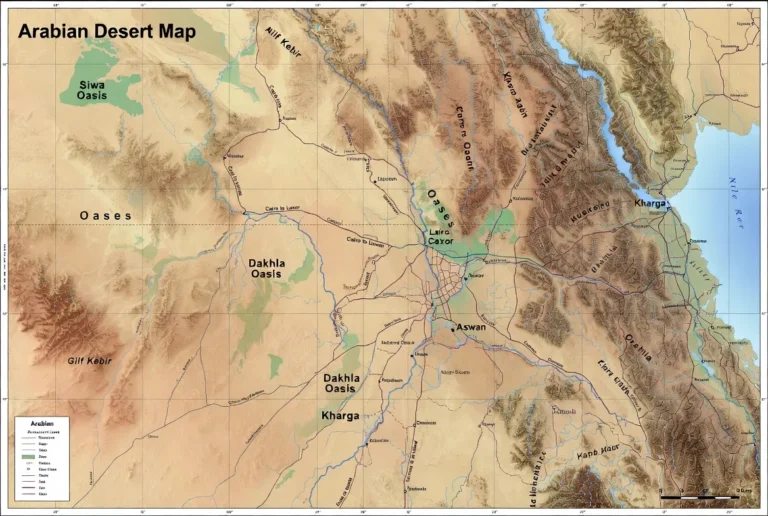
A: Import the KML into Google Earth for navigation, open the SVG for printing and layout, and use GeoTIFFs in QGIS for technical mapping or analysis.
A: Avoid peak summer months (May–September) unless you are part of a professionally equipped expedition. Heat-related risks are significant.
Simple step-by-step checklist to plan a desert trip
- Choose region: Wahiba for accessible experiences; Rubʿ al-Khālī for deep desert expeditions.
- Pick dates: Prefer November–March.
- Book operator: For Empty Quarter expeditions, insist on licensed, experienced operators.
- Get permits: Ask your operator to arrange cross-border permits if required.
- Prep vehicle/gear: Recovery kit, spare fuel, water, satellite comms.
- Download maps: KML and offline tiles; print a one-page cheat sheet.
- Tell someone: Share your plan with a trusted contact and your embassy if relevant.
- Follow low-impact rules: Stay on tracks and respect wildlife.
Conclusion
The Arabian Desert rewards careful planning: use the Map Pack, travel in season (best November–March), and book licensed operators for deep desert routes. Keep trips low-impact, respect wildlife and Bedouin communities, and rely on the practical checklists and maps here to make your desert experience safe, sustainable, and unforgettable.