
Introduction
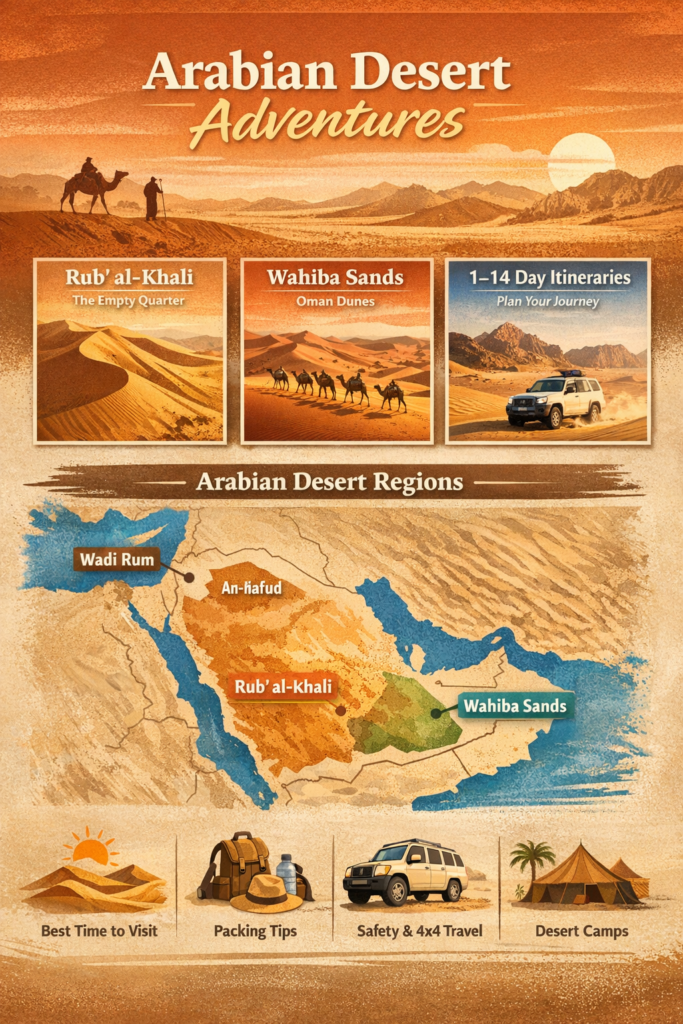
The Arabian Desert stretches across the heart of the Middle East, offering a rare mix of vast silence, sculpted dunes, and deep cultural history. From the accessible Wahiba (Sharqiya) Sands to the immense scale of the Rubʿ al-Khali (Empty Quarter), this guide helps you choose the right region, season, and itinerary. Whether you’re planning a one-day desert escape or a multi-day expedition, you’ll find practical tips, safety insights, and clear planning steps to travel confidently and responsibly.
- Quick facts & map snapshot
- Location & Geography
- Where the Arabian Desert sits
- Key sub-regions covered in this guide
- Rubʿ al-Khali
- Wahiba / Sharqiya Sands
- An-Nafud
- Wadi Rum
- Liwa & UAE dunes
- Climate & Weather Patterns
- Seasonality
- Daily swings
- Rain & rare blooms
- Practical weather tips
- Landscape Features
- Dunes
- Sabkhas & salt flats
- Rocky outcrops & wadis
- Flora & Fauna
- Plants
- Animals
- Human History & Cultures
- Survival Tips & Main Risks
- Main risks
- Essentials for safety
- Tourism: Attractions & Activities
- What to do
- How to pick a tour operator
- Region Head-to-Head: Quick Comparison Table
- Sample Detailed Itineraries
- 1-day
- 3-day
- 7-day
- 14-day
- How to Get There, Permits & Transport
- Oman
- Saudi / UAE access to Rubʿ al-Khali fringes
- Vehicles & driving
- Permits
- Where to Sleep — Camps, Lodges & Luxury
- Fixed desert camps
- Mobile expedition camps
- Luxury glamping
- Responsible Travel & Cultural Etiquette
- Pros & Cons
- Pros
- Cons
- Comparison: Wahiba Sands vs Rubʿ al-Khali
- Sample Packing Checklist
- Tours, Booking & Proof of Demand
- Checklist for choosing a desert tour operator
- Environmental & Archaeological Sensitivity
- FAQs
- Interesting Survival & Practical Tips
- Step-by-Step Planning Guide
- Sample Budget Guide
- Conclusion
Quick facts & map snapshot
- Region covered: Southern and central Arabian Peninsula — primarily parts of Saudi Arabia, Oman, and the UAE, with references to Jordan, Iraq,q and Yemen where relevant.
- Biggest sand sea: Rubʿ al-Khali — the largest continuous sand desert on Earth.
- Accessible classic desert: Wahiba (Sharqiya) Sands — ideal for short overnight stays and family trips from Muscat.
- Typical travellers: adventure seekers, photographers, families using fixed camps, and professional expedition teams.
- Best months: October–April for moderate days and cool nights.
Tip: Embed an interactive map if you publish online — highlight Rubʿ al-Khali, Wahiba/Sharqiya, An-Nafud, Liw, and Wadi Rum. Maps are navigational tools that help readers choose routes and check distances.
Location & Geography
Where the Arabian Desert sits
The Arabian Desert is a heterogeneous region across the Arabian Peninsula. It is not a single, uniform surface but a stitched composition of sand seas (ergs), stony plains (hamadas), salt flats (sabkhas), and rocky outcrops. Within this larger system, the Rubʿ al-Khali is the ultimate sand sea; Wahiba Sands is a smaller, human-tamed erg; An-Nafud offers red broadcrest dunes; Liwa in the UAE gives Photogenic horizons near oasis fringes; and Wadi Rum (Jordan) is primarily a sandstone desert with cliffs and chasms.
Key sub-regions covered in this guide
Rubʿ al-Khali
- Type: vast erg with star and seif dune morphologies, interspersed sabkhas, and occasional ancient lake beds.
- Best for: long exploratory expeditions, seeking solitude and scale.
- Difficulty: high — extremely remote, limited services, significant logistical requirements.
Wahiba / Sharqiya Sands
- Type: classic crescentic and linear dunes, with numerous established fixed camps on the dune margins.
- Best for: short trips, overnight stays, family visits, and photography.
- Access: straightforward drive from Muscat; tour options are abundant.
An-Nafud
- Type: broad, reddish erg with historic caravan traces and different dune textures.
- Best for: cultural context, varied dune forms,s and less touristic experience.
Wadi Rum
- Type: sandstone desert — dramatic arches, cliffs,s and narrow canyons.
- Best for: jeep tours, climbing, and cinematic landscapes.
Liwa & UAE dunes
- Type: oasis fringes and high dunes near Abu Dhabi; frequently used for photography and short luxury camps.
- Best for: short luxury experiences and easily accessible photo ops.
Climate & Weather Patterns
Seasonality
- Best travel window: October–April. During these months, daytime highs are comfortable,e and nights can be cool to cold; humidity is lower in most areas.
- Summer: extreme heat is possible — lowland deserts can reach 40–50°C (104–122°F). Avoid strenuous midday activity in the summer months.
Daily swings
Temperature diurnality is strong: hot, baking days can flip to cold, thin nights. Bring layered clothing: light, breathable garments for daytime thermal management, and insulating layers for night.
Rain & rare blooms
Precipitation is infrequent but ecologically consequential. Occasional rainfall triggers ephemeral blooming events: carpets of flowers, short-lived streams, and swollen wadis. These are rare, beautiful, and fragile — if you catch a bloom, follow low-impact protocols.
Practical weather tips
- Avoid heavy exertion during midday in the hot season.
- Carry 3–5 litres of water per person per active day — increase this amount if exerting or in higher temperatures.
- Bring a wide-brim sun hat, UV-blocking sunglasses, and high-SPF sunscreen.
- Monitor weather and sandstorm forecasts where available.
Landscape Features
Dunes
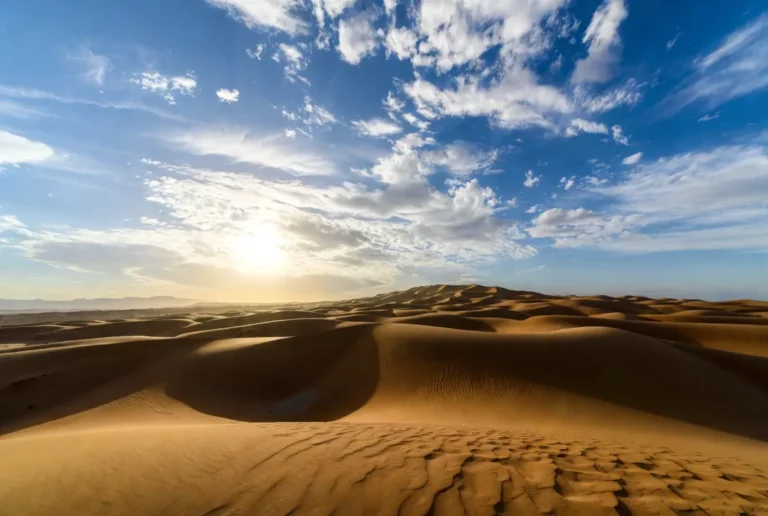
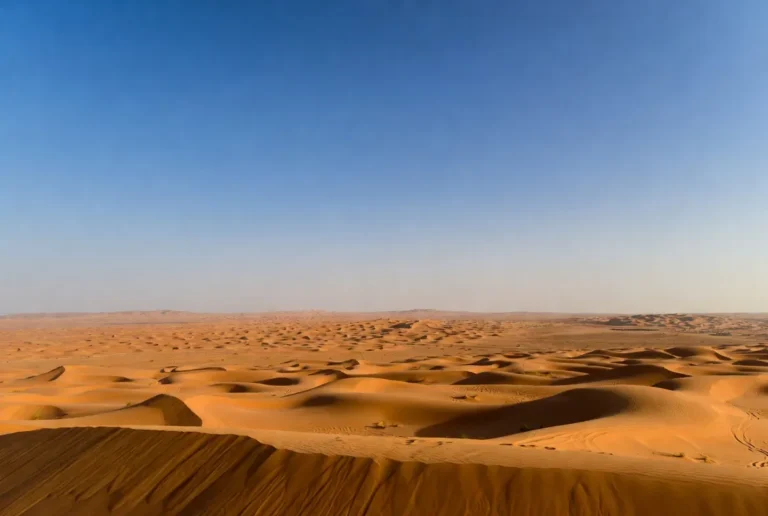
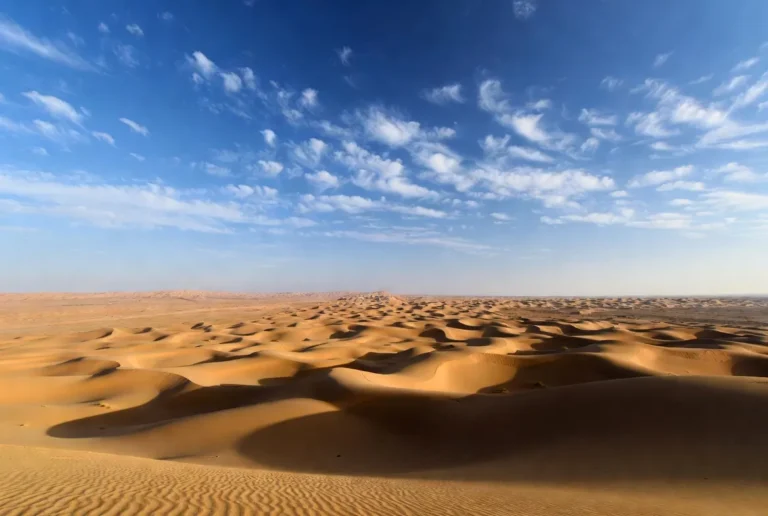
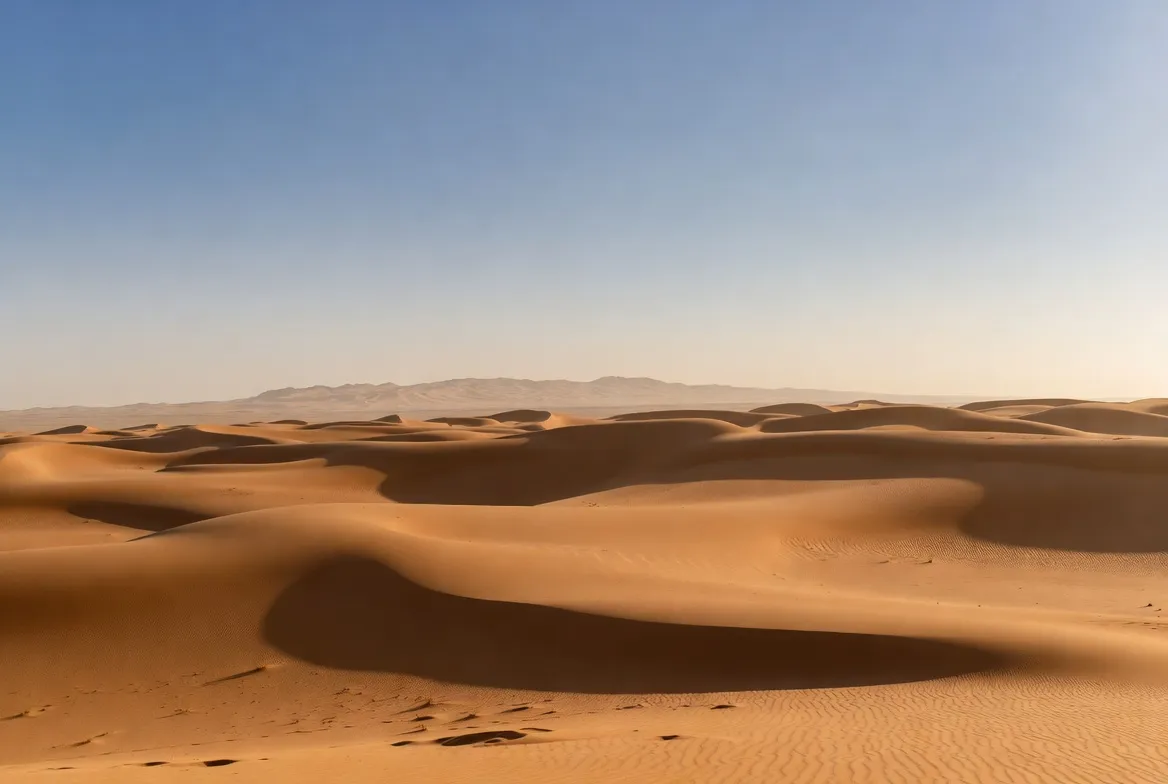
Dune morphology shifts regionally. Rubʿ al-Khali contains star dunes (radiating arms) and long seif ridges; Wahiba Sands is populated with long, smooth, photogenic dunes shaped by consistent wind regimes. Dune height varies — some dunes approach hundreds of meters, others are lower and more mobile.
Sabkhas & salt flats
Sabkhas can appear hard-packed and inviolable but may hide soft, treacherous substrates. Cross them with caution and prefer local advice; off-track crossings can immobilize vehicles.
Rocky outcrops & wadis
Wadis are seasonal riverbeds that occasionally hold pools; Wadi Bani Khalid in Oman is an attractive example with perennial springs in some years. Rock outcrops and mesas interrupt dune fields and provide shaded rest stops and geological interest.
Flora & Fauna
Plants
Vegetation is sparse but specialized: acacias, tamarisks, xerophytic shrubs, and date palms close to water. Plant communities are adapted to salt, drought, and fast evaporation.
Animals
Expect reptiles (geckos, agamas), small mammals (jerboas, foxes), and migratory and resident birds. Mammals like the Arabian oryx are conservation priorities; reintroduction projects exist in several countries.
Human History & Cultures
Trade routes, archaeological traces, and Bedouin living memory are layered across the dunes. Historic caravans once threaded through these spaces, moving incense, salt, and dates. Literary explorers such as Wilfred Thesiger chronicled Bedouin life and survival techniques. Modern travelers should approach cultural sites with respect and curiosity: ask permission before photographing people, accept local hospitality carefully, and support local service providers where possible.
Survival Tips & Main Risks
Main risks
- Heat and dehydration are the primary risks, especially during summer.
- Soft sand vehicle incidents — vulnerable to bogging and mechanical stress.
- Navigation loss — remote zones can lack mobile coverage.
- Medical evacuations — long response times in remote areas.
Essentials for safety
- Reliable 4×4 with recovery gear: shovel, snatch/tow straps, a high-quality compressor, and dual spare tires.
- Navigation redundancy: GPS device + paper map + compass.
- Communications: satellite phone or PLB (Personal Locator Beacon).
- Carry extra water and food caches beyond expected needs.
- Hire trained guides for dune driving unless you have verified experience.
- Ensure travel insurance includes off-road rescue and medical evacuation.
Tourism: Attractions & Activities
What to do
- Dunedriving/dune bashing — exhilarating, but choose reputable operators with safety gear.
- Sunrise & sunset photography — prime lighting windows; mornings and evenings provide lower contrast and beautiful colors.
- Overnight Bedouin camps or luxury glamping — from basic communal tents to en-suite glamping pavilions.
- Camel rides, cultural experiences,s and craft markets — local markets often sell woven goods, incense, and dates.
- Guided Empty Quarter expeditions — usually multi-day with logistical support.
How to pick a tour operator
- Check recent reviews across TripAdvisor, GetYourGuide, and Viator.
- Confirm inclusions: water, fuel, permits, and recovery gear.
- Ask about operator experience, group sizes, and contingency plans.
- Prefer operators who practice environmental stewardship and fair labor practices.
Region Head-to-Head: Quick Comparison Table
| Region | Best for | Accessibility | Typical experience | When to go |
| Wahiba / Sharqiya Sands (Oman) | Short trips, family camps, photography | ~2–4 hr drive from Muscat; many tour options | Fixed camps, dune drives | Oct–Apr |
| Rubʿ al-Khali (Empty Quarter) | Expedition travel, solitude, and large dunes | Remote — guided expeditions from Salalah or Saudi gateways | Multi-day, self-sufficient | Oct–Apr |
| An-Nafud (Northern Arabia) | Red dunes, historical caravan routes | Regional access inside Saudi | Cultural routes, varied dunes | Oct–Apr |
| Wadi Rum (Jordan) | Rock scenery, climbing, filmic vistas | Easy from Petra/Aqaba | Jeep tours, Bedouin camps | Oct–Apr |
Sample Detailed Itineraries
Below are compact, actionable itineraries you can copy, edit, and book. Each itinerary lists inputs (where to start), the daily activities, and an explicit recommendation about vehicle and guide level.
1-day
Start: Muscat (self-drive or operator pickup).
Morning: Drive to Wahiba (2–4 hours depending on traffic and start). Short dune walks and camel photo stops.
Afternoon: Lunch at a desert camp or a prepared picnic. Light exploration and cultural visit to a Bedouin family, if available.
Sunset: Ascend a dune for golden light and panoramic photos. Return to Muscat or stay overnight at a fixed camp.
Vehicle/Guide: 4×4 recommended for dune edges; many camps provide transfers.
3-day
Day 1: Muscat → Wahiba Sands. Sunset dunes and overnight camp (fixed camp recommended for families).
Day 2: Pre-dawn photography at a dune crest → drive to Wadi Bani Khalid (swim in pools if present) → overnight in a local guesthouse or back to a dune camp.
Day 3: Local souq (market) visit or cultural detour, then return to Muscat.
Vehicle/Guide: 4×4 recommended; local guide optional but helpful for pools and routes.
7-day
Days 1–2: Muscat → Wahiba Sands. Camping & Bedouin visits.
Days 3–4: Coastal or interior drive toward Salalah; stop at small towns and beaches.
Days 5–6: Guided edge-of-Empty Quarter excursion from Salalah (book with local operator).
Day 7: Return to Salalah for onward travel or return to Muscat.
Notes: Border crossings and long distances require planning. Flights into Salalah may be faster for some itineraries.
14-day
Combine Oman deserts with Rubʿ al-Khali crossings from Saudi fringes, or stitch together Jordan’s Wadi Rum and UAE Liwa with coastal detours. Expect complex border and permit logistics: use professional operators, ensure visas are valid, and allow buffer days for weather or mechanical delays.
How to Get There, Permits & Transport
Oman
- Wahiba (Sharqiya): Most travelers stay in Muscat. Numerous camps will arrange transfers or meet you at a rendezvous point. A 4×4 is useful for reaching dune fields and for controlled dune driving.
- Rubʿ al-Khali (Dhofar edge): Salalah is the usual logistical gateway for southern access.
Saudi / UAE access to Rubʿ al-Khali fringes
- Access requires local logistics, sometimes permits, and coordination. If crossing national boundaries, check visas and import/export rules for vehicles and fuel.
Vehicles & driving
- 4×4 mandatory for dune travel and off-road sections. Carry at least two spare tires, recovery equipment, and understand basic sand driving techniques.
Permits
- Protected areas and deep excursions may require permits. Operators should manage permit processes for you; always confirm.
Where to Sleep — Camps, Lodges & Luxury
Fixed desert camps
Fixed camps are ideal for families: they offer stable tents, shared facilities, meals, and sometimes electricity. Expect basic to comfortable amenities.
Mobile expedition camps
Used for deep Rubʿ al-Khali crossings, these are functional camps designed for mobility and survival rather than comfort.
Luxury glamping
High-end glamping — with private en-suite tents, curated meals and design touches — is available in parts of Oman and the UAE. These options are more expensive but suitable for travelers seeking comfort with desert immersion.
Responsible Travel & Cultural Etiquette
- Always ask permission before photographing people.
- Dress modestly in public and when near villages — cover shoulders and knees.
- Leave no trace: collect and carry out any waste, avoid burning plastics, and avoid driving off established tracks when possible.
- Support local businesses: book Bedouin-run camps and local guides where available.
- Respect archaeological sites: do not remove artifacts and report significant finds.
Pros & Cons
Pros
- Epic, often empty landscapes and dramatic solitude.
- Deep cultural interactions and traditional hospitality.
- A wide range of experiences — from family camps to serious expeditions.
Cons
- Harsh climate and logistical complexity.
- Need for specialized equipment and experienced guides.
- Cultural sensitivity is required — be respectful and self-aware.
Comparison: Wahiba Sands vs Rubʿ al-Khali
- Access: Wahiba — easy and structured; Rubʿ al-Khali — remote and costly.
- Experience: Wahiba — comfortable fixed camps and guided short trips; Rubʿ al-Khali — raw, expansive, requires self-sufficiency.
- For whom: Wahiba — families and photographers; Rubʿ al-Khali — experienced expeditioners and those seeking solitude.
Sample Packing Checklist
- 3–5 L of water per person per day (active days require more).
- Sun hat, sunglasses, high-SPF sunscreen.
- Lightweight, breathable garments plus warm layers for night.
- Sturdy closed shoes and sand gaiters.
- Comprehensive first aid kit & electrolyte powders.
- Headlamp and spare batteries.
- Satellite communicator or PLB for deep trips.
- Vehicle recovery kit: shovel, tow straps, compressor, dual spares.
- Copies of permits and travel insurance documentation.
Tours, Booking & Proof of Demand
Use reputable review platforms and booking marketplaces to compare options. Confirm what is included in tour packages — water, fuel, permits, emergency procedures, and local support. Request operator experience, ask for recent references,s and prefer small-group outings to reduce environmental footprint.
Checklist for choosing a desert tour operator
| Question | What to check |
| Safety gear | Does the operator provide recovery gear, first aid, and satellite comms? |
| Inclusions | Are water, food, permits, and fuel included? |
| Experience | How many years of operating and trips in the region? |
| Reviews | Are there recent, multi-platform reviews? |
| Group size | Smaller groups = lower environmental impact |
| Contingencies | Policies for refunds or rescheduling in case of weather/mechanical issues? |
Environmental & Archaeological Sensitivity
The Rubʿ al-Khali and adjacent areas contain paleolake beds and archaeological traces from wetter periods. Avoid collecting artifacts. If you find an object of potential significance, notify your guide or local authorities. Stick to designated tracks and use low-impact practices.
FAQs
Extremely remote. Most visitors join experienced operators from Salalah or Saudi gateways. Multi-day guided expeditions are the norm; deep crossings require full logistics, fuel planning, and satellite communications.
Yes. A 4×4 is recommended for dune edges and off-road access. Many fixed camps arrange transfers if you don’t drive.
October–April. Cooler daytime temperatures and crisp nights make this the most comfortable window. Avoid peak summer for strenuous outdoor activity.
Yes. Many fixed camps in Wahiba are family-friendly and provide basic comforts. For Rubʿ al-Khali expeditions, verify child policies with the operator.
Yes. Day and overnight tours depart Salalah to reach the edge of the Rubʿ al-Khali. Deeper, multi-day crossings require longer commitments and guides with specialized permits.
Interesting Survival & Practical Tips
- Practice sand recovery skills with an instructor before deep trips.
- Never travel into deep sand alone: go with at least one companion vehicle.
- Carry extra fuel — fuel consumption increases in soft sand.
- Mark waypoints and agreeo a daily check-in schedule.
- Learn to duplex your routeplan: primary GPS track and a secondary paper route with time estimates.
Step-by-Step Planning Guide
1: Choose your region
- Short trip/family: Wahiba Sands.
- Photography: Liwa or Wahiba.
- Expedition: Rubʿ al-Khali.
2: Pick dates
- Travel between October and April for comfort and predictable weather.
3: Book transport & operator
- Compare at least three operators across platforms.
- Ask about recovery gear, water allocation, permits, and contingency plans.
4: Pack smart
- Use the packing checklist above. Bring surplus water and a thorough first-aid kit.
5: Day of travel
- Share your route and check in on schedule. Avoid midday exertion in hot weather.
6: After the trip
- Leave comprehensive reviews to help good operators and future travelers.
Sample Budget Guide
- Day trip (Wahiba): low to moderate — transport + guide + basic camp fee.
- Overnight fixed camp: moderate — often includes dinner & breakfast.
- Multi-day Empty Quarter expedition: high — covers fuel, guides, permits, and logistics.
Prices are seasonally variable and depend on group size, vehicle requirements, and service level. Always request an itemized quote and confirm what is included.
Conclusion
Traveling through the Arabian Desert is as much about preparation as it is about wonder. Wahiba Sands rewards short, comfortable trips with classic dunes and starlit camps, while Rubʿ al-Khali offers unmatched scale and solitude for experienced explorers. By choosing the right season, respecting local culture, and traveling with reliable logistics, you can experience the desert safely and meaningfully. Plan carefully, move slowly, and let the desert reveal itself on its own terms.