
Introduction
Desert Nations, not just in the Sahara, but also in the Arabian Peninsula, the Thar or other arid areas, blend traditional ways of life with rapidly developing modern enterprises. This is a guide that assembles the most helpful, search-friendly information on work, wages, and career choices in deserts: pastoralism and horticulture of the oases, oil and gas, mining, utility-scale solar, desalination, hospitality and non-governmental organisation work. Search with it realistic points of entry, salary indicators, short-course programs, ready-made CV bullets and practical advice on how to work safely and effectively in remote, arid areas.
- Quick snapshot — Who works in deserts and why this matters
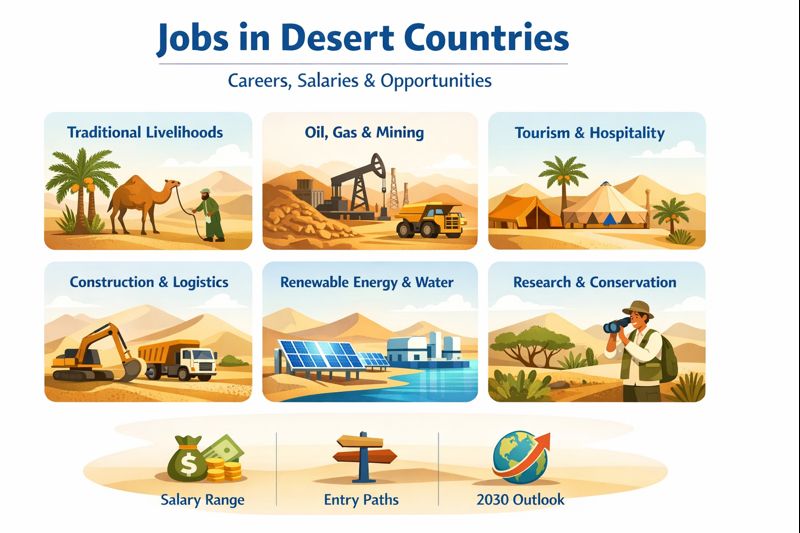
- The six job buckets you’ll find in desert countries
- Traditional livelihoods
- Natural-resource extraction
- Infrastructure, construction & logistics
- Tourism & hospitality
- Water, energy & climate jobs (desalination, solar, water engineering)
- Research, conservation & public services
- Regional snapshot: Sahara vs Arabian Peninsula vs South Asia deserts
- How to enter these careers: a realistic roadmap
- 0 → 12 months — baseline credentials & exposure
- 12 → 36 months — accumulate field experience & certifications
- 3 → 5 years — move toward supervisor roles
- Realistic salary ranges & demand signals
- Directional table
- Demand signals to watch:
- sample job titles + copy-ready CV bullets
- Short courses & where to look
- Practical tips for jobseekers in desert environments
- CV & Applications
- Interviews & tests
- Work life & contract structure
- Cultural awareness
- Safety, health & remote living — survival essentials
- Hydration & heat management
- Transport & logistics
- Remote camps & medical readiness
- Future jobs in desert countries — 2030 outlook and skill focus
- Trends to watch
- Where to find desert jobs
- Human history and cultures — why it matters for careers
- Pros & Cons
- Cons
- Environmental issues, conservation & job impacts
- Tourism: attractions, hiring & travel tips
- Short checklist before applying to desert jobs
- FAQs
- Conclusion
Quick snapshot — Who works in deserts and why this matters
Desert economies combine long-standing livelihoods with capital-intensive industries and rapidly growing green sectors. Key categories:
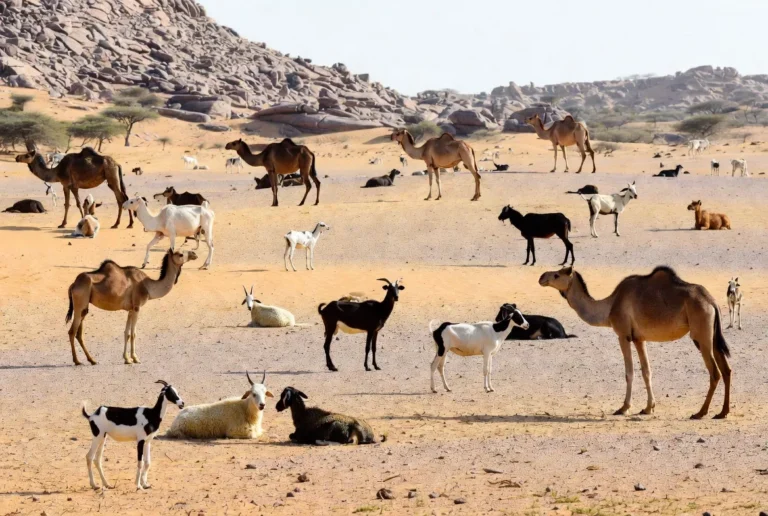
- Traditional: pastoralists (camels, goats), oasis horticulture (dates), artisanal crafts (textiles, ceramics).
- Capital-intensive: upstream and downstream oil & gas, large mining projects, heavy construction.
- Fast-growing: utility-scale solar, hybrid renewables, desalination, controlled-environment agriculture, regenerative tourism.
- Public & NGO: conservation, community development, extension services, research institutes.
Vocational programs that provide training and placement are frequently funded by governments, international donors and larger developers and speed up the process of getting into certain careers. In impact-related jobs, the donor programs and research projects establish consistent hires of mid-skilled and specialists.
The six job buckets you’ll find in desert countries
Traditional livelihoods
What it is: Herdsmanship (camels, goats, sheep), date-palm cultivation and oasis horticulture, water-harvesting techniques, and artisanal handicrafts (weaving, pottery, leatherwork).
Where: Sahara, Sahel, Arabian oasis belts, Thar, and Central Asian deserts.
Employers / Markets: Local markets, farmer cooperatives, small processors, niche cultural tourism operators, fair-trade exporters.
Entry path: Family learning, informal apprenticeship, short extension courses in drought-resilient agronomy or animal husbandry.
Why it matters: These occupations sustain food security, protect heritage, and feed niche tourism experiences (e.g., homestays, cultural circuits).
Example roles: Herdsman, Oasis farmer, Artisan weaver, Fodder technician, Cooperative manager.
Natural-resource extraction
What it is: Upstream exploration and production (E&P), downstream refining and processing, mineral and phosphate extraction, site services and logistics.
Who hires: National Oil Companies (NOCs), international oil majors, drilling & field service contractors, mining multinationals, engineering procurement & construction (EPC) firms.
Entry path: Technical diplomas, trade certificates (rig technician, welder, heavy mechanical), HSE (health, safety & environment) certifications, contractor internships.
Why it matters: High earning potential and scale — these projects fund local supply chains, infrastructure, and professional training.
Example roles: Drilling field technician, Petroleum engineer, Mining technician, HSE officer, Mud engineer.
Infrastructure, construction & logistics
Work types: Civil and structural engineers, heavy equipment operators, construction supervisors, pipeline crews, logistics and supply chain managers, truck drivers.
Entry path: Vocational training, trade school diplomas, equipment-operator certification, progressive on-site experience.
Why it matters: Airports, ports, pipelines, desalination conveyance lines, and resort developments create long chains of skilled and semi-skilled employment. Remote camps support cooks, electricians, and camp managers.
Example roles: Site engineer, Crane operator, Civil foreman, Logistics coordinator.
Tourism & hospitality
Jobs: Resort managers, experience designers, desert guides, guest-experience hosts, chefs, housekeeping supervisors, events coordinators.
Growth drivers: High-end developers and national tourism strategies are expanding luxury desert resorts, eco-lodges, and curated cultural experiences. Many hospitality programs include placement guarantees.
Entry path: Short vocational hospitality courses, language training, internships with hotel chains, and guiding certifications.
Example roles: Desert tour guide, Experience host, Resort operations supervisor, F&B manager.
Water, energy & climate jobs (desalination, solar, water engineering)
Jobs: Solar PV technician, renewable-systems integration engineer, battery storage O&M, desalination plant operator (RO specialist), water-resource engineer, water utilities technician.
Why it matters: Arid climates favour large solar installations and desalination to meet water demand. These sectors create steady mid-skill and Specialist roles with visible career ladders.
Entry path: PV installer courses, electrical technician certification, RO operations training, process instrumentation courses, battery maintenance certificates.
Example roles: PV installer, RO plant operator, Battery storage technician, Grid integration engineer.
Research, conservation & public services
Jobs: Ecologists, land-rehabilitation specialists, climate adaptation officers, NGO program officers, extension agents, government water officers, and public health staff.
Who hires: NGOs, academic and research institutions, donor agencies (UN, bilateral donors), and national ministries.
Why it matters: Donor funding for desertification control, climate resilience, and livelihood diversification results in long-term, impact-oriented roles that blend technical and community skills.
Example roles: Restoration ecologist, Community outreach officer, Monitoring & evaluation (M&E) specialist.
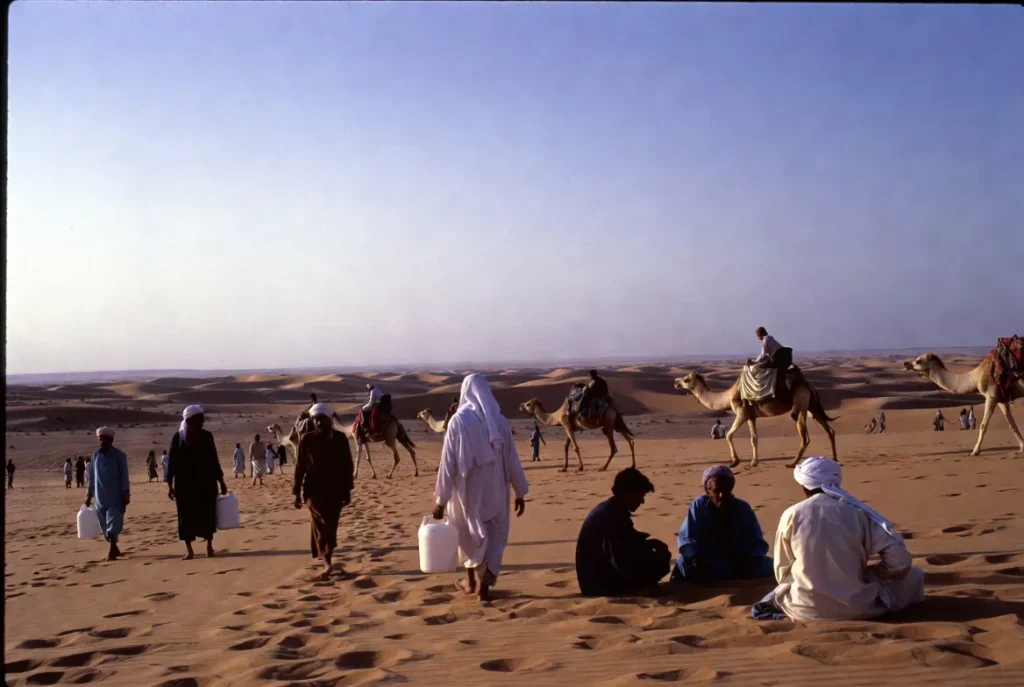
Regional snapshot: Sahara vs Arabian Peninsula vs South Asia deserts
| Region | Dominant sectors | Hiring profile & visa notes | Local nuance |
| Sahara (North & West Africa) | Pastoralism, mining, and small tourism | Mostly local hires; contractors for big mines | Seasonal pastoral cycles; strong local craft markets |
| Arabian Peninsula (UAE, Saudi Arabia, Oman, Qatar, Bahrain) | Oil & gas, luxury tourism, renewables | High expat hiring; nationality quota policies (e.g., Saudization) | Vocational programs with placement, high specialist pay |
| South Asia deserts (Thar) | Oasis farming, small mining, nascent solar | Mixed local hiring; fewer expat packages | Community programs, microfinance, NGO presence |
Takeaway: For the highest specialist pay and structured ladders, Gulf states generally lead. For community impact, traditional livelihoods, and NGO work — North Africa and South Asia offer accessible local paths.
How to enter these careers: a realistic roadmap
Step 0 — Choose your bucket
Decide early whether you prefer: technical trades (solar, RO, drilling), hospitality, natural resources, research/NGO, logistics, or traditional livelihoods. Focus narrows choices and training.
0 → 12 months — baseline credentials & exposure
- Enrol in a short targeted course: PV installation (3–6 months), RO operator (3–6 months), HSE basic card, hospitality basics, heavy-equipment operator.
- Get key safety cards: first aid, basic HSE.
- Build a desert-ready CV: emphasise physical fitness, remote living or rotational work, and any field experience.
- Apply for internships, seasonal roles, or entry-level contract jobs to gain proven field time.
12 → 36 months — accumulate field experience & certifications
- Take rotational contracts to build “desert experience” — many employers require 12–24 months fieldtime before promotion.
- Upskill with a diploma (e.g., electrical, renewable energy technology, hospitality management).
- Gain recognised certifications: ISO safety, RO plant operator, electrical licensing, forklift/MEWP cards.
3 → 5 years — move toward supervisor roles
- Aim for team-lead or supervisory positions.
- Add soft-skill training: leadership, emergency response, and technical reporting.
- Consider a bachelor’s or specialised master’s (hydrogeology, energy systems, tourism management) for corporate or senior technical tracks.
Realistic salary ranges & demand signals
Salaries vary dramatically by country, citizenship, employer type, and contract terms (local vs expat). Below is directional guidance — treat this as a starting point, not a guarantee.
Directional table
| Job type | Entry salary (approx., local currency varies) | Mid-career (3–7 yrs) | Pays best in |
| Oil & Gas Field Technician | low–mid to high (contracts) | high (shift pay + expat packages) | Gulf states |
| Solar PV Technician | low–mid | mid | UAE, Saudi; expanding in North Africa |
| Desalination Plant Operator | mid | mid–high | Gulf & arid coastal states |
| Hospitality entry (F&B, housekeeping) | low | mid (supervisor) | Luxury resort markets |
| Tourism guide | low–mid (+tips) | mid | Niche luxury destinations |
| Mining technician | mid | mid–high | Active mine regions (North Africa) |
| NGO / Research officer | low–mid | mid | Donor hotspots & universities |
Demand signals to watch:
- Job boards like Bayt and GulfTalent show large numbers of energy, construction, and hospitality roles in the Gulf.
- Major developers (e.g., Red Sea Global, NEOM, other coastal or desert developers) run vocational programs and recruit regionally.
- Donor programs (CGIAR, ICARDA, UNDP) increase hiring for agritech and climate resilience roles.
sample job titles + copy-ready CV bullets
Use these short, measurable bullets that hiring managers can scan. Tailor metrics to your own results.
- Solar PV Technician — “Installed and commissioned a 2 MW utility PV array in an arid site; performed daily string testing and preventive maintenance under strict HSE protocols.”
- Desert Tour Guide / Experience Host — “Led cultural desert experiences for groups of 8–20 guests; managed off-road logistics, safety procedures, and guest storytelling, achieving 98% satisfaction.”
- Drilling Field Technician — “Operated and maintained drilling pumps and rigs on 12-hour shifts; contributed to zero lost-time incidents through rigorous safety checks.”
- Desalination Plant Operator — “Operated RO units, performed scheduled CIP and membrane cleaning, and optimised brine schedules to increase uptime by 8%.”
- Hospitality Operations Supervisor — “Supervised guest operations for a 120-room eco-resort; improved guest satisfaction scores by 18% through staff training and process changes.”
- Logistics & Fleet Coordinator — “Managed cross-desert supply chain for a 300-person camp; improved delivery timeliness by 22% via route optimisation.”
- Pastoralism Extension Officer — “Worked with 450 households to introduce drought-tolerant fodder and trained 60 farmers in water-harvesting techniques.”
- Mining Safety Officer — “Conducted daily inspections and safety briefings, reducing recordable incidents by 30% in 12 months.”
- Climate Adaptation Project Officer (NGO) — “Designed a livelihood diversification pilot across three villages; secured funding and led M&E to meet outcome targets.”
- Oasis Horticulture Specialist — “Introduced low-water date-palm pruning and drip irrigation methods, increasing yield per hectare by 12%.”
Short courses & where to look
| Role | Short course (duration) | Where to get it |
| Solar PV Technician | PV installation & maintenance (3–6 months) | Vocational colleges, private training centres, manufacturer bootcamps |
| Desalination Operator | RO operations & maintenance (3–6 months) | Technical institutes, water utilities, vendor training |
| Hospitality Frontline | Hospitality basics (1–4 months) | Hotel groups, online certs, vocational schools |
| Heavy Equipment Operator | Equipment operator certificate (1–3 months) | Technical colleges, onsite vendor training |
| Guide / Experience Host | Guiding & safety (1–2 months) | Local tourism boards, private tour operators, and national park authorities |
Practical tips for jobseekers in desert environments
CV & Applications
- Highlight HSE cards, remote living or rotational experience, and any survival/fieldwork training.
- Use numbers: per cent uptime, guest satisfaction, deliveries on time.
- Include languages: English, French (for North Africa), Arabic for Gulf roles. Recruiters value language ability.
Interviews & tests
- Expect practical tests: PV wiring tasks, safety drills, driving tests.
- Bring original certificates and medical screening documents.
Work life & contract structure
- Many remote roles use rotation patterns (e.g., 14/14).
- Employers often provide accommodation, meals, and travel allowances. Factor these into total compensation comparisons.
Cultural awareness
- Learn local customs and basic phrases; show cultural sensitivity in community roles and tourism. This reduces friction and increases hireability.
Safety, health & remote living — survival essentials
Hydration & heat management
- Know heat-stress symptoms and follow mandated break schedules.
- Employers usually supply hydration protocols—adhere to them strictly.
Transport & logistics
- Roads may be extreme. If driving, obtain the correct license and attend desert driving training. Ensure vehicle maintenance knowledge.
Remote camps & medical readiness
- Company accommodation often has rules and limited amenities; expect rotational leave and restricted family visits.
- Maintain up-to-date vaccinations and medical clearance; many industrial roles require fitness assessments.
Future jobs in desert countries — 2030 outlook and skill focus
Trends to watch
- Utility-scale solar & hybrid renewables — demand for PV installers, storage technicians, grid integration specialists.
- Smart desalination & water reuse — modular plants and efficient processes requiring skilled RO operators and process engineers.
- Controlled Environment Agriculture (CEA) — hydroponics and greenhouse technicians for desert-adapted food systems.
- Regenerative tourism & experience design — sustainability officers, community liaison roles, and ethical tourism designers.
- Green restoration jobs — land rehabilitation specialists, soil scientists, and climate adaptation officers.
Skill focus recommendation: transferable foundations — basic electrical understanding, safety protocol mastery, data logging and reporting, mechanical troubleshooting. These serve across renewables, water, and infrastructure roles.
Where to find desert jobs
- Regional job boards: Bayt, GulfTalent, Naukri Gulf, and Indeed regional sites.
- Company career pages: Major developers, NOCs, renewable project owners, and hotel groups.
- LinkedIn: Use alerts and network with vocational program alumni.
- Government & vocational portals: National training agencies often list positions linked to graduates.
- NGO & donor portals: UN Jobs, Devex, ReliefWeb, CGIAR career pages.
Human history and cultures — why it matters for careers
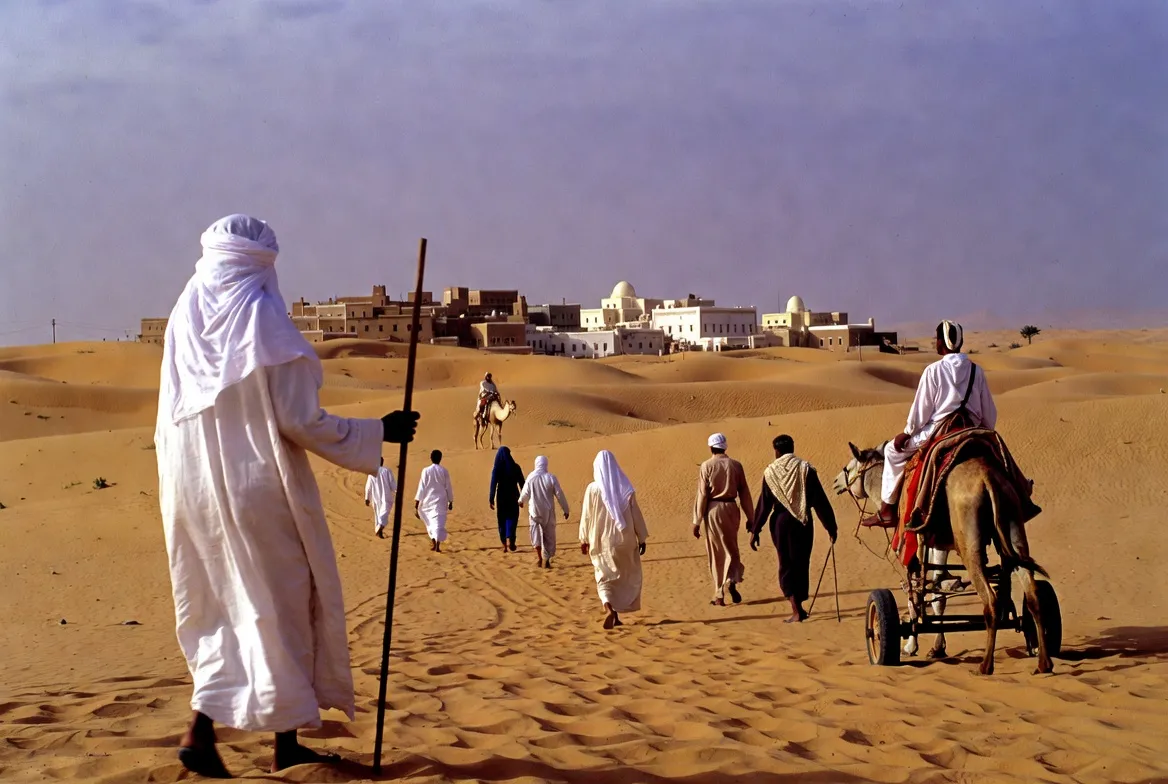
Hospitality, land use, and social governance of desert societies have strong cultural norms. Being aware of dress code, the ways to greet someone, and what is expected of a person enhances performance in community-based jobs. Feeling culturally fluent is an essential quality that has been highly ranked by employers when it comes to tourism and livelihood projects.
Pros & Cons
- Growing sectors (renewables, desalination, tourism) with structured training.
- Employers often provide accommodation, training, and travel.
- Opportunities to blend culture with modern careers (eco-tourism, agritech).
Cons
- Harsh working conditions (heat, remoteness).
- Pay and benefits vary by nationality and region.
- Boom-and-bust cycles are tied to commodity markets and mega-projects.
- Some roles (e.g., offshore, oil & gas) require strict medical and safety screenings.
Environmental issues, conservation & job impacts
The labour market is determined by water shortage and desertification: It limits the old forms of livelihood and initiates green jobs (restoration, water engineering). Adaptation projects are frequently supported by donors and governments that create paid jobs in the areas of monitoring, community outreach, and technical support.
Tourism: attractions, hiring & travel tips
Top desert draws: dune safaris, cultural homestays, stargazing, eco-resorts, adventure sports.
Most hired roles: guides, resort staff, chefs, housekeeping, and events.
Tips for jobseekers: take hospitality basics, learn a relevant language, volunteer or intern with small operators to build references.
Where to apply: developer career pages (e.g., Red Sea Global), international hotel chains, and national tourism boards.
Short checklist before applying to desert jobs
- Completed relevant short course (PV, RO, hospitality).
- Holdan HSE or first-aid certificate.
- Updated desert-ready CV with measurable results.
- At least one reference from field or volunteer work.
- Set job alerts on Bayt, GulfTalent, and LinkedIn.
- Know visa/permit requirements for the target country.
FAQs
A1: A wide range — traditional livelihoods (herding, oasis farming), oil & gas, mining, construction, hospitality, renewables (solar and desalination), research/NGOs, and public services. The mix depends on the region.
A2: It depends. Specialist roles in oil & gas and some renewable jobs pay well (especially expat packages). Entry-level hospitality and community roles usually pay modestly. Check job boards and company pages for current pay.
A3: Start with a vocational PV course, get safety and electrical certificates, then apply for OJT (on-the-job training). Many projects run employer-led apprenticeships.
A4: Yes — tourism, some agricultural harvests, and some construction roles are seasonal. Large projects (solar farms, desalination) usually offer year-round jobs.
Conclusion
The economies of the desert offer variety, including concrete career opportunities – both conventional and community-based activities, as well as well-paid specialist employment in the energy, mining, and desalination sectors. Specialise in technical skills (basic electrical, HSE, data/logging, RO/PV basics) that can be transferred, develop field experience with short courses and rotational contracts and target regional job boards and Developer career pages. With proper training and cultural sensitivity, deserts could become the place of stagnant careers and accelerated development until 2030 and beyond.