
Introduction
The Thar Desert, or the Great Indian desert is the largest desert in India and among the most populated arid regions of the earth. The Thar, which is mostly found in western Rajasthan and spreads into eastern Pakistan, is more than just dunes, endless. It is a living environment of forts, desert towns, grasslands, wildlife, and strong communities that are influenced by the extreme weather. The explanation of the Thar is simplified and structured in a clear language, such as maps, climate, flora and fauna, traveling routes, itineraries, conservation concerns, and practical advice; therefore, it can serve travelers, students, and content creators alike.
- Quick facts & map
- Overview & boundaries
- Climate — month-by-month guide
- Landscape features & habitats
- Flora — what grows and why
- Key species and their functional roles:
- Fauna — animals, birds, reptiles, and invertebrates
- Large mammals & medium-sized fauna:
- Birds (notable species & conservation highlights):
- Human history, culture & towns
- Travel — attractions, activities & tips
- Where to go: top places, activities & sample itineraries
- Practicalities: permits, costs & booking
- Packing checklist
- Environmental issues & conservation
- How visitors can help
- Interesting facts
- Pros & cons of visiting
- Pros
- Cons
- FAQs
- Conclusion
Quick facts & map
- Name: Thar Desert / Great Indian Desert
- Primary location: Western Rajasthan (India); extends west into Punjab & Sindh (Pakistan).
- Important Indian states included: Rajasthan (dominant), the drier parts of Punjab and Gujarat.
- Key gateway cities (high-value named entities): Jaisalmer, Jodhpur, Bikaner, Barmer.
- Important protected area: Desert National Park (Rajasthan) — core habitat for grassland specialist species and a key site for Great Indian Bustard conservation.
- Best time to visit (seasonal attribute): October–March (cool days, cold nights; prime for camping, stargazing, cultural festivals).
Overview & boundaries
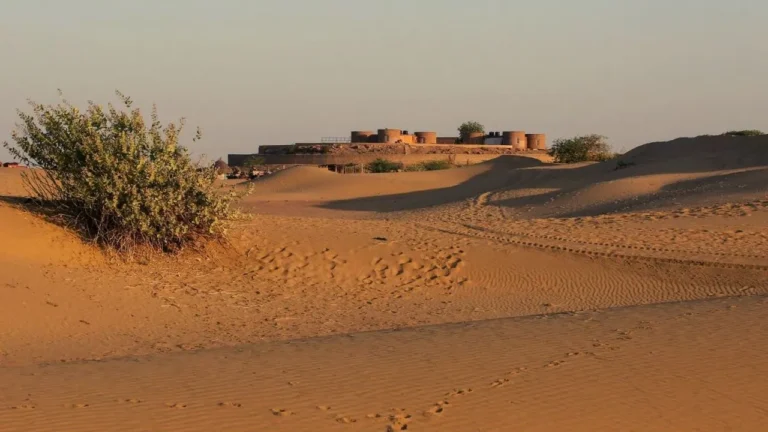
From a Geospatial perspective, the Thar Desert occupies the northwestern margin of the Indian subcontinent. It is enclosed by the low Aravalli mountain chain in some areas on the eastern side, and the western side leads to the dry plains of the eastern part of Pakistan. The substrate and surface morphology are heterogeneous: mobile aeolian dunes dominate in some districts (notably the Sam and Khuri dune systems near Jaisalmer), while other sectors show stabilized dunes, stony plains, interdunal basins (playas), and saline flats. Human land use overlays this heterogeneous land-surface: villages and towns cluster where groundwater or shallow aquifers permit wells, and pastoralists follow seasonal forage. For mapping layers, think of the desert as a stack of semantic layers in a GIS: international/state/district boundaries; urban nodes; protected areas; dune belts; major transport arteries; and tourism infrastructure (camps, viewpoint tracks, and established camel routes).
Recommended GIS layer list for a downloadable pack (SVG/PDF/KML):
- International boundary (India/Pakistan)
- State boundaries (Rajasthan + adjacent districts)
- Major cities & towns (Jaisalmer, Jodhpur, Bikaner, Barmer, Pokhran)
- Protected areas & Key Biodiversity Areas (Desert National Park, bustard ranges)
- Dune belts/erg extents (Sam, Khuri)
- Interdunal flats/salt pans/playas
- Roads, rail lines & airports (transport connectivity)
- Tourism hubs, campsites & recommended low-impact tracks
Climate — month-by-month guide
The Thar’s climate ranges from arid to semi-arid, with pronounced diurnal temperature shifts and a short, often erratic monsoon. Considering climate as a vector, the desert’s temporal signal is dominated by three pulses: cool winter, scorching pre-monsoon summer, and brief monsoon moisture.
- January–February (Winter): Cool to cold nights, bright days. Ideal for camping, stargazing, and outdoor cultural events. Minimum temperatures can be chilly at night; bring warm layers.
- March–May (Pre-monsoon → Hot season): Rapid warming; April–June frequently top 40°C in the plains. Dust storms kick in; the hot “loo” winds are common. Travel is possible but strenuous; prioritize early-morning and late-afternoon outings.
- June–September (Monsoon window): Rainfall is uneven and highly variable by year and subregion. When rains arrive strongly, interdunal flats and ephemeral streams green the landscape briefly and bring a flush of annual herbs and grasses. In wet years, you can witness spectacular desert bloom; in dry years, the monsoon may barely register. Road conditions to some dunes can become challenging.
- October (Post-monsoon): Vegetation recovers; pleasant days and cooler nights—an excellent transitional month for travel.
- November–February (Peak tourist window): Cool nights (can be near-freezing in some years), comfortable days. This is the principal tourism season: book early for tents and guided safaris.
Field tip (seasonal observation): If your interest is ephemeral wildflower displays, plan travel soon after a robust monsoon year. The greening is dramatic but short-lived: the phenological window often closes within a few weeks.
Landscape features & habitats
The Thar’s geomorphology is a mosaic; each landform supports distinct species assemblages and is sensitive to different human pressures.
- Dunes (ergs): Mobile and dynamic in wind-dominated sectors (e.g., Sam, Khuri). Vegetation is sparse—phog, sparse grasses—and stabilization is primarily through shrubs and perennial grasses. Dune mobility creates shifting habitats with low structural complexity but unique specialist fauna.
- Interdunal flats & playas: Seasonal water collection zones that support ephemeral plants after rain and attract birds and insects. These flats often harbor richer soils and higher productivity during wet pulses.
- Rocky outcrops & inselbergs: Hard substrata with steppe-like vegetation; often the location for settlements and grazing because they retain perchable substrates and sometimes shallow groundwater.
- Salt pans & saline flats: Closed basins with halophytic species; archaic microbial and halophyte communities can be important for local ecological functioning.
- Semi-arable pockets & riparian strips: Where wells and canals allow some cultivation (millets, pulses), you find a matrix of agrarian habitats and semi-natural grasslands.
Each feature is a “feature vector” in ecological modeling: dune index, soil texture, moisture regime, vegetation cover, human footprint score — and these vectors determine which species (including the Great Indian Bustard) can persist.
Flora — what grows and why
Vegetation in the Thar is dominated by drought-tolerant, thorn-scrub, and xerophytic assemblages. Plants play keystone roles: providing fodder, fixing nitrogen, stabilizing dunes, and supporting pollinators.
Key species and their functional roles:
- Prosopis cineraria (Khejri / Shami): Keystone tree; nitrogen-fixer, provider of shade, fodder,r and cultural value. Often central in agroforestry and pastoral systems.
- Calligonum polygonoides (Phog): A dune-stabilizing shrub; critical for reducing aeolian mobility and allowing secondary colonizers to establish.
- Acacia spp. & Tamarix aphylla: Common in thorn-scrub; Tamarix is often associated with saline microhabitats.
- Cenchrus spp. & other grasses: Form the groundcover in interdunal flats and support grazers and seed-eating birds.
Regional plant inventories typically report 160–170 vascular plant taxa in survey transects, with floristic composition varying along east-west moisture gradients. Many species have direct ethnobotanical uses (fodder, fuel, traditional medicine), underscoring the human–plant nexus.
Fauna — animals, birds, reptiles, and invertebrates
The Thar supports a spectrum of arid-adapted fauna. Some taxa are wide-ranging; others are habitat specialists of semi-natural grasslands.
Large mammals & medium-sized fauna:
- Chinkara (Indian gazelle) — common in undisturbed scrub and grassland.
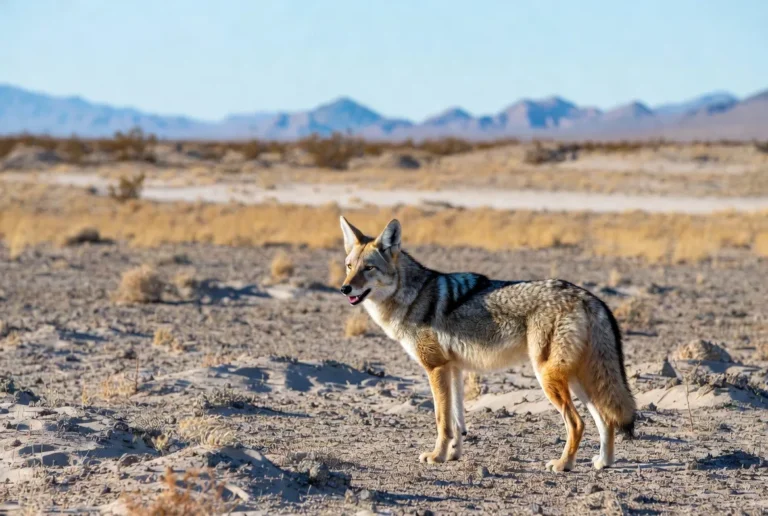
- Desert fox / Indian fox — typical mesopredator.
- Wolf — occasional; occupies broader arid ecosystems.
- Nilgai (blue bull) — present in patches where browse exists.
Birds (notable species & conservation highlights):
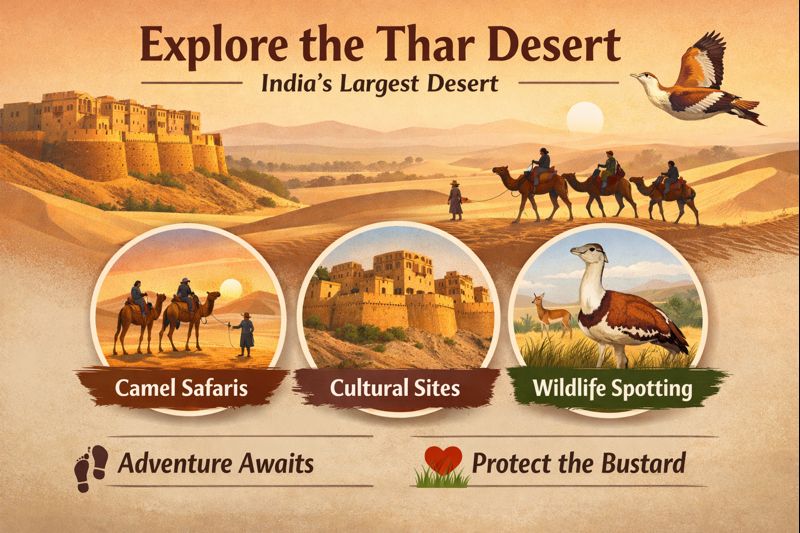
- Great Indian Bustard (GIB) — the emblematic and critically endangered grassland specialist. Historically widespread across peninsular India, its current strongholds are tiny and fragmented; the Thar’s grasslands remain one of the species’ key remaining habitats. Bustards require wide, low-intensity landscapes with sparse tall vegetation—conditions threatened by conversion to agriculture, high-tension powerlines, and increasing infrastructure.
- Other grassland birds & raptors — many small passerines, larks, pipits, and raptors (e.g., harriers and eagles) use grassland mosaics for foraging and nesting.
Reptiles & invertebrates: Agamid lizards, sand vipers, and a rich array of arthropods (beetles, ants) are critical to food webs.
Conservation note: Protected areas such as Desert National Park and adjacent KBAs are focal for monitoring and recovery efforts. Incremental positive signals—localized increases in bustard counts during targeted protection—suggest that well-coordinated conservation can produce measurable gains, but the species remains at high risk.
Human history, culture & towns
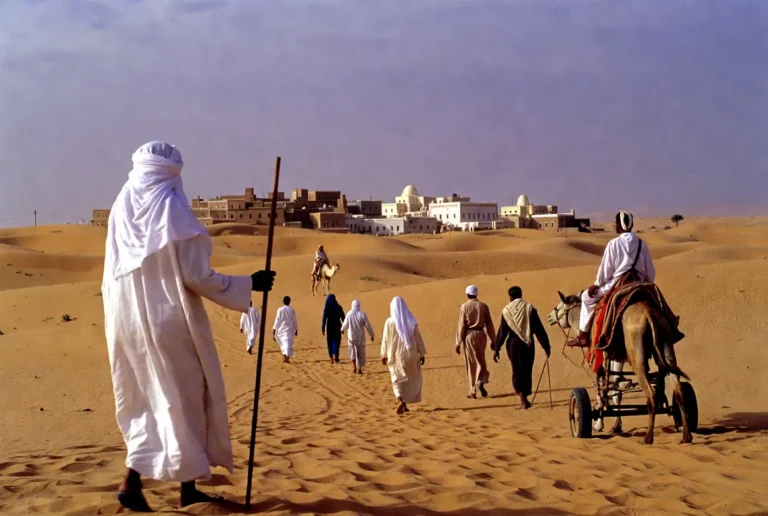
- Thar has been inhabited by people who have lived for millennia. Traditionally, the desert was the route of caravans and trading posts; its cities were defense points on trade and pilgrimage routes.
- Cultural highlights:
- Jaisalmer: The sandstone fort (Jaisalmer Fort), havelis, old bazaa,r,s, and adjacent Sam and Khuri dunes, are tourist attractions.
- Jodhpur: A major urban gateway with palaces and transport links—useful as a staging point for Thar itineraries.
- Bikaner: Known for strong Rajput heritagepalacesce,s and agricultural research centers (including camel research).
- Pastoralism & cropping: Nomadic and semi-nomadic pastoralists, millet and pulse cultivation, and historically limited opium growing in specific pockets have shaped local economies. Traditional water management (stepwells, johads, and baoris) is a testament to long-term human adaptation.
Respect for local customs—asking before photographing, dressing modestly in villages, and supporting community-led initiatives is central to ethical travel.
Travel — attractions, activities & tips
Top attractions & activity types:
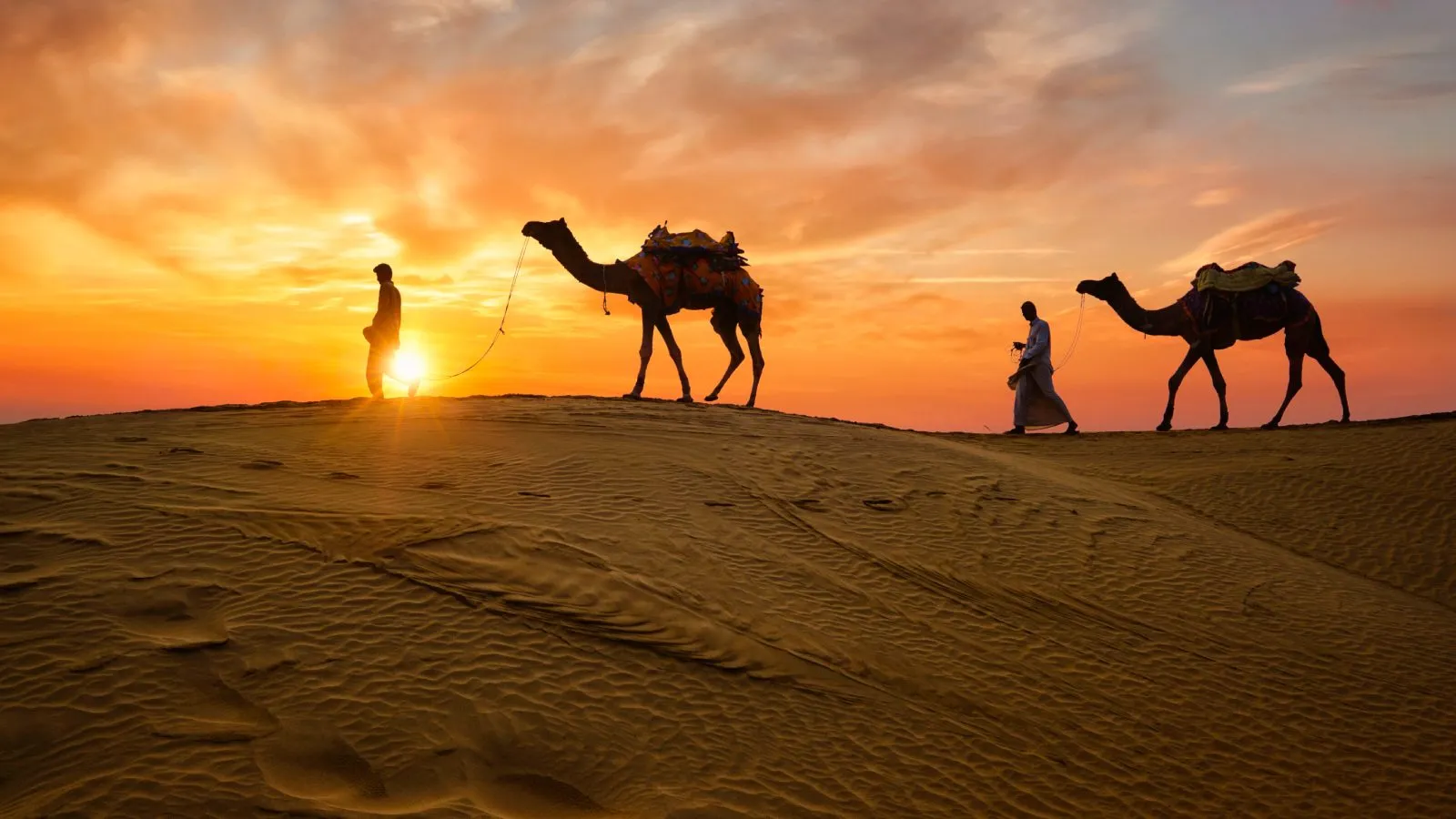
- Camel safaris: Sunrise/sunset rides and overnight camel camps around Sam and Khuri dunes. When well-run, camel safaris are lower-emission, slower-paced, and culturally immersive.
- Jeep / 4×4 tours: Practical for reaching remote dunes and photo vantage points; they allow flexible day trips but can increase habitat disturbance if unregulated.
- Desert National Park visits: Offers wildlife viewing (with low probabilities for rare species unless guided); best visited with vetted naturalists.
- Cultural homestays & village visits: Support local artisans and provide meaningful socio-cultural exchange.
Camel vs Jeep vs 4×4 — quick comparison (decision matrix):
| Experience | Best for | Typical duration | Comfort | Pros | Cons |
| Camel safari | Rustic immersion | 1–2 hrs to overnight | Rustic | Authentic, lower fuel impact | Slow, variable animal welfare |
| Jeep (local) | Quick sunset | 2–4 hrs | Moderate | Fast, scenic viewpoints | Less immersive |
| 4×4 (private) | Remote access | Half-day to multi-day | Varies (luxury options) | Reach remote sites | Costly, potential habitat damage |
Operator selection tip: Look for licensed operators, transparent animal welfare practices, and community benefit models. Prefer operators who avoid off-track driving in fragile grasslands.
Where to go: top places, activities & sample itineraries
Top places to visit
- Jaisalmer: Fort, havelis, Sam & Khuri dunes, night camps, traditional markets.
- Jodhpur: Gateway to the region, palaces, transport links.
- Bikaner: Forts, camel research farm, desert culture.
- Barmer & Pokhran: Lesser-visited towns with cultural authenticity and historical sites.
- Desert National Park: Core conservation area and grassland habitat.
Sample itineraries — drop-in ready:
1-day quick (Jaisalmer)
- Morning: Jaisalmer Fort & historic havelis.
- Afternoon: Local markets & Thar Museum.
- Late afternoon: Drive to Sam dunes → sunset camel ride.
- Night: Cultural dinner at desert camp → return or stay overnight.
3-day classic
- Day 1: Arrive Jaisalmer → Fort, havelis → overnight city stay.
- Day 2: Morning market, Kuldhara ruins → Sam dunes overnight camp (camel or jeep).
- Day 3: Partial Desert National Park visit (wildlife) or return via Longewala/war memorials → onward to Jodhpur.
7-day deep dive
Jaisalmer → Khuri dunes → Barmer villages → Pokhran (museum) → Desert National Park → Bikaner → Jodhpur. Add village homestays, bustard site visits, and craft workshops.
Practicalities: permits, costs & booking
Permits: Most mainstream tourism circuits do not require special permits. However, border-adjacent or military-controlled zones—always check with local authorities, especially near international boundaries or sensitive installations.
Costs:
- Budget camps: Economical, shared facilities.
- Mid-range camps: Comfortable bedding, group meals.
- Luxury camps: Private tents, curated experiences, and higher costs.
Prices spike during the November–February peak season and during major festivals.
Booking tips: Book winter (peak) season accommodations and guided experiences well in advance. Use operator reviews, local tourism board recommendations, and community-sourced references.
Safety & rules: Carry ID copies and any needed permits. Follow the guide instructions, especially when visiting protected grasslands or near military zones. Respect local norms—ask permission before photographing individuals.
Packing checklist
| Item | Purpose / Note |
| Water bottle + oral rehydration salts/electrolytes | Stay hydrated; refill at safe points |
| Layered clothing | Hot daytime, cold nights—bring a warm jacket for winter nights |
| High-SPF sunscreen & wide-brim hat | Strong solar radiation |
| Sunglasses | Protect eyes from glare |
| Closed walking shoes | Sand/walking comfort; prevent blisters |
| First-aid kit & personal meds | For minor emergencies, blister plasters |
| Power bank & headlamp | Camps may have patchy power; a headlamp for night walks |
| Local cash | Small vendors often prefer cash; ATMs are limited in remote areas |
| Photocopies of ID & permits | Carry originals in sensitive zones when required |
Environmental issues & conservation
The Thar faces multiple anthropogenic pressures that fragment habitats and degrade grasslands essential to species like the Great Indian Bustard.
Key threats:
- Habitat fragmentation: Fences, roads, and cropland expansion divide continuous grasslands into smaller areas, decreasing the safe foraging and breeding areas of large birds.
- Powerlines and risk of collision: Above-ground transmission lines lead to bird collisions- this is disproportionately dangerous to large ground-based species that undertake low-altitude flight.
- Tourism effects & off-road vehicle use: Uncontrolled 4X4 use and sites located in vulnerable areas destroy biological soil crust, delicate vegetation, and nesting areas.
- Agricultural conversion & irrigation: Grasslands converted to rangeland or cropland reduce suitable large bird habitat.
- Poaching & disturbance: Direct threats in some areas; disturbance during breeding can lower reproductive success.
Conservation wins & hope: Targeted measures—powerline marking and rerouting, protected area enforcement, community-based conservation programs, and site-specific monitoring—have produced pockets of recovery. For example, coordinated census efforts and local protection in Desert National Park have led to localized increases in some species counts, though the Great Indian Bustard remains critically endangered.
How visitors can help
- Choose low-impact camps that limit waste, manage water responsibly, and integrate community benefits.
- Avoid driving on fragile grasslands. Stick to established routes and tracks.
- Support community tourism: Prefer homestays and operators that demonstrate equitable benefit-sharing.
- Follow wildlife protection rules: Keep distance from nests and breeding areas; do not drive across scrublands suspected to host sensitive species.
- Donate to vetted NGOs or local ranger programs rather than buying wildlife souvenirs.
- Spread awareness: Use social channels to amplify conservation-positive messages and to discourage destructive tourism behaviors.
Interesting facts
- The Thar is one of the most densely populated deserts in the world: people, livestock, and wildlife share the landscape.
- Khejri (Prosopis cineraria) is locally venerated; its role in soil health and pastoral livelihoods is culturally central.
- The Great Indian Bustard, once widespread, now survives in small, isolated pockets—making the Thar an important conservation landscape.
Pros & cons of visiting
Pros
- Unique cultural immersion (forts, music, artisan crafts).
- Dramatic dune scenery and exceptional stargazing.
- Wildlife in protected nodes (birdwatching & grassland ecology).
- Good rail and road connectivity to Rajasthan’s cities.
Cons
- Heat extremes (April–June).
- Fragile habitats that can be damaged by careless tourism.
- Border areas may have security or permit restrictions—always confirm ahead of travel.
FAQs
A: Yes. The Thar, commonly called the Great Indian Desert, is widely recognized as India’s largest arid region. Exact area figures vary by definitional boundaries (for instance, whether peripheral semi-arid tracts are included), but the Thar is the predominant arid landscape of northwestern India and extends westwards into eastern Pakistan.
A: The optimal travel window is October to March. Days are pleasantly warm and nights are cool or cold—ideal for camping, outdoor cultural events, and wildlife watching. Shoulder months such as October and March offer fewer crowds and comfortable weather. Avoid the summer peak (April–June) unless you are prepared for intense heat.
A: The Desert National Park and adjacent grasslands offer the best potential to see grassland specialists, including the Great Indian Bustard. However, sightings are rare because the species is critically endangered and occurs at low densities. To increase your likelihood while minimizing disturbance, travel with experienced local naturalists and follow established low-impact viewing practices.
A: Camel safaris can be both safe and ethical if provided by reputable operators who adhere to animal welfare norms and treat their animals humanely. Choose operators with transparent welfare policies, proper camel care, and community benefits. Avoid operators or camps with apparent mistreatment or neglect.
A: For most tourism circuits, you do not need special permits. However, border-adjacent zones and certain military-controlled sectors require permissions—always check current local regulations before visiting areas near international frontiers or restricted installations.
Conclusion
Thar (Great Indian Desert) is a locality where human life, nature, and history are closely intertwined. Desert is both beautiful and responsible: Moving dunes, old forts, subtle grasslands with rare species, like the Great Indian Bustard. Traveling to the Thar during the period of October-March, selecting righteous operators and also being respectful to the local ecologies would save this exclusive place. It is a desert, a tourist and research, and study destination, and it remains the most valuable desert scenery in India, with its culture, diversity, and proven wisdom of the desert.