

Introduction
The Thar Desert — the Biggest Desert in India and often called the Great Indian Desert — is a living landscape of shifting dunes, salt pans, fortified towns, and resilient communities. This guide gives clear, publish-ready information on the Thar’s size and map, climate and seasons, wildlife and culture, travel tips,s and downloadable assets so readers can plan trips, learn about conservation, and use ready-made content for publishing.
- Quick Facts at a Glance
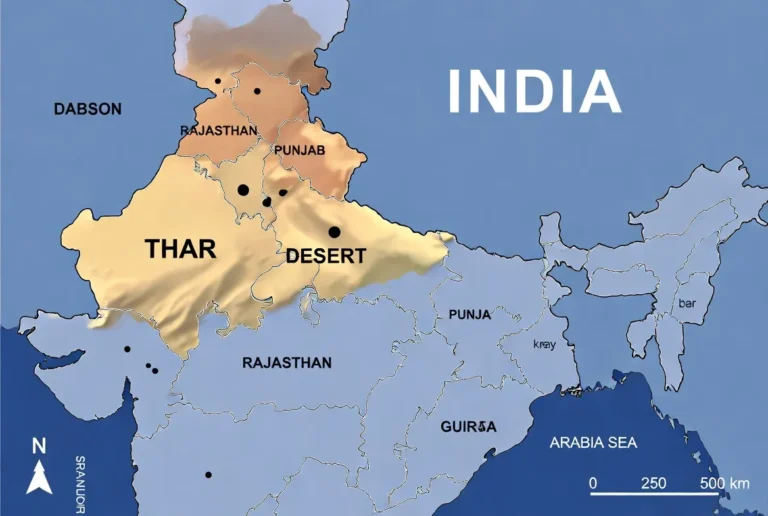
- Where is the Thar Desert? Map & Borders
- Climate & Seasons — What to Expect
- Landscape features — a mosaic, not just dunes
- Flora — desert plants & adaptations
- Fauna — life that endures the arid pulse
- Human history and culture — a vivid cultural landscape
- Threats & Conservation — the trade-offs
- Tourism: attractions, activities & travel tips
- Sample short itineraries
- Permits & rules
- Interesting facts
- How to make your travel/content page conservation-positive
- Maps & downloadable resources
- FAQs
- Conclusion
Quick Facts at a Glance
- Name: Thar Desert (also Great Indian Desert)
- Claim: The biggest desert in India
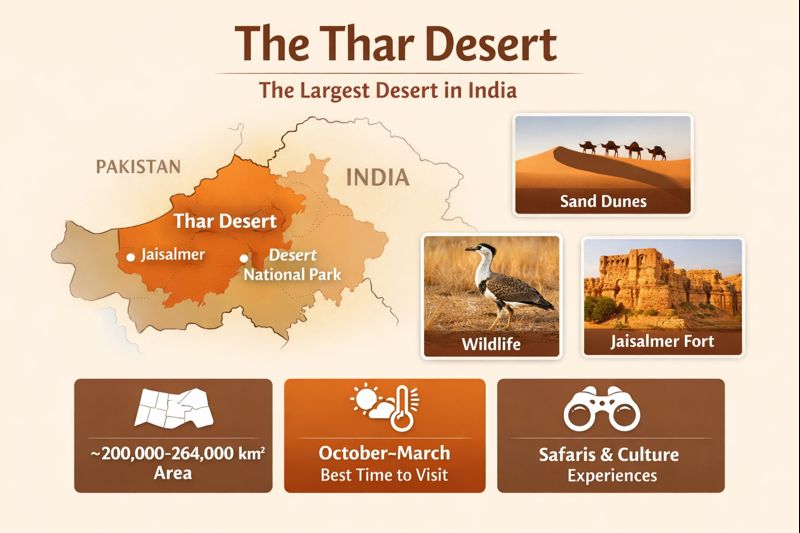
- Area (commonly cited): ~200,000 km² (conservative/core) — up to ~264,000 km² (broader definition)
- Location: Mostly Rajasthan (India); parts of Gujarat, Haryana, Punjab (India); extends into Punjab & Sindh (Pakistan)
- Core protected area: Desert National Park (near Jaisalmer) plus other sanctuaries and community conservation zones
- Best time to visit: October–March (cooler, more comfortable)
- Main attractions: Jaisalmer Fort, Sam & Khuri dunes, Desert National Park, Sambhar Salt Lake
Where is the Thar Desert? Map & Borders
Geographically, the Thar sits on the northwest edge of the Indian subcontinent:
- West: slopes into the Indus plains and deserts of Pakistan.
- South/Southeast: meets the Rann of Kachchh and the Aravalli Range.
- Northeast: transitions into the Punjab plains.
Map types differ by use case:
- Ecoregion/physical maps: show the core sandy & sandy–plain areas.
- Administrative maps: often include populated semi-arid districts and irrigation pockets.
Downloadable map suggestions for publishers:
- High-resolution SVG for classroom printouts and vector zoom.
- KML for Google Earth with waypoints: Jaisalmer, Desert National Park, Sambhar Lake, Didwana salt works.
- Printable PDF route maps for 2–4 day itineraries (with parking, nearest towns, and safe overnight camp sites marked).
Climate & Seasons — What to Expect
The Thar Desert’s climate is tropical arid to semi-arid with large diurnal and seasonal temperature ranges.
- Summer (April–June): Very hot — peak temperatures frequently exceed 45°C in exposed locations. Travelers should avoid strenuous daytime activities during these months.
- Monsoon (July–September): Rainfall is highly variable; episodic rains can create temporary lakes, spur short-lived greening, and make some tracks difficult to traverse.
- Winter (October–March): The recommended travel window — warm sunlit days, cool nights (great for camping and rooftop dining).
Packing tips (intent-refined): Layered clothing to handle warm days and cool nights; robust sun protection (hat, sunglasses, sunscreen); hydration gear — plan for 3–4 liters per person per day in hot weather; dust mask/goggles for sandstorms and fine dust.
Landscape features — a mosaic, not just dunes
The Thar is heterogeneous:
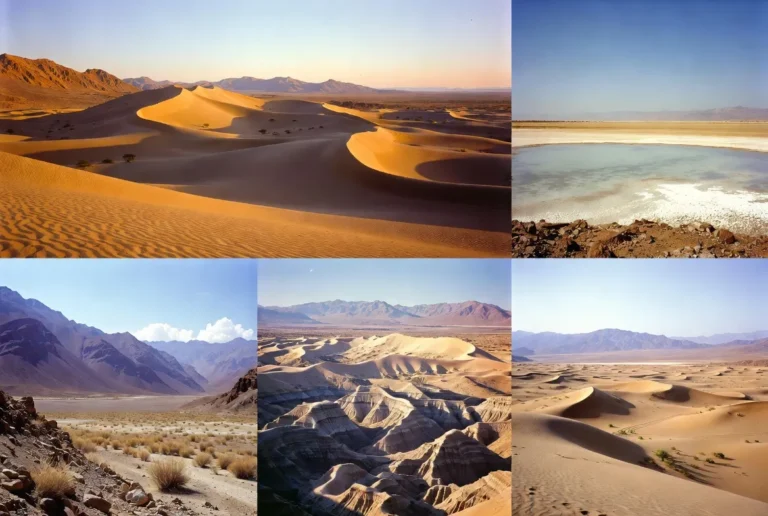
- Dunes: Iconic near Jaisalmer (Sam & Khuri) — actively shifting dune systems sculpted by wind.
- Sandy plains & interdunal corridors: Areas of low, sparse vegetation that stabilize the landscape and support shrubs and grasses.
- Salt pans & lakes: Sambhar, Didwana, and other playas collect seasonal water and feed salt production and wader bird populations.
- Rocky outcrops & badlands: Erosion-carved features, small hills, and exposed strata.
- Paleo-channels: Remnants of ancient rivers (for example, strands of the Ghaggar-Hakra system) that influence deposits and archaeological sites.
Flora — desert plants & adaptations
Plants are water-saving.
Khejri (Prosopis cineraria): the culturally Important tree because of the provision of shade, fodder, and the addition of nitrogen.
Acacia and thorny bushes: characteristic of arid scrub.
Plants and grasses, salt-tolerant: encircling salt pans.
The strategies of small leaves, deep root systems, and other drought-resistant mechanisms are utilized by plants. Numerous species are used locally as fodder, fuel, shade, and as a source of traditional medicine.
Fauna — life that endures the arid pulse
Despite scarcity, the Thar supports an impressive array of animals:
- Mammals: chinkara (Indian gazelle), blackbuck, desert fox, caracal (in some reports), and fringe populations of larger species in protected zones. The Indian wild ass occurs inthe adjacent Rann areas and other semi-desert tracts.
- Birds: raptors, harriers, bustards (e.g., great Indian bustard historically present in the broader region — its status requires careful local verification), waterbirds at seasonal wetlands, and many migratory shorebirds at salt lakes.
- Reptiles & invertebrates: lizards, snakes, and specialized arthropods adapted to arid conditions.
Species spotlight (content box idea): Feature 3–5 marquee animals (Chinkara, Blackbuck, Great Indian Bustard [if historically present; check current status], and a flagship raptor) with short notes on where to see them and conservation status.
Human history and culture — a vivid cultural landscape
The Thar is dense with heritage:
- Historic towns: Jaisalmer, Jodhpur, Bikaner — cities featuring forts, stepwells, and lively craft markets.
- Livelihoods: pastoral nomadism (camels, sheep, goats), irrigated agriculture in canal-fed pockets, salt production, artisanal crafts, and tourism.
- Communities & traditions: groups such as the Bishnois are renowned for long-standing wildlife-protection practices — their ethos and stories make excellent content hooks for human-interest sections.
Threats & Conservation — the trade-offs
The Thar faces diverse pressures:
- Desertification & land use change: overgrazing, inappropriate irrigation, and habitat fragmentation can accelerate degradation.
- Infrastructure & energy development: solar farms and wind parks are key for renewable energy, but require careful planning to avoid fragmenting wildlife habitats and grazing lands.
- Greening paradox: satellite studies sometimes detect “greening” due to irrigation expansion or cropping. That can be socially beneficial — boosting food security and livelihoods — but ecologically it may replace native grasslands and modify groundwater regimes.
Tourism: attractions, activities & travel tips
Top visitor experiences:
- Jaisalmer fort and old city: marketplaces and rooftop sandstone fort.
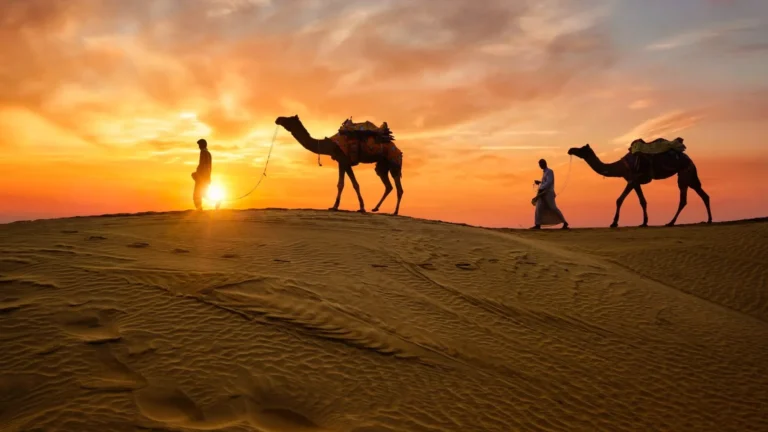
- Camel desert tours and night camping: dunes of Sam and Khuri.
- Desert National Park: Safari and birdwatching guided tours of species that live in deserts.
- Sambhar Salt Lake: salt pans, migratory birds, and deserted sceneries.
How to reach:
- Air: Jaisalmer and Jodhpur have regional airports, which are connected to other bigger cities.
- Through train; Jaisalmer Junction is linked to Jodhpur, Jaipur, etc.
- Via road: Towns are connected by means of roads and highways; nevertheless, the dune area may require local 4x4s.
Local tips:
- Book reputable overnight camps (check reviews and community involvement).
- Use local guides for wildlife spotting and dune safety.
- Avoid uncertain border-area trips — some dunes near the India–Pakistan boundary require permits.
Sample short itineraries
| Days | Focus | Highlights |
| 2 days | Jaisalmer quick visit | Jaisalmer Fort, Patwon Ki Haveli, Sam dunes sunset (camel ride), evening cultural show |
| 3 days | Jaisalmer + dunes | Fort, Sam dunes overnight camp, sunrise dune walk, Khuri dunes |
| 4–5 days | Jaisalmer → Jodhpur loop | Jaisalmer (2 days) → drive to Jodhpur (Mehrangarh Fort) → optional Pushkar or Ranakpur detou.r |
Permits & rules
Most tourist sites do not need special permits. However, border-side dunes or sensitive areas near the international boundary often require permits. If planning off-road or border-proximate trips, check local regulations or book through registered tour operators to ensure safety and legality.
Interesting facts
- The Thar is a highly populated desert in the world.
- The Sambhar Lake is still a major salt producer and migratory destination for birds.
- The Bishnoi communities are known for their conservation traditions and the protection of wildlife at the local level.
How to make your travel/content page conservation-positive
- Promote community-run tours and local guides.
- Include a “How to help” section linking to reputable conservation groups working in Rajasthan.
- Avoid portraying development as uniformly “good” — explain trade-offs between livelihoods and habitat.
- Provide a short Responsible travel checklist: minimize plastic use, stick to marked tracks, support local businesses, and respect wildlife.
Maps & downloadable resources
High-value downloadable assets:
- Printable classroom map (SVG) — labeled towns, parks, and dune clusters.
- KML file for Google Earth — with waypoints for Jaisalmer, Desert National Park, Sambhar Lake, and Didwana.
- Route PDF — a 3-day sampler with driving times, recommended camping sites, and contact details for guides.
- Photo gallery — descriptive alt text and short captions.
Sample alt text for maps: “Map of the Thar Desert across India & Pakistan showing major towns and protected areas.”
CTA (publish-ready): Plan your Thar trip: Download the 3-day Jaisalmer route PDF | Get the Thar KML for Google Earth | Book a community-run desert camp
FAQs
A: The Thar Desert (also called the Great Indian Desert) is the biggest in India.
A: No. While dunes are a famous feature, much of the Thar is sandy plains, scrub, salt pans, and rocky areas.
A: October to March. These months have the most comfortable weather for day trips and night camping.
A: Yes. Desert National Park and local operators offer guided safaris and birdwatching trips. Choose responsible operators.
A: There are places near the India-Pakistan border that need permits. Check local regulations or employ registered operators of tours.
Conclusion
The Thar is the greatest desert in India, as well as a culturally diverse and Ecologically valuable region that needs delicate accounts and effective control. This guide will contain facts and maps, tips on how to be a responsible traveler to educate the visitors, and assist an organization on the ground to conserve the place, and add to your pillar page regularly with new information and downloads.