
Introduction
The Mojave Desert is one of North America’s most remarkable desert regions. Spanning parts of California, Nevada, Arizona, and Utah, it is known for its extreme climate, striking landforms, unique plants, and resilient wildlife. Far from empty, the Mojave is a living landscape shaped by geology, weather, Indigenous history, and ongoing environmental change. From Joshua trees and desert tortoises to salt flats, dunes, and mountain ranges, the Mojave offers a powerful example of how life adapts to harsh conditions.
- Mojave Desert at a Glance
- What Is the Mojave Desert?
- Mojave Desert Map and Geographic Location
- Why the map matters for visitors and learners
- Mojave Desert Climate and Weather Patterns
- Climate change and the Mojave Desert
- Mojave Desert Landforms, Dunes, Salt Flats, and Mountains
- Key landforms and why they matter
- Mojave Desert Plants and Flora
- Common Mojave Desert plants
- Mojave Desert Animals and Wildlife
- Animal survival in the Mojave
- Mojave Desert History and Indigenous Cultures
- Later history in the desert
- Mojave Desert Tourism, Attractions, and Travel Tips
- Best places to visit in the Mojave Desert
- Travel tips for desert safety
- Why the Mojave Desert Is Special
- Environmental Problems and Conservation in the Mojave Desert
- Conservation efforts that matter
- Interesting Facts About the Mojave Desert
- Pros and Cons
- Pros
- Cons
- FAQs
- Conclusion
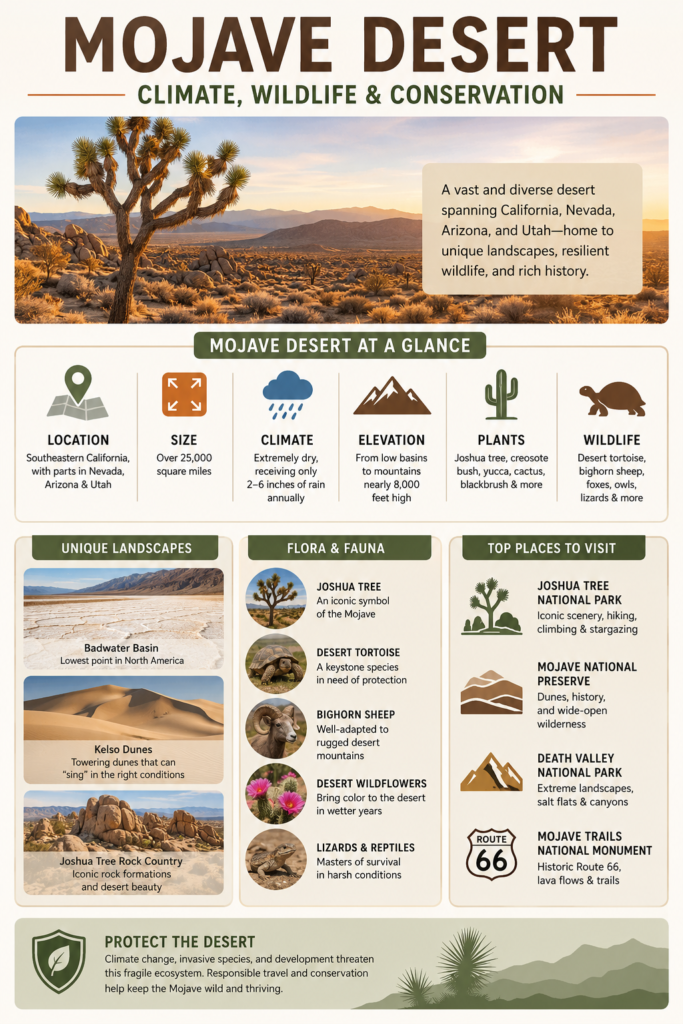
Mojave Desert at a Glance
| Topic | Key Facts |
| Location | Mostly southeastern California, with portions in Nevada, Arizona, and Utah |
| Size | More than 25,000 square miles; the Mojave region in California alone covers about 20 million acres |
| Climate | Extremely dry, with many areas receiving only 2 to 6 inches of annual precipitation |
| Elevation | Ranges from low basins to high mountains; some areas are among the lowest in North America, while others rise to nearly 8,000 feet |
| Signature Plants | Joshua tree, creosote bush, yucca, cactus, blackbrush, and riparian vegetation near water |
| Signature Wildlife | Desert tortoise, bighorn sheep, foxes, owls, lizards, snakes, bats, birds, and many nocturnal species |
| Major Destinations | Death Valley, Joshua Tree National Park, Mojave National Preserve, Mojave Trails National Monument |
This summary captures the essential character of the region: large, diverse, dry, and ecologically significant. It is a desert, but not a uniform one. Its variety is exactly what gives it meaning.
What Is the Mojave Desert?
The Mojave Desert is an arid region named after the Mojave people, and it occupies a distinctive position in the southwestern United States. It is often described less as a fixed block of terrain and more as a transition zone. That description matters because the Mojave shifts from place to place. The ecology changes with altitude, exposure, soil type, rainfall patterns, and proximity to mountains or water sources. In one section, the land may support sparse creosote scrub. In another, it may host Joshua tree woodland. Higher terrain can support pinyon-juniper associations. Around springs and seeps, the desert suddenly becomes greener and far more biologically active.
That complexity is one reason the Mojave cannot be understood through a simplistic lens. It is not just “hot desert.” It is a mosaic landscape. It is a convergence zone where ecological communities overlap. Joshua Tree National Park even identifies itself as a place where the Mojave and Colorado deserts meet, reinforcing the idea that the region functions as a borderland and a blending space rather than a neat, isolated unit.
The human dimension is equally important. National Park Service sources describe a human presence in the region going back roughly 10,000 years. Springs, pathways, seasonal camps, and trade routes all helped people move through and live within the desert. That deep timeline transforms the Mojave from a scenic backdrop into a place of memory, adaptation, and cultural continuity.
Mojave Desert Map and Geographic Location
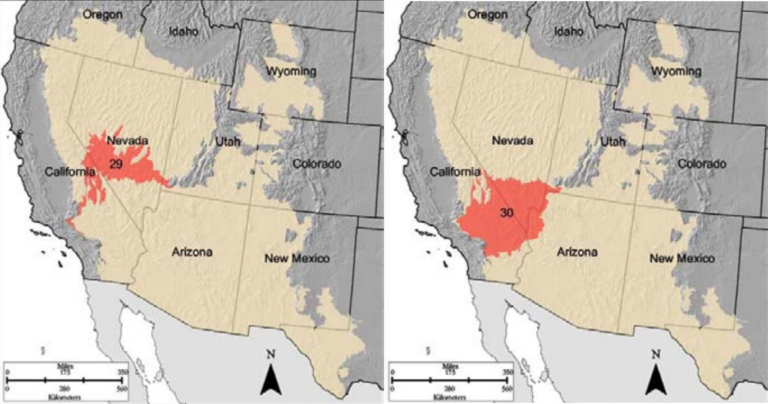
A Mojave Desert map is best imagined as a broad, irregular ecological field rather than a tidy geometric shape. The desert is concentrated in southeastern California, but it extends into Nevada, Arizona, and Utah. It sits between several major physiographic regions, including the Sierra Nevada, the Colorado Plateau, the Great Basin Desert, and the Sonoran Desert. This location explains much of the Mojave’s diversity, because it is influenced by neighboring systems while still maintaining its own distinct identity.
The land is dramatic and highly variable. In Mojave National Preserve, elevations range from about 800 feet to nearly 8,000 feet, while Death Valley includes Badwater Basin, the lowest point in North America, at 282 feet below sea level. This enormous vertical range means that a person driving across the region can move rapidly from salt flats to basaltic hills, from broad basins to rugged peaks, and from dry plains to cooler highland zones. Few deserts contain such a stark concentration of contrasting landforms.
The geographic spread also matters for planners, travelers, and students. A map of the Mojave is not just about location. It is about scale, access, distance, elevation, and habitat distribution. It helps visitors Understand where major parks are located, how remote certain sites are, and why desert travel requires preparation. It also reveals the landscape’s ecological logic, as elevation bands and watershed patterns strongly influence where life can persist.
Why the map matters for visitors and learners
A well-designed Mojave map shows far more than roads and boundaries. It reveals why some areas are rich in rock formations, why others hold dunes, why some valleys remain barren, and others support springs, and why travel across the region takes time and caution. For hikers, campers, photographers, scholars, and road-trippers, the map is a practical tool. For anyone trying to understand the desert as a living system, it is an interpretive key.
Mojave Desert Climate and Weather Patterns
The Mojave Desert climate is defined by dryness, heat, and strong variability. Many areas receive only 2 to 6 inches of precipitation annually, and the evaporation rate is high enough that water disappears quickly from the surface. This creates a landscape where every drop matters. Rain can be scarce, and its arrival often determines when plants bloom, when seeds germinate, and when animals become more active.
Temperature patterns are equally extreme. Summer heat can be intense, with some areas soaring above 100°F, while winter nights can fall sharply, especially in higher elevations. In certain zones, frost is possible. Wind can be strong, visibility can shift quickly, and mountain weather may differ dramatically from basin weather. In spring, if the timing is favorable, the desert can briefly transform into a colorful bloomscape as annual wildflowers emerge, covering the ground in a short-lived but spectacular display.
This is why the Mojave should never be imagined as a single-season desert. It is a place of pulses and intervals, of rare rainfall events and abrupt temperature swings. Its weather patterns are demanding, but they also create ecological opportunities for species adapted to irregular conditions.
Climate change and the Mojave Desert
Climate change has become one of the most serious forces reshaping the Mojave. In Joshua Tree National Park, long-term records show a substantial decline in precipitation and a rise in average temperature over time. These changes do more than alter comfort for visitors. They influence groundwater recharge, plant survival, wildlife distribution, fire behavior, and the persistence of springs and seeps.
The effects are cumulative. When rainfall decreases, plants become more stressed and less likely to reproduce successfully. When temperatures climb, animals face more thermal pressure and may spend less time foraging. When heat and dryness intensify, wildfire risk increases, and desert ecosystems that evolved under low-fire conditions become more vulnerable. The result is an environmental stress test that many species may not be able to pass.
In a practical sense, climate change makes the Mojave harder to predict and harder to endure. It also raises the stakes for conservation, because protecting the region now requires not only preserving land but also adapting management strategies to a changing future.
Mojave Desert Landforms, Dunes, Salt Flats, and Mountains
The Mojave’s landforms are among its most unforgettable features. The region includes salt flats, dune fields, broad alluvial fans, canyons, dry washes, basins, mesas, ridges, and mountain chains. The variety is startling. A visitor can stand in a place that looks lunar and then drive to an area that feels almost alpine. That geological range is one of the Mojave’s defining traits.
Badwater Basin is the best-known salt flat in the desert. It is famous not only because it lies far below sea level, but also because its white salt crust stretches across a vast open expanse that feels otherworldly. The basin is a product of faulting and crustal movement, illustrating how tectonic forces shaped the region over millions of years.
Kelso Dunes are another iconic feature. These giant sand formations, shaped by persistent winds, rise dramatically from the desert floor and can exceed 600 feet in height. Under the right conditions, the dunes may produce a booming or singing sound when the sand slides. That rare acoustic phenomenon makes the dunes one of the most memorable features in the Mojave.
Key landforms and why they matter
| Landform / Place | What Makes It Special | Visitor Takeaway |
| Badwater Basin | Lowest point in North America; expansive salt flats; surreal visual effect | Ideal for geology enthusiasts, photographers, and first-time Death Valley visitors |
| Kelso Dunes | Towering dunes shaped by wind; a famous booming sound | Best for hikers seeking a classic desert challenge |
| Joshua Tree rock country | Massive boulder formations, desert transition habitat, and iconic scenery | Great for climbing, hiking, and accessible desert exploration |
| Mojave Mountain Basins | Strong elevation changes and habitat diversity | Excellent for understanding ecological variety |
These features are not random scenery. They are physical evidence of the forces that built the desert. Wind, water, faulting, erosion, and uplift all played roles in creating the Mojave’s dramatic terrain.
Mojave Desert Plants and Flora
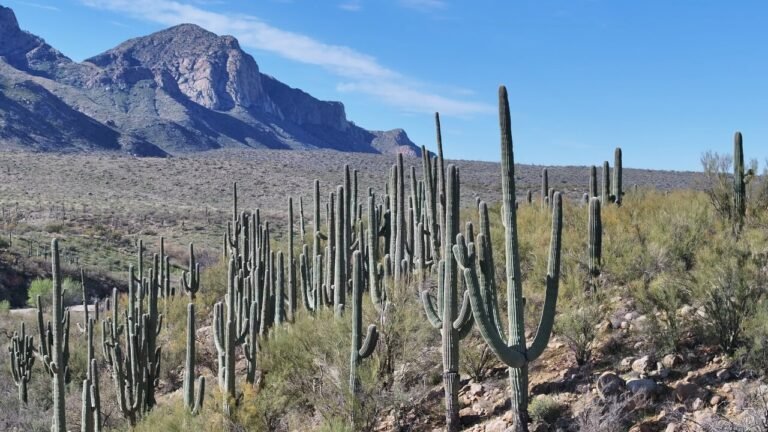
The Mojave Desert flora is an excellent example of biological ingenuity. At a glance, the landscape may seem sparse, but the region supports an impressive range of plant life. Shrubs, succulents, cacti, yucca, annual wildflowers, riparian species, and rare endemics all contribute to the desert’s ecological fabric. The vegetation is not abundant in the conventional sense, but it is highly specialized, carefully adapted, and deeply important.
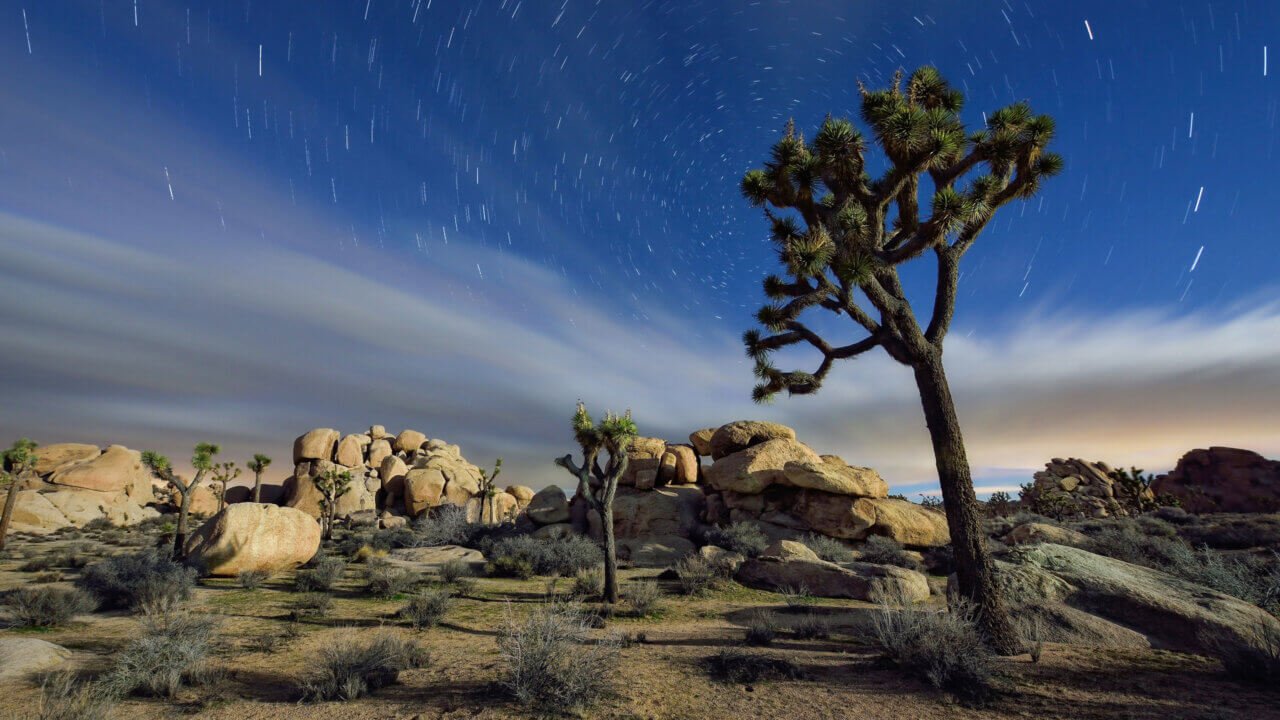
The Joshua tree is the desert’s most recognizable plant. It occupies a specific ecological range, often establishing itself with the help of “nurse plants” that provide the shade and protection young seedlings need to survive. This relationship is a clear example of how cooperation, not just competition, shapes desert life. Joshua trees are also long-lived and strongly associated with the identity of the region.
Creosote bush is another foundational species. It is widespread, hardy, and ecologically central. Its presence across a broad range of the Mojave demonstrates how resilient some desert species can be. In some locations, creosote rings are astonishingly ancient, making them symbols of endurance and deep time. Their longevity offers a powerful reminder that desert ecosystems often evolve over scales far longer than human time.
Common Mojave Desert plants
Joshua tree
Creosote bush
Mojave yucca
Blackbrush
Brittlebush
Cacti and cholla
Riparian plants near springs and seeps
Desert wildflowers in wetter years
Water-centered vegetation deserves special attention. Springs, seeps, and riparian corridors create islands of productivity in an otherwise arid environment. These moist pockets support higher biodiversity and act as gathering points for birds, mammals, insects, and reptiles. In the Mojave, water is not just a resource. It is an organizing principle for life.
The plant communities also change with elevation and microclimate. Lower, hotter zones may support different shrubs than higher, cooler slopes. This layered pattern contributes to the desert’s ecological richness and explains why the Mojave should be viewed as a network of habitats rather than a blank, uniform plain.
Mojave Desert Animals and Wildlife
The Mojave Desert fauna is more active and diverse than many people assume. The secret is timing. Much of the wildlife is crepuscular or nocturnal, meaning it moves during dawn, dusk, or darkness to avoid heat and conserve water. As a result, visitors often see lizards, birds, and tracks before they see the larger animals themselves. But the region is full of life.
The desert tortoise is one of the most important species in the Mojave conservation story. It is slow-moving, vulnerable to habitat disruption, and highly dependent on protected terrain. Because it is sensitive to development, vehicles, disease, and altered fire regimes, it has become a symbol of desert stewardship. Protecting the tortoise also means protecting the habitat network that supports many other species.
The Mojave is home to bighorn sheep, foxes, coyotes, jackrabbits, owls, bats, snakes, lizards, rodents, and numerous bird species. These animals survive through a blend of physiological and behavioral adaptation. Some stay underground during the hottest hours. Others use shade, burrows, rock shelters, or nighttime movement to reduce heat load. Birds often rely on isolated water sources and seasonal food availability. Even predator-prey relationships in the desert are shaped by temperature, concealment, and scarcity.
Animal survival in the Mojave
Survival in the Mojave is a matter of timing, efficiency, and restraint. Many animals minimize activity in the middle of the day. Reptiles regulate body temperature through behavior and basking choices. Small mammals reduce exposure by sheltering in burrows. Predators hunt when conditions are cooler, and prey is more vulnerable. The entire system is governed by energy conservation.
This makes the Mojave one of the best examples of ecological adaptation in North America. Life persists here, but it does so strategically. The animals are not dramatically fighting the desert. They are negotiating with it constantly.
Mojave Desert History and Indigenous Cultures
The human history of the Mojave Desert stretches back at least 10,000 years. That long continuity is crucial because it shows that the desert has never been empty or untouched. Springs, trails, seasonal camps, gathering areas, and trade routes all shaped how people lived in this region long before modern development.
Joshua Tree National Park recognizes the Serrano, Cahuilla, Chemehuevi, and Mohave peoples as traditional stewards and ancestral communities connected to the region. These groups used detailed ecological knowledge to survive in a demanding environment. They understood where water flowed, where plants could be gathered, where game traveled, and how the seasons altered movement across the land.
Trade routes were especially important. Pathways across the Mojave linked the Colorado River with coastal areas, connecting communities and resources over long distances. These routes were not accidental. They were carefully chosen and maintained, often because they followed known water sources and avoided unnecessary risk. In this way, the Mojave functioned as a corridor of movement rather than an impassable barrier.
Later history in the desert
The arrival of miners, ranchers, railroads, road builders, and military users added new layers to the desert’s story. The late nineteenth and early twentieth centuries brought cabins, camps, rail stops, extraction sites, and transportation corridors. Much of this history remains visible in ruins, road remnants, and preserved cultural sites.
Mojave Trails National Monument preserves a powerful mix of heritage and landscape, including a long, undeveloped stretch of Route 66, desert training sites, lava flows, dunes, and wilderness segments. Mojave National Preserve also protects historic cabins, mining remains, and trail corridors. This cultural layering matters because the Mojave is not only a natural landscape. It is also a human record.
The region tells the story of adaptation on multiple timelines. Indigenous groups adapted to the desert through deep ecological knowledge. Later settlers and travelers attempted to exploit, cross, or transform it. Modern conservation efforts now attempt to preserve what remains while making space for future resilience.
Mojave Desert Tourism, Attractions, and Travel Tips
The Mojave Desert offers an extraordinary travel experience for visitors who are prepared for its demands. The region’s top destinations include Joshua Tree National Park, Mojave National Preserve, Death Valley National Park, and Mojave Trails National Monument. Each offers a different expression of the desert, from accessible iconography to remote wilderness.
Joshua Tree is often the most approachable starting point. It combines famous boulders, unusual trees, easy-to-recognize vistas, climbing areas, scenic drives, hiking trails, and stargazing opportunities. Its visual identity is strong, which makes it an excellent introduction to the desert.
Mojave National Preserve is quieter and more expansive. It appeals to travelers who want solitude, wide horizons, and a less crowded experience. The preserve includes dunes, rugged uplands, historic sites, and remote roads. Death Valley is the place for extreme geology and dramatic scale, with salt flats, basins, rugged cliffs, and some of the most striking terrain in the United States. Mojave Trails National Monument adds Route 66 heritage, lava fields, dunes, and a broad protected corridor.
Best places to visit in the Mojave Desert
| Destination | Best For | Why It Stands Out |
| Joshua Tree National Park | Hikers, climbers, stargazers, first-time visitors | Iconic scenery and a wide range of activities |
| Mojave National Preserve | Road-trippers, history lovers, solitude seekers | Huge, quiet, and rich in dunes, trails, and heritage sites |
| Death Valley National Park | Geology fans, photographers, and landscape travelers | Famous for salt flats, extreme relief, and visual drama |
| Mojave Trails National Monument | Route 66 fans, heritage travelers, open-space explorers | Protected corridor with wilderness, lava flows, and historic roads |
These destinations help visitors see the Mojave as an interconnected system instead of a collection of separate attractions. Together, they provide a layered experience of geology, ecology, and culture.
Travel tips for desert safety
Traveling in the Mojave requires planning. Summer heat can become dangerous quickly. Water sources are limited. Distances between services can be long. Cell coverage may be weak in remote sections. Visitors should check conditions before leaving, carry more water than they think they will need, and rely on official maps and guidance.
A smart desert traveler also starts early, avoids unnecessary midday exertion, and respects the scale of the landscape. Hiking during extreme heat is risky, especially on exposed trails with little shade. The desert rewards patience, preparation, and humility. It punishes haste.
Why the Mojave Desert Is Special
The Mojave stands out because it compresses contradiction into one sweeping landscape. It is dry but alive. Harsh but beautiful. Ancient but changing. Remote but historically connected. Low in some places and mountainous in others. It contains salt flats, dunes, spring ecosystems, boulder fields, and broad open basins. It also contains millennia of human history, from Indigenous travel networks to modern road culture.
That combination makes the Mojave unusually rich for study and visitation. Geologists examine how faults and uplift shaped its basins and mountains. Ecologists study how plants and animals survive under thermal and hydrological pressure. Historians explore trade routes, settlement, mining, and transportation. Cultural researchers investigate how people have continually reinterpreted the desert’s meaning.
The region is also special because it still retains a sense of wildness. Even where roads, towns, and tourist destinations exist, large portions of the Mojave remain open, quiet, and expansive. That sense of space is part of its value. It gives visitors the chance to experience scale, silence, and vulnerability all at once.
Environmental Problems and Conservation in the Mojave Desert
The Mojave is resilient, but it is also fragile. That apparent contradiction is central to understanding conservation in the region. Desert ecosystems can withstand heat and drought, yet they are often highly sensitive to disturbance. A single invasive species, a recurring fire, a road barrier, or a changing rainfall pattern can create outsized impacts.
Climate change is one of the biggest threats. As temperatures rise and precipitation patterns shift, many native species are forced to cope with longer dry periods, greater heat stress, and changing seasonal cues. Joshua trees, tortoises, and spring-dependent species are particularly vulnerable. Fire is another major hazard, especially where invasive grasses increase fuel continuity. In the Mojave, fire can transform slow-recovering vegetation into more simplified and less stable systems.
Development and infrastructure also create pressure. Roads fragment habitat and increase wildlife mortality. Energy projects, mining, ranching, and recreational use can all disturb sensitive terrain. Even well-intentioned tourism can add stress if visitors stray from designated routes or overuse fragile areas. The problem is not simply human presence. It is the intensity and pattern of that presence.
Conservation efforts that matter
Effective conservation in the Mojave depends on scale and connectivity. Large protected areas such as Joshua Tree National Park, Death Valley National Park, Mojave National Preserve, and Mojave Trails National Monument provide the land base needed for species movement and ecological continuity. These spaces also preserve geological, cultural, and historic resources.
Conservation also requires active management. That includes habitat restoration, invasive species control, fire mitigation, water monitoring, wildlife tracking, tortoise protection, and climate adaptation strategies. Springs and seeps need careful stewardship because they support disproportionately high biodiversity. Wildlife corridors matter because animals need room to move. Cultural sites matter because they are part of the desert’s human inheritance.
The broader lesson is simple: protecting the Mojave is not only about preserving scenery. It is about preserving function. A healthy desert is one where ecological processes can continue, species can persist, and cultural connections can remain meaningful.
Interesting Facts About the Mojave Desert
The Mojave includes Badwater Basin, the lowest point in North America at 282 feet below sea level.
Kelso Dunes rise to more than 600 feet and can produce booming or singing sounds.
Creosote rings may be among the oldest living organisms on Earth, with estimates reaching 11,000 to 14,000 years.
The Mojave has a human history spanning at least 10,000 years.
Joshua Tree National Park has recorded long-term warming and drying trends.
Mojave Trails National Monument protects one of the longest undeveloped stretches of Route 66.
These facts reveal just how unusual the Mojave really is. It is a place where geological extremes, biological longevity, and cultural depth meet in one astonishing region.
Pros and Cons
Pros
The Mojave is visually extraordinary. It offers mountains, salt flats, dunes, canyons, springs, unusual plants, and iconic wildlife all within one broad desert system. It is also highly rewarding for travelers interested in hiking, photography, camping, stargazing, geology, and road trips. Its human history is rich and multi-layered, especially because Indigenous routes and settlements shaped the region long before modern tourism emerged. The combination of beauty, scale, and significance makes it one of the most distinctive desert landscapes in the world.
Cons
The Mojave is unforgiving for unprepared visitors. Heat can become dangerous, water is limited, and many roads and trails are remote. Distances between services can be deceptive, and weather can change quickly. The ecosystem itself is also under pressure from climate change, wildfire, invasive species, habitat fragmentation, and land-use change. Some of the most beautiful places are also the most vulnerable, which means visitors must behave responsibly and travel with care.
FAQs
The Mojave is shaped by diverse elevations, landforms, and habitat types. It sits among several major desert and mountain systems, which gives it a more complex ecological structure than many people expect. Instead of one uniform environment, it contains creosote scrub, Joshua tree woodland, mountain habitats, dunes, basins, and dry washes.
No. The Mojave supports a wide range of plants and animals, along with deep Indigenous and historic human connections. Much of its life is hidden, seasonal, or nocturnal, so it can seem quiet on the surface even though it is ecologically active.
Joshua trees are one of the Mojave’s most iconic species and a major part of its identity. They support the desert’s ecology and serve as a visible marker of change because they are sensitive to shifts in temperature, rainfall, and fire patterns.
Cooler seasons are usually the most comfortable and safest for travel. Summer conditions can be severe, especially for hiking and long drives. Spring and autumn often provide the best balance of weather, visibility, and access.
Joshua Tree National Park, Mojave National Preserve, Death Valley National Park, and Mojave Trails National Monument are among the most important places for understanding the desert’s landforms, plants, wildlife, and human history.
Conclusion
The Mojave Desert is more than a dry and dramatic landscape. It is a region rich in natural beauty, ecological diversity, and cultural history. Its plants, animals, and landforms reveal how life survives in extreme Environments, while its history shows the deep connection between people and the desert. As climate change and human pressure continue to affect the region, protecting the Mojave has become more important than ever.