
Introduction
This is a full, easily parsed guide to Sharjah Safari Park. We treat the park as a multi-intent user query: location & nav intent, ticketing & pricing intent, itinerary intent, photography & packing intent, and safety/conservation intent. Each section is structured as an information node (H2) with short-slot facts (entities and values), example utterances (what visitors search or ask), and actionable CTAs. Book tickets through the official portal and verify timeslots before travel. For booking and live availability, use the official ticket portal.
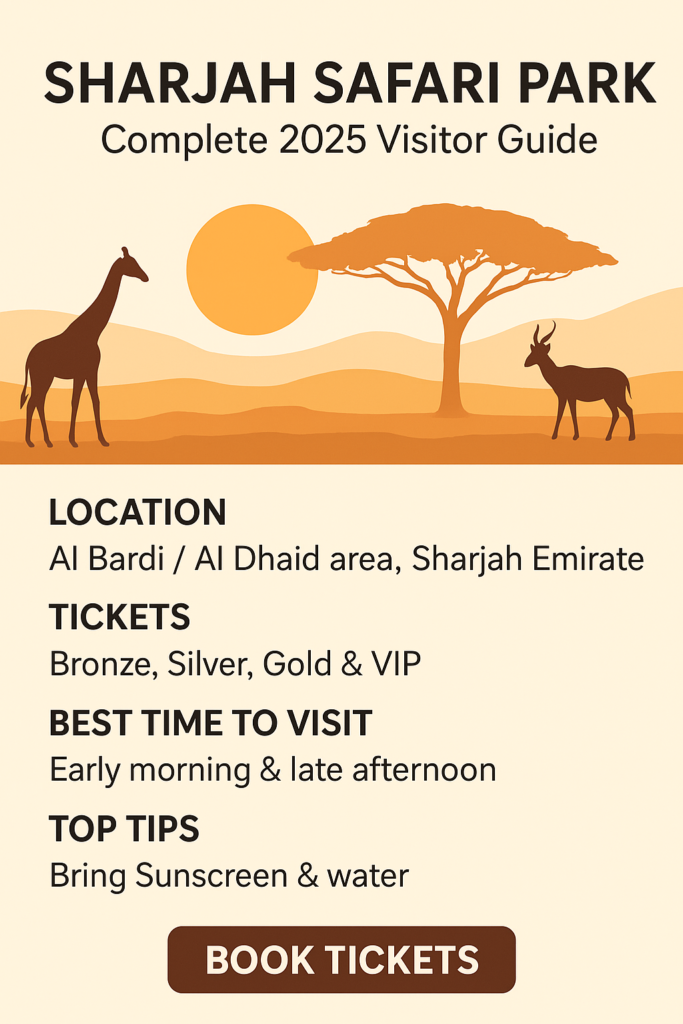
Quick facts — at a glance:
- Name: Sharjah Safari Park (also referenced as Sharjah Safari / Al Bardi Reserve).
- Location: Al Bardi / Al Dhaid area, Emirate of Sharjah. Confirm GPS before you leave (use the official map).
- Typical opening hours: Park generally opens early morning and closes in the early evening; confirmed schedules and last-entry vary by ticket type — always check the official booking portal before travel. Example published hours indicate openings around 06:30–18:30 on selected days, with standard public hours from ~08:30–18:30.
- Ticket types: Bronze (basic), Silver (guided drive), Gold (walking + premium access), and VIP/private tours. Book on the official ticketing site to reserve a timed slot.
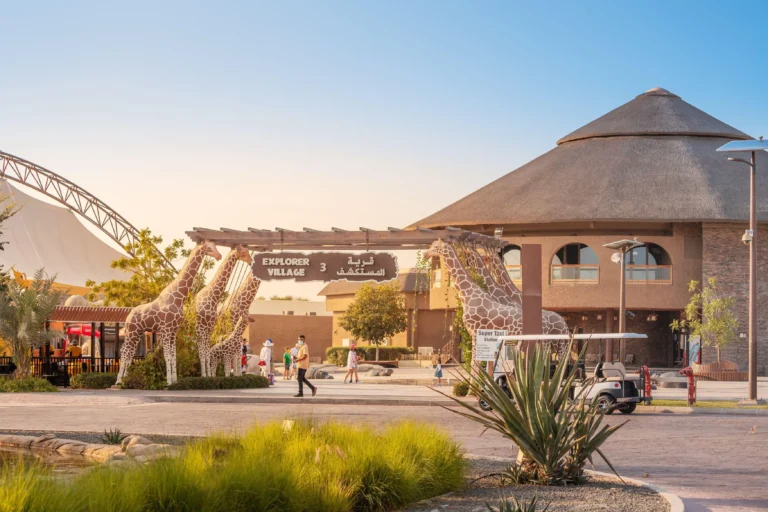
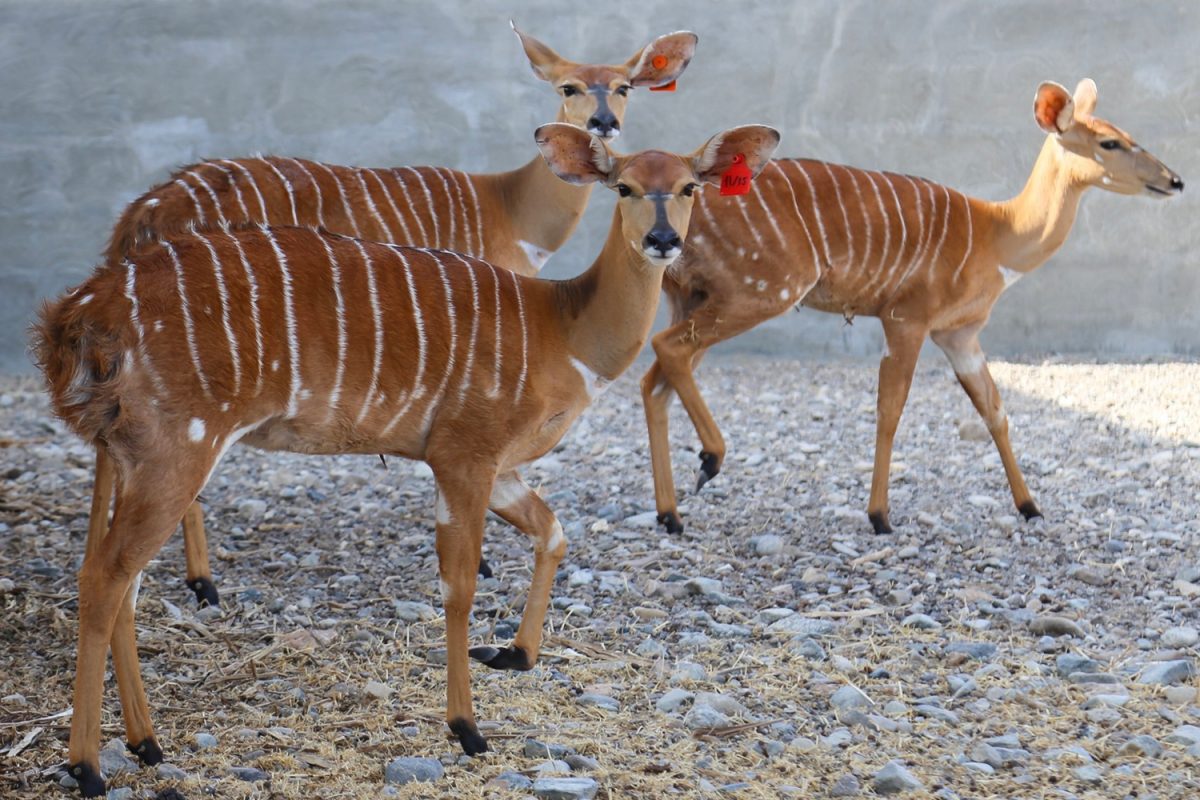
- Park size & animals: Multi-zone reserve with habitat-style enclosures — giraffes, zebras, rhinos, antelope, birds, and big-cat viewing zones.
- Why visit Sharjah Safari Park
- Location & how to get there
- Canonical coordinates & mapping
- Driving tips (utterances & microcopy)
- Parking & gate names (UX microcopy)
- Ride-share / taxi
- Tickets explained — Bronze, Silver, Gold & VIP.
- Best time to visit & seasonal tips
- Daily rhythm (what the animals “tell us”)
- Seasonal guidance (climate-aware scheduling)
- Weekend & holiday demand
- Three ready-to-use itineraries
- Family Day — 4–5 hours (easy, kid-friendly)
- Photographer’s Sunrise — 3–4 hours (Gold recommended)
- Express Half-Day — 2–3 hours (Bronze)
- What to expect on a visit — step-by-step timeline
- Best photo spots & camera tips
- Top photo locations (keypoint anchors)
- Gear & settings (microcopy)
- Practical logistics — parking, ride-share, accessibility, fees
- Parking
- Ride-share & taxis
- Accessibility
- Payment & booking
- What to pack & health/safety checklist
- Pros & cons
- FAQs
- Final verdict
Why visit Sharjah Safari Park
Frame the visitor experience as a set of user intents. This helps both content structure and on-page semantic markup (FAQ/FAQPage, HowTo, and Dataset snippets).
Primary visitor personas
- The family planner (informational + transactional intent): wants safety, toilets, a picnic area, kid-friendly routes, and a simple itinerary.
- The photographer (visual & temporal intent): wants early sunrise access, walking vantage points, lens recommendations, and EXIF suggestions.
- The explorer/nature student (learning intent): looks for conservation messaging, animal welfare, breeding programs, and education activity schedules.
- The value traveler (price/slot intent): compares Bronze vs Silver vs Gold versus VIP for time and cost trade-offs.
Why it converts: Sharjah Safari offers an “African-style” multi-environment experience within reach of UAE population centers — high relevance for family day trips and specialty photography pages. Use intent-focused headings (e.g., “Family itinerary — 4–5 hours”) so that search engines can map queries to the right content node.
Location & how to get there
Canonical coordinates & mapping
Publish a single canonical GPS point (lat/long) near your H1 and in the opening paragraph: 25.228497, 55.951584 — this matches public map entries and reduces “wrong gate” queries in directions. (Always verify on the official map before publishing.)
Driving tips (utterances & microcopy)
- “Set destination to ‘Sharjah Safari — Main Gate’ in Waze / Google” — include phone & a short “if lost” script: call park reception.
- Last-mile: some unpaved/gravel lanes close to the park — avoid very low-clearance cars after heavy rain. Suggest search query examples: “Sharjah Safari best way from Dubai” and provide ETA ranges (40–60 minutes from central Sharjah/Dubai, depending on traffic).
Parking & gate names (UX microcopy)
- On-site parking is located adjacent to the visitor plaza/ticketing hub. Publish a tiny labeled parking map with 2–3 photos: “Parking zone A — main entrance”, “Short-stroll route for families with strollers.” The park website’s map services page is a good source for your map image/annotations.
Ride-share / taxi
- For Careem / Uber directions, recommend drop-off at “Sharjah Safari main gate” and instruct drivers to call the park if unsure. Including the park phone number reduces missed drop-offs and saves users time.
Tickets explained — Bronze, Silver, Gold & VIP.
Provide a compact, scannable comparison table with intent labels (budget, guided, premium, VIP) and the operational details (duration, best-for, last-entry rules). Use the official ticket portal as the canonical link in your CTA.
| Ticket | Typical inclusions | Typical duration | Best for |
| Gold | Priority entry, guided walking segments, premium vantage points, smaller groups (sometimes private vans / AC options) | 4–6 hrs | Photographers & wildlife enthusiasts. |
| Silver | Guided drive tour across multiple zones with narration | 4–6 hrs | Families wanting comfort + commentary. |
| Bronze | Basic walking tour/short loop (cheaper, less access) | 2–3 hrs | Budget visitors, quick stops. |
| VIP / Private | Private guide, private vehicle/van, tailor-made route & times | As arranged | Private groups, commercial shoots. |
Pricing signals: Published ticket rate snapshots (subject to change) have shown Bronze from ~AED 40, Silver ~AED 120–140, Gold ~AED 275 (adult), with child prices lower for some packages. Report these as “example rates” and link to live pricing on the ticket portal.
Timeslot controls & last-entry
Gold & Silver often have earlier last-entry windows; Bronze sometimes allows later entry. Always show and link to the official booking page so users don’t rely on stale copy. Example guidance: Gold & Silver last entry often closes around early afternoon — check live before you go.
Best time to visit & seasonal tips
Daily rhythm (what the animals “tell us”)
- Early morning & late afternoon: highest animal activity; better light for photography.
- Midday: heat-driven low activity, many Animals rest or seek shade.
- Carnivores: more active at dawn/dusk.
- Herbivores: often near water, mid-morning.
Seasonal guidance (climate-aware scheduling)
- Cool months (Nov–Mar): ideal for walking segments and full-day visits.
- Summer (Jun–Sep): extreme heat — choose early-morning slots or short Bronze loops. Provide hydration microcopy and shade tips.
Weekend & holiday demand
- Fridays and national holidays fill early — recommend booking weeks ahead during peak season (Nov–Mar).
Three ready-to-use itineraries
Provide copy-paste itineraries with slot timings and microcopy for the visitor’s calendar invites. These are designed as small task automations (add to calendar + notes).
Family Day — 4–5 hours (easy, kid-friendly)
- 08:15 — Arrive early; park and take a photo of your car location.
- 08:45 — Ticket validation & short safety briefing.
- 09:00 — Silver guided drive (commentary + kid-friendly stops).
- 11:30 — Shaded picnic/playground stop.
- 12:30 — Short accessible walking loop & souvenir shop.
- 13:00 — Leave; stop for refreshments on the way back.
Photographer’s Sunrise — 3–4 hours (Gold recommended)
- 05:30 — Arrive; check in and prep gear.
- 06:00–09:00 — Gold walking segments + vantage points. Use 200–400mm lenses for distant mammals; 70–200mm for mid-range.
- 09:15 — Short break and exit.
Express Half-Day — 2–3 hours (Bronze)
- 10:00 — Bronze drive loop — highlights only.
- 11:30 — Quick walk at the main viewing platform.
- 12:00 — Depart.
These itineraries are ideal as one-page PDFs — put each itinerary on its own capsule card to increase shareability and CTR.
What to expect on a visit — step-by-step timeline
Think of a visit as a short conversation between the user and the venue. Each node in the visit flow can be its own page fragment (anchor-link), improving dwell time and internal link signals.
- Arrival & parking — locate parking zone, document car spot.
- Ticketing & security — staff may check timeslot confirmations; keep your booking screenshot handy.
- Safety briefing/boarding — short instructions for guided drives.
- Guided vehicle loop (Silver/Gold) — narration, stops & photo chances.
- Walking zones & viewing platforms (Gold) — closer vantage points, controlled group sizes.
- Exit, gift shop & café — pick up souvenirs and refreshments.
Best photo spots & camera tips
Top photo locations (keypoint anchors)
- Central savannah / open plains: great for giraffes & zebras — long sightlines.
- Watering holes: rhinos and grazers gather — strong mid-morning frames.
- Carnivore zones: dawn/dusk for more dynamic behavior.
- Walking vantage points (Gold): more controlled positions for portraits & close-ups.
Gear & settings (microcopy)
- Lenses: 200–400mm for distant mammals; 70–200mm for mid-range; 24–70mm for context & visitor shots.
- Tripod/monopod: useful for dawn low-light; monopod preferred for mobility.
- Settings: shoot RAW, use fast shutter speeds for moving subjects, keep ISO low where possible.
- Etiquette: no flash, follow staff instructions, never provoke animals for a photo.
Practical logistics — parking, ride-share, accessibility, fees
Parking
- On-site parking near the ticket plaza. Add a Downloadable “shortest walking route” image for families & strollers.
Ride-share & taxis
- For Careem / Uber, set the destination to the main gate. Give drivers the park phone number in your microcopy so they can call if GPS misroutes them.
Accessibility
- The park includes guided vehicles and accessible routes in key sections — but accessibility specifics vary by package; advise callers to confirm when booking.
Payment & booking
- All official tickets are sold through the Sharjah Safari ticketing portal. Timeslots and seat options can change, so link to live booking to avoid stale guidance.
What to pack & health/safety checklist
Provide a printable table and short checklist microcopy.
| Item | Why it matters |
| Sunscreen & wide hat | Strong UAE sun; shade limited |
| Refillable water bottle | Hydration — vendors are limited in some zones |
| Binoculars | Spot animals at a distance |
| Camera & spare batteries | Extra memory & power for long visits |
| Lightweight layers | Warm mornings, potentially cool early hours |
| Snacks for kids | On-site dining may be limited |
| Basic first-aid kit | For minor scrapes or insect bites |
| Booking screenshot / QR | Staff may check timeslot allocations |
Health & safety rules (short bullets)
- Stay inside vehicles unless instructed otherwise.
- Keep hands/arms inside cars — animals are wild.
- Supervise children at all times.
- Shorten visits during heatwaves; drink water often.
Pros & cons
Pros
- Large, immersive safari-style reserve close enough for day trips from major UAE cities.
- Tiered ticket options to match budgets and visit goals.
- Excellent photo opportunities for sunrise/late-afternoon sessions.
Cons
- Remote-ish: expect a 40–60 minute transfer from central Sharjah/Dubai — include transport options on your page.
- Confusing last-entry windows — always confirm times when booking.
- Limited on-site dining reported by some visitors; plan accordingly.
FAQs
A: In the Al Bardi / Al Dhaid reserve in the Emirate of Sharjah. Use the official map/GPS for directions.
A: The park commonly opens early morning and closes in the early evening; last-entry times differ by ticket type. Always check the official booking portal before visiting.
A: Bronze = budget, short drive/walk; Silver = guided drive with commentary; Gold = walking segments and premium access (best for photographers).
A: Mostly no — the park operates guided vehicles for safe animal viewing. Check the official rules for specific private-vehicle options.
A: Refunds depend on the package and booking terms. Check the official booking page for the package-specific refund policy at purchase.
Final verdict
Verdict: Sharjah Safari Park is a high-value destination for Families and wildlife photographers; it converts well when your page reduces friction around transport, booking timeslots, parking, and what to expect. The main pain points for visitors are the remote location, timeslot rules, and limited logistical info — exactly where your content can win.