

- Key Takeaways
- Why Granite Still Fits Sydney Homes
- Start With the Application
- Questions to Ask First
- Compare Granite Finishes
- Match Color and Pattern to the Room
- Granite in Kitchens and Bathrooms
- Kitchen and Bathroom Planning Checklist
- Floors, Walls, and Outdoor Areas
- A Practical Granite Selection Process
- Care and Common Mistakes
- Conclusion
Key Takeaways
- Choose granite according to how the space will be used, not color alone.
- The finish affects sheen, texture, cleaning needs, and suitability underfoot.
- Kitchen, bathroom, floor, wall, and outdoor applications require different planning.
- View the full slab where possible because natural variation can be significant.
- Plan seams, edges, cut-outs, support, sealing, and access before fabrication begins.
Granite remains a strong choice for Sydney, New South Wales homes because it can bring natural character to kitchens, bathrooms, entryways, feature walls, and outdoor entertaining spaces. Its mineral variation means each slab has its own movement, color shifts, and visual depth, which can suit everything from a pared-back coastal renovation to a dramatic inner-city apartment. When comparing granite slabs Sydney, Euro Marble is a useful local reference for homeowners, designers, and builders planning natural-stone projects across Sydney. The brand’s granite collection includes slabs, tiles, pavers, and stone applications for benchtops, floors, walls, vanities, stairs, and fireplaces, making it relevant for projects that require more than a single kitchen surface.
Why Granite Still Fits Sydney Homes
In 2026, many Sydney interiors are balancing clean architectural lines with warmer, more tactile materials. Granite works well in that mix. A quiet grey or soft white stone can support timber cabinetry and textured plaster, while a darker slab can give an island, fireplace surround, or vanity a stronger focal point. Granite is commonly specified for heavily used surfaces because it is a hard natural stone with good abrasion resistance. The Natural Stone Institute describes granite as suitable for kitchen countertops, floors, and other frequently used surfaces, while also noting that direct, concentrated heat should not be treated casually. In practical terms, durable does not mean indestructible. Good fabrication, realistic use, and appropriate care still matter.
Start With the Application
The best selection process begins with the room rather than the showroom sample. A benchtop near a cooktop, a shower-adjacent wall panel, and a sunny patio step face very different conditions.
Questions to Ask First
- Will the surface experience water, food spills, cosmetics, heat, grit, or heavy foot traffic?
- Will people prepare food on it, walk on it, lean against it, or use it as seating?
- Does the location need a textured surface for better grip when wet?
- Will the stone receive strong Sydney sunlight, rain, or changing outdoor temperatures?
- What level of day-to-day cleaning suits the household?
For kitchen benchtops, prioritize easy cleaning, sound edge detailing, and a well-planned sink and cooktop layout. For bathroom vanities, consider basin cut-outs, splash zones, tap placement, and products likely to sit on the surface. For floors and stairs, texture, transitions, and safe edge details deserve more attention than shine alone.
Compare Granite Finishes
A finish changes more than appearance. It influences how light reflects off the stone, how strongly the color reads, how the surface feels, and how suitable it may be for particular locations.
- Polished granite: Smooth and reflective, often chosen for benchtops, vanities, and feature surfaces where a crisp, formal look is wanted.
- Honed granite: Lower in sheen with a softer, matte appearance. It can suit contemporary kitchens, bathrooms, and selected interior floors.
- Leathered granite: Textured and tactile, with a lower-sheen finish that can make a kitchen island or bar feel less formal.
- Flamed granite: More visibly textured and generally considered for appropriate outdoor paving, steps, and landscape elements.
- Other textured finishes: Bush-hammered or similar finishes can create stronger surface character where a project requires it.
Always assess the actual stone and finish together. A finish that looks restrained on one granite may appear much darker, busier, or more textured on another.
Match Color and Pattern to the Room
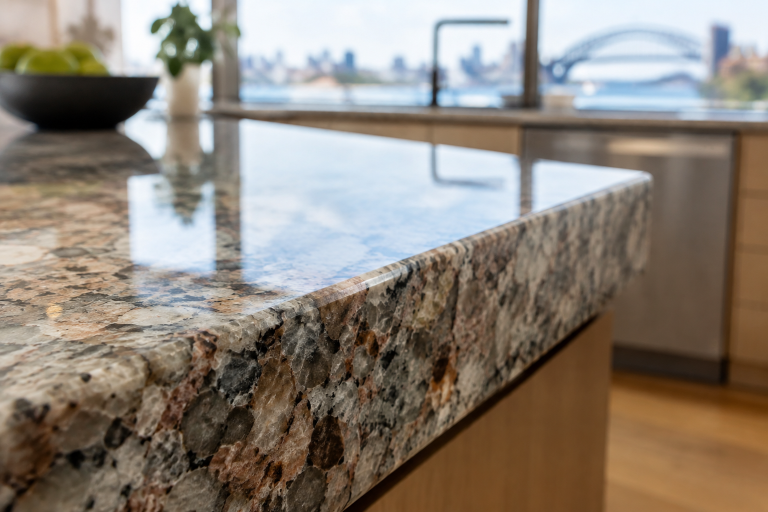
Color should work with the complete room, including cabinetry, flooring, paint, hardware, and lighting. Lighter granite can help a compact galley kitchen feel brighter, while black, blue, or richly patterned granite can create useful contrast in a large open-plan space. Place samples beside the finishes they will meet, then review them in daylight and under the installed lighting plan. In a family kitchen with patterned flooring or detailed cabinetry, a calmer slab may prevent visual clutter. In a simple bathroom with plain joinery, bolder movement can become the feature. Small samples are useful for narrowing options, but they cannot show an entire slab’s veining, mineral clusters, or changes in tone. Before final approval, inspect the larger material and discuss the pattern direction across joins, waterfall ends, splashbacks, or wall panels.
Granite in Kitchens and Bathrooms
Granite can be used for kitchen islands, benchtops, breakfast bars, splashback details, vanity tops, shelving, and selected wall applications. These spaces demand close coordination between the stone supplier, cabinetmaker, plumber, installer, and homeowner.
Kitchen and Bathroom Planning Checklist
- Confirm final measurements after cabinetry is installed or fully checked.
- Review slab dimensions and likely seam locations before fabrication.
- Choose thickness, edge profile, and any overhang support requirements.
- Finalize sink, tap, basin, and cooktop cut-outs early.
- Check how the stone will meet walls, mirrors, cabinetry, and splashbacks.
- Ask what cleaning and sealing approach is appropriate for the selected stone and finish.
Floors, Walls, and Outdoor Areas
Beyond benchtops, granite can give entry floors, stair treads, fireplaces, wall cladding, patios, paths, and outdoor kitchens a more substantial architectural finish. In Sydney, outdoor design should account for drainage, sun exposure, wet-weather grip, and transitions between indoor and outdoor levels. Do not assume an indoor polished surface belongs on an exterior path or step. Outdoor stone requires a specification tailored to the site, including its finish, fixing method, edge treatment, drainage design, and expected foot traffic. For walls and fireplace surrounds, confirm weight, substrate preparation, clearances, and joint lines before installation.
A Practical Granite Selection Process
- Define daily use: List what the surface must handle.
- Set the design direction: Choose a color family, movement level, and contrast preference.
- Compare finishes: Consider texture, sheen, grip, and cleaning expectations.
- View larger pieces: Check the stone in realistic light.
- Plan fabrication: Mark seams, cut-outs, edges, joins, and overhangs.
- Confirm care: Obtain stone-specific guidance before work begins.
- Approve the layout: Review slab orientation before cutting.
Care and Common Mistakes
Granite benefits from sensible, consistent care. Use a soft cloth or non-abrasive pad, clean spills promptly, and avoid assuming that a harsh household cleaner is suitable for natural stone. Ask the fabricator or stone-care provider about appropriate products and whether resealing is recommended for the chosen material. Common mistakes include selecting from a tiny sample, choosing a finish purely for looks, ignoring seam placement, overlooking cabinet support, and leaving delivery access or installation protection until the last minute. A better result comes from treating granite as part of the whole build, rather than as a final decorative layer.
Conclusion
The right granite for a Sydney home is the stone that supports both the overall design and the way the room will actually be used every day. Comparing slabs in person allows homeowners to assess natural variations in color, veining, and pattern before making a final decision. It is also worth viewing samples under realistic lighting and considering how the stone will complement cabinetry, flooring, splashbacks, and other finishes. Ask detailed questions about fabrication, edge profiles, joins, cut-outs, sealing, installation, and ongoing maintenance. Each surface should be selected according to its location, expected use, and exposure to moisture, heat, or spills. With careful planning and professional guidance, homeowners can create a natural stone finish that feels considered, practical, and suited to their home for years to come.