Introduction
The Thar — Rajasthan’s Great Indian Desert — is a landscape of sweeping dunes, salt flats, and living heritage, where rooftop forts, camel columns, and fragile grasslands meet. This compact guide provides practical timing, wildlife context, responsible-travel checks, and ready-to-use 1/3/7-day itineraries, allowing you to plan memorable, low-impact visits to Jaisalmer, Sam, the Desert National Park, and surrounding towns.
Quick facts — at a glance
- Location: Northwestern Indian subcontinent; primarily Rajasthan (also parts of Gujarat, Punjab, Haryana, and across the border into Pakistan).
- Common name: Thar Desert (Great Indian Desert).
- Area: Commonly cited figures for the Thar range from ~200,000 km² to ~264,000 km², depending on boundary definitions.
- Main gateway towns: Jaisalmer, Jodhpur, Bikaner, Barmer.
- Key protected area: Desert National Park (near Jaisalmer; ~3,162 km²).
- Best time to visit: October–March for pleasant days and starry nights.
Why visit the Thar?
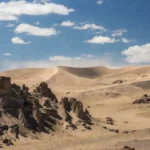
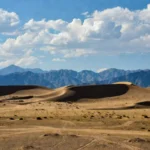
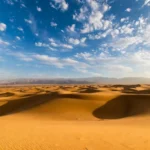
- Stunning landscapes: sweeping dunes, flat salt pans, rocky outcrops, and long horizon lines for dramatic images.
- Living culture: forts, havelis, textile crafts, folk music, and desert cuisine.
- Wildlife: desert-adapted mammals and birds (including priority conservation species).
- Unique experiences: camel safaris, jeep drives on dune edges, multiday treks, fossil parks, and winter festivals.
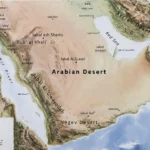
Geography & landscape: a concise map for planners
The Thar is an ecological mosaic rather than one uniform surface. Key landscape types:
- Mobile sand seas (ergs): moving dunes that shift seasonally — biggest around Sam and Khuri near Jaisalmer.
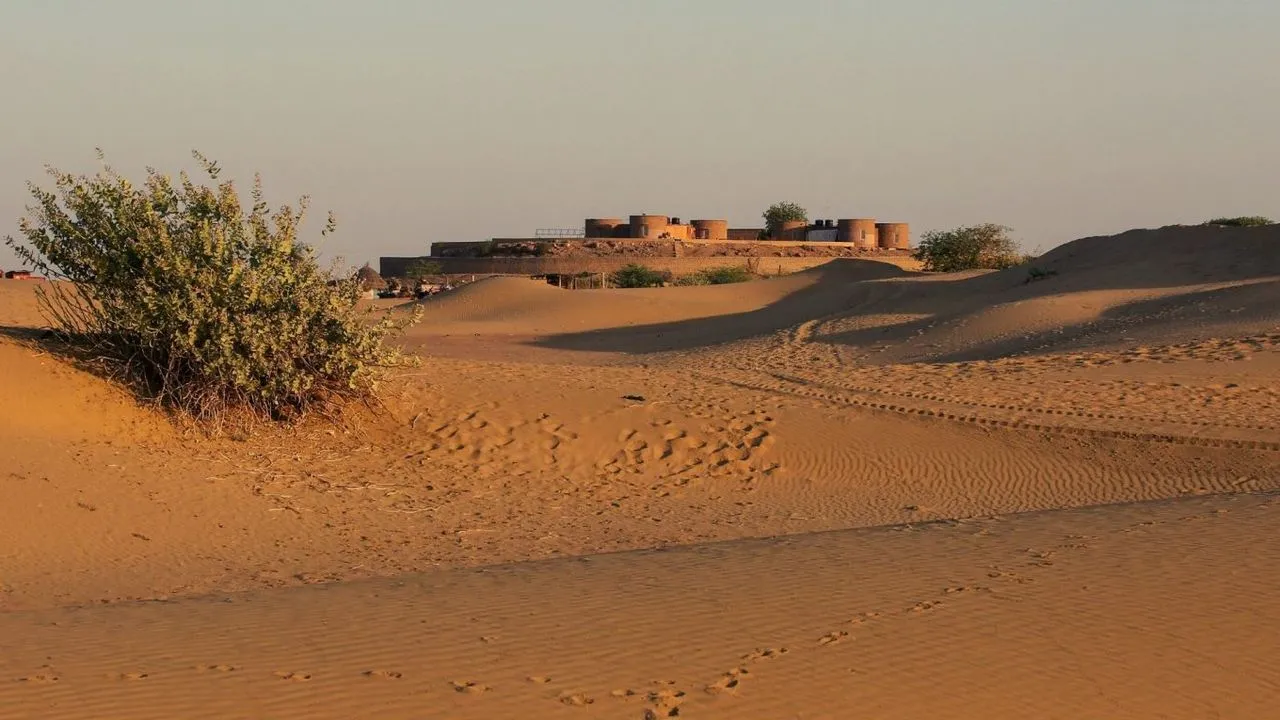
- Stabilized dunes & scrub: dune fields bound by shrubs and grasses that reduce sand mobility.
- Salt pans & flats: Sambhar, Pachpadra, and other playas that collect monsoon water and leave reflective crusts.
- Rocky plateaus & outcrops: hard substrata in parts of Barmer and western Thar.
- Desert grasslands: low, stunted steppe that supports ground-nesting birds and small mammals.
Understanding this mix helps you pick targets: big picture dunes (Sam/Khuri), conservation birding (Desert National Park), or heritage and markets (Jaisalmer/Bikaner).
Climate & when to go — an NLP month-by-month timing sheet
Short rule: travel October–March for the most comfortable conditions, best light for photography, and active cultural events. Official climatology used by Rajasthan tourism highlights pleasant winter days (10–27°C) and hot pre-monsoon extremes (up to 45°C).
Month snapshot (useful for planning search intents and trip copy):
- January–March: Cool mornings, mild days (10–27°C). Excellent festival and photographic window.
- April–June: Very hot (30–45°C+). Best avoided for long outdoor itineraries unless you plan dawn/dusk activity.
- July–September (monsoon): Low but variable rainfall; green flushes after rains can yield rare photographic contrast, but heavy rains occasionally affect rural roads.
- October–December: Comfortable days, cold nights; peak festival and event season (book early).
Flora & fauna — what to expect and how to frame this for wildlife SERPs
Vegetation: drought-tolerant shrubs (Acacia species, Prosopis juliflora in invaded pockets), halophytes near salt pans, and cultivated bajra (pearl millet) in irrigated areas. Vegetation stabilizes dunes and curtails erosion.
Mammals to watch for: chinkara (Indian gazelle), blackbuck in localized pockets, desert foxes, and occasional nilgai. Sightings are dependent on time of day, seasonal water, and local protection measures.
Birdlife: The Thar supports a suite of dry-land birds — sandgrouse, larks, raptors, and historically the Great Indian Bustard (GIB). The GIB requires expansive, undisturbed grassland and is highly sensitive to habitat fragmentation and overhead infrastructure. National conservation actions and court rulings have constrained new infrastructure in priority areas to reduce collision risk and habitat loss.
Reptiles & invertebrates: expect lizards, sand vipers, scorpions, and a huge diversity of arthropods that underpin soil health. For wildlife copy, emphasise patience, local guides,s and early-morning windows for higher detection rates.
Human history, towns & culture — structured narrative for long-read SEO
Caravan towns & trade routes: Jaisalmer and Bikaner expanded as trading hubs along trans-regional caravan lines; their forts and merchant havelis reflect wealth accumulated from salt, textiles, and camel-caravan commerce.
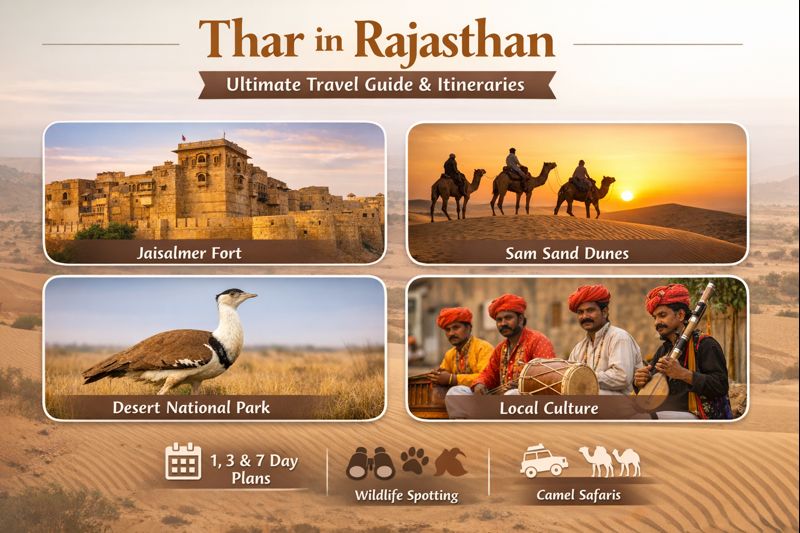
Jaisalmer Fort: a living fort with populated lanes, rooftop cafés, and shopper footfall at sunset — a principal anchor for tourists and a prime example of living heritage.
Folk culture: strong oral traditions, unique musical instruments (e.g., kamaycha), turban-tying styles, and traditional crafts (block printing and embroidery). Communities like the Bishnoi are well-documented for informal Conservation customs.
Content tip: pair cultural descriptions with micro-howtos (“how to respect village etiquette”) and local interviews or micro-quotes for authenticity.
Top experiences & attractions
- Sam & Khuri dunes — sunset camel rides, jeep safaris, overnight luxury and community camps, and star photography. Sam is busier and easier to service; Khuri is quieter and more solitary.
- Jaisalmer Fort & Havelis — Patwon Ki Haveli, narrow lanes, and sunset rooftop views.
- Desert National Park — ranger drives and birdwatching representing Thar ecosystems; park area ~3,162 km². Book guides and entry in advance.
- Bikaner — forts, sweets (rasgulla/feathered local sweets), and the Karni Mata Temple (rat temple) for a culturally unique visit.
- Village workshops — textiles, embroidered crafts, and traditional meals (dal-baati-churma).
- Fossil parks — Akal Wood Fossil Park provides geological stories and accessible interpretation.
Sample itineraries
| Itinerary | Ideal for | Highlights | Pace |
| 1-Day (from Jaisalmer) | Short stopover | Jaisalmer Fort, Gadisar Lake, Sam dunes sunset + camel ride | Fast |
| 3-Day Classic | First-time visitors | Fort & markets, Sam/Khuri dunes overnight camp, Desert NP half-day | Moderate |
| 7-Day In-Depth | Culture & wildlife fans | Jaisalmer, Desert NP full day, Bikaner, Barmer, Jodhpur return | Leisurely |
1-Day (quick desert day)
- Morning: Jaisalmer Fort, Patwon Ki Haveli, rooftop chai.
- Afternoon: Drive to Sam Sand Dunes (40–50 km), check into pre-booked camp.
- Evening: Sunset camel ride and cultural program. Return to town or stay overnight.
3-Day (classic circuit)
- Day 1: Arrive Jaisalmer — Fort, market, rooftop sunset.
- Day 2: Heritage walk in the morning; afternoon to Sam/Khuri for dunes, overnight camp.
- Day 3: Early morning dunes; return to Jaisalmer and half-day Desert NP drive (book park entry in advance) or visit Kuldhara ghost village.
7-Day (in-depth)
Days 1–2: Jaisalmer — Fort, markets, local workshops.
3: Sam/Khuri dunes — multi-day camel trek or extended camp.
4: Desert National Park — guided drive and conservation talk.
5: Travel to Bikaner — forts and local culinary stops.
6: Barmer — folk music and craft study.
7: Return via Jodhpur or continue onward.
Practical tips — safety, health & sensible choices
- Water: carry a refillable bottle; 1.5–2 liters for short trips, more for longer walks.
- Clothing: breathable layers, wide-brim hat, sunglasses; warm layers for nights.
- Sun & heat: schedule active outdoor time early/late; use broad-spectrum sunscreen and electrolytes.
- Health & medicines: basic first aid, blister care, prescription meds with doctor’s note.
- Transport: distances are large; use reliable operators and check vehicle condition and fuel.
- Local norms: ask permission before photographing people; support local guides.
- Connectivity: expect patchy mobile signal in remote stretches — leave travel plans with someone.
- Drone rules: many heritage sites and protected areas restrict drones — check DGCA rules and park notices before flying.
Responsible travel & conservation — do’s & don’ts
Do:
- Hire local guides and operators.
- Use refillable bottles; avoid single-use plastic.
- Stay on tracks and avoid trampling vegetation.
- Support community-run tourism and local handicrafts.
Don’t:
- Feed wildlife or leave food waste.
- Ride animals with operators who show mistreatment.
- Drive off established tracks in protected areas.
- Disturb nesting or sensitive habitats.
Conservation context: The Thar is undergoing pressure from habitat fragmentation and infrastructure development. The Great Indian Bustard has been a particular focus of legal and policy action to protect priority habitats and reduce collision risks from power lines and renewable energy infrastructure.
Where to stay — quick decision tree
- Luxury desert camps (Sam): private tents, curated cultural programs, and often solar energy. Good for comfort and romantic stays.
- Heritage havelis (Jaisalmer): central, atmospheric, and well-placed for sightseeing.
- Mid-range boutique hotels & guesthouses: comfortable town bases.
- Budget hostels & guesthouses: economical options in Jaisalmer and Jodhpur.
- Sustainability tip: ask camps about water management, waste handling, and local employment.
Booking & transport — how to get there and move around
- By air: Jaisalmer airport (small) and Jodhpur airport (better connectivity). Arrange transfers or taxis.
- By train: Jaisalmer and Jodhpur rail links to Jaipur and Delhi; overnight trains are common.
- By road: National highways connect major towns; remote dunes require 4x4s or trained jeep drivers.
- Local transport: For dune safaris, prefer operators with verified reviews and transparent animal welfare statements.
Packing checklist — desert essentials
- Refillable water bottle + electrolyte sachets
- Wide-brim hat, sunglasses, SPF 30+ sunscreen
- Breathable long sleeves, layers for cold nights
- Sturdy closed shoes + sandals for camp
- Torch/headlamp, power bank (solar charger helpful)
- Small first-aid kit, blister strips, medicines
- Copies of ID, some cash for rural purchases
- Camera, extra batteries, memory cards
- Lightweight scarf for dust protection
- Binoculars for birding and spotting small mammals
Food & local dishes to try
- Dal-baati-churma — Rajasthani staple (lentils + baked wheat balls + sweet crumb).
- Ker sangri — desert vegetable with beans and berries.
- Bajra rotis — millet flatbreads.
- Local sweets: ghevar and other seasonal confections.
Supporting small dhabas and village eateries helps local economies.
Photography & drone rules
- Best light: sunrise and sunset; dunes and fort faces are best in golden hours.
- Composition tips: use a human, camel, or tree as scale; foreground ridges lead the eye.
- Drones: check DGCA and park restrictions — many heritage and protected areas restrict flights to protect wildlife and privacy.
Responsible camel & animal tourism — what to ask operators
- Do animals get veterinary checkups?
- Are ride times limited and rotated?
- Do handlers follow humane practices and receive fair wages?
- If the operator cannot discuss welfare openly, seek alternatives.
Conservation focus: Great Indian Bustard — short primer
The Great Indian Bustard (GIB) is a large grassland bird requiring wide, open plains for foraging and breeding. It is critically endangered and extremely sensitive to habitat fragmentation; collisions with overhead power lines are a primary modern threat. India has implemented habitat protection measures and legal actions to restrict infrastructure development in priority GIB areas; those policy shifts have influenced how wind and solar projects and associated transmission lines are planned across Rajasthan and Gujarat. For wildlife-minded travellers, supporting protected areas, local conservation NGOs, and low-impact tourism helps conservation goals.
Useful contacts & booking advice
- Desert National Park office — check for ranger-led drives and permit requirements. (Search your preferred contact channel/state forest department.)
- Rajasthan Tourism — for festival dates and general climate guidance.
- Local operators: choose those with verified reviews, transparent animal-welfare policies, and clear water/waste standards.
Book Now CTA copy (website use):
Ready to explore the Thar? Book a vetted 3-day Jaisalmer & Dunes package now — includes airport transfer, a heritage walk, overnight desert camp with cultural program, and a ranger-guided half-day in Desert National Park. Travel responsibly and support local guides.
FAQs
A: October–March. Days are pleasant, nights are cool to cold, and many festivals happen in winter.
A: Many operators run ethical camel safaris. Choose operators who show clear animal care, reasonable ride times, and local welfare standards.
A: Yes — but sightings can be sparse. Desert National Park is the best place for birding and occasional mammal sightings. Book a ranger or local guide.
A: Entry permits and guide fees apply for park visits. Always check the park’s official site or the forest department for current rules and booking steps.
A: Yes — Jaisalmer Fort is called a “living fort” because many residents still live inside it, keeping old traditions alive.
Conclution
The Thar rewards slow travel: choose cooler months, book vetted local guides, and prioritise low-impact experiences that support conservation and communities. With the itineraries, packing tips, and wildlife notes here, you’ll be ready to explore responsibly — bringing home photos, stories, and a positive footprint rather than Footprints on the dunes.