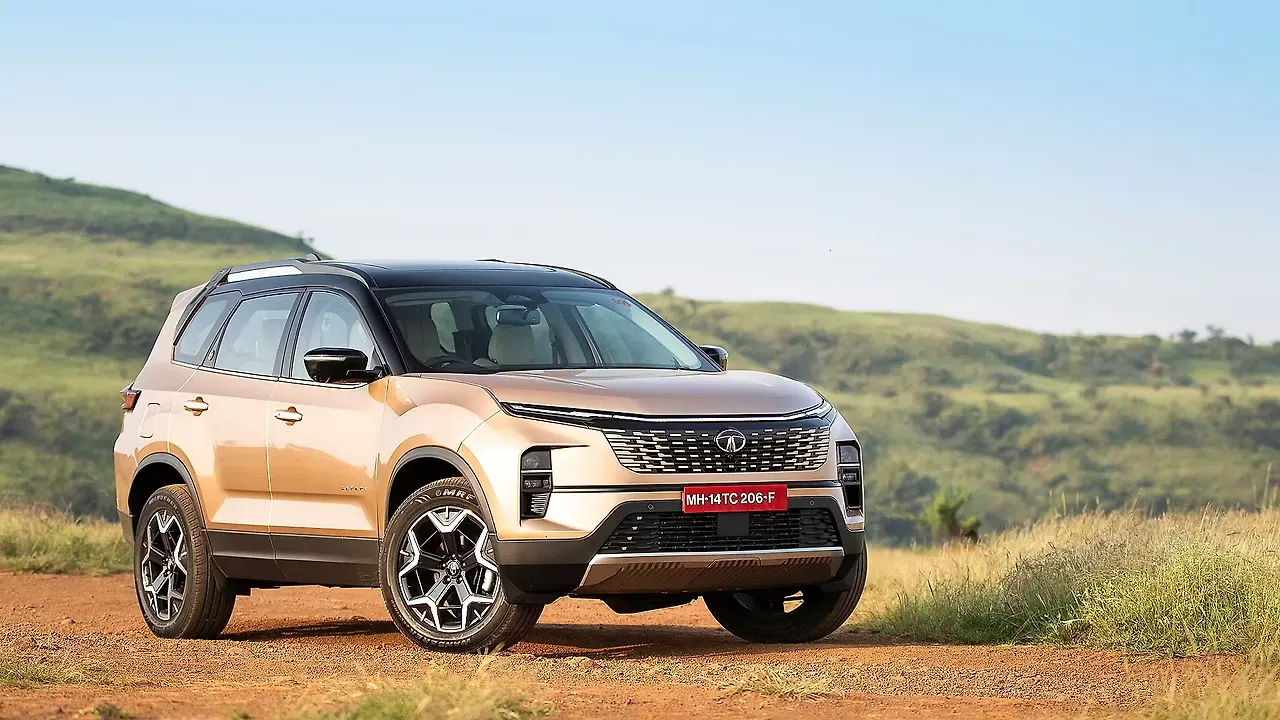
Introduction of Tata Safari 2025
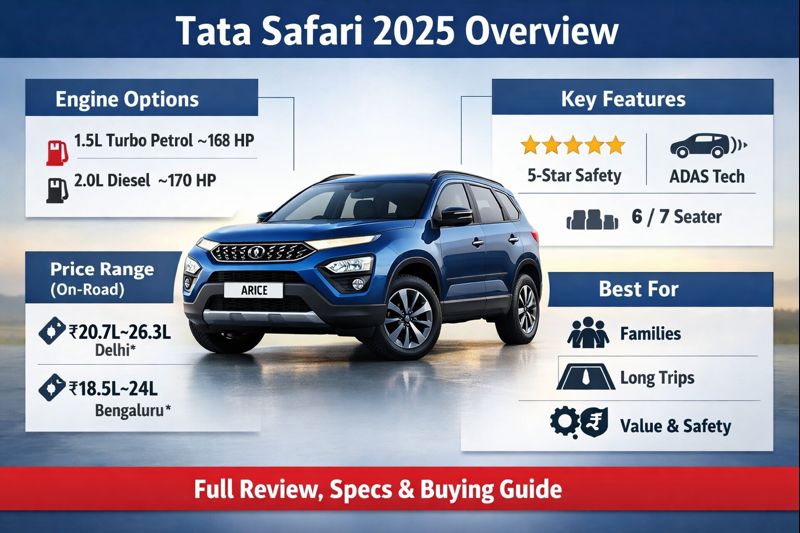
The Tata Safari 2025 is a spacious, safety-first 6- or 7-seater vehicle with modern technology and practical equipment levels, designed for families. If you value passenger protection, usable third-row space and strong equipment per rupee, Safari is a compelling pick. Prefer diesel for laden or long-distance usage; choose the new 1.5-litre Hyperion petrol automatic for calmer city driving and lower NVH on short trips. Always test-drive both drivetrains before you decide.
At a glance — key specs & highlights
| Item | Figure / Note |
| Seating | 6–7 (captain seats in higher trims) |
| Petrol engine | 1.5-litre Hyperion TGDI — ≈168 bhp / 280 Nm (Safari tune). 6-sp MT / 6-sp AT options. |
| Diesel engine | Kryotec 1.96–2.0 diesel — ≈167–170 bhp / ≈350 Nm (variant dependent). |
| Safety | Global NCAP / Safer Choice — 5 stars (adult & child protection). |
| Platform | OMEGARC — Tata’s modular D8-derived architecture. |
| Starting ex-showroom price | ≈₹14.66 Lakh (varies with city & variant). |
| Notable tech | Large touchscreen, wireless mirroring on top trims, OTA updates (trim dependent). |
| Suitability | Families, long-distance commuters, safety-conscious buyers |
Note: Prices and feature availability differ by variant, region and date — always confirm with a dealer for the exact on-road figure and AVAILABILITY.
What’s new for 2025
Tata’s 2025 update for the Safari focuses on two principal moves: expanding powertrain choices (the new 1.5-litre Hyperion petrol) and simplifying the trim ladder while adding distinct Adventure X / Accomplished Ultra variant lines that bring cosmetic differentiation and equipment packages aimed at buyers who want both personality and additional safety tech. Tata has also continued to push OTA improvements, feature packaging rationalisation (fewer, clearer trims), and occasional mid-year pricing or scheme updates, which dealers sometimes reflect as running offers.
Engines, performance & real-world fuel economy
Petrol — 1.5-litre Hyperion TGDI
Claimed output: ≈168 bhp and 280 Nm (Safari tune). The petrol is available in manual and torque-converter automatic forms depending on trim.
How it feels: The petrol Hyperion delivers linear torque through the midrange and feels perky for urban manoeuvres. Expect a refined NVH package,e especially with the AT — that’s the configuration most city buyers prefer. The petrol’s relative lightness and higher rev-happy character make it suited for stop-start traffic and shorter runs, where diesel’s extra torque isn’t fully exploited.
Real-world economy: Mixed driving mid-teens km/l (expect more conservative returns in dense urban use; better on open roads). As always, the AT will usually return slightly less than a manual on identical trips.
Diesel — Kryotec 1.96–2.0
Claimed output: ≈167–170 bhp and ≈350 Nm, tuned to provide solid low-end shove for overtakes and loaded running.
How it feels: Diesel shines when the cabin is full, and luggage is onboard — the torque is available low down, so you don’t need to hustle the gearbox for overtakes. For long intercity hauls with multiple passengers and AC on, diesel’s thermodynamic efficiency often translates into better real-world fuel economy and lower per-kilometre fuel cost.
Real-world economy: Expect higher highway km/l than petrol; in mixed driving, expect figures in the mid-teens, but loaded highway runs can push the diesel figure higher.
Bottom line:
- Choose Petrol AT: if your typical use is urban commuting, you prefer lower NVH and simpler ownership.
- Choose Diesel: if you routinely do long highway trips, carry heavy loads, or regularly travel with a full cabin.
Drive, handling & ride quality
Tata’s tuning for the Safari steers the car toward a comfortable, composed long-distance cruiser rather than a tautly handled SUV. Suspension is tuned to smooth undulations and absorb mid-speed imperfections gracefully; this makes it an easy companion on hours-long drives. At highway speeds, the Safari feels stable with controlled body motions and predictable responses — confidence-inspiring when overtaking or maintaining a steady cruise. Steering is weighted to prioritise stability and low fatigue rather than razor-sharp turn-in; it’s accurate enough for city manoeuvres and comfortable on long stretches.
Brakes & feel: Progressive pedal feel with adequate stopping power for everyday use. Electronic driver aids, including ESC and brake-based functions, help manage mass under emergency inputs.
Use case takeaway: If you prize ride comfort and Stability under load (family outings with luggage), Safari’s chassis tuning will likely please. If you’re after razor-sharp cornering or highly sporting behaviour, rivals with sportier suspension calibration will deliver that — but at a likely cost to day-to-day comfort.
Interior, comfort & family-friendly tech
Space & seating
The Safari’s 6/7 seating flexibility (captain seats as an option on higher trims) is one of its core strengths. The second row in higher variants offers comfortable captain chairs, and the third row is usable for children and shorter adults on medium-length journeys. Folding configurations unlock usable cargo room; the layout focuses on pragmatic family ergonomics.
Materials & ergonomics
Top trims bring leatherette or premium upholstery, soft-touch panels and better fit/finish. Mid and entry trims focus on durable, easy-to-clean materials that work well for family life, where spills and active kids are a reality.
Infotainment & connectivity
High-resolution central touchscreen, smartphone mirroring (wireless on top trims), voice recognition (trim dependent), and OTA updates on select variants give the cabin a contemporary feel. Multiple USB sockets, wireless phone charging on higher variants and rear AC vents are standard family conveniences.
Practicality
Thoughtful cubby provision, numerous cup holders, ISOFIX anchors and multiple airbags make the Safari family-ready. Third-row ingress and egress are competitive for the segment; still, check the third row in person if adults will sit there often — taller adults will want to test comfort on longer hauls.
Safety & ADAS — why Safari stands out
Safety is a major part of the Safari’s proposition. Tata’s Harrier/Safari pair were awarded top marks in Global NCAP testing and have been recognised under the Safer Cars for India programme — this is a clear differentiator for buyers who prioritise occupant protection. The Tata platform, safety structure, and restraint systems contributed to five-star adult and child protection recognition.
Active & passive safety kit: Multiple airbags across trims, ESC, hill-hold, TPMS (on upper trims), ABS with EBD and seatbelt reminder systems. Higher Adventure X / top trims carry ADAS functions: Autonomous Emergency Braking (AEB), lane assist, adaptive cruise and related systems — availability is variant dependent, so confirm what’s fitted on your chosen SKU and get written confirmation.
Why this matters in practice: For family buyers and those comparing three-row options, Global NCAP recognition simplifies decisions: it’s a tangible, third-party validation that the structure, airbags and restraint design deliver measurable occupant protection in standardised tests.
Variants, colours & which trim to pick
Quick variant guidance (practical shortlist)
- City family / daily commute: Mid-range Petrol AT — balanced features and low NVH.
- Frequent long trips / full family load: Diesel top trim — torque for loaded running and better highway efficiency.
- Budget-conscious: Entry or mid diesel/manual — core features at a lower cost.
- Feature lovers/trophy buyers: Adventure X / Stealth top trims for ADAS, cosmetic packs and highest equipment.
Example variant recommendation (by use case)
| Use case | Recommended trim type |
| Daily commute (2–4 people, city) | Petrol AT — Mid trim |
| Large family & highways | Diesel — Top trim (Adventure X / Accomplished) |
| Tight budget | Base/mid Diesel manual |
| Want ADAS & styling | Adventure X / Accomplished Ultra / Stealth editions |
Variant tip: ADAS and certain connectivity features are heavily variant dependent — if ADAS is a must-have, insist on written confirmation of the feature list before purchase.
Prices & example city on-road figures
Representative examples. RTO, taxes and insurance vary by city and change frequently — use dealer calculators for exact figures.
Starting price (ex-showroom): Tata lists a base price in the mid-₹14 Lakh bracket for entry diesel variants. Example promotional pages and price lists show base ex-showroom figures ~₹14.66 Lakh.
Representative on-road bands (mid/popular trims):
- New Delhi: Typical on-road price for a mid to top popular trim can range roughly ₹20.7 Lakh to ₹26.3 Lakh depending on trim and options.
- Mumbai: Mid trims often land in the ₹22–25 Lakh on-road band.
- Bengaluru: Mid to top configurations typically come in around ₹18.5 Lakh – ₹24 Lakh on-road, variant dependent.
Dealer negotiation tip: Ask for a detailed on-road breakdown: ex-showroom, RTO, insurance, handling, and any dealer accessory/fitment charges. Dealers often run monthly or seasonal schemes; get two written quotes for comparison.
Ownership costs, warranty & maintenance
Servicing & maintenance
Service intervals are commonly set at 10k–15k km or annual ritual checks, depending on usage. Diesel engines may need more frequent consumables attention (filters, oil changes) if you do a lot of short urban trips. Tata dealers sell prepaid maintenance and extended warranty packages, which can be cost-effective if you plan to retain the car for multiple years.
Fuel & running costs (rough)
- Petrol AT: mid-teens km/l in mixed driving → expect higher fuel cost per km in city traffic.
- Diesel: generally better on highways; lower per-km fuel cost on long trips. Exact numbers vary with speed, load and driving style.
Insurance & depreciation
Mid-segment SUVs tend to depreciate moderately; the choice of colour and very high-end trims can slightly affect resale velocity. Comparing insurance quotes and shopping for third-party add-ons often reduces annual premium costs.
Tips to reduce costs
- Buy prepaid maintenance if you plan long retention (3–5 years).
- Compare insurance providers, especially for add-on covers; dealer premiums sometimes include commissions.
- Source common accessories (floor mats, roof rails) outside the dealer if you find a better value.
Competitor comparison — Safari vs Alcazar vs Hector Plus vs Fortuner
| Model | Seats | Typical strengths | Where Safari wins |
| Hyundai Alcazar | 6/7 | Refinement, dealer reach | Safari > safety credentials, rugged presence |
| MG Hector Plus | 6/7 | Tech ecosystem, cabin space | Safari > third row ergonomics and safety validation |
| Toyota Fortuner | 7 | Brand cachet, off-road ruggedness | Fortuner > long term resale & proven toughness; Safari > modern safety + value |
Verdict in plain terms:
- Fortuner remains the pick if brand prestige, resale and rugged, ladder-frame durability are critical.
- Alcazar wins if you want a dealer network & refinement.
- Hector Plus is for tech and interior space.
- Safari is best for buyers who prioritise safety, family practicality and value for equipment.
Detailed specs table
| Spec | Petrol TGDI (1.5 Hyperion) | Diesel Kryotec (1.96–2.0) |
| Power (bhp) | ≈168 bhp. | ≈167–170 bhp. |
| Torque (Nm) | ≈280 Nm. | ≈350 Nm (approx). |
| Transmission | 6-sp MT / 6-sp AT (variant dependent) | 6-sp MT / 6-sp AT (variant dependent) |
| Seating | 6 / 7 | 6 / 7 |
| Claimed fuel economy | ~16 kmpl (mixed) petrol (claimed varies) | ~16.3 kmpl (claimed varies) — real numbers depend on driving. |
| Safety rating | Global NCAP 5* | Global NCAP 5* |
Pros & Cons
Pros
- Strong safety credentials (Global NCAP Safer Choice recognition).
- Flexible seating (6/7) and usable third row.
- Good equipment levels on mid and upper trims for the price.
- The petrol option adds a quieter, city-oriented choice.
Cons
- Top trims can be pricey and approach larger rivals — compare value vs Fortuner/XUV700.
- Some owner reports note infotainment or small fit-and-finish niggles — these are common conversation points in owner forums.
- Petrol economy is mid-teens; diesel may be better for long trips.
FAQs
A: Yes — if you want a spacious 6/7-seater with a strong safety score and rich equipment levels at a competitive mid-segment price. Diesel suits long trips/heavy use; Petrol AT suits city commuting and quieter cabin priorities.
A: The 1.5-litre Hyperion TGDI petrol in the Safari is tuned to roughly 168 bhp and 280 Nm.
A: Expect mid-teens km/l for the petrol AT in mixed driving. The diesel returns better highway economy, but real figures vary with load, driving style and traffic.
A: Mid-to-high trims with captain seats (2nd row) offer the best family comfort. For long highway family trips, consider a diesel top trim for torque and economy.
A: Yes — the Safari (and Harrier sibling) achieved five-star recognition from Global NCAP under the Safer Cars for India campaign.
Final verdict
If you prioritise occupant protection, usable three-row space and sound equipment/per-rupee value, the Tata Safari 2025 is high on the shortlist. Choose the Petrol AT mid trim for city-based use, where NVH and smoothness are key Considerations. Choose the Diesel top trim if you routinely haul full loads, run long-distance highway miles, or need maximum low-end torque for overtaking. Before finalising: lock variant details, confirm ADAS availability in writing and get full on-road quotes (including RTO & insurance).