Introduction
This guide treats the Kalahari Desert as both a definable geological basin and a living ecological landscape, giving readers clear definitions, printable A0 maps, GeoTIFFs, MBTiles and ready-to-use GPX route packs. It highlights practical travel anchors across Botswana and key sites like the Okavango Delta and the Makgadikgadi Pans, and explains seasonality, safety, and conservation context so researchers and travellers can plan responsibly.
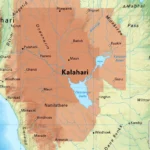
Where exactly is the Kalahari?
In natural-language processing, we talk about tokens, spans, and annotations. Treat the word Kalahari as an ambiguous token with two common annotated senses:
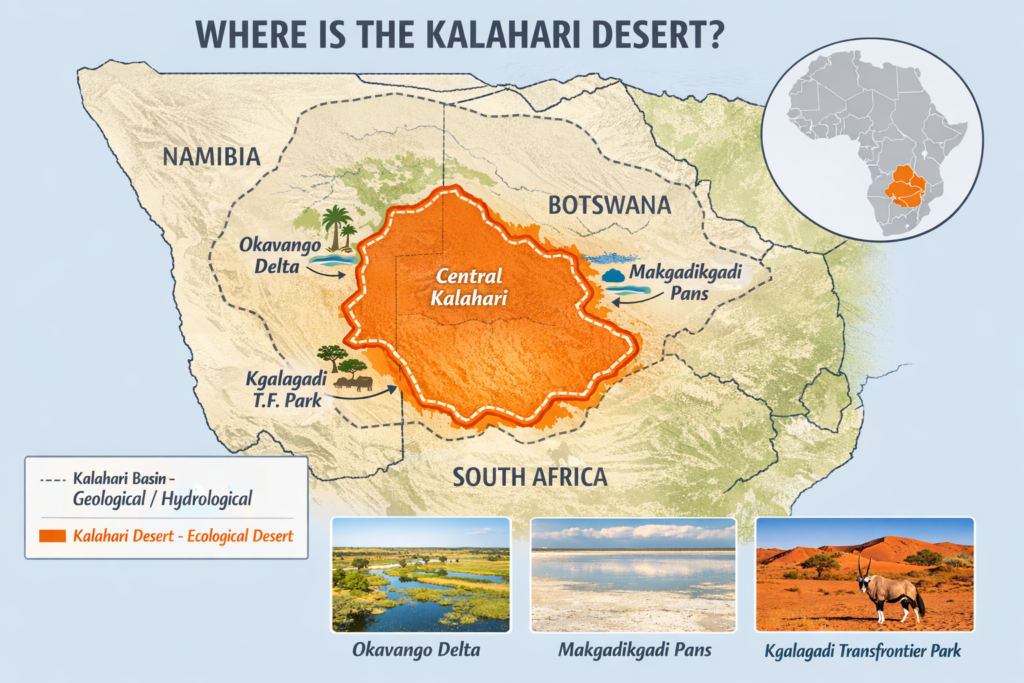
- Kalahari Basin (geological span / long-range context) — this sense tags a broad drainage and sediment basin for which maps often use a low-confidence, high-coverage bounding polygon. When you publish a map, label this layer “basin — geological/hydrological” and include provenance (source and projection). The basin’s full extent explains why published map footprints vary.
- Kalahari Desert (ecological / vegetation span) — this is a higher-precision annotation: a semi-arid ecological polygon where vegetation cover, soil class, and rainfall thresholds meet a defined rule-set (e.g., mean annual precipitation < 450 mm and vegetation dominated by xeric grasses and scattered woody species). Use this as the “core desert” polygon on your printable maps.
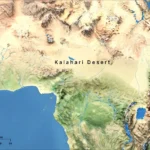
Coordinates for a compact visual anchor: the central centroid commonly used is near 23°S, 22°E, and the commonly-used mapped lat/lon box often falls between roughly 18°–28°S and 18°–25°E. When producing a map, expose both definitions to users — show the basin as a low-opacity overlay and the ecological desert boundary as a solid, labelled line. This directly answers the common query: “Why do Kalahari maps differ?”
Mapping recommendation
- Layer 1: basin_geology (transparent, metadata: source, date, EPSG)
- Layer 2: desert_ecology (solid line, metadata: source, vegetation class)
- Layer 3: seasonal_pans (dashed for wet-season extent, attribute: month_range)
By presenting the three layers,s you reduce user confusion and improve long-tail SEO because you satisfy both search intents: “Kalahari basin” and “Kalahari desert”.
Key map anchors
In search-ranking terms, these are high-importance entities closeh attention weight) that you should make clickable, indexable, and downloadable as GPX waypoint files.
- Okavango Delta — a hydrological megafeature whose seasonal flooding reshapes adjacent Kalahari habitats. Include flood extents per year and a raster time-series if possible.
- Makgadikgadi Pans — immense salt pans that episodically convert to lakes; crucial for bird migration signals.
- Central Kalahari Game Reserve — the deep interior reserve; critical for long-route planning and conservation notes.
- Kgalagadi Transfrontier Park — dunes, large predators, southern Kalahari character.
For each anchor, provide the following downloadable micro-assets:
- Park boundary polygon (GeoJSON).
- Gate point(s) (lat/lon, contact) as CSV and GPX waypoint.
- Recommended access routes as GPX track(s).
- Trusted water and fuel points (annotated POIs with last-verified date).
Map layer set per anchor: park_boundaries, gates_and_camps, access_roads, 4x4_tracks, water_points (verified), fuel_points, elevation_contours, pan_extent_wet, pan_extent_dry. These layers are your feature set for both web map tiles and A0 printable exports.
Maps & downloadable assets that convert
Think like an ML product manager: users want ready-to-use datasets with clear metadata. Publish a “Maps Hub” package for each region (e.g., Central Kalahari pack) with assets, manifest and checksums.
Essential downloadable files
- A0 printable PDF (300 dpi, CMYK) — purpose: in-vehicle planning, wall briefing. Include a scale bar, UTM graticule, crop marks, and a locator inset. Export Prespecified print profiles and recommended printer settings.
- GeoTIFF satellite overlay — purpose: accurate basemap for GIS and print. Include EPSG:4326 or a local projected CRS, embedded tags, and suggested band combos for natural colour and for printing contrast.
- MBTiles — purpose: offline raster tile package for mobile apps (Maps.me, OsmAnd). Provide recommended zoom range (e.g., z4–z14), estimated file size, and a sample tile preview.
- XYZ / TileJSON — purpose: web tile serving. Host tiles on a CDN and publish TileJSON metadata for clients.
- GPX / KML route packs — purpose: approach and in-park tracks with waypoints for gates, fuel, water, and emergency contacts.
- CSV / GMT point list — purpose: GIS ingestion with headers: id, lat, lon, elev_m, phone, note.
- MD5 checksums + file sizes — trust signals for downloads; publish adjacent Dataset schema JSON-LD.
Packaging & UX:
- Offer a “full pack ZIP” (A0 PDF + GeoTIFF + MBTiles + GPX + README + manifest.json) and single-file downloads for users who want only one file.
- Provide a “what’s inside” table on the download page listing each file’s type, coverage, approximate size, and a thumbnail preview.
- Embed Dataset JSON-LD for each downloadable resource to increase rich results in search.
How to reach the Kalahari — transport tokens & route graphs
Treat roads as edges and nodes as towns/airports. Provide GPX tracks and a small route-cost widget (fuel calculator) that computes safe refills.
Air gateways
- Gaborone — southern access, often used for Kgalagadi southern approaches.
- Maun — principal gateway for the Okavango and northern Kalahari approaches.
- Upington — southern Kgalagadi access.
Typical approach routes
- Gaborone → Ghanzi → Central Kalahari (tar to Ghanzi, then long graded roads and remote tracks; 4×4 recommended).
- Maun → Nxai Pan / Makgadikgadi (good for pan access; many lodges operate here).
- Upington → Twee Rivieren → Kgalagadi (southern route with managed park gates).
GPX & planning assets to provide:
- GPX tracks with segment distances and estimated fuel consumption.
- Waypoints for fuel, water, park gates, and emergency numbers.
- A fuel buffer calculator (web widget) — let the user input mpg (or l/100 km) and tank litres to get safe refuel points.
Permits & gate micro-pages: each park micro-page should list current gate hours, permit fees, and emergency contacts. Keep them updated — these pages tend to attract backlinks from NGOs and travel communities.
Climate & best times to visit
Encode seasonality as a small temporal vector for use on a webpage. Summary: wet season (Nov–Mar) brings pans to life but makes many tracks impassable; dry season (May–Sep) is the most reliable for travel and game viewing.
Seasonal windows
- Jan–Mar: hot; rains common; pans fill — riskier to cross.
- Apr–May: warm; drying; great bird movement as habitats change.
- Jun–Aug: cool days, cold nights; best predator viewing.
- Sep–Oct: warming; dusty; occasional late rains.
- Nov–Dec: start of rains; sharp vegetation response.
Packing & field checklist
- Clothing: breathable daywear + insulated night layer.
- Water: minimum 5 L per person per day + contingency.
- Recovery kit: snatch strap, shovel, spare tyre, compressor.
- Navigation: offline MBTiles + GPX + a satellite messenger (e.g., recommended device).
- Vehicle: high-clearance 4×4 for interior routes; carry spare parts and two spare tyres.
Safety rules
- Do not attempt to cross pans immediately after heavy rainfall — tracks wash out.
- Night driving increases wildlife collision risk; many parks restrict night driving.
- Keep current park advisories and local radio/emergency numbers accessible.
Landscape features
Use polygon layers to represent dune fields, pans, and savanna. Provide a short text legend on your printable maps:
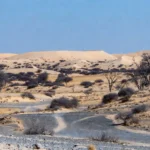
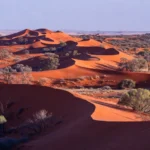
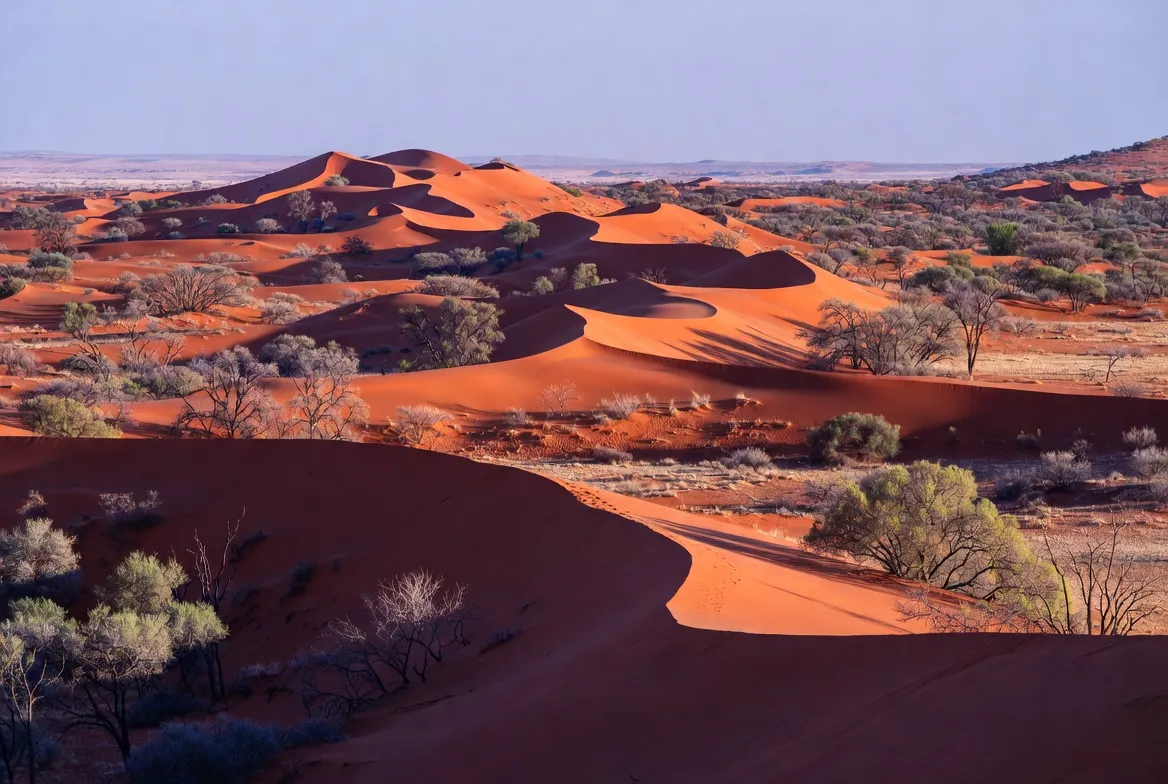
- Dunes: orange-red from iron oxide in sand grains. Two morphological classes: fixed (vegetated) and mobile (shifting). Southern and northwestern zones show the classic dune fields.
- Pans (salt flats): broad bowl-shaped depressions that turn into shallow lakes after rains; the Makgadikgadi system is the archetype.
- Grassy plains & woodlands: large savanna patches that green rapidly after rains and sustain grazers.
Mapping tip: produce an elevation contour layer, dune-field polygons, and seasonal pan polygons (wet vs dry) so users can print precise wet-season vs dry-season maps.
Flora & fauna
This is your species-level knowledge graph. Quick species list for field users:
- Plants: grasses, umbrella thorn and camel thorn acacias, adapted succulents, wild melons and ephemeral herbs.
- Large mammals: lions, spotted hyenas, brown hyenas, springbok, gemsbok (oryx), kudu. The southern Kalahari is predator-rich.
- Birds: enormous gatherings of flamingos and waterbirds on pans following rains.
Conservation note: distributions depend on seasonal water; mining and climate shifts threaten migratory and foraging patterns. On your conservation micro-page, cite authoritative sources (park pages and peer-reviewed studies) and link to community-led projects.
Human history & culture
People have inhabited the Kalahari for millennia. When you publish cultural information, treat communities as living stakeholders and reference contemporary voices.
- San people — deep indigenous knowledge of the landscape; prioritise community-led projects and first-person sources.
- Tswana and Herero communities have historical and contemporary ties to Kalahari landscapes; craft content collaboratively and avoid stereotyping.
Always include links to community-run tourism, land-rights resources, and ethical wildlife-viewing guidelines.
Survival tips & field checklist
Create a printed checklist (A4 or as a PDF poster) that users can tuck into gloveboxes. Key sections:
Vehicle & fuel
- Use a reliable high-clearance 4×4 for interior travel.
- Carry 30–50% extra fuel beyond estimated consumption; always aim for the next fuel point with a buffer.
Water & food
- At least 5 L per person per day; in peak summer, allow more.
- Bring non-perishable, high-calorie rations and a small camping stove.
Spare parts & tools
- Two spare tyres, tyre repair kit, air compressor, snatch strap, high-lift jack, shovel.
Navigation & communications
- Offline maps (MBTiles), GPX tracks, and a satellite messenger for emergencies.
Weather & terrain hazards
- Avoid crossing pans after heavy rains; tracks can wash out.
- Wildlife is more active at dawn/dusk; respect park rules about night movement.
Tourism highlights & activity taxonomy
Top attractions
- Predator viewing in the southern dune & scrublands of Kgalagadi (famous for territorial big cats).
- Birding and ephemeral lake spectacles on the Makgadikgadi Pans following rains.
- Cultural experiences managed by San and other local communities.
Activities
- Self-drive 4×4 expeditions, guided safaris, pan walks in dry conditions, and stargazing at night.
Booking tips
- Book lodges and permits early in the dry season. Carry cash for small purchases in remote facilities and keep copies of permits accessible.
Quick tables for easy pasting
Quick facts — at-a-glance (copy-ready)
| Fact | Value |
| Area | ~360,000 sq mi (≈930,000 km²). |
| Main countries | Botswana, Namibia, South Africa. |
| Typical elevation | 600–1,600 m above sea level. |
| Annual rainfall | 250–450 mm (varies regionally). |
Region comparison & visitor notes (copy-ready)
| Region / Place | Best season | Highlights | Access difficulty | Vehicle |
| Central Kalahari Game Reserve | Dry (May–Sep) | Vast grasslands, predators, culture | Remote, long drives | 4×4 high-clearance |
| Makgadikgadi Pans | After rains (Dec–Mar) | Flamingos, ephemeral lakes | Roads variable | 4×4 recommended |
| Kgalagadi Transfrontier Park | Dry (May–Sep) | Red dunes, predators | Remote, but park roads are good | 4×4 / sturdy 2WD possible |
High-ROI micro-pages to add
- Park gate hours & permits (per park) — operational and linkable.
- GPX approach pack (e.g., Gaborone → Ghanzi → Central Kalahari) with fuel waypoints and contingency planning.
- “How to print an A0 map” — print presets and local print-shop workflow.
- Conservation resources — NGOs, community tourism programs, and relevant literature.
FAQs
A: Most of the Kalahari Desert lies in Botswana, with large parts also in Namibia and northern South Africa.
A: It is best described as a semi-arid or xeric savanna. Parts are true semi-desert, but much of the Kalahari supports grasses, trees and seasonal wetlands.
A: Interior travel is safest with a high-clearance 4×4. Some park roads and fringes are OK for sturdy 2WD, but always check current road reports and carry recovery gear.
A: Shortly after heavy rains — during the wet season — when pans fill and attract flamingos and other waterbirds.
Conclusion
Use the Maps Hub and downloadable packs (A0 PDF, GeoTIFF, MBTiles, GPX) along with the permit and gate micro-pages and the field checklist to plan safe, well-documented trips and publications. Centre community voices—especially the San people—in any conservation or tourism work, and pick one CTA below if you want me to Generate an A0 map, a GPX pack, or a Maps Hub template right away.