Introduction
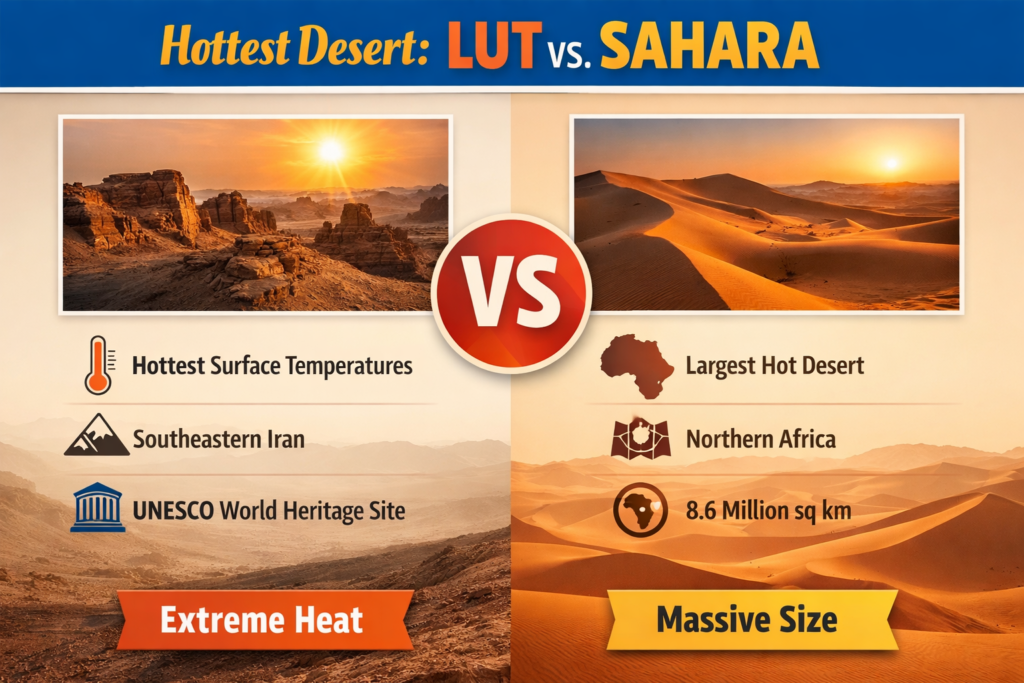
When people ask about the hottest desert in the world, many assume it is the Sahara. While the Sahara is the largest hot desert, the Lut Desert in Iran is widely recognized for recording the highest land-surface temperatures. Understanding this difference is key to answering the question correctly.
Overview of the Lut Desert
The Lut Desert is hyper-arid in southeastern Iran, and it is one of the most dramatic dry landscapes on Earth. UNESCO explains that the Persian word “Lut” refers to bare land without water and without vegetation, which is an especially fitting description for the desert’s core. From a semantic perspective, the name itself tells the story: this is a landscape defined by scarcity, exposure, and extreme physical conditions.
UNESCO also notes that the Lut Desert sits inside an interior basin surrounded by mountains. That geography helps create a rain-shadow effect, which blocks moisture from reaching the area and keeps rainfall extremely low. When a place is cut off from regular precipitation, vegetation struggles to establish itself, soils dry out, and surface temperatures can rise sharply under the sun.
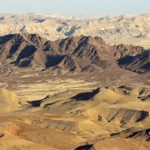
The Lut Desert is also famous because it is not a single-feature environment. It is an integrated desert system made up of yardangs, dune seas, stony pavements, salt features, and wind-shaped erosional forms. This makes it scientifically valuable and visually unforgettable. NASA has emphasized that the hottest parts of the desert are often dry, dark, and rocky, which helps explain why this region absorbs so much heat.
So the Lut Desert is not merely “hot” in a casual sense. It is one of the planet’s most extreme thermal, geological, and geomorphological environments. That is why it stands out so strongly in search results and why it deserves a much deeper explanation than a short list answer.
Why the Question Creates So Much Confusion
The phrase “hottest desert in the world” is deceptively simple. In reality, it mixes together several different ideas, and many pages fail to separate them.
The main confusion usually comes from three overlapping concepts:
- The largest hot desert in the world
- The hottest desert by land-surface temperature
- The hottest place on Earth, which may refer to air temperature or surface temperature, depending on the source
Britannica clearly identifies the Sahara as the largest hot desert in the world. That is a scale-based fact. NASA, however, has shown through satellite observation that the Lut Desert repeatedly ranked as the hottest in terms of land-surface temperature in several of the years studied. That is a heat-based fact.
This distinction is not a minor editorial detail. It is the core of the search intent. If someone types this keyword, they usually want a result tied to extreme heat, not a geographic area simply because it is huge. That is why generic Sahara-first pages often underperform for this query: they answer a related question, but not the exact one.
NASA also explains that air temperature andland-surfacen temperature are different. Air temperature is measured above the ground, while land-surface temperature refers to how hot the ground itself becomes. This matters because a desert can be extremely hot at the surface even if weather-station air readings do not always match that impression. In SEO terms, the winner is the page that resolves the user’s intent mismatch cleanly.
So the best answer is not a simplistic “Sahara” or “Lut” without context. The best answer is this:
The Sahara is the largest hot desert in the world, but the Lut Desert is the stronger answer when the question is about extreme surface heat.
That single clarification is the foundation of a strong article.
Why the Lut Desert Is the Stronger Answer for “Hottest Desert in the World”
NASA’s Earth Observatory reported that in a seven-year study of global land-surface temperatures, the Lut Desert ranked as the hottest in five of the seven years. NASA also recorded a surface temperature of 70.7°C (159.3°F) in 2005 using MODIS satellite data. That measurement is one of the most cited reasons the Lut Desert is associated with record-breaking heat.
UNESCO reinforces this interpretation by describing the Lut Desert as one of the hottest places on Earth and by emphasizing that it experiences extraordinary environmental conditions. UNESCO’s World Heritage description also highlights the region’s extreme dryness, limited accessibility, and major landform diversity. In other words, the desert is not only thermally extreme; it is structurally and ecologically extreme as well.
The reason Lut is so compelling for search intent is that it combines scientific credibility with memorable language. The desert is not just a trivia fact. It is a location supported by satellite data, recognized by UNESCO, and visually Distinctive enough to be studied across disciplines such as climatology, geomorphology, and environmental science.
For readers, that means the article can confidently answer the main query and then expand into related subtopics. For search engines, that means stronger topical depth, better semantic coverage, and more natural alignment with related entities and long-tail searches.
Lut Desert vs Sahara Desert: The Most Important Comparison
The easiest way to settle the confusion is to compare the two deserts directly.
| Feature | Lut Desert (Dasht-e Lut) | Sahara Desert |
| Main claim | Hottest surface temperatures in satellite records | The largest hot desert in the world |
| Location | Southeastern Iran | Northern Africa |
| Scale | Much smaller than the Sahara | About 8.6 million sq km |
| Famous landforms | Yardangs, Kaluts, giant dunes, stony pavements, salt features | Dunes, plateaus, basins, mountains, salt flats |
| Best SEO angle | Heat record, landforms, UNESCO status | Size, geography, climate, and human life |
| Biggest mistake | Treated as a generic desert | Used as the answer to “hottest desert.” |
Britannica identifies the Sahara as the world’s largest hot desert, with a total area of about 8.6 million square kilometers. UNESCO, on the other hand, describes the Lut Desert as an exceptional desert landscape with yardangs, dune seas, salt landforms, and intense wind-shaped terrain. NASA then adds the decisive thermal evidence: Lut repeatedly emerged as the hottest in the satellite record it studied.
This is the cleanest possible way to explain the user intent. The Sahara is a giant. The Lut Desert is the heat champion. A well-structured article should say both clearly and early so the reader does not have to guess.
Location and Geography of the Lut Desert
The Lut Desert lies in southeastern Iran, and it occupies a vast interior basin. UNESCO refers to it as an arid continental subtropical area, which is a technical way of saying it exists in a region that is persistently dry, strongly exposed, and shaped by powerful natural forces.
Its location is highly relevant to its climate. The desert is enclosed by mountains, and that mountain enclosure creates a rain-shadow environment. Moist air loses much of its water before it can enter the basin, so the interior remains very dry. Over time, this dryness becomes a defining ecological and geological force.
That geography also helps explain the desert’s dramatic landforms. Wind can move sediment across large open spaces, erode rock into ridges, and sculpt the land over immense spans of time. UNESCO describes the Lut Desert not as a static empty zone, but as an active geological system where erosion and deposition continue to shape the terrain.
The region is also highly remote. Much of the desert is difficult to access because of the lack of water and extreme heat. Habitations have historically clustered around the edges instead of the center. That remoteness has helped preserve the landscape, but it also means tourism and travel require planning, caution, and respect for the environment.
Climate and Weather Patterns
The climate of the Lut Desert is hyper-arid, meaning it is even drier than what many people imagine when they think of a standard desert. UNESCO explains that the area experiences strong winds, especially between June and October, and those winds carry sediment across the surface, contributing to large-scale erosion.
Winds are not a side note here; they are one of the primary shaping forces. They carve ridges, transport sand, strip away fine material, and leave behind the bold geometric landforms that make the region so visually distinctive.
NASA’s observations add another layer of understanding. The hottest parts of the Lut Desert are often dry, dark, and rocky. That matters because dark surfaces absorb more incoming solar energy, while dry surfaces lack the cooling effect of moisture and vegetation. In a place like Lut, the land itself behaves like a heat amplifier.
Another key point is the distinction between air temperature and surface temperature. Many people assume “hottest” must refer to the weather report, but NASA’s work shows that the ground can become much hotter than the air above it. That is why satellite land-surface data is so important when comparing deserts.
In short, the Lut Desert is not merely hot because it sits under the sun. It is hot because multiple factors reinforce one another: dryness, low vegetation, dark rocky surfaces, wind-swept terrain, and basin geography. This layered explanation is exactly what readers need and what search engines reward as semantically rich content.
What Makes the Lut Desert So Hot?
Several forces work together to make the Lut Desert one of the most extreme heat environments on Earth.
1) The surface absorbs heat efficiently
NASA notes that the hottest areas are often dark, rocky, and gravel-covered rather than bright, reflective sand. Darker surfaces absorb more solar radiation, which means they heat up more quickly and retain that heat longer. This is a basic physical mechanism, but in Lut it becomes especially important because the landscape is so exposed.
2) The desert is extremely dry
UNESCO describes the region as hyper-arid and located in a rain shadow. With almost no moisture in the environment, the ground cannot benefit from natural evaporative cooling. There is also little vegetation to provide shade or reduce surface heating.
3) The basin shape contributes to heat retention
The Lut Desert sits inside a mountain-surrounded basin. That landform arrangement helps confine dry conditions and limits the movement of cooler air into the region. The result is a landscape that heats intensely under sunlight and cools inefficiently.
4) The terrain supports extreme microclimates
Different patches of the desert behave differently depending on whether they are rocky, sandy, or mixed with salts and gravel. NASA’s satellite readings reveal that the hottest spots are not random. They are tied to specific surface characteristics that intensify absorption and reduce cooling.
All of these factors combine into a powerful environmental system. Lut is hot not because of a single cause, but because several causes work together in a reinforcing pattern. That makes it an excellent example of how climate, geography, and surface composition interact.
Landforms That Make the Lut Desert Famous
One of the strongest reasons the Lut Desert stands out is its landform diversity. UNESCO describes the desert as a landscape of extraordinary erosional and depositional features, and that variety gives the area major scientific and visual value.
1) Yardangs and Kaluts
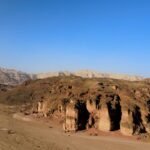
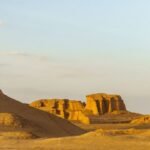
The most iconic landforms in Lut are its yardangs, locally known as Kaluts. These are long, streamlined ridges carved by persistent wind and sand abrasion. UNESCO describes them as some of the best-developed examples in the world in terms of extent, continuity, and height.
Kaluts are especially important because they are not just impressive to look at; they are also key evidence of long-term wind erosion. In photography and travel writing, they create a dramatic skyline of parallel ridges and corridors. In scientific terms, they are a textbook example of aeolian land shaping.
2) Giant dune fields
UNESCO also highlights the desert’s large sand seas. These include active dunes with shapes such as crescentic ridges, star dunes, complex linear dunes, and funnel-shaped dunes. Some dunes in the desert reach roughly 475 meters in height, placing them among the tallest dunes on Earth.
This variety matters because it shows that Lut is not a monolithic sandscape. It is a layered desert system where wind patterns, sediment supply, and topographic conditions create different dune morphologies.
3) Stony desert pavements
The desert also contains extensive hamada, or stony desert pavement. These surfaces are made up of wind-faceted stones and coarse materials left behind after finer particles are removed. The presence of desert pavement is important because it reinforces the dry, exposed character of the region.
4) Salt landforms
Lut also includes salt pans, salt-crusted riverbeds, gypsum domes, and evaporite-related features. These forms reveal the role of evaporation and mineral concentration in a place where water is scarce but geological processes remain active.
This variety makes the Lut Desert a very strong topic for topical clustering. It supports related search terms such as Kaluts, yardangs, giant dunes, desert pavements, salt flats, and hot desert landforms, which improves semantic coverage and article depth.
Key Facts About the Lut Desert
| Topic | Key Detail |
| Country | Iran |
| Region | Southeastern Iran |
| Desert type | Hyper-arid hot desert |
| UNESCO status | World Heritage Site, inscribed in 2016 |
| Main landforms | Yardangs, Kaluts, dune fields, stony pavements, salt features |
| Climate | Extreme dryness, strong winds, high surface heat |
| Scientific value | Exceptional example of desert erosion and deposition |
UNESCO states that the Lut Desert was inscribed in 2016 and recognized for its exceptional natural values and geological processes. The site includes a large property area and buffer zone, which helps protect the desert’s landscape from disturbance. That protection status adds authority and gives the article an additional trust signal.
Flora: What Grows in the Lut Desert?
Plant life in the core of the Lut Desert is extremely limited. UNESCO describes the most extreme zones as bare land without water and without vegetation. That should not be misunderstood as a claim that the entire broader region is absolutely lifeless, but it does mean the center of the desert is among the harshest plant environments on Earth.
Any vegetation that does survive in such a place must be highly specialized. Plants typically endure by occupying small microhabitats, using brief moisture availability, or remaining near the edges where conditions are slightly less severe. In a landscape like Lut, the important point is not abundance. The important point is resilience.
A truthful article should not exaggerate plant life for the sake of making the destination sound prettier. Readers searching this topic want accuracy, and the absence of much vegetation is part of what makes the Lut Desert scientifically and visually unique.
Fauna: What Animals Live There?
Although the Lut Desert is brutally harsh, it is not empty. UNESCO notes that the wider region’s biodiversity and ecology deserve further study, which suggests that life exists even if it is difficult to observe. In extreme deserts, animals survive through a variety of adaptations that reduce heat stress and conserve water.
Most desert-adapted animals avoid the hottest hours, hide in burrows, remain active at night, or use very efficient water management strategies. That pattern is common in deserts around the world, and it likely applies to species connected to the Lut ecosystem as well.
The most accurate way to describe the fauna is not to portray the desert as a wildlife hotspot. Rather, it is a survival environment where only highly adapted species can endure. Some animals may remain unseen for long periods because they are nocturnal, elusive, or active only under narrow environmental conditions.
That framing is important for both trust and SEO. It avoids sensationalism while still giving the reader a meaningful understanding of desert life.
Human History and Settlements Around the Lut Desert
Despite its severity, the Lut region has a long human story. UNESCO states that there is evidence of habitation going back about 7,000 years, though permanent settlement has generally stayed around the edges of the desert rather than in the most extreme interior.
This is a valuable detail because it adds human geography to the physical story. The Lut Desert is not just an empty expanse; it is a place that people have lived beside, adapted to, and navigated around for millennia. The margin between habitable land and uninhabitable core is itself part of the region’s historical identity.
UNESCO also notes the presence of villages and small settlements in the surrounding zone. That means the desert has always been linked to human life, even if its center has remained too harsh for ordinary settlement. This edge-core relationship is a powerful theme for readers because it shows how humans respond to extreme environments.
Why the Lut Desert Matters in Science
The Lut Desert is a major scientific site because it combines extreme heat, wind erosion, deposition, desert pavement, salt processes, and dune formation in one landscape. NASA’s satellite work made the desert globally famous for its surface heat record, while UNESCO recognized its geological significance and ongoing natural processes.
That makes the desert valuable across multiple scientific fields:
- Climatology, because it helps researchers study how heat behaves in hyper-arid environments
- Geomorphology, because it reveals how wind shapes landforms over time
- Remote sensing, because satellite data is essential for understanding its temperatures
- Environmental science, because it illustrates the fragility of extreme desert systems
The Lut Desert is a perfect example of a place where the landscape itself becomes a scientific archive. Each ridge, dune, and pavement tells a story about wind, heat, dryness, and time.
Tourism in the Lut Desert
The Lut Desert has strong tourism potential because it looks dramatic, rare, and otherworldly. UNESCO describes the site as having major aesthetic value due to its scale, diversity, uninterrupted views, and spectacular landforms. For photographers, geographers, geology enthusiasts, and adventurous travelers, that makes Lut an exceptional destination.
But tourism here is not casual. UNESCO also warns that the site needs protection from inappropriate tourism and off-road motorized access. That warning is important because the same features that make the desert beautiful are also fragile. The landscape can be damaged by careless vehicles, surface disturbance, and irresponsible visitation.
The best way to frame travel is therefore simple and responsible: the Lut Desert is a place for careful, guided, respectful exploration, not reckless wandering. That tone is more trustworthy and more useful to readers than exaggerated adventure copy.
Best Things to See in the Lut Desert
There are several standout features visitors and readers will care about most:
The Kaluts and yardangs, which look like immense wind-carved walls and ridges
The giant dune fields, including tall and complex dune systems
The stony desert pavements, where the ground appears dark, rough, and severe
The salt flats and salt-crusted terrain, which reflect the desert’s evaporative history
The wide open horizons, which make the landscape feel endless and almost lunar
UNESCO emphasizes that the yardangs are among the best expressed in the world and that the dune systems are exceptionally developed. That makes the Lut Desert one of the most visually powerful desert destinations on the planet.
Travel Tips for the Lut Desert
Because the Lut Desert is remote, dry, and extremely hot, travel requires planning. UNESCO’s description makes it clear that the area’s water scarcity and environmental harshness are not minor inconveniences. They are defining conditions.
A safe and respectful trip should account for the following realities:
- Bring enough water
- Travel with local guidance
- Avoid the hottest times of day
- Respect protected zones and fragile surfaces
- Do not drive off-road in sensitive areas
- Prepare for isolation and limited services
This kind of practical advice is valuable because it matches the real-world nature of the destination. It also builds trust with readers by showing that the article is not romanticizing danger. The Lut Desert is beautiful, but it is also unforgiving.
Pros and Cons
Pros
It is one of the strongest answers to the keyword hottest desert in the world because of its satellite-recorded surface heat.
It has rare and powerful landforms, including yardangs, Kaluts, and giant dunes.
It has UNESCO World Heritage status, which adds authority and credibility.
It works well for geology, travel, photography, and science content.
Cons
It is remote and difficult to visit safely.
The core desert has very limited vegetation and visible wildlife.
Tourism must be managed carefully to avoid damaging fragile landforms.
This kind of balanced analysis improves user trust because it avoids one-sided praise. Readers can see both the appeal and the challenge of the destination.
Pros and Cons
Pros
It is the largest hot desert in the world, so it has immense geographic importance.
It covers a vast area across northern Africa and has global recognition.
It is ideal for explaining dunes, plateaus, climate systems, and human adaptation.
Cons
It is often used as a shortcut answer to “hottest desert,” even though that is not the same question.
Much of the Sahara content is broad and overused, so it can feel less fresh.
It does not always solve the user’s intent when the user wants the hottest surface desert rather than the largest desert.
This comparison is useful because it explains why the Sahara keeps appearing in search results even when the Lut Desert is the better fit for the actual query.
Interesting Facts About the Lut Desert
UNESCO says the Lut Desert contains some of the best-expressed yardangs in the world.
UNESCO also says its dune fields are among the best-developed active dunes on Earth.
Some dunes in Lut reach about 475 meters high.
NASA found that Lut ranked as the hottest place in five of the seven years it studied.
NASA explains that the hottest spots are often dry, dark, and rocky rather than soft, bright sand.
UNESCO says the region has evidence of habitation going back 7,000 years.
These facts work especially well for snippets, social sharing, and FAQ-style content because they are compact, memorable, and high-impact.
Environmental Issues and Conservation
The Lut Desert is fragile. UNESCO notes that the property is protected in part because much of it is naturally inaccessible, but it also warns that the site requires strong management to prevent harm from tourism and off-road vehicle use.
That warning matters because fragile desert features can be damaged surprisingly easily. Dunes can be disturbed, crusts can be broken, and wind-carved forms can be scarred by careless movement. When a landscape is this extreme, conservation is not optional. It is essential.
UNESCO also explains that management involves multiple Iranian authorities and formal protection measures. That helps preserve the site’s scientific, ecological, and tourism value over time.
The big takeaway is simple: the Lut Desert is not just a place to admire. It is a place to protect.
FAQs
Not in the most precise sense. The Sahara is the largest hot desert in the world, but NASA’s satellite analysis and UNESCO’s description make the Lut Desert the stronger answer for extreme land-surface heat.
Because its dark ground absorbs heat efficiently, the area is extremely dry, and the basin is surrounded by mountains that limit air movement. UNESCO also says the desert sits in a rain shadow and has a hyper-arid climate.
Not always. NASA explains that air temperature and land-surface temperature are different measurements. That is why some records talk about the ground surface while others refer to the air above it.
Yes, but it is remote and harsh, so it should be visited with care and planning. UNESCO warns that the area needs protection from inappropriate tourism and off-road vehicle access.
Kalut is the local name for the dramatic yardang ridges in the Lut Desert. These are large wind-carved landforms that create the desert’s famous striped and sculpted appearance.
Yes. UNESCO inscribed the Lut Desert in 2016 for its exceptional desert landforms and ongoing geological processes.
Conclusion
The Sahara Remains the largest hot desert, but the Lut Desert stands out for extreme surface heat. If the question is about the hottest desert, Lut is the more accurate answer.