Introduction
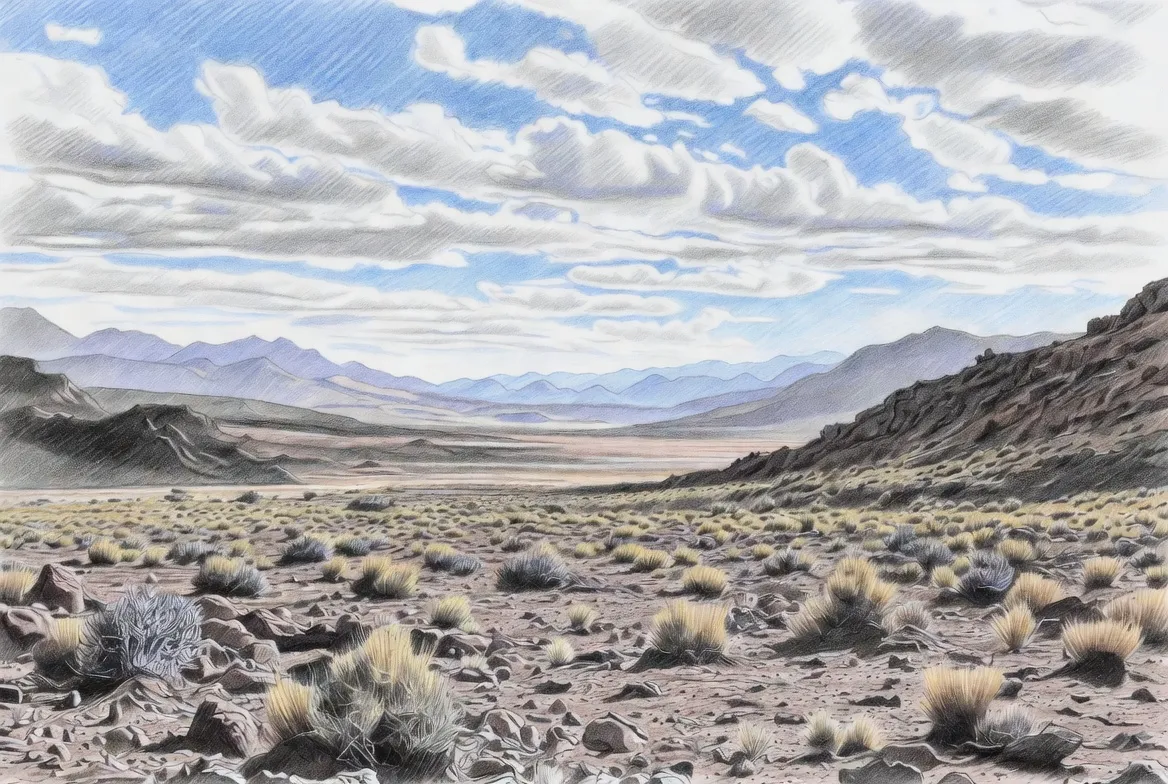
The Atacama Desert is a study in bold simplicity: vast white salt flats, sculpted badlands, and solitary volcanoes set against crystal-clear skies. Its extreme dryness sharpens edges and clarifies color, making it perfect for artists who want strong shapes, clear values, and minimal marks. In this guide, you’ll learn a straightforward pencil-to-ink-to-watercolor workflow—and get free lineart and color palettes—to start drawing the Atacama with confidence.
Quick facts
- Where: Northern Chile, wedged between the Pacific coast and the Andes.
- Main visuals: salt flats (salars), eroded badlands, volcano silhouettes, high-altitude lagoons with flamingos.
- Famous spots: Salar de Atacama, Valle de la Luna, Tatio Geysers, La Mano del Desierto, Chajnantor plateau (ALMA).
- Why it’s special for artists: hyper-arid air → sharp contrast and color clarity; huge negative-space plains; iconic solitary motifs that read at any size.
Why the Atacama makes such great art
Large, simplified geometry. The desert turns complicated geology into a small number of large planes — think broad white saline plains, wedge-shaped badlands, and single-shape volcano cones. That reduction makes it easy to design strong compositions.
Textural richness without clutter. The cracked salt, gullied badlands, and erosion lines are highly textural but repeat at a scale that reads well from a distance. You get character without chaos.
Clear atmospheric perspective. The dry, clean air produces crisp layers: the foreground is tactile, the midground carries texture, and the background recedes in cool washes of blue or gray — a perfect scenario for value-based depth.
Iconic focal motifs. A lone volcano, a small flock of flamingos in a salt pond, or the man-sized concrete hand (La Mano del Desierto) function as immediate anchors that tell a story and show scale.
Night-sky potential. With minimal light pollution and a famously clear Milky Way, the Atacama is ideal for astro-art variants.
Overview: geography, climate, and the key visual features
Where it sits
Imagine the landscape as three horizontal feature layers:
- Foreground (near): salt polygons, close sand textures, low scrub — tactile marks.
- Middle ground (mid): serrated badlands, terraces, gullies — directional strokes.
- Background (far): volcano silhouettes and distant Andean horizon — Flattened shapes and cool tones.
This three-band staging keeps scale intuitive and compositions legible.
Why is it so dry
Three main climatic mechanisms create hyper-aridity: the rain shadow effect of the Andes, the cold Humboldt Current offshore suppressing moisture, and prevailing large-scale atmospheric circulation patterns. The result: decades — sometimes centuries in instrument readings — of almost no measurable rainfall in some locales. For artists, this means stable salt crusts, clear air, and minimal vegetation.
Observatories & plateaus
The Chajnantor plateau (ALMA) and similar high-altitude sites are astrophysical nodes because the dry, thin air allows deep-sky observations. Visually, the plateaus look like broad, flattened foregrounds with dramatic horizon silhouettes — great for compositions that foreground the sky.
Salt flats, lagoons, and flamingos
The Salar de Atacama contains shallow, reflective lagoons that can host flamingos. These bright patches of color break the monotone plains and offer a complementary accent (pink birds against cool blue water or stark white salt).
Human markers
La Mano del Desierto — a giant concrete hand — functions as a modern icon and scale reference. Geoglyphs and petroglyphs are culturally important; if you incorporate such patterns, do so respectfully and ideally as stylized, inspired motifs rather than direct reproductions.
Visual elements to study and how to simplify them for drawing
Below, I treat each visual element as an NLP feature you should either preserve, abstract, or omit.
Salt flats (salars) — feature: high-value negative space
Visual: enormous white plains interrupted by polygonal salt cracks.
How to simplify: trust the paper — leave areas white. Draw loose polygons (hexagons/irregular pentagons) for texture. Add a very diluted cool wash in places to imply shallow reflections.
Badlands & eroded plateaus — feature: directional texture
Visual: terraces, gullies, and layered sedimentary faces.
How to simplify: map primary planes and then add short, directional strokes that follow the slope. Use stronger shadow in gullies and softer marks on terraces.
Volcano silhouettes & ridgelines — feature: read-at-a-distance shapes
Visual: single or multiple cones that punch the horizon.
How to simplify: treat them as flat cutouts — single tone shapes with minimal internal detail. This preserves distance and scale.
High-altitude lagoons & flamingos — feature: high chroma accents
Visual: bright shallow pools and small pink birds.
How to simplify: paint water as horizontal washes with clear edges; render flamingos as tiny pink strokes or S-shapes — no anatomy necessary.
Human-made motifs — feature: narrative hook
La Mano del Desierto: a bold, sculptural silhouette that anchors scale.
Geoglyphs: use inspired, abstracted motifs — do not copy sacred patterns exactly.
Materials & downloadable assets
Physical materials
- Pencils: 2H for layout, HB for mid-lines, 2B for darker accents.
- Erasers: kneaded + vinyl (kneaded for lifting light graphite).
- Inking pens: Micron 0.1, 0.3, 0.5 (or a brush pen for variable line weight).
- Paper: 300 gsm cold-press watercolor paper (for washes), or heavyweight sketch paper if you’re only doing ink.
- Watercolors: Yellow Ochre, Burnt Sienna, Raw Umber, Ultramarine, Payne’s Gray, Cerulean or equivalents.
- Brushes: large wash (size 8–10), round (size 4), detail (size 0–2).
- Masking fluid: for preserving crisp salt whites.
- White gouache/gel pen: for stars and final highlights.
Digital option
- Apps: Procreate, Photoshop, or similar.
- Workflow: sketch → ink on a separate layer → flat washes beneath linework → texture overlays.
- Brushes: soft wash, grainy texture, scratchy pencil.
Downloads / CTAs
- Free A3 SVG Lineart (volcano / La Mano/geoglyph) — vector ready for tracing or poster printing.
- Palette PNG (HEX + Pantone) — 6 swatches for web and print: Warm Ochre (#C89F57), Burnt Sienna (#8A4B2F), Burnt Umber (#5C3A2B), Ultramarine (#2E3B8E), Cool Tint (#DCEAF5), Deep Night (#0B0C1A).
- Reference photo pack (wide/mid/close) — for accurate study and tracing.
If you want, I can generate the A3 SVG lineart and palette PNG now. Tell me which composition you prefer — volcano, La Mano, or geoglyph — and I’ll create the files.
Composition: thumbnails to final idea
Treat composition as a small computational model: inputs (references), transformation (thumbnails), output (final layout). Keep thumbnails minimal and iterate fast.
Collect references
Gather three photo types:
- Wide panoramic — salt plain + horizon.
- Mid-range — badland ridges/terraces.
- Close detail — salt polygons, rock striations.
Thumbnails
Make 3 small thumbnails focusing on:
- Horizon placement: low (emphasize sky), middle (balanced), high (emphasize ground).
- Focal anchor: volcano, La Mano, or flamingo group.
- Negative space: how much salt flat to keep as “white” to give drama.
Composition checklist
| Element | Purpose | Tip |
| Salt flats | Negative space & highlights | Preserve whites or use masking fluid |
| Midground badlands | Texture & interest | Directional marks, not micro-detail |
| Volcano silhouette | Scale & anchor | A single flat shape is often stronger |
| La Mano/geoglyph | Narrative & human scale | Off-center placement increases tension |
| Sky | Mood & color | Graduated washes or starfields for night pieces |
Step-by-step drawing & painting
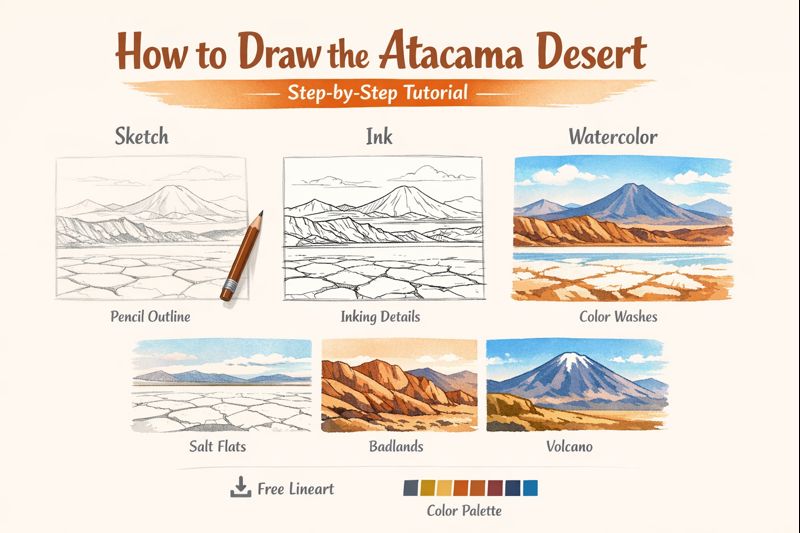
We present a five-stage pipeline. Each stage is an incremental transformation of the image representation.
Thumbnails & composition
- Make three tiny value and shape studies.
- Decide on the focal anchor and the horizon.
- Choose horizontal or vertical orientation depending on use (poster vs. sketchbook).
Block in basic shapes
- Use a 2H pencil to lay out the large planes: foreground salt, wedge hills, and distant volcano. Keep everything light.
- Remember the three-band layout: foreground/midground/background.
Build texture and linework
- Switch to HB.
- Salt polygons: sketch loose hexagons and irregular shapes — avoid mechanical repetition.
- Badlands: short strokes that follow slope direction, grouped to suggest strata and erosion.
- Line weight: distant lines thin, foreground lines heavier. Vary to imply depth.
Ink and value structure
- Ink main contours with 0.5 mm for primary lines and 0.1–0.3 for texture.
- Use cross-hatching or dense marks for deep gullies and shadow pockets.
- Establish three values: white (paper), midtones (wash/ink), darks (dense hatching or heavy watercolor). Keep the salt pans predominantly white.
Watercolor washes & finishing
- Let the ink dry completely.
- Base wash: light warm ochre on plains (wet-on-dry).
- Midground: build with burnt sienna / raw umber in layers (wet-on-dry for texture). Use tissue-lift while slightly damp for highlights.
- Distant mountains: one or two diluted ultramarine/Payne’s gray washes for atmospheric haze.
- Salt pans: preserve white or add a diluted cool tint to suggest shallow water.
- Night sky option: graded ultramarine to near-black, then white gouache splatters for stars and a soft Milky Way band.
Example palette & color usage
- Warm Ochre — #C89F57 (base plains & warm highlights).
- Burnt Sienna — #8A4B2F (midground strata & warm shadows).
- Burnt Umber — #5C3A2B (deep earth shadows).
- Ultramarine — #2E3B8E (distant mountains and some sky tones).
- Cool Tint — #DCEAF5 (salt reflections).
- Deep Night — #0B0C1A (astro skies).
Stylization ideas & variations
Choose a representation function depending on your output goals (poster, print, study, or astro piece).
Minimalist poster
- Reduce to three flat color blocks: sky, mountain, salt plain.
- Use a single silhouette (volcano or La Mano) and emphasize negative space.
Low-poly / geometric
- Break landscape planes into polygons. Slight hue shifts per plane give faceted depth. Great for screen prints.
Mixed media
- Pencil lines + watercolor wash + white gel pen highlights produce tactile, layered results.
Night / astro piece
- Deep ultramarine sky and a bright Milky Way band. Keep foreground silhouettes stark and minimal; add a small cluster of lights for a distant settlement.
Process table — time & steps summary
| Step | Action | Typical Time |
| 1 | Collect references & thumbnails | 10–20 min |
| 2 | Basic shapes & perspective | 20–30 min |
| 3 | Refined linework & textures | 30–60 min |
| 4 | Ink & establish values | 20–40 min |
| 5 | Watercolor washes & finishing | 30–90 min |
| Total | Typical complete piece | ~2–4 hours |
How to draw special motifs
La Mano del Desierto
- Simplify the hand to a single large, negative-form silhouette rising from sand.
- Consider adding tiny human figures nearby to emphasize scale. Keep surface texture minimal — the hand reads best as a bold shape.
Geoglyphs & petroglyphs
- Use inspired patterns rather than direct copies. Treat them as graphic replications — spirals, repeated lines, stylized figures. Avoid the reproduction of sacred designs without permission or context.
Flamingos & wildlife
- Suggest flamingos as groupings of tiny pink S-shapes or vertical strokes with little detail. Use them as scale punctuation rather than subjects.
Ethics, copyrights & conservation notes for artists
- Respect sacred motifs. Don’t reproduce sacred indigenous designs exactly. Use stylized or inspired forms and give attribution when relevant.
- Cite photo sources. If you base commercial work on somebody else’s photographs, get permission.
- Support local causes. Mining and water extraction (e.g., for lithium) put stress on local ecosystems and communities; consider donating a portion of sales to local conservation or community initiatives.
- Leave no trace. When sketching in situ, avoid walking on fragile crusts and do not disturb lagoon margins.
CTA — Downloads & what I can make for you now
Download the starter pack:
- A3 SVG lineart (choose: volcano / La Mano/geoglyph).
- Palette swatch PNG (HEX + Pantone).
- Reference photo pack (wide, mid, detail).
Would you like me to generate the A3 SVG lineart and palette PNG for the volcano, La Mano, or geoglyph composition? Pick one, and I’ll prepare the files.
FAQs
A: The Atacama is commonly described as the driest non-polar desert on Earth. Central sections recorded extremely low rainfall — in some historic instrument series, almost no measurable precipitation was recorded for decades. Definitions vary (some polar deserts are drier in certain metrics), but for the practical purposes of landscape and photographic dryness, the Atacama is among the driest. When drawing, that dryness translates to stable salt flats, minimal vegetation, and very clean air.
A: Yes. Use high-quality references and combine multiple images when possible to avoid direct copying. If you intend to sell artwork derived from a photographer’s image, obtain permission or use royalty-free images. Using multiple references and mixing details will make your piece more original.
A: Golden hour (shortly after sunrise or before sunset) produces side light that accentuates texture and reveals erosion patterns. For geysers, early morning can provide steam and warmer light contrasts. Moonless nights are ideal for astro shots.
A: Yes. Respect sacred motifs — avoid using them in commercial work without consent. Use stylized inspiration and credit sources where possible. If you’re unsure about a motif’s cultural significance, reach out to local cultural organizations.
A: Yes — it’s possible but harder. Either use masking fluid to preserve crisp paper whites, or paint around white shapes carefully with thin glazes and controlled edges. Practicing careful wet-on-dry techniques will help preserve whites without masking fluid.
Conclusion
The Atacama Rewards simplicity. By focusing on big shapes, strong values, and restrained color, you can capture its scale and clarity with very few marks. Start with quick thumbnails, commit to clean silhouettes, and finish with confident, economical washes. When you’re ready, choose a composition—volcano, La Mano, or geoglyph—, and I’ll generate the A3 SVG lineart and color palette so you can begin right away.