Introduction
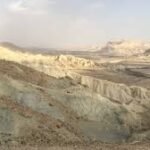
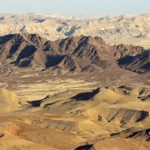
Dasht-e Lut Desert In Iran is one of the world’s most extraordinary deserts, known for its extreme heat, vast wind-carved landforms, and striking natural beauty. From the Kaluts to Gandom Beryan, this UNESCO-listed desert offers a rare mix of science, scenery, and adventure.
Quick Facts About Dasht-e Lut
| Topic | Key Detail | Why It Matters |
| Location | Southeastern Iran | Helps readers place the desert geographically |
| Desert type | Hyper-arid desert basin | Explains the severe dryness |
| Record heat | 70.7°C land-surface temperature | Connects to the hottest desert search intent |
| Main landforms | Kaluts, dunes, salt flats, stony plains | Reveals the desert’s visual identity |
| UNESCO status | World Heritage Site | Adds authority and international value |
| Best access point | Kerman and Shahdad | Useful for travel planning |
| Famous area | Gandom Beryan | A memorable landmark for readers |
| Key natural force | Strong wind | Shapes the desert continuously |
Where is the Dasht-e Lut Desert Located?
Dasht-e Lut Desert is located in southeastern Iran. It stretches across a broad desert zone and is associated with the provinces and regions connected to Kerman, Sistan and Baluchestan, and South Khorasan. The desert lies within a large interior basin surrounded by mountain systems, and this topographic structure is one of the main reasons the climate is so harsh.
That mountain-basin configuration creates a powerful moisture barrier. Air masses carrying water are partially blocked before they can move into the inner desert. Rainfall remains extremely limited, evaporation is intense, and the atmosphere stays dry for long periods. The result is a place where heat, wind, and scarcity shape almost every visible feature.
The word “Lut” itself is meaningful. In Persian, it refers to bare land, land without water, and land without vegetation. That linguistic meaning fits the environment precisely. The name does not feel accidental; it mirrors the reality of the landscape.
For searchers, this section is crucial because people are not only asking “What is Lut?” They are asking, “Where exactly is it?” The most direct answer is that the Dasht-e Lut Desert in Iran is in southeastern Iran, deep inside a dry, enclosed basin that intensifies aridity and heat.
Why Is Dasht-e Lut So Famous?
Dasht-e Lut is famous for several interconnected reasons:
It is extraordinarily hot.
This contains dramatic and unusual landforms.
It has been recognized by UNESCO.
It looks unlike most other deserts on Earth.
Most deserts are dry. Many are hot. Many contain sand. But Lut combines these characteristics with remarkable scale, visual intensity, and geological uniqueness. It includes expansive empty surfaces, razor-like wind-carved ridges, giant dune fields, salt crusts, and some of the harshest environmental conditions known in desert regions.
The desert is also widely discussed because of satellite temperature records. NASA has reported that Lut reached a land-surface temperature of 70.7°C. That figure is one reason the desert is so often connected to the phrase “hottest desert in the world.”
However, one important distinction must be made. This figure refers to land-surface temperature, not the air temperature measured at human height. That difference is essential because the ground can become much hotter than the surrounding air in a desert environment. So when people refer to Lut as one of the hottest places on Earth, they are usually speaking about satellite-based surface readings rather than a regular thermometer reading in the shade.
That distinction strengthens the accuracy, credibility, and search quality of your article.
Climate and Weather in Dasht-e Lut
Hyper-Arid Climate
The climate of the Dasht-e Lut Desert in Iran is defined by intense heat, deep dryness, and strong wind activity. It is one of the most arid environments on the planet. Rainfall is scarce, water is limited, and the ground remains dry for long stretches of time.
This happens because the desert sits in a basin bordered by mountains. Those mountains reduce the amount of moisture that can travel into the interior. In climatic terms, this creates a rain-shadow-style effect, meaning that clouds lose much of their water before reaching the desert core.
Wind as a Major Force
Wind is not a secondary detail in Lut. It is one of the principal sculptors of the landscape. Powerful winds move across the desert, especially during warm periods, carrying dust, fine sediment, and sand. Over time, they scrape Exposed rock, mold ridges, shift material, and gradually redesign the terrain.
This constant movement is the reason the desert has so many unusual forms. The surface is never truly static. It is always being adjusted, remade, and reworked. Even though the area appears empty, it is full of ongoing natural processes.
Temperature Extremes
Lut is known for extreme heat, especially at the surface level. The desert floor absorbs direct sunlight strongly and has very little moisture available to moderate the temperature. Because there is almost no vegetation, almost no shade, and minimal surface water, the ground warms very quickly.
This creates a landscape where the land itself can become much hotter than the air above it. That is why satellite measurements are so important in discussions of desert heat.
Simple Explanation for Readers
Think of Lut as a vast natural furnace. The mountains restrict moisture. The sun heats the barren ground. The wind continuously reshapes the terrain. Together, these forces produce a desert that is dry, severe, and unforgettable.
Quick Table: Surface Heat vs Air Temperature
| Type of Temperature | What It Measures | Why It Matters in Lut |
| Land-surface temperature | Heat of the ground surface | Shows how hot the desert floor becomes |
| Air temperature | Heat of the air at human level | More familiar to most readers |
| Satellite data | Measures surface from space | Often used for desert heat records |
This distinction matters because weaker articles often blur these terms. A strong SEO pillar should explain the difference clearly and simply.
The Main Landforms of Dasht-e Lut
One of the reasons the Dasht-e Lut Desert in Iran attracts so much attention is the diversity of its landforms. It is not a single flat plain. It is a layered collection of arid environments, each with its own shape, texture, and geological story.
1. The Kaluts
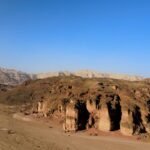
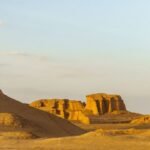
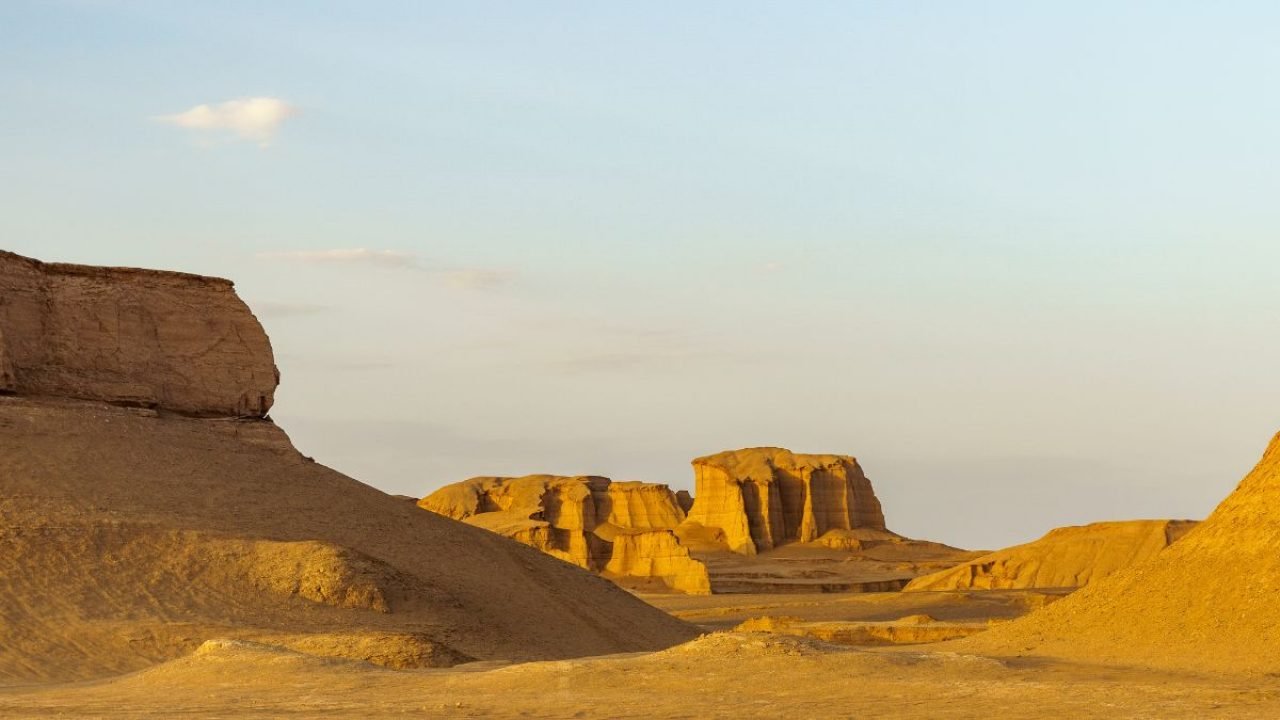
The Kaluts are the most iconic landforms in the Lut Desert. They are tall wind-carved ridges, also known as yardangs. These features were formed over long periods as strong winds eroded softer materials and left behind elongated ridges of more resistant ground.
The Kaluts are dramatic, vast, and visually extraordinary. Many visitors come to Lut specifically to see them. They are among the most photographed and most recognizable elements of the desert.
Why the Kaluts matter:
These demonstrate how wind shapes land
They create a surreal skyline of ridges and corridors.
They can be seen from great distances.
They are one of the strongest visual symbols of the Lut Desert.
From a scientific perspective, the Kaluts are also important because they show active aeolian erosion in action. They are not decorative rock hills. They are evidence of an ongoing process that has been sculpting the desert for ages.
2. Giant Dunes
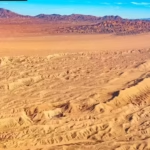
Some sections of Lut contain immense dune systems. These dunes can rise dramatically and extend across vast distances. They are among the largest dune landscapes in the world.
The dunes move slowly as the wind redistributes sand grains over time. Their shapes evolve continually, which makes the terrain feel alive and in motion.
3. Salt Flats and Salt Crusts
Lut also includes salt flats and evaporite crusts. These are broad, level surfaces left behind when water evaporates, and mineral salts remain.
The result is a pale, bright terrain that contrasts strongly with darker rocks and sands. This contrast makes the desert especially compelling in photography and satellite imagery.
4. Stony Deserts
Not all of Lut is soft sand. Large areas are covered with stones, gravel, and hard, compact surfaces. These stony desert areas are often comparable to hamada-style desert landscapes.
They are rugged, dry, and harsh, yet they are an important part of the desert’s identity because they demonstrate that deserts are not all the same. A desert can be sandy, rocky, salty, or mixed.
5. Nebkhas
Nebkhas are dunes that develop around plants. They may seem small at first, but they are meaningful because they reveal where life still influences land formation.
In some desert systems, nebkhas become surprisingly noticeable structures. They show that even in an extreme place like Lut, vegetation can still affect the shape of the ground.
Gandom Beryan: The Famous Black Stony Plateau
Gandom Beryan is one of the best-known names associated with the Dasht-e Lut Desert in Iran. It is often described as a black, stony plateau in the core zone’s northwestern part.
The dark surface is significant because darker ground absorbs more solar energy than lighter material. That is one reason Gandom Beryan is frequently mentioned in discussions about desert heat and extreme environmental conditions.
For readers, Gandom Beryan is helpful because it gives the desert a concrete and memorable landmark. Instead of speaking only about a huge abstract desert region, the article can point to a specific, named place inside it.
Why Gandom Beryan matters:
It is a named desert locality
It is associated with extreme heat.
This area makes the desert easier to remember.
It deepens the article beyond general desert facts.
If your goal is to rank for the Dasht-e Lut Desert in Iran, mentioning Gandom Beryan is smart because it supports both informational search intent and semantic search relevance.
UNESCO World Heritage Status
Dasht-e Lut was inscribed on the UNESCO World Heritage List in 2016. That is a major milestone because it confirms that the desert is not only beautiful but also globally significant.
UNESCO recognized Lut because of its extraordinary natural beauty, its ongoing geological processes, its exceptional desert environment, and its distinctive landforms. The listing reflects both scenic and scientific value.
Why UNESCO protection matters:
Off-road driving can damage fragile surfaces
Sensitive dunes and crusts need care.
Tourism must be managed responsibly.
The scientific value should be preserved for future study.
UNESCO status is important in an SEO article because it establishes authority and trust. It also reassures readers that the desert is not just a travel attraction but a protected natural asset with international importance.
Flora: What Plants Grow in Dasht-e Lut?
At first glance, the Dasht-e Lut Desert in Iran may appear lifeless. But it is not completely barren. Several plant species can survive there because they are adapted to extreme heat, salt, and water scarcity.
Common Desert-Adapted Plants
In desert regions similar to Lut, people commonly refer to plants such as:
saxaul
tamarisk
acacia
wild desert herbs
jujube
salt-tolerant shrubs
These plants are not dense or lush. They survive in sparse clusters under tough conditions. Their roots are often deep, their leaves are usually small, and many are specialized to handle heat, drought, and saline soils.
Why Plants Matter in a Desert Article
Plants in a desert matter because they prove that life can endure under severe stress. They also influence the land. Some plants capture moving sand and contribute to nebkha formation. Others stabilize soil. Some offer shelter for insects and small animals.
For readers, the main message is simple:
The Lut Desert is severe, but it still supports adapted forms of life.
That message adds depth, balance, and realism to the article.
Fauna: What Animals Live in Dasht-e Lut?
The desert does not support large wildlife populations like a forest or wetland would. Still, it is not empty. It supports a range of organisms that are well adapted to extreme dryness and heat.
Common Desert Life Forms
These may include:
insects
spiders
reptiles
small mammals
desert birds
microbial life
The most important idea is adaptation. Animals in Lut survive by conserving water, avoiding the hottest hours of the day, staying hidden in cooler microhabitats, or remaining active during more favorable conditions.
Why Fauna in Lut Is Special
The desert is not famous for abundance. It is famous for resilience.
That means the most interesting wildlife is not always the largest or loudest. It is the life that can endure the strongest sun, the lowest water availability, and the least forgiving landscape conditions.
This also makes the article more useful for people searching:
plants and animals in Dasht-e Lut
desert biodiversity
wildlife in Iran’s deserts
extreme ecosystem adaptation
Human History Around Dasht-e Lut
Even though the desert itself is severe, the broader Lut region has a long human history. People did not simply avoid this area. They lived around it, traveled through it, and developed settlements on its margins.
Shahdad and Ancient Settlement
One of the most important historical places near Lut is Shahdad. It lies on the western edge of the desert and is well known in archaeology.
Shahdad is linked with:
ancient settlement
Bronze Age culture
trade routes
remarkable burial discoveries
long-term human adaptation to harsh surroundings
This matters because it shows that the desert zone was never just an empty blank on a map. It was part of broader human networks of survival, exchange, and settlement.
Why Human History Improves the Article
Many desert articles focus only on geology and climate. A strong pillar article should also include the human dimension.
The Lut region matters because it sits at the intersection of:
geology
climate
culture
survival
archaeology
That combination gives the article greater depth and a broader appeal.
The Science Behind the Heat
This section is especially important for users searching for the hottest desert keyword.
Why Is Lut So Hot?
Several overlapping factors explain the heat:
1. Very Little Moisture
Dry soil heats faster than wet soil. Since Lut contains almost no moisture, the surface warms quickly and cools slowly.
2. Strong Sunlight
The desert receives powerful solar radiation with little cloud cover to reduce it.
3. Dark Surfaces
Some areas, including black stony surfaces, absorb heat more strongly.
4. Very Little Shade
There are a few trees, tall shrubs, or shaded zones to protect the ground from direct sunlight.
5. Basin Geography
The basin-like topography surrounded by mountains helps trap aridity and intensify the desert environment.
Why the Heat Record Matters
The reported 70.7°C land-surface temperature is one of the main reasons Lut is included in global discussions about extreme heat. It helps place the desert firmly within the conversation about the hottest desert in the world.
The most accurate phrasing is this:
Lut is one of the hottest places on Earth when measured by satellite land-surface temperature.
That wording is precise, trustworthy, and easy for readers to understand.
Travel to the Dasht-e Lut Desert in Iran
Dasht-e Lut Desert, Iran, is not a casual short trip. It is remote, intense, and best experienced with thoughtful planning.
Best Access Point
Most visitors reach the desert through Kerman and then continue toward Shahdad. Shahdad often acts as a gateway town for visitors heading toward the Kaluts and nearby desert zones.
Best Time to Visit
The most comfortable and safest seasons are usually:
late autumn
winter
early spring
These months tend to offer more manageable temperatures. Summer is usually too severe for most travelers.
Travel Tips
Here are practical desert travel recommendations:
Carry plenty of water
wear light but protective clothing
avoid the hottest hours of the day
Use a reliable vehicle.
Travel with an experienced local guid.e
Do not enter isolated areas alone.e
respect protected zones and local regulations
Why Planning Matters
The desert is stunning, but it can also be dangerous if approached carelessly. Heat, distance, unstable terrain, and lack of services can quickly become serious problems. Responsible planning is essential.
What to See in and Around the Desert
If you are visiting Dasht-e Lut, the landscape itself is the main attraction.
Top Sights
1. The Kaluts
These are the signature attractions. They are dramatic, monumental, and unforgettable.
2. Dune Fields
The enormous dunes give the desert its classic and powerful appearance.
3. Salt Flats
These bright expanses produce stunning visual contrast.
4. Black Stony Areas
These areas, including Gandom Beryan, add a darker, more intense dimension to the desert experience.
5. Sunset Views
Desert sunsets are often unforgettable. The light can transform ridges and dunes into gold, rust, and deep shadow.
Photography Value
The desert is a dream location for photographers because it offers:
strong contrast
monumental scale
unusual shapes
long shadows
expansive emptiness
textured surfaces
That makes it especially valuable for travel content, visual SEO, and featured snippet opportunities.
Pros and Cons of Visiting Dasht-e Lut
Pros
amazing scenery
unique geology
UNESCO recognition
excellent photography opportunities
strong scientific value
memorable travel experience
Cons
extreme heat
remote access
limited infrastructure
fragile landforms
need for careful planning
This balanced view helps readers make informed decisions instead of only seeing the desert through romantic imagery.
Environmental Issues and Conservation
Even though the desert is harsh, it still requires protection. Some parts of the landscape are fragile and may be damaged by irresponsible tourism or vehicle use.
Main Conservation Concerns
off-road driving damage
disturbance to dunes and crusts
tourism pressure
harm to sensitive landforms
slow recovery after surface disturbance
Why Conservation Matters
Desert surfaces often heal very slowly. A tire mark or broken crust can remain visible for years. That is why responsible travel is not optional.
Conservation also protects:
geological features
biological adaptation zones
scientific research value
heritage value
A well-built article should show that beauty and responsibility belong together.
Interesting Facts About Dasht-e Lut Desert, Iran
Here are some engaging facts that help the article feel complete and memorable:
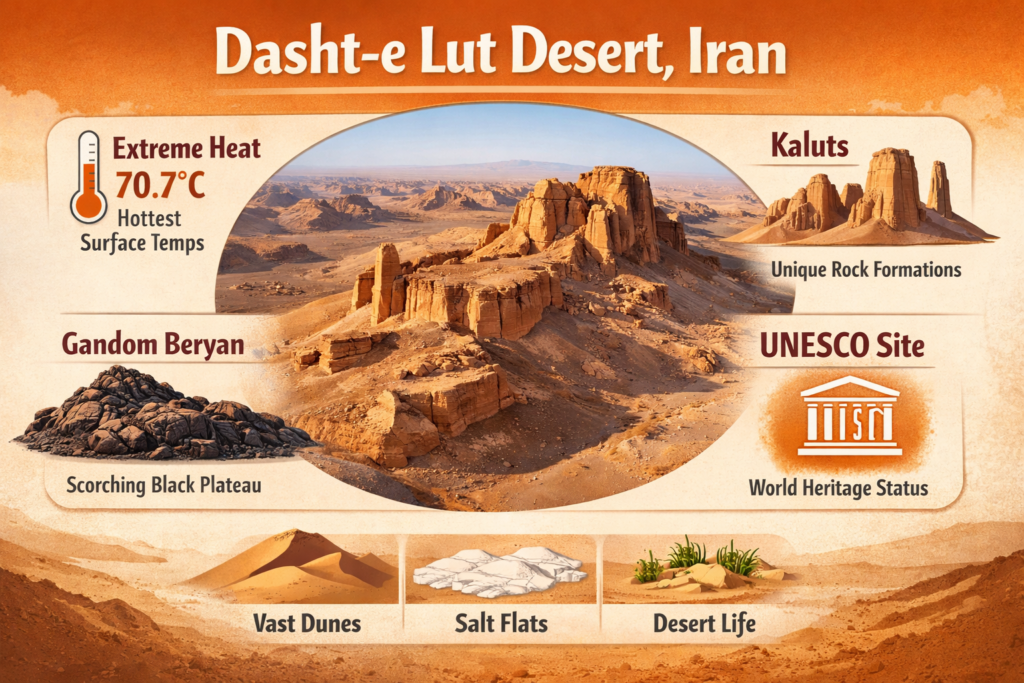
Dasht-e Lut is one of the hottest places on Earth according to satellite surface measurements.
It contains Kaluts, dunes, salt flats, and stony plains.
UNESCO lists it as a World Heritage Site.
Gandom Beryan is one of its best-known black stony zones.
The name Lut refers to bare land without water and vegetation.
Wind is one of the main forces shaping the desert.
Its landforms are so vast and distinctive that they can appear dramatic even from space-based views.
These facts support readability, credibility, and shareability while also strengthening semantic relevance.
Comparison Table: Dasht-e Lut vs Other Famous Deserts
| Desert | Famous For | Main Difference From Lut |
| Dasht-e Lut | Extreme land heat, Kaluts, UNESCO status | Strong blend of heat, geology, and wind-shaped landforms |
| Sahara | Massive size and sand seas | Much larger, but not known for the same surface heat record |
| Death Valley | Air temperature fame | Often discussed for air heat, not Lut-style desert landforms |
| Atacama | Exceptional dryness | Extremely dry, but visually and climatically different |
This comparison helps readers understand where Lut stands in the broader global desert conversation.
FAQs
Dasht-e Lut is one of the strongest answers to that question. It has recorded exceptionally high land-surface temperature readings, which is why it is often associated with the hottest desert keyword.
It is located in southeastern Iran, within a large interior desert basin. Many travelers reach it through Kerman and Shahdad.
In Persian, Lut refers to bare land without water and without vegetation. That meaning matches the desert very closely.
The Kaluts are giant wind-carved ridges, also known as yardangs. They are among the most famous features of the desert.
Gandom Beryan is a black stony plateau in the desert region. It is often mentioned because of its dark surface and its association with extreme heat.
It can be visited safely with proper planning, the right season, enough water, and local guidance. It is not a place for careless travel.
Late autumn, winter, and early spring are usually the best times. Summer is generally too hot for most visitors.
Its combination of extreme heat, giant dunes, Kaluts, salt flats, and UNESCO World Heritage Site designation makes it stand apart from many other deserts.
Conclusion
Dasht-e Lut Desert In Iran stands out for its heat, geology, and unforgettable landscapes. Its UNESCO status, dramatic formations, and harsh climate make it one of the most fascinating deserts on Earth.