Introduction
The Dasht-e Lut Desert is one of Iran’s most remarkable natural landscapes. Known for its extreme heat, dramatic landforms, and UNESCO World Heritage status, it attracts travelers, photographers, and geography lovers alike. This guide covers its meaning, location, climate, major features, and travel basics.
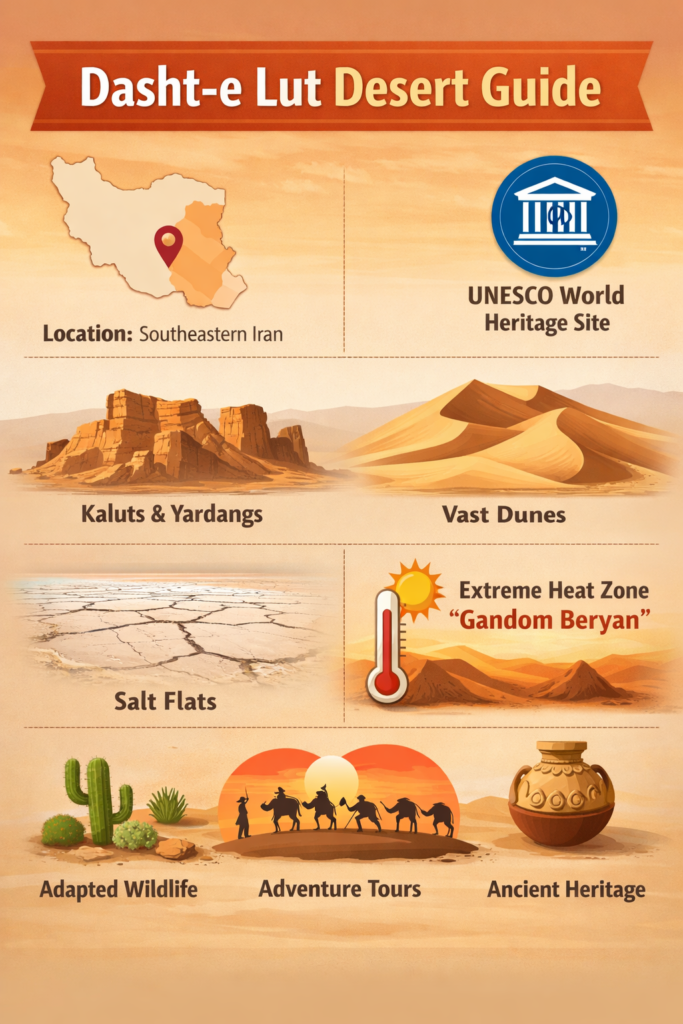
Quick Overview of Dasht-e Lut Desert
| Topic | What to Know |
| Location | Southeastern Iran |
| Nearby regions | Kerman, Sistan and Baluchestan, South Khorasan |
| UNESCO status | World Heritage Site since 2016 |
| Main landforms | Kaluts, yardangs, dune fields, salt pans, stony deserts |
| Climate | Hyper-arid, very hot, windy, and extremely dry |
| Famous hot spot | Gandom Beryan |
| Best travel time | Late autumn to early spring |
Why Dasht-e Lut Desert Matters So Much
The Dasht-e Lut Desert matters for three major reasons.
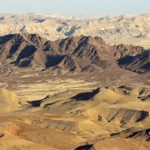
First, it is visually stunning. The desert does not look ordinary. Its surface is shaped into huge forms by natural forces that have been active for thousands of years. In some places, the land resembles a stone city. In other places, it looks like a sea of golden ridges or a cracked, pale mineral field. The scenery is so surreal that many visitors describe it as alien or otherworldly.
Second, the desert is scientifically important. Geologists, climatologists, and environmental researchers study it because it provides a living laboratory for understanding wind erosion, desert formation, surface heat, and landform evolution in extremely dry environments. Few places on Earth show these processes so clearly and so dramatically.
Third, it has historical and travel value. The desert is linked with ancient settlements, trade corridors, and human life along its margins. Even though its core is too harsh for dense habitation, the region around it has supported communities for centuries. This gives the desert cultural depth as well as natural significance.
That combination of beauty, science, and history makes Dasht-e Lut one of the most important desert regions in the world.
What Does Dasht-e Lut Mean?
The phrase Dasht-e Lut is commonly understood as referring to a dry, barren, or empty land. In Persian, the word dasht means plain or open land, while Lut is associated with dryness, emptiness, and a landscape with very little water or vegetation. The meaning fits the desert perfectly.
That is why the phrase Dasht-e Lut Desert meaning is such a common search term. People do not just want the location. They want the Significance behind the name.
Where Is the Dasht-e Lut Desert Located?
The Dasht-e Lut Desert is located in southeastern Iran. It lies inside a large internal basin surrounded by mountains. This geographical setting is extremely important because the mountains block much of the moisture that might otherwise reach the desert interior. As a result, the central parts of the desert remain intensely dry.
The desert is usually associated with the provinces of Kerman, Sistan and Baluchestan, and South Khorasan. For most travelers, Kerman is the main gateway city and the most practical base for desert access. Shahdad is one of the best-known entry points for reaching the famous desert landscapes, especially the Kaluts.
This location is not just a point on the map. It is part of the desert’s identity. The surrounding terrain, mountain barriers, and basin shape all contribute to its harsh climate and striking landforms.
Geography of Dasht-e Lut Desert
The geography of the Dasht-e Lut Desert is complex and varied. It is not one uniform sheet of sand. Instead, it contains multiple distinct environments, each with its own character.
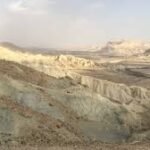
Some zones are covered by active dunes. Others are rocky and stripped bare. Some areas contain salt crusts or dry basins. Still others are composed of elongated ridges and sculpted formations carved by wind over long periods of time. This diversity is one of the reasons the desert has such a strong scientific and visual appeal.
The main geographic zones include dune fields, yardangs, Kaluts, stony plains, salt pans, evaporite surfaces, and rocky corridors. Together, these zones create a landscape that is both harsh and spectacular. The variety is so rich that the desert can feel like several different worlds within one immense region.
Climate of the Dasht-e Lut Desert
The climate of the Dasht-e Lut Desert is extremely severe. It is a hyper-arid desert, meaning it receives very little precipitation and remains dry for much of the year. Strong winds, intense sunlight, and low atmospheric moisture define the environment.
One of the major reasons the desert stays so dry is the rain-shadow effect created by the surrounding mountains. Moist air is blocked before it can enter the basin, so clouds lose much of their water on the outer slopes. By the time the air reaches the interior, it is much drier.
Wind is another powerful shaping force. Gusts sweep across the landscape, move sand, strip away loose material, and carve the land into unusual forms. These winds help create the ridges, grooves, and erosion patterns that make the desert so famous.
Heat is also a defining feature. The surface can become intensely hot because there is very little shade, very little moisture, and very little vegetation to moderate the temperature. The sun strikes exposed ground directly, and the land absorbs and stores energy quickly. That is why the climate of Dasht-e Lut is often described as among the harshest on the planet.
Why is the Dasht-e Lut Desert So Hot?
This is one of the most frequently asked questions about the desert.
There are several reasons why the Dasht-e Lut Desert becomes so hot:
1. Very little moisture
Water in the air has a cooling effect. In the Lut Desert, the air is extraordinarily dry, so there is almost no natural humidity to reduce heat.
2. Strong sunlight
The desert receives intense solar radiation, and cloud cover is minimal. That means the ground is exposed to direct sunlight for long periods.
3. Dark ground surfaces
Some parts of the landscape contain darker material that absorbs heat more efficiently than lighter surfaces. This raises surface temperatures even further.
4. Basin shape
Because the desert lies inside a broad basin, heat can become trapped in certain areas. The surrounding mountains influence airflow and reduce the movement of cooler air into the interior.
5. Exposed surfaces and wind erosion
Strong winds remove loose debris and keep much of the ground uncovered. When the surface is exposed, it heats more rapidly under the sun.
Together, these factors create extreme land-surface temperatures. This is why Dasht-e Lut is often discussed among the hottest places on Earth.
Is Gandom Beryan Really the Hottest Place on Earth?
Gandom Beryan is one of the best-known extreme heat zones in the Dasht-e Lut Desert. It became famous because of reports of exceptionally high surface temperatures.
However, it is important to distinguish between air temperature and land-surface temperature.
Air temperature refers to the temperature of the air around a person or object.
Land-surface temperature refers to the heat measured at the ground itself.
The fame of Gandom Beryan comes mainly from its extreme surface heat, not from regular air temperature readings in the same way weather stations report temperatures for cities. For that reason, it is safest to describe it as one of the most intense heat zones known on the desert surface and one of the most widely discussed thermal hotspots on Earth.
So, when people ask whether Gandom Beryan is truly the hottest place on Earth, the careful answer is this: it is one of the most extreme and famous surface-heat locations ever recorded, and it remains a major part of the Dasht-e Lut story.
UNESCO World Heritage Status of Dasht-e Lut Desert
The Dasht-e Lut Desert was inscribed as a UNESCO World Heritage Site in 2016. This recognition brought global attention to the desert and confirmed its outstanding natural value.
UNESCO honored the site because of its remarkable geological processes and unique landforms. The desert offers a clear and powerful example of how wind, erosion, time, and extreme dryness can shape the Earth’s surface.
This status is important because it shows that the desert is more than a scenic destination. It is a site of global scientific interest and natural heritage. UNESCO recognized it for its exceptional value in demonstrating active desert formation and evolution.
Why UNESCO values the site:
It shows ongoing desert landform processes
It contains large wind-shaped ridges and dune systems.
It preserves rare and dramatic desert features.s
It represents a major example of natural desert evolution
For SEO purposes, UNESCO status is one of the strongest search terms connected to the desert, because many readers want to know whether it has official international recognition.
The Famous Landforms of the Dasht-e Lut Desert
The landforms of the Dasht-e Lut Desert are among its most memorable features. They are the reason so many photographers, geographers, and travelers are drawn to it.
1. Kaluts
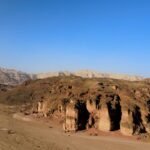
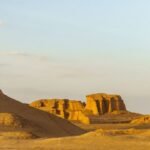
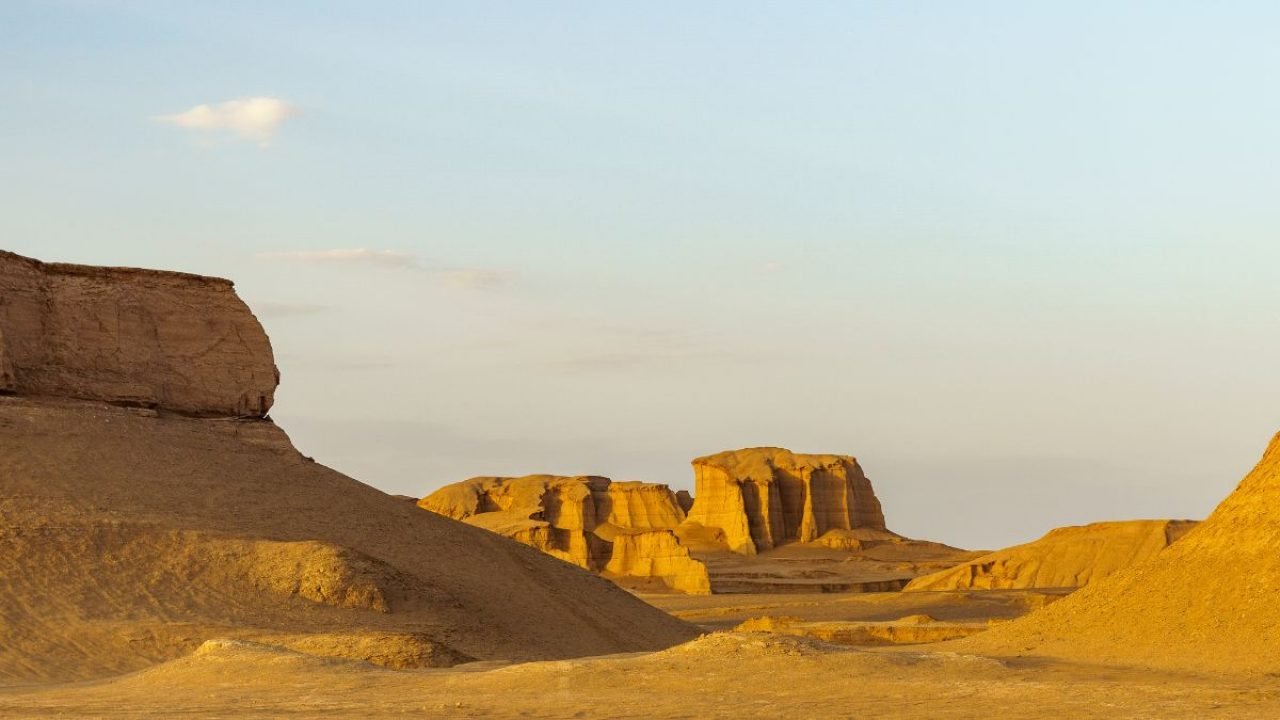
The Kaluts are massive wind-carved ridges and towers that rise dramatically from the desert floor. They are one of the most famous desert features in Iran. In some views, they resemble a ruined city built by nature. In others, they look like cliffs, walls, and narrow passageways formed by wind erosion over time.
2. Yardangs
Yardangs are elongated ridges shaped by strong winds. They give the desert a textured, striped appearance and show the power of erosion in a dry environment.
3. Dune fields
Large dune systems dominate parts of the desert, especially toward the eastern sections. These dunes can be enormous and active, slowly shifting under wind influence.
4. Salt pans
Flat, pale salt surfaces appear in some areas and create a striking contrast with the darker ridges and sandy zones.
5. Stony Plains
Some parts of the desert consist of hard, rocky, barren terrain. These plains are stark, exposed, and visually severe.
6. Evaporite crusts
These mineral layers form after water evaporates and leaves behind salts and other deposits. They are evidence of the extreme dryness of the area.
This variety of landforms makes the Dasht-e Lut Desert one of the most geologically interesting desert regions in the world.
What Are the Kaluts?
The Kaluts are the most iconic and visually dramatic landforms in the Dasht-e Lut Desert.
They are long, sculpted ridges and towers shaped by wind erosion. In photographs and in person, they often appear like the remains of a giant stone metropolis. The passageways between them can look like natural corridors, while the taller forms resemble walls and watchtowers.
The Kaluts are especially beautiful at sunrise and sunset, when low-angle light creates deep shadows and golden highlights. This contrast gives them a cinematic look that attracts photographers from around the world.
Why the Kaluts matter:
These landforms are among the most recognizable in Iran. The formations demonstrate the force of wind erosion. The landscape creates one of the most striking visual scenes in the country. This feature helps explain the desert’s scientific value.
For many people, seeing the Kaluts is the highlight of any visit to the Dasht-e Lut Desert.
Dunes in the Dasht-e Lut Desert
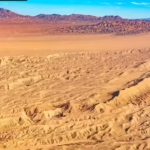
The desert also contains major dune systems. These dunes are not all identical. Some are crescent-shaped, some are linear, and some are more complex in shape. Their variety reflects differences in wind direction, wind strength, and sand supply across the region.
The dune fields give the desert a classic “sea of sand” appearance in some areas, although the Lut Desert is much more diverse than a simple sand sea. These moving forms show that the landscape is still alive and changing. Wind continues to build, reshape, and transport the dunes over time.
Why the dunes matter:
They reveal active wind movement
They show that the desert is still evolving.
They create dramatic scenery for travelers and photographers.s
They add a classic desert character to the region.n
The dunes are one of the strongest examples of the desert’s ongoing geological activity.
Salt Flats and Stony Plains
Not all of the Dasht-e Lut Desert is sand, ridges, and dunes. Some of its areas are dominated by salt flats and rocky plains.
These salt-crusted surfaces are important because they reveal the long-term evaporation processes that have shaped the region. When water once flowed or pooled in low areas, it left behind mineral residues as it dried. Over time, those residues formed bright, crusty surfaces.
The stony plains are equally significant. They look bare and severe, but they help show the full spectrum of desert conditions. They make it clear that this is a landscape where only the toughest environmental processes remain active.
Why are these areas interesting?
They create bright, reflective surfaces.
They provide evidence of ancient evaporation.
Those contribute to the desert’s empty, stark look.k
They add more geological diversity to the overall landscape
A complete article about Dasht-e Lut should include these features, not just the dunes and Kaluts.
Flora: Does Anything Grow in the Dasht-e Lut Desert?
Many people assume that nothing grows in the Dasht-e Lut Desert, but that is not entirely true.
The desert is extremely inhospitable, yet certain plants can survive in limited zones. These plants are usually highly adapted to dryness, salinity, and heat. They may appear in small pockets where moisture lasts a little longer or where the terrain offers some protection from the harshest conditions.
Plants in desert systems like Lut may survive in:
slightly wetter edges
low-lying areas where water lingers briefly
microhabitats protected by sand or stone
places where the wind deposits and holds fine material around roots
So while the desert is far from lush, it is not lifeless. The correct way to understand Dasht-e Lut flora is to see it as sparse, specialized, and resilient.
In short, the desert is not green, but it is alive.
Fauna: Animals in the Dasht-e Lut Desert
Like the plant life, the animals of the Dasht-e Lut Desert are adapted to extreme conditions.
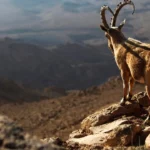
The most difficult areas of the desert support very little life, but the margins, transitional zones, and sheltered habitats can host different species. In desert ecosystems such as this one, animals often include reptiles, insects, arachnids, birds, small mammals, foxes, and scorpions.
These organisms survive by adapting to heat, dehydration, and food scarcity. Their presence proves that the desert is not an empty void. It is a harsh environment, yes, but also an ecosystem with life strategies shaped by survival.
Why fauna matters:
It shows that the desert is biologically active
It demonstrates survival under extreme stress.
It adds ecological significance to the site.e
It makes the desert more than a geological attraction
This is why the topic of Dasht-e Lut Desert wildlife is valuable for both readers and search engines.
The Human History of Dasht-e Lut Desert
Although the center of the Dasht-e Lut Desert is extremely difficult to inhabit, the broader region has a long human history.
For thousands of years, people have lived around the desert’s margins, using routes, wells, and settlements to survive in a challenging environment. The desert was not only a barrier. It was also a part of daily life, movement, and trade for the communities around it.
One of the most important historical places near the desert is Shahdad. This area has archaeological significance and is connected to ancient settlement patterns. It helps show that the region had human activity long before modern tourism and modern road access.
Why history matters:
It gives the desert cultural depth
It connects the site to older trade and movement networks.
This links the landscape with Bronze Age and ancient settlement history.
It enriches the travel experience for the visitor.
A strong Dasht-e Lut article should always include the human story along with the physical geography.
Shahdad: The Gateway to Dasht-e Lut Desert
Shahdad is one of the most important access points for the Dasht-e Lut Desert.
Travelers often use it as a starting point for reaching the Kaluts and other famous desert zones. But Shahdad is more than a convenient gateway. It also has archaeological and cultural importance of its own.
Why Shahdad is important:
It serves as a practical route into the desert
It is connected to historic desert-edge life.e
It has archaeological significance.e
It helps link modern travel with ancient regional history
Because of this, Shahdad is a useful keyword and an essential section in any comprehensive article about the Dasht-e Lut Desert.
Travel Guide to Dasht-e Lut Desert
The Dasht-e Lut Desert is one of Iran’s most dramatic travel destinations, but it is not the kind of place to visit casually or without preparation. Travel here requires planning, seasonal awareness, and respect for the environment.
Most visitors begin in Kerman, which functions as the main gateway city. From there, travelers typically continue toward Shahdad and then into the desert landscapes. Kerman is useful because it offers better transport links, accommodation options, and tour access than the desert itself.
What visitors usually do:
See the Kaluts
drive through scenic desert routes
Stop for photography
visit nearby heritage and desert-edge sites
Watch sunrise and sunset.
stargaze at night under clear skies
A good travel guide for Dasht-e Lut should help readers appreciate both the wonder of the landscape and the practical realities of visiting it.
Best Time to Visit Dasht-e Lut Desert
The best time to visit the Dasht-e Lut Desert is generally late autumn through early spring.
This season is preferred because the summer heat is too intense for comfortable travel. During the cooler months, conditions are far more manageable, especially for sightseeing, photography, and desert driving.
Best seasons for travel:
late autumn
winter
early spring
Why these months are better:
Temperatures are lower
Travel is more comfortable.
Outdoor movement is safe.r
Photography conditions are often better
For search optimization, this section is especially important because many travelers look specifically for the best time to visit the Dasht-e Lut Desert.
Travel Tips for Dasht-e Lut Desert
A visit to the Dasht-e Lut Desert should be treated seriously. It is not a regular park or a simple day trip. It is a remote, fragile, and very demanding natural environment.
Important travel tips:
carry enough water
avoid the hottest hours of the day
Travel with a local guide.e
Do not explore remote sections alone. ne
Check your route before entering the desert
wear sun protection and appropriate clothing
Use a reliable vehicle for desert roads.
A simple rule applies here: respect the desert, or it can quickly become dangerous. Careful planning makes the experience safer and much more enjoyable.
Things to See in Dasht-e Lut Desert
If you are building travel content, this section is especially helpful because it gives readers a quick list of standout attractions.
Top things to see:
the Kaluts
giant dune fields
salt flats
rocky desert plains
sunset views over the ridges
clear night skies and stars
Shahdad and nearby heritage locations
These sights are the main reasons travelers are drawn to the Dasht-e Lut Desert in the first place.
Photography in Dasht-e Lut Desert
The Dasht-e Lut Desert is one of the best places in Iran for dramatic landscape photography.
Why is it so photogenic?
strong textures and shadow patterns
massive landforms
golden light at sunrise and sunset
clear skies with minimal atmospheric haze
wide-angle views that feel cinematic
The Kaluts are especially popular because their ridges, valleys, and contours create powerful visual compositions. Dunes add flowing texture, while salt flats and empty plains provide contrast and scale.
For travel writers, content creators, and SEO editors, this section helps improve engagement because it gives readers an emotional reason to keep reading.
Why the Dasht-e Lut Desert Feels So Alien
Many visitors say the desert feels like another planet. That reaction makes sense.
The landforms are unusual, the spaces are enormous, and the environment is intensely dry. The absence of vegetation in many areas adds to the feeling of emptiness. Wind-shaped ridges, salt basins, and rough stony terrain combine to create a landscape that feels distant from everyday experience.
Why it feels alien:
unusual landforms
very little vegetation
wide open space
extreme dryness
sharp wind-carved shapes
This alien quality is one reason the Dasht-e Lut Desert captures the imagination so strongly.
Interesting Facts About Dasht-e Lut Desert
Here are some useful facts that readers often enjoy.
1. It is a UNESCO World Heritage Site
The desert was recognized in 2016.
2. It has some of the world’s most striking desert landforms
The Kaluts and yardangs are especially famous.
3. It includes massive dune systems
The desert is not only rocky. It also contains major dune zones.
4. It is one of the hottest desert regions on Earth
Its surface heat is one of its most discussed features.
5. It has both scientific and travel significance
The desert matters for research, heritage, and tourism.
6. It is connected to ancient human history
Nearby sites such as Shahdad add archaeological value.
These facts make the Dasht-e Lut Desert a rich topic for a pillar article.
Environmental Protection and Conservation
The Dasht-e Lut Desert is partly protected by its harsh conditions. Many of its areas are difficult to access, which has helped preserve the landscape in a relatively untouched form.
Still, conservation remains important.
Why conservation matters:
Tourism can disturb fragile surfaces
Vehicles can damage desert terrain if routes are ignored.
Small habitats can be sensitive to disruption.n
desert ecosystems recover slowly from damage
The fact that the desert is difficult to reach does not mean it is invulnerable. Responsible tourism and careful management help protect its long-term value.
This is an important section because it reminds readers that the Dasht-e Lut Desert is not only beautiful but also environmentally delicate.
Pros and Cons
Pros
incredible scenery
UNESCO World Heritage value
strong photography opportunities
deep scientific and historical interest
excellent adventure appeal
Cons
very hot in summer
remote and difficult to reach
limited services in the core desert
requires careful planning
Not ideal for casual or unprepared visitors
This balanced view helps readers understand the realities of travel as well as the rewards.
Dasht-e Lut Desert for Science Lovers
If your audience enjoys science, this desert is incredibly rich.
It is a real-world example of:
wind erosion
yardang formation
dune movement
desert climate systems
surface heat extremes
arid land evolution
That is why Dasht-e Lut Desert geology is such a strong keyword phrase. The site shows how Earth behaves in the most severe dry environments.
Dasht-e Lut Desert for Adventure Travelers
Adventure travelers are often drawn to the desert because it feels remote, dramatic, and powerful.
Possible activities include:
off-road desert tours
photography trips
dune visits
sunrise and sunset viewing
guided exploration
stargazing
At the same time, adventure should always be paired with caution. The desert is beautiful, but it is not forgiving of careless travel.
FAQs
What is the Dasht-e Lut Desert famous for?
It is famous for extreme heat, giant dunes, wind-carved ridges, the Kaluts, and UNESCO World Heritage status.
What does Dasht-e Lut mean?
It refers to a barren, dry land with very little water or vegetation.
Where is the Dasht-e Lut Desert located?
It is in southeastern Iran, mainly connected with the Kerman region and nearby provinces.
What are the Kaluts?
The Kaluts are huge wind-carved ridges and towers that create the desert’s most famous landscape.
Is Gandom Beryan really the hottest place on Earth?
It is one of the best-known extreme heat zones in the desert and is often discussed in connection with record surface heat.
When is the best time to visit the Dasht-e Lut Desert?
The best time is usually late autumn to early spring.
Is Dasht-e Lut Desert safe to visit?
Yes, but only with proper planning, enough water, and careful travel in the right season. Summer travel is not recommended.
Does anything live in the Dasht-e Lut Desert?
Yes. Some plants, insects, reptiles, birds, and other desert-adapted species survive there, especially in marginal and sheltered areas.
Why is Dasht-e Lut Desert a UNESCO site?
It is a major example of desert landforms, wind erosion, and ongoing geological processes.
What is the main gateway for travel to the Dasht-e Lut Desert?
Kerman is usually the main gateway, with Shahdad serving as a practical entry point.
Conclusion
The Dasht-e Lut Desert is a unique place where beauty, science, and history come together. From the Kaluts to the dunes and salt flats, it offers one of the most unforgettable desert landscapes in the world.