Introduction
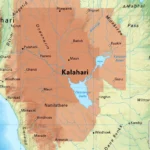
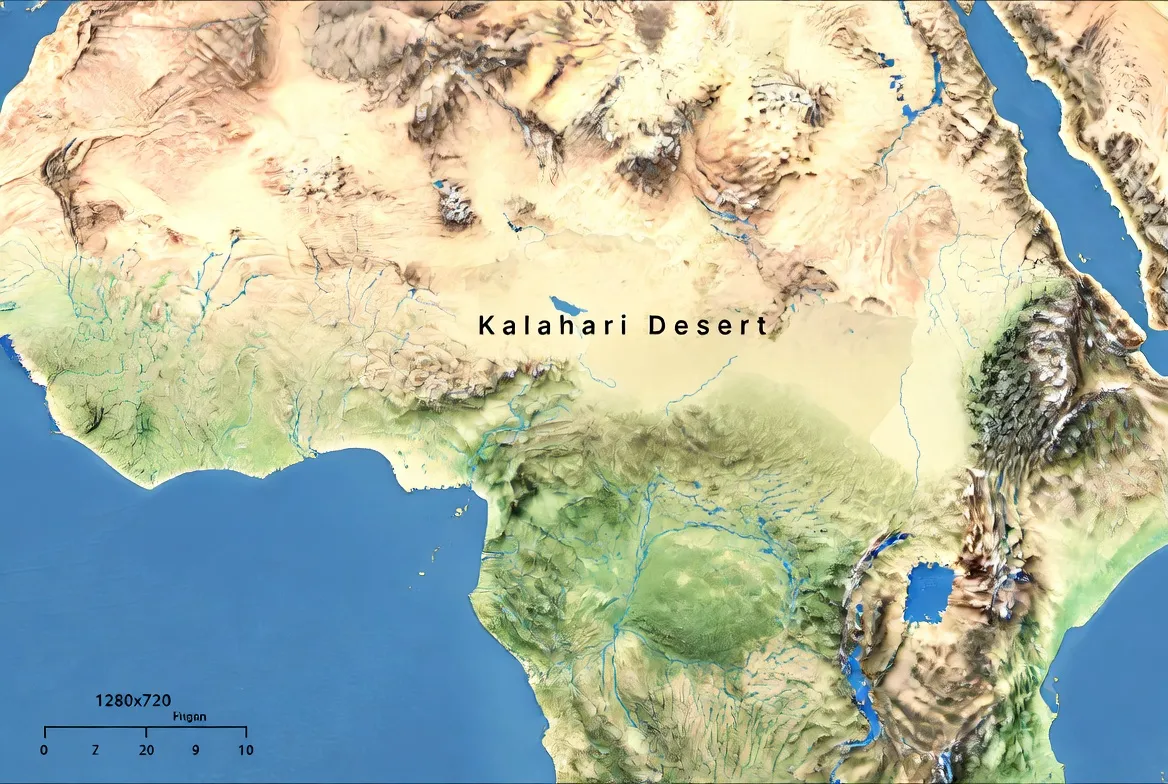
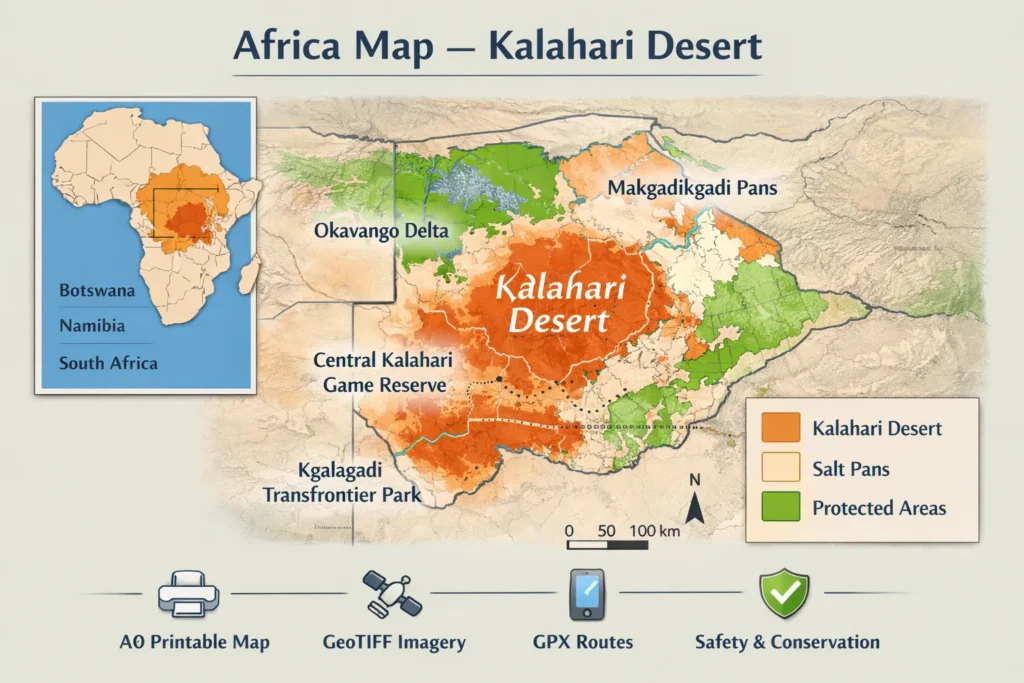
The Africa Map — Kalahari Desert is a compact, field-ready resource that bundles A0-printable topography, GeoTIFF mosaics, MBTiles, and curated GPX routes with clear metadata and seasonal overlays so researchers, overlanders, and cartographers can navigate and study the region safely. Centered on the Kalahari Desert and its stretches across Botswana, Namibia, and South Africa, the guide highlights critical features like the Okavango Delta, the Makgadikgadi pans, the Central Kalahari Game Reserve, and the Kgalagadi Transfrontier Park while emphasizing safety, ethical data use, and machine-readable downloads.
At a glance — Quick facts & the map you need
- Area (approx.): ~360,000 sq mi / ~930,000 km² (commonly reported range ~900–932k km²).
- Where it lies (summary): Mostly in Botswana, with extensive western reaches into Namibia and a southern fringe touching South Africa.
- Biome: Semi-arid sandy savanna — dunes, pans, grasses, and seasonal wetlands.
- Key features to map: Okavango Delta fringe, Makgadikgadi pans, Central Kalahari Game Reserve, and Kgalagadi Transfrontier Park.
- Core deliverables for users: A0 printable topographic map, GeoTIFF satellite overlay (with metadata), MBTiles offline vector set, curated GPX routes with waypoints and seasonal notes, and monthly flood/NDVI overlays.
Why build this Africa Map Kalahari Desert pillar
Search engines reward utility and specificity. In information-retrieval terms, this page should maximize precision for the high-intent query “Africa Map Kalahari Desert” while covering relevant recall items (LSI terms like Kalahari map, Makgadikgadi pans map, GeoTIFF Kalahari, A0 printable map, GPX routes Kalahari). Treat the page like a multi-modal dataset: human-readable narrative + machine-readable downloads + structured schema for each file. That combination yields both topical authority and practical backlinks from conservation organizations, mapping groups, and travel guides.
How to structure the page
Use an H1 containing the exact keyphrase, followed by a short visual (interactive map) and a table of contents (anchor links). The page should have three major blocks:
- Overview & rapid downloads — interactive map, download CTA, quick safety callout (above the fold).
- Field guide & map design — detailed sections on required layers, cartographic design, and file metadata.
- Operational resources & ethics — GPX tracks, seasonal planning tables, conservation, and community-first mapping guidance.
Add schema.org/DownloadAction metadata for each downloadable asset and include an accessible A0 PDF preview and alt text Containing the exact keyphrase (image alt: “Africa Map Kalahari Desert — A0 printable topographic map”).
How to read the Kalahari on a good map — an NLP-friendly primer
A good map is a stack of layers (tokens) that together form a dense representation of the landscape. Think of each layer as a feature vector: elevation, surface type, hydrology, vegetation index, POIs, and track passability. For field use, you need both raster and vector representations:
- Raster (image-like) layers: GeoTIFF satellite mosaic, flood-extent rasters, NDVI. These are dense grids used for recognition.
- Vector layers: Roads, tracks, fuel POIs, ranger stations, protected-area boundaries, and pan outlines. These are discrete features useful for routing and queries.
- GPX: ordered waypoints (lat/lon), route segments, and track logs for navigation devices.
Always include coordinate reference system (CRS) metadata (EPSG code), acquisition dates, and an MD5 checksum for each file.
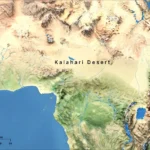
Botswana, Namibia & South Africa — Where is the Kalahari?
The Kalahari is a regional lowland and sand-dominated basin in southern Africa. When building the map, present two complementary boundaries:
- Basin layer (broad): the hydrological basin that drains into Kalahari depressions — includes savanna and non-sandylands.
- Desert layer (tight): sandier zones dominated by dunes, pans, and aeolian features.
Display both layers as toggles on the interactive map and include a figure that overlays administrative boundaries, protected areas, and hydrology for context.
Basin vs Desert
- Basin (wide) = hydrologically connected lowlands. Use a semi-transparent overlay on the map to show the catchment.
- Desert (tight) = areas of active dunes and pans. Use a rust/red dune symbol and pale pan fills to distinguish surfaces.
Always include admin boundaries and protected areas as separate vector layers with attribution metadata.
Map layers you must create.
Design your map like a feature engineering pipeline. Each layer is useful on its own and essential when combined.
- Topographic base (vector + raster): contours, hillshade, and roads. Export as A0 PDF for printing and as MBTiles for mobile. Add scale (e.g., ~1:250,000) and 300 dpi for A0.
- Satellite mosaic (GeoTIFF): recent cloud-masked imagery for field recognition. Supply acquisition dates and cloud percentage in the metadata. Use 10–30 m/pixel resolution where feasible.
- Seasonal flood extent (monthly composites): necessary for Okavango fringe planning and Makgadikgadi inundation. Offer monthly GeoTIFFs and a time slider on the interactive map.
- NDVI / vegetation rasters: composites that show greenness and grazing potential. Useful for wildlife predictions and campsite choice.
- Salt pan mask & hardness index (vector/raster): hardness index derived from moisture and soil surveys; flag causeways and known safe crossing windows.
- Tracks & passability index (vector): for each track, include surface type, last known condition, and a simple rule: “impassable if >20 mm/24h.”
- POIs (vector): fuel stations, ranger stations, permit offices, clinics — each with lat/long, phone (if public), and notes.
- Wildlife hotspots (vector/raster): species filters and density heatmaps; do not publish precise coordinates of endangered species’ dens or nests that could enable poaching.
- Cultural & community layers (vector): place names and community-shared water knowledge only with consent and attribution.
Practical map design tips
- Color & contrast: Use high contrast for pans and dunes. Pans should be pale/white; dunes rust/red. Avoid red/green combos that hinder colorblind users.
- Driving risk overlay: Use three risk classes — dry hard, soft/seasonal, and mud risk. Make the overlay toggleable.
- Legend & typography: Large, readable type for A0. Symbols should be simple and accompanied by short text.
- Print essentials: Title including Africa Map — Kalahari Desert, scale bar (km & miles), north arrow, coordinate grid ticks every 0.25° or appropriate interval, fold marks, and bleed.
- Alt text (SEO & accessibility): For every map image, we include alt text that contains the exact keyphrase Africa Map Kalahari Desert. Example: “Africa Map Kalahari Desert — A0 printable topographic map showing dunes, Makgadikgadi pans and Okavango flood fringe.”
- Mobile optimization: Reduce MBTiles size by limiting max zoom and simplifying geometries at small scales. Provide vector symbol sets to keep file sizes low.
Seasonal maps & travel planning — the temporal layer
Seasonal knowledge is critical. Treat flood extent and NDVI as time-series features and provide monthly composites for at least the past five years when possible.
Seasonal summary table
| Season | Months | Travel notes | Layers to use |
| Wet | Nov–Mar/Apr | Pans and delta flood — spectacular wildlife; many tracks are impassable | Flood extent, NDVI, and camp availability |
| Early dry | Apr–May | Pans are dry but still soft in parts — good for early pan access | Pan hardness index, fuel POIs |
| Dry | Jun–Oct | Best driving conditions across most areas | Base topo + satellite |
| Cold nights | Jun–Aug | Frost risk in the southern fringe at night | Temperature overlay |
Always check the latest flood composites and local reports before you travel. For safety, include a “last updated” timestamp on the interactive map and on each download’s metadata.
Driving & safety — map-backed checklist
Before you depart
- Download A0 PDF + MBTiles + GPX to two devices. Print A0 or A1 folded.
- Review the last 30 days of flood overlays.
- Plan fuel legs with 20% contingency, and carry extra jerry cans.
- Program check-in schedule and bring a satellite messenger (e.g., inReach).
- Inspect recovery gear: shovel, sand ladders, hi-lift jack, spare tyres, compressor.
On the road
- Use dry-season causeways only when the pan hardness index flags “safe.”
- After heavy rain, do not attempt tracks that show >20 mm/24h risk.
- Dry riverbeds (omiramba) are handy navigation corridors, but do not assume water. Use them as landmark routes only.
- If you are low on fuel, identify the nearest ranger station or town using the POI layer and verify opening hours in notes.
Flora & fauna map layers — ecological features to include
- NDVI / greenness: helps identify grazing and wildlife concentration. Publish seasonal NDVI composites.Acacia/camelthorn stands: mapped as polygons or point clusters — critical shade and water indicators.
- Wildlife hotspot layers: toggled layers for birds, predators, and ungulates. Avoid publishing precise den/denning coordinates for vulnerable species. Aggregate to heatmaps where necessary.
- Ethical restrictions: redact or aggregate locations if community or park authorities request non-publication (e.g., nesting sites, sensitive cultural places).
Community-first mapping & ethics
Mapping Indigenous place names and community water knowledge offers huge value but carries risk. Adopt these rules:
- Consent: Obtain documented consent before publishing community-sourced place names or water sources.
- Attribution: Credit contributors (organization/community) and include contact info if they permit it.
- Opt-out & redaction: Provide mechanisms to redact sensitive points (e.g., sacred sites). Explain redaction policy clearly and honor it.
- License choice: Use licenses that respect community choices — CC-BY-SA is common but not always appropriate; consider community-preferred licensing when required.
Field examples — three curated GPX tracks
Each GPX must include start/end, waypoints with lat/long, altitude (if available), nearest ranger/hospital, and seasonal notes.
- Northern Okavango Loop (~480 km): best in early dry (Apr–May). Mark concession boundaries, seasonal camp openings, water crossings, and fuel points.
- Makgadikgadi Pan Circumnavigation: avoid during the wet season. Use the pan hardness index to plan crossing. Include detours to solid ground options.
- Kgalagadi Gateway Route (Upington → Twee Rivieren): practical entry route with known fuel and rest stops. Include park gate times and permit office coordinates.
Set each GPX waypoint with the attribute impassable_if_rain_gt_mm_24h (e.g., 20) so users and automated tools can filter risky waypoints.
Example content blocks
Download pack CTA (short):
Download the complete Africa Map Kalahari Desert Pack — A0 PDF, GeoTIFF, MBTiles & GPX. Includes projection, MD5, and recommended apps. (button: Download pack — includes metadata table)
Quick safety callout box (short):
Always carry two navigation backups: a paper A0 map and a GPX on two devices. Check flood overlays within 48 hours of travel.
Printable A0 map layout checklist:
Title (include “Africa Map — Kalahari Desert”); scale bar (km & miles); north arrow; legend; coordinate grid every 0.25°; fold marks; bleed margin; layers shown: base topo, routes, fuel, ranger posts, campgrounds, pan outlines, dunes; inset showing Kalahari within Southern Africa.
FAQs
A: The Kalahari is in southern Africa. It covers most of Botswana, parts of Namibia, and the northern part of South Africa. It is a big sand-filled basin with dunes, pans, and some seasonal wetlands.
A: Yes. Offer an A0 PDF with scale, legend, fold guides, fuel points,s and ranger stations. Also include a GeoTIFF and MBTiles for offline maps.
A: The dry season (roughly May–October) is safest. Avoid the wet season when pans flood and become soft.
A: Yes. Provide curated GPX for loops like the Okavango loop, Makgadikgadi circumnavigation, and Kgalagadi gateway. Always add seasonal cautions.
Conclusion
Publish a complete Africa Map Kalahari Desert pack (A0 PDF, GeoTIFF, MBTiles, GPX) with explicit CRS and checksum metadata, monthly flood/NDVI overlays, and community-consent policies to create a high-value, linkable asset. Paired with up-to-date risk overlays and clear attribution/redaction rules, this map becomes a Practical tool for safe travel, rigorous research, and conservation impact.